

Network Peering Explained: A Practical Guide for IT TeamsNetwork peering is the direct interconnection of two or more autonomous networks to exchange traffic without paying each other per bit. Instead of routing traffic through a third-party transit provider, peering networks hand off packets directly, typically at an Internet Exchange Point (IXP) or via a dedicated Private Network Interconnect (PNI). Over 99% of peering arrangements are settlement-free, meaning neither party charges the other for the traffic exchanged.
Peering is the right tool in three specific situations:
- Latency reduction to high-volume destinations like CDNs, cloud providers, or streaming platforms
- Cost optimization on predictable, high-volume routes where per-bit transit fees add up fast
- Traffic control and resilience when you want direct path influence rather than relying on a transit provider's routing decisions
The contrast with IP transit is straightforward. Transit gives you full internet reachability through a provider's backbone. Peering gives you direct, optimized paths to specific networks, but only those networks. Most production architectures use both.
Table of Contents
- How network peering works technically
- What are the main types of network peering?
- Where peering happens physically
- Peering vs. transit: when does peering actually save money?
- What do you need before you can peer?
- What goes into a peering agreement?
- Keeping peering sessions healthy day to day
- A practical maturity model for implementing peering
- What causes depeering and how do you protect yourself?
- Key Takeaways
- The part most guides skip: peering is a business decision, not just a technical one
- How Californiatelecom helps you implement and operate peering
- Useful sources and further reading
How network peering works technically
Peering is implemented using the Border Gateway Protocol (BGP), the routing protocol that connects Autonomous Systems (ASes) across the internet. Each AS is identified by a globally unique Autonomous System Number (ASN), assigned by a Regional Internet Registry like ARIN in the United States.

When two networks peer, their routers establish an external BGP (eBGP) session over a shared Layer 2 fabric or a dedicated cross-connect. Once the session is up, each side advertises its IP prefixes to the other. What gets advertised, and what gets accepted, is governed entirely by routing policy.
What travels over a peering session:
- IP prefixes (the routes each network owns or aggregates)
- BGP path attributes: AS_PATH, NEXT_HOP, MED (Multi-Exit Discriminator), LOCAL_PREF
- BGP communities used for traffic engineering and policy signaling
- Route withdrawals when prefixes go down.
A critical distinction: peering sessions exchange only the routes both parties agree to share. You do not receive a full internet routing table from a peer the way you do from a transit provider. That limited scope is exactly the point. Your router's RIB (Routing Information Base) and FIB (Forwarding Information Base) grow with each new peer, which has real CPU and memory implications on older hardware. A router handling 200+ peers at a major IXP needs to be sized accordingly.
Routing policy is where peering either works or breaks. A misconfigured export filter that leaks customer routes to a peer can cause a route leak affecting thousands of networks. Strict prefix-list filters, max-prefix limits, and explicit export policies are not optional hygiene — they are the minimum viable configuration for any peering session.
Pro Tip: Apply a max-prefix limit on every eBGP session and set it to roughly 110% of the peer's expected prefix count. When the limit trips, the session drops cleanly rather than accepting a route flood. Pair this with IRR-validated prefix-lists and RPKI Route Origin Validation (ROV) to reject hijacked prefixes before they enter your RIB.
Quick glossary:
- BGP: Border Gateway Protocol, the inter-domain routing protocol
- ASN: Autonomous System Number, the unique identifier for each routing domain
- Prefix: A block of IP addresses advertised as a single routing entry
- Route server: A shared BGP speaker at an IXP that redistributes routes among participants without requiring bilateral sessions
- NEXT_HOP: The BGP attribute pointing to the next-hop IP for a given prefix
What are the main types of network peering?
The three models differ in cost, performance, operational complexity, and the degree of control you retain over traffic paths.
Public peering at IXPs
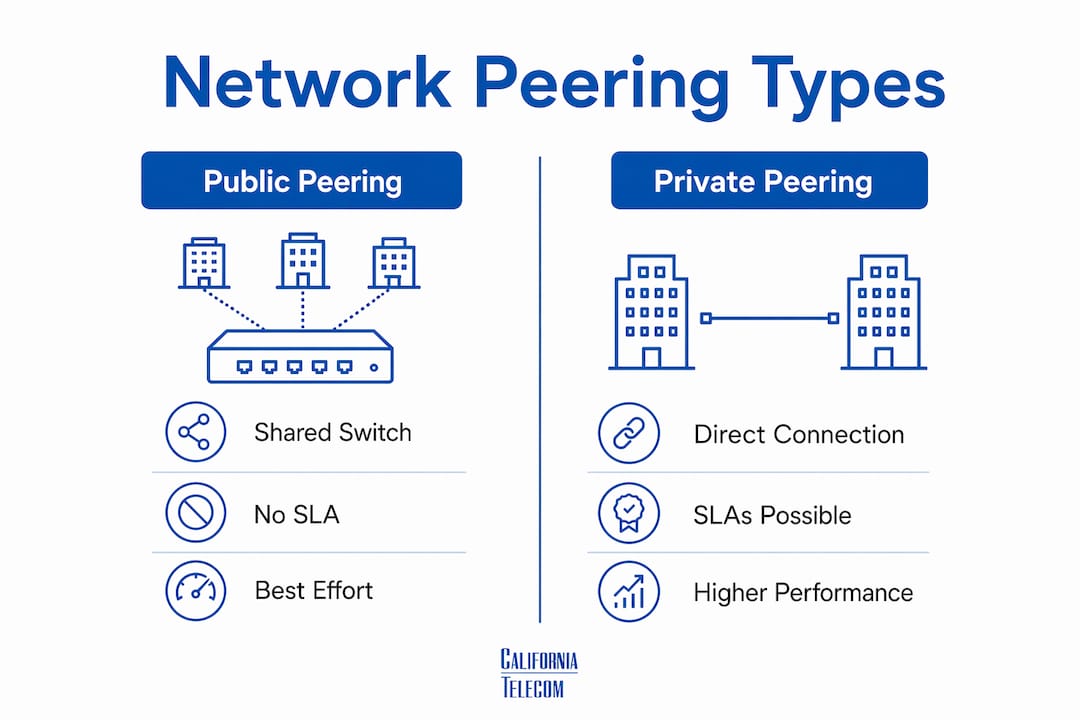
Public peering happens on a shared switching fabric at an IXP. You connect a single port to the IXP's switch, and from that one port you can establish BGP sessions with every other member on the fabric, either bilaterally or via a route server. Route servers handle multilateral peering: you advertise your prefixes to the route server, and it redistributes them to all participating members who accept your routes. This dramatically reduces the number of individual BGP sessions you need to manage.
The trade-off is that the IXP fabric is shared. You get best-effort service with no formal SLA on latency or packet loss. Public IXP peering typically offers no negotiated performance guarantees, which matters when you're carrying latency-sensitive traffic like real-time voice or financial transactions.
Private peering (PNI)
A Private Network Interconnect is a dedicated point-to-point connection between two networks, usually provisioned as a cross-connect within a colocation facility. PNIs use dedicated capacity not shared by any other parties, which means you can negotiate performance guarantees, defined escalation procedures, and capacity commitments. The cost is higher — you pay for the cross-connect, the port on both sides, and the engineering time to configure and maintain it — but for a peer carrying sustained multi-gigabit traffic, the economics often justify it.
Bilateral vs. multilateral peering
Bilateral peering is a direct BGP session between two specific networks, with routing policies negotiated between them. Multilateral peering, done via a route server at an IXP, trades policy granularity for operational simplicity. With multilateral peering, your route policy applies to all route-server peers at once; you cannot easily apply per-peer filters without moving to bilateral sessions.
| Dimension | Public IXP (multilateral) | Public IXP (bilateral) | Private PNI |
|---|---|---|---|
| Performance | Best-effort, shared fabric | Best-effort, shared fabric | Negotiable SLA, dedicated |
| Cost | Port fee + cross-connect to IXP | Port fee + cross-connect to IXP | Cross-connect + port fees both sides |
| Reach/scope | All IXP members via route server | Selected IXP members | Single peer only |
| Policy control | Coarse (route server policy) | Per-peer filters | Full bilateral control |
| Operational complexity | Low (one session to route server) | Medium (N bilateral sessions) | High (dedicated circuit, SLA management) |
| Typical use case | Broad reach, low-volume peers | Specific peers needing custom policy | High-volume, strategic relationships |
When to move a public peer to a PNI: sustained utilization above roughly 1 Gbps on the IXP session, latency-sensitive traffic, or a strategic partner relationship (major cloud provider, CDN, or content platform) where you need guaranteed capacity and escalation paths. Keep the IXP session active as a fallback even after you bring up the PNI.
Where peering happens physically
Every peering session needs a physical meeting point. That is almost always a colocation data center or carrier hotel, where multiple networks co-locate equipment in the same building.
The key physical components:
- IXP switching fabric: A shared Ethernet switch (or distributed switch fabric spanning multiple buildings) that IXP members connect to via a single port. Major U.S. IXPs include DE-CIX New York, Equinix IX, and Any2 Exchange in Los Angeles.
- Cross-connects: Physical fiber jumpers provisioned within a colocation facility to connect your cage/cabinet to the IXP switch or directly to another tenant's equipment for a PNI. Metro fiber cross-connects within a building are typically provisioned in days; leased dark fiber between buildings can take weeks.
- Meet-me rooms (MMRs): Dedicated spaces within colocation facilities where carriers and networks interconnect. The MMR is where cross-connects terminate.
- Route servers: Shared BGP speakers operated by the IXP that simplify multilateral peering. Instead of establishing individual sessions with 300 members, you establish one or two sessions to the route server.
- VLANs: IXP fabrics use VLANs to segment peering traffic. Your router needs a dedicated interface or sub-interface configured for the IXP's peering VLAN and assigned an IP from the IXP's peering subnet.
Port speeds at major IXPs typically run 1G, 10G, 25G, and 100G. Start with 10G for a pilot; 100G ports make sense once you're sustaining multi-gigabit aggregate traffic across many peers. For data center connectivity decisions, the colocation facility you choose determines which IXPs and peers you can reach without paying for external transport.
Pro Tip: Cross-connect lead times at major colocation facilities range from a few days to several weeks depending on the facility and circuit type. Get your Letter of Authorization (LOA) and cross-connect order in before your IXP port is provisioned, not after — the port will sit idle while you wait for the physical fiber if you sequence them wrong.
Peering vs. transit: when does peering actually save money?
The honest answer is: it depends on your traffic profile, and many teams underestimate the fixed costs involved.
Operational benefits of peering:
- Lower latency and fewer hops to specific high-volume destinations
- Reduced per-bit cost on routes where transit fees are significant
- Direct path control, reducing dependence on a transit provider's routing decisions
- Resilience through path diversity when combined with transit
Limitations that often get glossed over:
- Peering only reaches networks you've peered with. For everything else, you still need transit.
- Fixed costs are real: cross-connect fees, IXP port charges, hardware, and engineering time add up regardless of traffic volume.
- Operational overhead is non-trivial. BGP policy management, monitoring, and incident response require dedicated engineering capacity.
Peering and IP transit are complementary, not competing. Transit handles global reach; peering optimizes repeat, high-volume flows. The most resilient architectures use both. For networks that cannot justify managing their own peering, choosing a transit provider with strong peering relationships to major cloud and CDN providers delivers many of the same performance benefits without the operational burden.
| Cost category | IP transit | Public IXP peering | Private PNI |
|---|---|---|---|
| Per-bit fees | Yes (per Mbps) | No (settlement-free) | No (settlement-free) |
| Port/access fees | Included in transit contract | Monthly IXP port fee | Monthly port fees (both sides) |
| Cross-connect fees | None (provider-managed) | One-time + monthly to IXP | One-time + monthly per PNI |
| Hardware capex | Minimal (provider-managed) | Router with IXP-capable port | Router with dedicated port capacity |
| Engineering opex | Low (provider manages routing) | Medium (BGP policy, monitoring) | High (dedicated circuit management) |
| Reach | Full internet | IXP members only | Single peer only |
The decision trigger for peering is sustained traffic volume to a specific peer or set of peers. A rough rule of thumb: if you're paying transit fees on a route where you could peer directly, and the monthly transit cost on that route exceeds the all-in monthly cost of the peering port and cross-connect, the math favors peering. Run a multi-year total cost of ownership model before committing, factoring in engineering time honestly.
What do you need before you can peer?
Peering has real prerequisites. Showing up at an IXP without these in place wastes time and money.
- An ASN. You need your own Autonomous System Number, obtained from ARIN (the Regional Internet Registry for the United States). Without an ASN, you cannot run BGP as an independent routing domain.
- IP address space. You need a block of IP addresses to advertise. ARIN-assigned space or provider-independent (PI) space is required; provider-aggregated (PA) space from your transit provider cannot be advertised independently.
- IRR registration. Register your route objects in an Internet Routing Registry (IRR) like ARIN's IRR or RADB. Peers use IRR data to build prefix-list filters. Unregistered prefixes get filtered.
- RPKI ROAs. Create Route Origin Authorizations (ROAs) in ARIN's RPKI system. An increasing number of networks enforce RPKI-based Route Origin Validation and will reject prefixes without valid ROAs.
- Peering policy publication. Publish your peering policy on PeeringDB, the industry-standard database for peering information. Include your NOC contact, technical contact, and policy type (open, selective, or restrictive).
- Router capacity. Your edge router needs available port capacity for the IXP connection, sufficient memory to hold additional RIB/FIB entries, and CPU headroom for BGP processing. A router already running hot on transit routes will struggle with 200+ additional IXP peers.
- Colocation presence. You need a cage or cabinet at a facility that hosts the IXP you want to join, or you need to arrange remote peering via a transport provider.
- Engineering staffing. Someone on your team needs to own BGP policy configuration, monitoring, and incident response. This is not a set-and-forget deployment.
- Monitoring tooling. You need visibility into BGP session state, prefix counts, and traffic volumes before you go live. Deploying peering without monitoring is flying blind.
- Abuse and NOC contacts. IXPs and peers expect responsive NOC and abuse contacts. Publish accurate contact information and make sure someone actually answers.
Pro Tip: Before submitting your IXP membership application, run a PeeringDB audit. Incomplete or stale PeeringDB records are one of the most common reasons selective-policy networks reject peering requests. Update your prefixes, NOC hours, and policy type before you start outreach.
What goes into a peering agreement?
Peering policy types determine who you'll peer with and on what terms. There are three standard models:
- Open policy: You peer with any network that meets basic technical requirements (valid ASN, PeeringDB record, operational NOC). Most IXP route-server peering is effectively open.
- Selective policy: You evaluate each request individually based on criteria like traffic volume, geographic presence, mutual benefit, and operational readiness. Large networks and content providers typically use selective policies.
- Restrictive policy: You peer only with specific, pre-approved networks, usually strategic partners. Common among Tier 1 networks and large enterprises with specific interconnection needs.
A PNI agreement typically includes more contractual structure than an IXP peering arrangement. Key elements to expect:
- Traffic ratios: Some agreements specify acceptable inbound/outbound traffic ratios. Significant imbalance can trigger renegotiation or depeering.
- Notice and termination: Standard PNI agreements include a notice period (commonly 30–90 days) before either party can terminate. IXP peering is often terminable at will.
- SLA terms: PNIs can include latency, packet loss, and availability commitments. IXP peering typically has none.
- Port and cross-connect fees: Who pays for what, and how costs are split if the PNI spans multiple facilities.
- Confidentiality: Traffic volumes and commercial terms are usually confidential.
- Indemnity and liability: Standard limitation-of-liability clauses protecting both parties from consequential damages.
A selective peering policy example: "We will peer with networks that maintain a minimum of 100 Mbps sustained traffic exchange, have a published PeeringDB record with accurate NOC contacts, operate in at least two of our IXP locations, and demonstrate operational readiness including RPKI ROA coverage for their advertised prefixes."
Route policy in a PNI agreement should specify prefix-list filters (built from IRR data), AS-path filters, max-prefix limits, bogon filtering (rejecting RFC 1918 and other non-routable space), and any BGP community conventions used for traffic engineering. Get these in writing before the circuit goes live.
Keeping peering sessions healthy day to day
Operational discipline separates a well-run peering program from one that creates incidents.
- Monitor BGP session state continuously. A session that drops silently can black-hole traffic for minutes before anyone notices. Alert on session down within 60 seconds.
- Track prefix counts per peer. A sudden spike in prefixes from a peer often signals a route leak. A sudden drop can mean the peer is withdrawing routes due to an internal issue. Set thresholds and alert on both directions.
- Measure traffic per peer. You need per-peer traffic graphs to make data-driven decisions about moving peers to PNIs and to detect traffic shifts that might indicate routing problems.
- Monitor RTT and latency. BGP session monitoring alone is insufficient; you need active latency measurements to detect path degradation that doesn't trigger a session drop.
- Implement RPKI Route Origin Validation. Configure your routers to drop RPKI-invalid prefixes. This is the single most effective control against prefix hijacking.
- Apply strict prefix filtering. Build prefix-lists from IRR data and regenerate them regularly. A peer that starts advertising unexpected prefixes should trigger an alert, not silent acceptance.
- Plan for DDoS at IXPs. IXP fabrics are shared, which means a DDoS targeting one member can affect others. Work with your IXP on blackhole community support (typically a BGP community that triggers null-routing at the IXP) and have your own scrubbing capacity or upstream DDoS mitigation in place. Firewall segmentation at the edge complements IXP-level controls.
- Depeering response playbook. When a peer depeers you (or you depeer them), traffic that was flowing over that session needs to reroute immediately. Have transit capacity available to absorb the traffic, pre-configure BGP communities to shift traffic to backup paths, and test the failover before you need it.
Pro Tip: Run synthetic tests (ICMP ping and TCP handshake probes) to destination prefixes reachable via each peer. These catch path degradation and silent black-holes that BGP session state monitoring misses entirely. Schedule them every 30–60 seconds and alert on sustained packet loss above 1%.
A practical maturity model for implementing peering
Most networks follow a predictable progression. Skipping stages usually means paying for complexity you're not ready to manage.
Stage 1: Assessment and discovery (weeks 1–4)
- Audit your current traffic: identify the top 10–20 destination ASNs by volume using NetFlow or sFlow data.
- Check whether those ASNs are present at IXPs accessible to you.
- Estimate potential transit savings against all-in peering costs (port, cross-connect, engineering).
- Obtain or confirm your ASN and IP address space; register IRR route objects and RPKI ROAs.
- Publish or update your PeeringDB record.
Stage 2: Public IXP pilot (months 1–3)
- Select one IXP with strong membership overlap with your target peers.
- Provision colocation space and cross-connect; order IXP port.
- Configure BGP sessions to the route server with strict prefix-list filters and max-prefix limits.
- Bring up bilateral sessions with your highest-priority peers.
- Monitor traffic, latency, and prefix counts for 30 days before declaring success.
Stage 3: Selective PNIs for high-volume peers (months 3–12)
- Identify peers where sustained IXP traffic justifies a dedicated circuit (typically above 1 Gbps sustained).
- Negotiate PNI agreements including SLA terms, traffic ratios, and notice periods.
- Provision cross-connects and configure dedicated BGP sessions with full bilateral policy.
- Keep IXP sessions active as fallback paths.
Stage 4: Optimization and redundancy (ongoing)
- Add IXP presence at a second location for geographic redundancy.
- Review PNI utilization quarterly; upgrade port speeds as traffic grows.
- Automate prefix-list regeneration from IRR data.
- Run annual peering policy reviews and update PeeringDB records.
Scaling network infrastructure across multiple locations follows a similar staged logic: prove the model at one site before rolling it out broadly.
| Stage | Typical capex | Typical monthly opex | Timeline |
|---|---|---|---|
| Assessment | Minimal (staff time) | Existing transit costs | 2–4 weeks |
| IXP pilot (1G port) | Colocation setup + cross-connect | IXP port fee + colo | 1–3 months |
| IXP pilot (10G port) | Higher port hardware cost | Higher IXP port fee | 1–3 months |
| PNI (10G dedicated) | Cross-connect both sides | Port fees both sides + engineering | 3–6 months per PNI |
| PNI (100G dedicated) | Significant hardware investment | Higher port fees, dedicated capacity | 6–12 months per PNI |
The ROI metric that matters most: cost per Mbps on peered traffic versus the same traffic over transit, measured over a 12–24 month window after accounting for all fixed costs.
What causes depeering and how do you protect yourself?
Depeering often stems from policy disputes or traffic ratio imbalances, and the business impact can be significant if you're not prepared.
Common causes:
- Traffic ratio violations (one side sends significantly more than it receives)
- Policy changes at the peer (moving from open to selective or restrictive)
- Contractual breaches or billing disputes on PNIs
- Operational failures: persistent BGP flapping, route leaks, or unresponsive NOC contacts
- Strategic decisions: a peer decides to monetize the relationship as paid transit
Business impacts when depeering happens:
- Traffic that was flowing directly now routes through transit, increasing latency and potentially hitting transit capacity limits
- Route path inflation: longer AS paths, more hops, higher RTT
- Customer-visible performance degradation on services that relied on the direct path
- Potential revenue impact for high-traffic services where latency directly affects user experience. The cost of network downtime extends well beyond the technical disruption.
Mitigation checklist:
- Maintain sufficient transit capacity to absorb traffic from your largest peers if they depeer simultaneously
- Pre-configure BGP communities to shift traffic to transit paths without manual intervention
- Include a minimum notice period (30–90 days) in all PNI agreements
- Diversify your peer mix so no single peer carries more than 20–30% of your total traffic
- Monitor traffic ratios on all PNI sessions and address imbalances proactively before they become contractual issues
- Keep detailed records of all peering agreements, including termination clauses and escalation contacts
Pro Tip: Keep at least one transit provider's capacity in a "warm standby" state: the BGP session is up, but you're not routing significant traffic over it. When a major peer depeers you, you can shift traffic to that transit path within minutes rather than waiting for a new circuit to be provisioned.
Key Takeaways
Network peering delivers the most value when it is treated as a strategic complement to transit, not a replacement, and when the full cost picture is modeled before committing to infrastructure.
| Point | Details |
|---|---|
| Peering is almost always settlement-free | Over 99% of peering arrangements are bill-and-keep; neither party pays per bit exchanged. |
| Start with public IXP peering | Connect to an IXP first for broad reach and low complexity before committing to PNI infrastructure. |
| Move high-volume peers to PNIs | Sustained high-volume traffic to a single peer typically justifies a dedicated cross-connect with negotiated SLAs. |
| Transit remains necessary | Peering only reaches peered networks; a hybrid peering-plus-transit architecture is required for full internet reachability. |
| Californiatelecom handles the complexity | Californiatelecom's multi-carrier sourcing, BGP engineering, and 24/7 U.S.-based NOC support can manage peering implementation and monitoring for multi-location businesses. |
The part most guides skip: peering is a business decision, not just a technical one
Most technical write-ups on peering spend 90% of their words on BGP mechanics and almost none on the organizational reality of running a peering program. That gap is where implementations fail.
The teams that get the most out of peering are the ones that treat it like a product line with a P&L. They track cost per Mbps on peered traffic, they review peer utilization quarterly, and they have a clear decision rule for when a public peer earns a PNI. The teams that struggle are the ones that stand up IXP sessions because it sounds like a good idea, then let the peering program drift without ownership or metrics.
There is also a staffing reality that vendor documentation never mentions. A well-run peering program at a mid-market enterprise requires someone who genuinely understands BGP policy, IRR/RPKI hygiene, and IXP operations. That is not a part-time responsibility. If your team does not have that depth, the operational overhead of peering can easily exceed the transit savings, especially in the first 12–18 months before the program matures.
For multi-location businesses, the calculus is different from a single-site operator. You have more traffic aggregation points, more potential peers, and more complexity in routing policy across sites. The private network connectivity model that works for a single data center often needs significant redesign when you add five or ten locations. That is where a managed-services approach, rather than DIY peering, often makes more financial sense than the transit savings alone would suggest.
The bottom line: peering is worth doing when the traffic volume, the peer mix, and the engineering capacity all align. When one of those three is missing, you are better off choosing a transit provider with strong peering relationships and letting them carry the operational burden.
How Californiatelecom helps you implement and operate peering
Multi-location businesses face a specific challenge with peering: the traffic aggregation, BGP engineering, and colocation coordination that make peering viable are exactly the things that are hardest to staff and manage in-house across distributed sites.
Californiatelecom sources from 50+ carriers, coordinates colocation and cross-connect procurement, and handles BGP engineering across your locations so you are not managing vendor relationships and routing policy simultaneously. Every deployment is backed by a 24/7 U.S.-based NOC with a 99.99% uptime SLA on data, which means peering sessions are monitored continuously and incidents are handled before they become customer-visible problems.Whether you are at the assessment stage trying to build a business case, piloting your first IXP connection, or ready to move high-volume peers to PNIs, Californiatelecom's managed network services cover the full implementation path. For multi-location businesses that want the performance benefits of peering without the operational drag of running it themselves, the managed LAN/WAN service is the practical starting point. Contact Californiatelecom to schedule a network assessment and get a clear picture of where peering fits in your connectivity strategy.
Useful sources and further reading
- What is peering? — Cloudflare: Concise technical reference on peering mechanics and settlement-free arrangements.
- What is Internet Peering (BGP Peering)? — Kentik: Detailed explanation of BGP peering sessions, ASNs, and route exchange.
- Peering — Wikipedia: Comprehensive overview of peering history, types, and depeering causes.
- All About Peering — Internet Society: Accessible explainer on IXPs, PNIs, and the role of peering in internet infrastructure.
- Public vs. Private Peering — Gcore: Side-by-side comparison of IXP and PNI models with use-case guidance.
- Public vs. Private Peering — Skip2 Networks: Practical breakdown of SLA differences between IXP and PNI peering.
- IP Transit vs. Peering — DCConnect Global: Business-focused comparison of transit and peering with hybrid strategy guidance.
- To Peer or Not to Peer: Business Case for Peering — LACNIC (PDF): Rigorous cost-benefit framework for evaluating peering economics.
- Peering, Transit and Interconnection — ThousandEyes: Monitoring-focused reference covering BGP session observability and path verification.
- What is IP Transit? — Netrality: Explains how transit providers with strong peering relationships benefit customers who cannot manage their own peering.
- Equinix Peering and Interconnection Resources: IXP directory, colocation facility information, and interconnection guidance from a major U.S. colocation provider.
Recommended
- Picking a Managed Network Services Provider When Your IT Team Is Small | California Telecom
- How Enterprise Network Design Works for IT Pros | California Telecom
- Turn-Key Network Deployment: A Guide for IT Teams | California Telecom
- How to Improve Network Performance with Managed LAN/WAN Solutions | California Telecom