

How to choose the best data center connectivity in CaliforniaFor a multi-location business in California, a single network failure can cascade into thousands of dollars in lost revenue, missed SLAs, and frustrated customers within minutes. The challenge is not just finding a circuit that works today. It is building a connectivity strategy that holds up across San Jose, Los Angeles, and every branch office in between, even when a fiber contractor accidentally cuts a conduit on a Tuesday morning. This guide gives you a concrete decision framework, backed by real interconnection data, to help you select and deploy data center connectivity options that genuinely reduce risk and support business growth.
Table of Contents
- Assessing your connectivity needs across California locations
- Understanding California's top interconnection hubs and regional options
- The step-by-step framework: Combining interconnection, peering, and private transport
- Verifying, monitoring, and future-proofing your network deployments
- Why most California network strategies miss the mark and what we've learned
- How California Telecom makes resilient network design easier
- Frequently asked questions
Key Takeaways
| Point | Details |
|---|---|
| Start with the right hubs | Choose carrier-neutral interconnection facilities in key California metros for maximum flexibility. |
| Prioritize path diversity | Demand physical path separation and confirm it with documentation to mitigate outages. |
| Leverage peering and private circuits | Combine robust peering, IX access, and dedicated private transport for optimal performance and reliability. |
| Monitor and adapt proactively | Regularly test, monitor, and update your design to keep up with evolving business and technology. |
Assessing your connectivity needs across California locations
Before you evaluate a single provider or sign a contract, you need a clear picture of what your network actually requires. Skipping this step is how organizations end up with expensive circuits that do not solve the right problems.
Start by mapping every critical site in your footprint. That means your primary data center, secondary or disaster recovery sites, branch offices, cloud on-ramps, and any edge locations where latency matters. For each site, document the following:
- Bandwidth requirements today and projected 24 months out, accounting for video conferencing, cloud storage, and real-time applications
- Latency sensitivity by application type, since VoIP, video, and financial transactions tolerate very little delay
- Cloud and SaaS dependencies, including which providers you connect to most frequently and whether direct cloud access would improve performance
- Regulatory requirements, such as HIPAA, PCI-DSS, or CCPA data handling rules that may affect routing and logging obligations
- Redundancy tolerance, meaning how many minutes or hours of downtime your operations can absorb before the financial or reputational damage becomes serious
One factor that many IT teams underestimate is physical path diversity. Buying two circuits from two different carriers sounds like redundancy, but if both cables enter your building through the same conduit and the same riser, you have spent twice the money for zero additional protection. Physical path diversity such as second building entrances for dark fiber routes directly mitigates route failure and congestion risks that logical redundancy alone cannot address.
Pro Tip: During your site audit, physically walk the cable path from the street to your equipment room. Ask your facilities team to confirm how many distinct conduit entries the building has. If there is only one, that is a risk you need to price into your connectivity strategy.
The table below gives you a quick reference for matching site type to best-practice requirements.
| Site type | Minimum redundancy | Recommended bandwidth headroom | Key regional consideration |
|---|---|---|---|
| Primary data center | Dual diverse entrances, diverse carriers | 2x current peak usage | Proximity to IX and cloud on-ramp |
| Branch office | Dual circuits, diverse last mile | 1.5x current peak usage | Carrier availability in local market |
| Cloud on-ramp | Direct connect plus backup internet | Scalable, burstable | Latency to nearest cloud region |
| Edge or retail location | Primary plus LTE/5G failover | Match application SLA | Local loop diversity |
Working through managed network services with a provider who can assess all of these factors across your entire California footprint saves significant time compared to evaluating each site independently.

Understanding California's top interconnection hubs and regional options
California is home to some of the most densely connected data center ecosystems in the world. Knowing which hubs offer the right combination of carriers, peering, and cloud access for your specific needs is a genuine competitive advantage.
Bay Area and Silicon Valley sit at the center of the West Coast internet. CoreSite SV1 in San Jose provides interconnection with more than 65 networks, offers tethering to other CoreSite facilities, and includes peering at major exchanges. That density means you can reach a large number of networks with very short, low-latency paths rather than routing traffic across the broader internet. Equinix's Silicon Valley facilities take this further: network services from over 135 providers are available, along with direct connection to AWS and access to major peering hubs, making it one of the most carrier-rich environments in North America.
Los Angeles serves a different but equally important role. CoreSite LA3 in Los Angeles connects to the largest interconnection community in North America and supports multi-cloud architectures, which is critical for businesses that depend on Azure, Google Cloud, or AWS in parallel. LA is also the primary gateway for trans-Pacific traffic, making it essential for companies with Asia-Pacific operations or customer bases. You can explore Los Angeles network options to understand what carrier density and cloud access look like for your specific use cases in that market.
Here is a comparison of California's primary interconnection hubs:
| Hub | Carrier count | Peering exchanges | Cloud on-ramps | Physical diversity options |
|---|---|---|---|---|
| San Jose (SV1 / Equinix SV) | 65 to 135+ networks | SFMIX, PAIX | AWS, Azure, Google | Multiple fiber providers, diverse entrances |
| Los Angeles (LA3 / Equinix LA) | 100+ networks | LAIIX, DE-CIX LA | AWS, Azure, Google, Oracle | Multiple carrier-neutral facilities |
| Sacramento | Moderate | Regional IX | Select cloud on-ramps | Growing fiber infrastructure |
| San Diego | Growing | Regional IX | Select cloud on-ramps | Proximity to military/government networks |
Carrier-neutral facilities are worth emphasizing here. When you colocate in a carrier-neutral hub, no single provider controls your options. You can bring in a second or third carrier without renegotiating a master agreement or dealing with proprietary lock-in. That flexibility is what makes business fiber solutions in these hubs so much more valuable than a standard last-mile circuit from a single incumbent carrier.
The strategic insight is this: placing your critical infrastructure inside or directly adjacent to a well-connected, carrier-neutral hub does not just improve performance today. It expands your options as your business grows and as new cloud services, CDN nodes, and IX participants come online.
The step-by-step framework: Combining interconnection, peering, and private transport
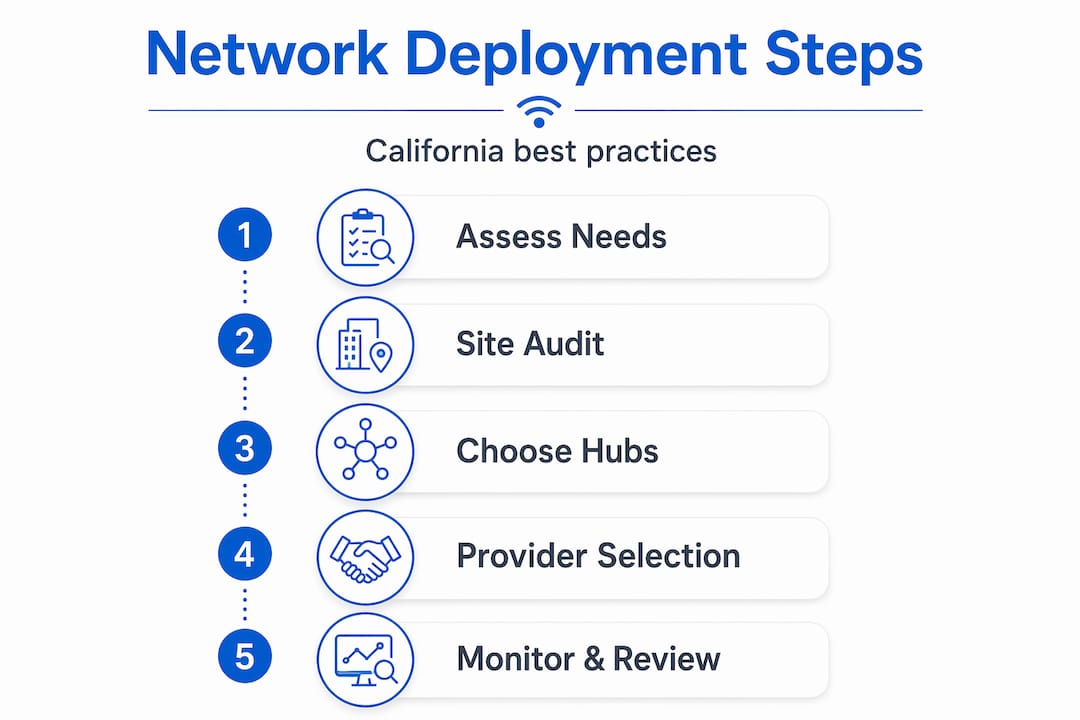
With your requirements documented and your target hubs identified, you can now build a connectivity architecture that is both resilient and cost-effective. This is not a one-size-fits-all process, but the following steps apply to nearly every multi-location California business.
-
Place critical locations in or near carrier-neutral interconnection hubs. If your primary data center is not already in a well-connected facility, this is your highest-leverage move. Proximity to a hub like CoreSite SV1 or an Equinix campus means you can activate new carriers, peering relationships, and cloud connections without waiting months for new fiber builds. Start with carrier-neutral interconnection hubs, enable IX and peering to reduce hops, and use private transport for critical links.
-
Activate peering and IX access for your most-used networks. If you are sending significant traffic to a CDN, a SaaS provider, or a cloud platform, peering at the relevant Internet Exchange can dramatically reduce latency and improve reliability. Instead of your traffic bouncing through multiple transit providers, it takes a direct path. This step often delivers measurable performance improvements with relatively modest cost increases.
-
Add private transport circuits for your most critical links. Optical wavelengths and dark fiber give you dedicated capacity that is not shared with other customers and not subject to the congestion that can affect shared internet paths. For connections between your primary and secondary data centers, or between your data center and a major cloud on-ramp, dedicated fiber options provide the throughput and predictability that business-critical applications demand.
-
Validate physical path diversity at every step. This is where many strategies fall apart. Ensure true physical path diversity, not just logical redundancy, to mitigate risks. Ask every provider to show you a route map, confirm building entrance locations, and document the physical separation between your primary and backup paths.
Path diversity can mean the difference between business-as-usual and hours of outage after a fiber cut. Never assume that two circuits from two carriers are physically separate without written confirmation and a route map.
Pro Tip: Include a physical path diversity clause in every contract and RFP. Require providers to certify in writing that primary and backup routes do not share conduit, building entrance, or local loop infrastructure. If a provider cannot or will not provide this documentation, treat that as a red flag.
Pairing private transport with intelligent traffic management through managed SD-WAN gives you the ability to route traffic dynamically across your diverse paths, prioritizing latency-sensitive applications and failing over automatically when a path degrades.
Verifying, monitoring, and future-proofing your network deployments
Getting the right circuits in place is only half the job. Ongoing verification and proactive monitoring are what separate organizations that maintain high uptime from those that discover problems only after customers complain.
Follow these steps once your network is live:
-
Validate every SLA in writing before go-live. Confirm that your provider's uptime commitment, mean time to repair, and escalation procedures are documented and match what was sold. A 99.99% uptime SLA means roughly 52 minutes of allowed downtime per year. Anything less should prompt a conversation about whether that circuit is appropriate for your most critical applications.
-
Simulate failover before you need it. Schedule a planned maintenance window and physically disable your primary path to confirm that failover activates within your acceptable recovery time. Many organizations discover configuration errors or routing problems during these tests that would have caused extended outages in a real failure scenario.
-
Deploy independent monitoring alongside provider portals. Provider monitoring tools are useful, but they have an obvious conflict of interest when it comes to reporting their own outages. Some California customers use dark fiber and dedicated metro routes to bypass congestion and provide maximum path diversity, especially when they can directly monitor their links. Independent monitoring gives you objective data to hold providers accountable.
-
Set calendar reminders to reassess every 12 to 18 months. Traffic patterns change, cloud dependencies shift, and new infrastructure comes online. A connectivity strategy that was optimal in early 2025 may be leaving performance and cost efficiency on the table by late 2026.
Pro Tip: When reassessing your network, look specifically for new dark fiber routes, IX expansions, and cloud on-ramp additions in your key markets. California's fiber infrastructure is actively growing, and new options can meaningfully improve your cost-to-performance ratio.
Managing this ongoing cycle across multiple locations is significantly easier when you have a partner with visibility across your entire footprint. Managed LAN/WAN services that include proactive monitoring and regular business reviews take the operational burden off your internal team while keeping your network aligned with your business needs.
Why most California network strategies miss the mark and what we've learned
Here is the uncomfortable truth we have observed working with multi-location businesses across California: most network outages that should have been prevented were not caused by technology failures. They were caused by documentation failures.
IT teams buy dual circuits, check the redundancy box, and move on. Nobody asks the hard question: are these two circuits actually running through separate physical paths? In a surprising number of cases, the answer is no. Both cables enter the same building through the same conduit, or they share a common segment in the local loop before diverging. When a contractor cuts that shared segment, both circuits go dark simultaneously. The business experiences a full outage despite having paid for redundancy.
We have seen this scenario play out repeatedly with California companies that were otherwise sophisticated in their network management. The fix is not expensive. It is simply asking the right questions before signing the contract, and then verifying the answers with physical documentation.
The organizations that consistently outperform on uptime metrics are the ones that treat physical path diversity as a non-negotiable requirement, not a nice-to-have. They place their infrastructure in proven interconnection facilities, they document every route, and they test failover on a schedule. They also invest in monitoring that gives them ground truth about what is happening on their network, independent of what their carriers report.
Our case studies show a consistent pattern: the businesses that ask the hardest questions during procurement end up with the fewest surprises during operations. Make physical path diversity a standard part of every RFP, every reference check, and every contract renewal conversation. It is the single highest-impact action most IT teams are not taking.
How California Telecom makes resilient network design easier
Building a high-availability, multi-site network across California is genuinely complex. The good news is that you do not have to navigate it alone.California Telecom works with multi-location businesses to design, deploy, and manage connectivity strategies that hold up under real-world conditions. We source from 50+ carriers, which means we can find the right combination of dedicated fiber solutions and managed LAN/WAN services for each site in your footprint, rather than forcing every location into the same template. Our engineers handle deployment, our 24/7 U.S.-based NOC handles monitoring, and our SD-WAN for multi-location businesses gives you intelligent traffic management across every path. One provider, one bill, one engineer's number. Talk with a specialist about your California connectivity strategy today.
Frequently asked questions
What is the difference between logical and physical path diversity?
Logical path diversity uses different circuits or carriers but may still share physical cable routes, while physical path diversity ensures cables travel through separate physical routes and building entrances for genuinely higher reliability.
Why use carrier-neutral interconnection hubs?
Carrier-neutral hubs give you access to dozens of carriers and cloud providers under one roof, so you can build flexible, competitive networks without vendor lock-in. Multi-site businesses improve uptime by leveraging the density and redundancy these facilities provide.
How often should we reassess our California data center connectivity?
Review your network needs at least every 12 to 18 months to account for new technologies, business growth, and changes in your cloud and application dependencies.
What are the advantages of peering at an Internet Exchange (IX)?
Peering at an IX reduces the number of network hops your traffic takes, which lowers latency and improves reliability. Peering at IXs and private exchanges reduces hop count for frequently accessed networks, CDNs, and clouds, which translates directly into better application performance.