

Private Network Connection for Multi-Location BusinessesA private network connection is a dedicated, isolated communications infrastructure that restricts access exclusively to authorized devices and users, keeping sensitive business data off the public internet. The industry term for this architecture is a private network, and understanding what is a private network connection separates businesses that control their communications from those that leave them exposed. RFC 1918 reserves three specific IP address blocks for private use: 10.0.0.0/8, 172.16.0.0/12, and 192.168.0.0/16. These ranges are not routable on the public internet, which means unauthorized external parties cannot reach devices on your internal network by default. For multi-location businesses, this foundation is not optional. It is the baseline for secure, predictable communications between offices, warehouses, and data centers.
What is a private network connection, and how does it differ from public networks?
A private network connection creates a controlled environment where only approved devices communicate with each other. A public network, by contrast, allows any device to connect and transmit data across shared infrastructure. The gap between these two models is not subtle. On a public network, your traffic competes with millions of other users, and any misconfiguration can expose internal data to external parties.
VPNs occupy a middle ground that businesses frequently misunderstand. A VPN creates an encrypted tunnel over public internet infrastructure but does not physically isolate your traffic from that infrastructure. The data still travels through shared public networks. VPN types include remote access, site-to-site, and cloud VPNs, each serving different use cases, but none replicates full isolation the way a dedicated private network does. Businesses that rely solely on VPNs for multi-site connectivity accept performance variability and shared infrastructure risk that a true private network eliminates.

| Feature | Public Network | VPN | Private Network Connection |
|---|---|---|---|
| Traffic isolation | None | Encrypted, not isolated | Full physical isolation |
| Performance predictability | Low | Moderate | High |
| Access control | Open | Policy-based | Strict, device-level |
| Infrastructure ownership | Shared | Shared (encrypted) | Dedicated |
| Best use case | General browsing | Remote access | Multi-site enterprise |
Pro Tip: If your business runs latency-sensitive applications like VoIP or real-time ERP transactions across sites, a VPN alone will not deliver the consistency you need. A dedicated private network connection is the correct architecture.
Core components and architecture of enterprise private networks
Enterprise private networks (EPNs) integrate local area networks (LANs) at multiple sites with a wide area network (WAN) backbone using dedicated lines, firewalls, and strict access controls. This architecture gives businesses a single, unified network that spans every location without touching public internet infrastructure. The WAN backbone is the connective tissue. It carries traffic between sites over dedicated physical or logical circuits, not shared public pipes.
The key components of a well-built enterprise private network include:
- Private IP addressing. All internal devices use RFC 1918 address ranges. These addresses are not routable on the public internet, which adds a foundational layer of protection.
- Dedicated WAN circuits. Physical private lines or MPLS circuits carry inter-site traffic. Dedicated infrastructure delivers better performance guarantees and lower latency than software-only VPNs.
- Firewalls and access policies. Perimeter firewalls control what enters and exits each site. Internal firewall rules restrict lateral movement between network segments.
- Quality of Service (QoS). QoS policies prioritize critical application traffic, such as voice and video, over lower-priority data. This prevents congestion from degrading mission-critical tools.
- VLANs for network segmentation. VLANs combined with strict firewall policies restrict internal access between departments or functions, limiting the blast radius of any internal security incident.
- Centralized IP address management. Large organizations use IP address management (IPAM) tools to track and allocate addresses across every site, preventing conflicts and routing errors.
Pro Tip: Treat your IP address plan as a living document. Every new site, cloud integration, or acquired business unit needs to fit into a pre-planned address scheme. Retrofitting a chaotic IP structure across 20 locations is far more expensive than planning it correctly from the start.
What are the practical benefits for multi-location businesses?
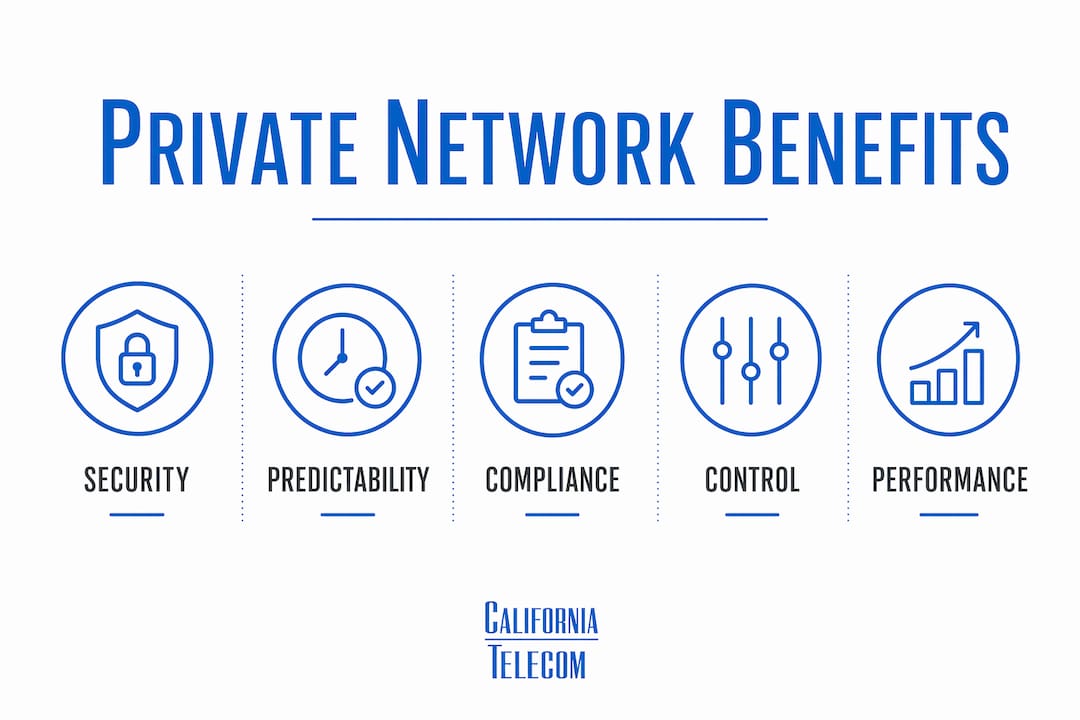
Predictability, not just security, is the primary reason enterprises invest in private network connections. Public internet performance fluctuates based on external congestion, routing changes, and carrier issues that your IT team cannot control or predict. A private network connection delivers consistent bandwidth and latency because your traffic does not compete with the public internet. That consistency directly supports applications like unified communications, cloud-hosted ERP systems, and point-of-sale platforms that fail or degrade under variable network conditions.
Security benefits are real but require context. Private network isolation reduces exposure to external cyber threats by keeping internal traffic off shared infrastructure. A private network acts as a perimeter fence, not a complete security system. Businesses still need firewalls, endpoint protections, and access policies to address threats that originate inside the network. The isolation handles the external attack surface. Internal controls handle everything else.
Compliance is a third driver that often goes underweighted. Regulations like HIPAA, PCI DSS, and SOC 2 require demonstrable control over how sensitive data moves between systems. A private network connection gives compliance teams a clear, auditable boundary. Traffic stays within a defined, controlled environment, which simplifies documentation and reduces audit risk.
Operational control rounds out the case. Your IT team sets the rules for routing, access, and performance. You are not dependent on a carrier's public network decisions or a shared infrastructure provider's congestion management. For businesses running five, ten, or fifty locations, that control translates directly into fewer outages and faster incident resolution.
How to implement and secure a private network across multiple locations
Building a private network connection across multiple sites requires deliberate planning before any equipment ships. Follow this sequence to avoid the most common and costly mistakes.
- Audit your current address space. Document every IP range in use at every location before designing the new network. Careful IP address planning prevents subnet conflicts and routing failures that are difficult to diagnose after deployment.
- Design a unified RFC 1918 address scheme. Assign non-overlapping subnets to each site from a single master plan. Use IPAM tools like SolarWinds IP Address Manager or BlueCat to track allocations centrally and flag conflicts before they occur.
- Select your WAN architecture. Decide between dedicated physical lines, MPLS circuits, or a hybrid approach based on your performance requirements and budget. Review your business internet connection options before committing to a WAN technology, since the right choice depends on site count, traffic volume, and latency targets.
- Deploy layered security controls. Private network isolation is the first layer, not the only layer. Add perimeter firewalls at each site, segment internal traffic with VLANs, and enforce endpoint protection policies across all connected devices.
- Implement QoS policies from day one. Define traffic classes before the network goes live. Voice, video conferencing, and ERP traffic should receive priority treatment. Bulk file transfers and backup jobs should be rate-limited during business hours.
- Establish centralized monitoring. A network operations center (NOC) with visibility across all sites catches performance degradation and security anomalies before they become outages. Businesses that lack internal NOC capacity should work with a managed LAN/WAN provider that provides 24/7 monitoring as part of the service.
Pro Tip: Never assume that a private network connection eliminates the need for endpoint security. An employee device that connects to your private network while also accessing public Wi-Fi can carry threats directly past your perimeter. Endpoint detection and secure internal data handling practices close that gap.
Key Takeaways
A private network connection is the most reliable foundation for secure, predictable multi-location business communications, but it requires layered security, careful IP planning, and ongoing management to deliver its full value.
| Point | Details |
|---|---|
| Private network definition | A dedicated, isolated infrastructure using RFC 1918 IP ranges, inaccessible from the public internet. |
| VPNs are not equivalent | VPNs encrypt traffic but share public infrastructure; they do not replace physical network isolation. |
| EPNs combine LAN and WAN | Enterprise private networks link multiple sites over dedicated circuits with firewalls and QoS controls. |
| Predictability drives ROI | Consistent bandwidth and latency support mission-critical applications that public internet cannot reliably serve. |
| Layered security is required | Isolation handles external threats; firewalls, VLANs, and endpoint controls address internal risks. |
Why I think most businesses underestimate what a private network actually demands
After years of working with multi-location businesses on network design, the pattern I see most often is this: a company invests in a private network connection, then treats it as a finished project. They get the circuits installed, the IP addresses assigned, and the firewalls configured. Then they move on. That is where the problems start.
A private network is not a product you buy and forget. It is an infrastructure you operate. The businesses that get the most value from private connectivity are the ones that treat network management as an ongoing discipline, not a one-time deployment. They review their IP address plans when they add locations. They update firewall rules when they add applications. They monitor performance continuously and act on anomalies before users report problems.
The second mistake I see is conflating isolation with security. Private network isolation is genuinely valuable. It removes your traffic from the public internet and shrinks your external attack surface. But internal threats, misconfigured devices, and compromised endpoints bypass that isolation entirely. The businesses that combine a well-designed private network with strong internal controls are the ones that avoid serious incidents.
My honest recommendation for any business running more than three locations: do not try to manage this infrastructure with a generalist IT team and a collection of carrier contracts. The operational complexity of a multi-site private network, including IP management, QoS tuning, circuit monitoring, and security policy enforcement, is a full-time discipline. Working with a managed network services provider that owns the design, deployment, and monitoring gives you the expertise without building a dedicated network operations team from scratch.
— Jim
How Californiatelecom supports private network deployments
Californiatelecom designs, deploys, and manages private network connections for multi-location businesses nationwide, sourcing circuits from more than 50 carriers and handling every site through its own engineers.Every deployment is backed by a 99.99% uptime SLA on data services and a 24/7 U.S.-based NOC that monitors performance across all client sites. Businesses work with one provider, one bill, and one engineer's direct number. That single-provider model eliminates the vendor coordination overhead that makes multi-site private networks difficult to manage. If your business needs a private network connection that performs reliably across every location, explore Californiatelecom's managed LAN/WAN solutions or contact the team directly for a network assessment.
FAQ
What is a private network connection in simple terms?
A private network connection is a dedicated communications infrastructure that only authorized devices can access, using private IP address ranges defined by RFC 1918. It keeps internal business traffic off the public internet entirely.
How is a private network different from a VPN?
A VPN encrypts traffic but still routes it through public internet infrastructure. A private network connection uses dedicated circuits that never touch the public internet, providing true physical isolation and more predictable performance.
What private IP address ranges does RFC 1918 define?
RFC 1918 defines three blocks: 10.0.0.0/8, 172.16.0.0/12, and 192.168.0.0/16. Devices using these addresses are not reachable from the public internet, which forms the foundation of private network security.
Do private networks eliminate the need for firewalls?
No. Private network isolation reduces external exposure but does not protect against internal threats, misconfigured devices, or compromised endpoints. Firewalls, VLANs, and endpoint protections remain required.
What is an enterprise private network (EPN)?
An EPN integrates LANs at multiple business sites with a dedicated WAN backbone, using firewalls, access controls, and QoS policies to deliver secure, reliable connectivity across all locations without relying on public internet infrastructure.