

How SD-WAN transforms connectivity for multi-location businessesSwitching to SD-WAN does not automatically eliminate dropped calls, sluggish cloud applications, or unplanned outages across your branch locations. Many IT leaders discover this the hard way after deployment. The real performance gains come from deliberate underlay design, precise policy configuration, and continuous monitoring — not from the technology alone. This article walks you through what actually drives SD-WAN success: from choosing the right circuits to selecting the right architecture, managing traffic policies, and avoiding the operational pitfalls that derail even well-funded rollouts.
Table of Contents
- What is SD-WAN and why multi-location businesses need it
- Underlay strategy: Getting the foundation right
- SD-WAN architectures: Hub-and-spoke, mesh, and hybrid models
- Policy, traffic steering, and SLA monitoring
- High availability, operational risks, and government deployment lessons
- What most guides miss about SD-WAN success
- Advance your network with expert SD-WAN solutions
- Frequently asked questions
Key Takeaways
| Point | Details |
|---|---|
| Foundation matters | SD-WAN performance depends on careful underlay circuit selection and monitoring, not just overlay features. |
| Architecture drives results | Choosing the right SD-WAN topology, like hub-and-spoke or hybrid, affects scalability and resilience. |
| Policy powers agility | Dynamic policies and real-time metrics ensure applications always have the best possible path across networks. |
| Minimize operational risk | Planning for high availability and learning from public sector rollouts prevents downtime and surprises. |
What is SD-WAN and why multi-location businesses need it
SD-WAN stands for Software-Defined Wide Area Network. It separates the network control layer from the physical transport layer, letting you manage traffic across all your sites from a central console rather than configuring each router individually.
The key concept is the overlay and underlay model. The underlay is your physical circuits: MPLS, broadband, LTE, or 5G. The overlay is the SD-WAN fabric riding on top. As one technical resource explains, SD-WAN is an overlay that rides on top of diverse underlay transports, and its performance depends heavily on underlay quality, diversity, and bandwidth at each site.
Legacy WAN approaches — primarily MPLS-only networks — are expensive, slow to provision, and rigid. Adding a new site can take 60 to 90 days. Failover is static. Visibility into application performance is limited. For a business with 20 or 200 locations, that rigidity creates real operational drag.
SD-WAN addresses this by steering traffic based on application requirements in real time. Here is what that means in practice:
- Voice and video calls get routed over the lowest-latency path automatically
- Backup circuits activate without manual intervention when a primary link degrades
- You gain per-application visibility across every site from a single dashboard
- Circuit costs drop when you substitute expensive MPLS bandwidth with broadband
"The promise of SD-WAN is not cheaper circuits. It is smarter use of whatever circuits you have, combined with the agility to add, change, or replace transport without touching individual devices."
If you want a deeper primer, the what is SD-WAN overview covers the fundamentals in plain language. When you are ready to evaluate options, a purpose-built managed SD-WAN solution removes the burden of ongoing configuration and monitoring from your internal team.
Underlay strategy: Getting the foundation right
SD-WAN is only as good as the circuits underneath it. This is where most deployments stumble. Teams spend weeks configuring policies and then wonder why performance is still inconsistent — because the underlay was never properly evaluated.

SD-WAN does not replace the circuits; it monitors latency, jitter, and packet loss and steers traffic based on application requirements over available paths. If your broadband circuit at a branch site regularly loses 3% of packets during peak hours, no amount of policy tuning will fix that. The underlay problem must be solved first.
Common circuit options and their roles:
| Circuit type | Typical use case | Strengths | Weaknesses |
|---|---|---|---|
| MPLS | Primary for latency-sensitive apps | Low jitter, guaranteed SLA | High cost, slow provisioning |
| Broadband (fiber/cable) | Primary or secondary at most sites | Low cost, widely available | Variable performance |
| LTE/5G | Failover or primary at remote sites | Fast deployment | Shared bandwidth, higher latency |
| Fixed wireless | Rural or hard-to-reach locations | No trenching required | Weather-dependent |
When evaluating your underlay, look beyond raw bandwidth numbers. A 100 Mbps broadband circuit that delivers 4ms latency and zero packet loss beats a 500 Mbps circuit with 40ms spikes during business hours. Measure actual performance under load, not just the carrier's advertised specs.
For cellular failover specifically, SD-WAN cellular failover best practices recommend testing signal strength at the physical device location, not just coverage maps, and validating throughput during peak usage windows.
Pro Tip: Configure your SD-WAN to score paths based on a composite of loss, jitter, and latency rather than any single metric. A path with low latency but high jitter will degrade real-time voice quality even if it looks healthy on a basic ping test.
Your managed LAN/WAN services provider should be able to source, test, and benchmark circuits across multiple carriers before a single SD-WAN policy goes live.
SD-WAN architectures: Hub-and-spoke, mesh, and hybrid models
Once your underlay is solid, you need to choose a topology that fits your business. There is no universally correct answer. The right model depends on your traffic patterns, number of sites, and tolerance for complexity.
Topology comparison:
| Architecture | Best for | Key advantage | Main tradeoff |
|---|---|---|---|
| Hub-and-spoke | 10 to 500+ sites with centralized apps | Simplified management, strong security control | Hub becomes a potential bottleneck |
| Full mesh | Small networks with heavy site-to-site traffic | Direct paths, low latency between branches | Complex to manage at scale |
| Hybrid | Mixed workloads, cloud and on-premise apps | Flexibility, optimized for each traffic type | Requires careful policy design |
For large deployments, hub-and-spoke is the most common starting point. Hub-and-spoke SD-WAN for scalability typically uses one or more central SD-WAN gateways, with routing design that recommends BGP and iBGP route-reflectors in the hub, especially when using ADVPN shortcuts for dynamic branch-to-branch tunnels.
How to choose the right model:
- Map your traffic flows first. Where do users actually send data? To a data center, to the cloud, or to other branches?
- Identify your latency-sensitive applications. Voice, video, and real-time collaboration tools need direct paths.
- Count your sites and project growth. Full mesh becomes operationally unmanageable beyond 15 to 20 sites.
- Assess your security requirements. Hub-and-spoke makes it easier to enforce consistent firewall and inspection policies.
- Plan for cloud access. If most traffic goes to SaaS platforms, a hybrid model with local internet breakout at each branch may outperform backhauling everything through a hub.
For a detailed comparison of cost and performance tradeoffs, the SD-WAN vs. MPLS for multi-site breakdown is worth reviewing before you finalize your architecture decision.
Policy, traffic steering, and SLA monitoring
Architecture defines the structure. Policy defines the behavior. This is where SD-WAN earns its value every day.
SD-WAN uses SLA monitoring of path performance — latency, jitter, and packet loss — to determine path eligibility and dynamically steer traffic to meet user-defined SLAs. In plain terms: you tell the system what each application needs, and it continuously checks whether each available path meets those requirements.
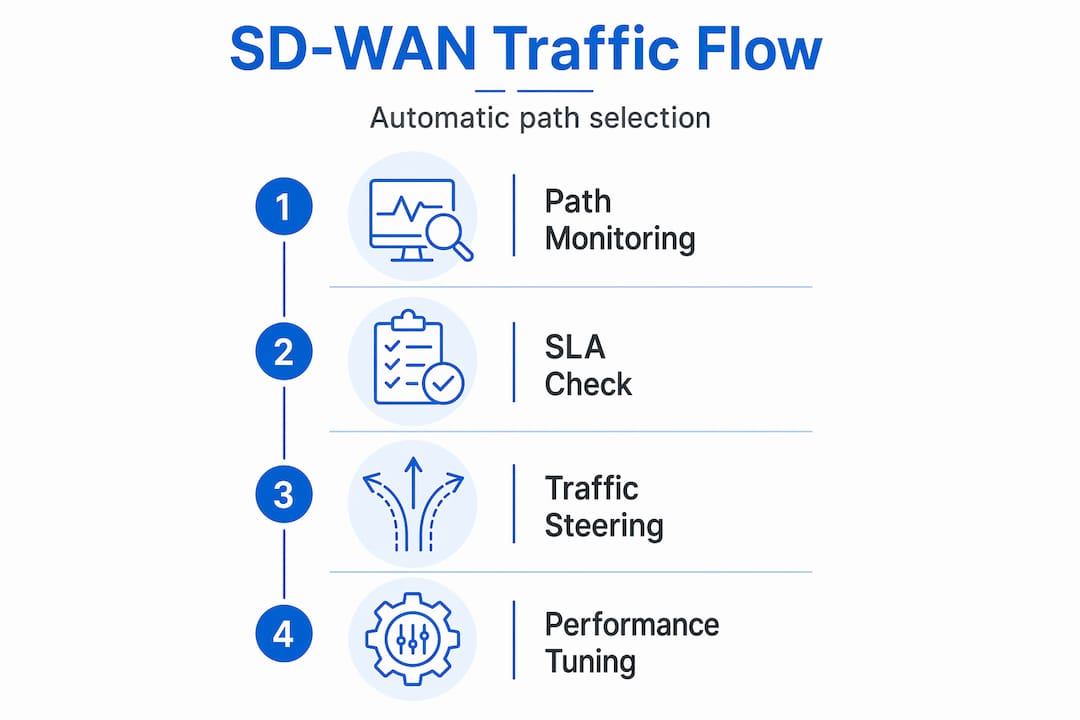
Here is a practical example. Your Microsoft Teams traffic requires less than 150ms latency and less than 1% packet loss. Your MPLS circuit meets that threshold. Your broadband circuit usually does too, but degrades during peak hours. Your SD-WAN monitors both paths every few seconds and keeps Teams on MPLS. If MPLS degrades, it shifts Teams to broadband automatically. If broadband also fails the threshold, it moves to LTE. Users experience no interruption.
Key SLA metrics to configure and monitor:
- Latency: Round-trip time between endpoints, measured in milliseconds
- Jitter: Variation in packet delivery timing, critical for voice quality
- Packet loss: Percentage of packets that fail to arrive, even 0.5% degrades voice
- MOS score: Mean Opinion Score, a composite quality rating for voice paths
One often-overlooked technique is real-time WAN design for remediation and hold-down timers. Without proper hold-down configuration, a flapping link can cause the SD-WAN to bounce traffic back and forth rapidly, which is worse than leaving it on a degraded path.
Pro Tip: Set hold-down timers so that once a path is marked ineligible, it must remain stable for at least 10 to 30 seconds before traffic is moved back. This prevents routing instability from a momentarily recovered link.
Your managed SD-WAN team should review and tune these policies quarterly, not just at deployment. Application performance requirements change as your business evolves.
High availability, operational risks, and government deployment lessons
Even well-designed SD-WAN deployments carry operational risks that documentation rarely prepares you for. High availability (HA) configurations are particularly prone to subtle failure modes.
Edge-case operational risk in HA SD-WAN deployments includes split-brain scenarios when heartbeat and failover timing interact with heavy traffic load. Vendor guidance specifically warns about increasing thresholds under high load to avoid split-brain, where two nodes each believe they are the active device and begin making conflicting routing decisions.
Common HA pitfalls to watch for:
- Heartbeat thresholds set too aggressively, triggering false failovers under normal load spikes
- Asymmetric routing after failover, where return traffic takes a different path than outbound traffic
- Route confusion when both HA nodes briefly advertise the same prefixes during transition
- Insufficient testing of failover under real production load, not just lab conditions
California's public sector provides useful lessons for enterprise IT. The California Department of Technology describes an SD-WAN service built as a transport-independent secure overlay for state agencies needing multi-branch connectivity. Their process follows a structured sequence: design and cost estimate first, then implementation order. This staged approach prevents agencies from ordering circuits before the design is validated.
"Treating deployment as a project with defined phases — design, validation, pilot, then full rollout — dramatically reduces the risk of discovering architectural problems after 50 sites are already live."
The lesson for enterprise IT is the same. Resist pressure to accelerate rollout before the design is proven. A pilot with 3 to 5 representative sites, including your most demanding locations, will surface problems that no lab test will catch.
Your managed SD-WAN deployments should include documented HA testing procedures and defined escalation paths before any site goes live.
What most guides miss about SD-WAN success
Here is the uncomfortable reality: most SD-WAN deployment guides are written around features, not outcomes. They walk you through interface configuration, policy syntax, and topology diagrams. What they rarely address is the gap between a technically correct deployment and one that actually improves user experience.
We have seen networks where every metric looked green on the dashboard while users complained about degraded video calls. The problem was that the SD-WAN was measuring probe traffic, not real application traffic. Probes were taking one path. Actual Teams sessions were taking another. The monitoring was accurate. It was just monitoring the wrong thing.
The deeper issue is that SD-WAN success requires alignment across three layers: architecture, policy, and operations. You can have a perfect hub-and-spoke design with well-tuned SLA policies, but if your NOC team does not have runbooks for responding to path degradation alerts, those alerts become noise. Over time, teams stop acting on them.
Failover testing is another area where organizations consistently cut corners. Testing failover in a lab tells you the mechanism works. Testing it in production, during business hours, with real users on real applications, tells you whether users actually notice. Those are very different tests. Build scheduled failover drills into your operational calendar, not just your initial deployment plan.
The SD-WAN fundamentals are accessible. The operational discipline to sustain performance over time is what separates organizations that see lasting ROI from those that are back to troubleshooting six months after go-live.
Advance your network with expert SD-WAN solutions
California Telecom designs and deploys SD-WAN for multi-location businesses across California and nationwide, handling everything from underlay circuit sourcing to post-deployment policy tuning. Our engineers build the architecture, configure the policies, and monitor performance through our 24/7 U.S.-based NOC — so your team is not carrying that operational load alone.Whether you need to replace aging MPLS, add resilient failover, or connect dozens of new sites quickly, we source circuits from 50+ carriers and match the right transport to each location. Our managed LAN/WAN and expert SD-WAN help services cover design through ongoing operations, backed by a 99.99% uptime SLA. For businesses operating across multiple states, our nationwide managed services extend the same engineering standards to every location. One provider, one bill, one engineer's number.
Frequently asked questions
Is SD-WAN necessary if all my business sites use the same internet provider?
SD-WAN still adds value by dynamically optimizing application traffic and monitoring real-time performance, since underlay quality and diversity at each site directly affect what the overlay can deliver, even on a single provider.
Can SD-WAN replace my existing MPLS network?
SD-WAN can complement or fully replace MPLS, but the transition requires careful circuit planning because SD-WAN steers traffic over available paths rather than replacing the underlying transport quality those paths provide.
What's the best SD-WAN design for a business with hundreds of branches?
A hub-and-spoke architecture with regional hubs is typically the right choice, since hub-and-spoke SD-WAN scalability relies on BGP and iBGP route-reflectors at the hub to keep routing manageable across large branch counts.
How does SD-WAN handle outages or link failures?
SD-WAN continuously measures path health and reroutes traffic automatically, using SLA monitoring of latency, jitter, and packet loss to determine which paths are eligible for each application at any given moment.
What is unique about SD-WAN rollouts for California government agencies?
California state agencies follow a structured, transport-independent approach where CDT's SD-WAN service requires a design and cost estimate before any implementation order is placed, ensuring architecture is validated before circuits are provisioned.