

Single Provider Multi-Location Connectivity: A Business GuideSingle provider multi-location connectivity is the practice of managing all network circuits, contracts, and support for every business location through one unified service provider, replacing the fragmented per-site approach that drains IT resources and inflates costs. For businesses running five locations or fifty, the difference between one accountable team and a patchwork of regional ISPs shows up immediately in provisioning speed, SLA enforcement, and monthly billing complexity. Providers like SRS Networks and Expereo have built entire service models around this consolidation principle. Californiatelecom delivers the same unified model nationwide, sourcing from 50-plus carriers while keeping every customer on a single contract, a single bill, and a single point of engineering contact.
How single provider multi-location connectivity differs from fragmented setups
The standard alternative to a unified provider is per-location circuit management. Each site contracts with a local or regional ISP, negotiates its own terms, and escalates support tickets through a separate vendor relationship. The result is a network that technically functions but operationally fragments every IT workflow.
| Approach | Contract management | SLA consistency | Support escalation |
|---|---|---|---|
| Fragmented multi-vendor | One contract per site | Varies by carrier | Multiple vendor contacts |
| Single provider model | One master agreement | Standardized across all sites | One accountable team |
The operational costs of fragmentation are concrete. IT teams spend time auditing disconnected invoices, chasing carriers with no cross-site visibility, and absorbing inconsistent service quality between locations. When one site goes down, there is no unified escalation path. The team calls a carrier that has no visibility into the rest of the network.

The case of Kingspan Insulation illustrates what consolidation actually delivers. Kingspan unified connectivity across 90 global sites using Expereo's managed platform, gaining centralized visibility, standardized contracts, and scalable onboarding across multiple countries. That outcome is not unique to enterprises of that scale. Any multi-location business running more than three or four sites starts to feel the same friction that Kingspan eliminated.
Key problems that fragmented setups create for IT and operations teams:
- Inconsistent SLAs across sites make it impossible to set a network performance baseline
- No volume pricing leverage when each location negotiates independently
- Delayed provisioning when new sites require separate carrier engagements
- Audit complexity when invoices arrive from six different vendors with different billing cycles
SRS Networks centralizes carrier and circuit management as a replacement for these fragmented approaches, and the operational improvement is immediate once a single team owns the full circuit lifecycle.
What technical architectures enable effective multi-site network connectivity?
The technology behind single provider network solutions has matured significantly. Three architectural approaches now define how unified multi-site networks are built and managed.
-
Centralized policy management with shared virtual networks. Microsoft's multisite networking model uses shared virtual networks and configurations to enable policy management from any site in the fabric. This architecture gives IT teams a single operating model regardless of how many physical locations exist. The practical benefit is that a policy change at the network level propagates everywhere, not just to the site where the change was made.
-
SD-WAN with zero-touch provisioning. Versa Secure SD-WAN provides centralized orchestration and automated provisioning that reduces the engineering time required to bring a new site online. Instead of sending a technician to configure hardware at each location, zero-touch provisioning ships a pre-configured device that connects and authenticates automatically. This approach cuts site onboarding from days to hours and preserves policy consistency across the entire network.
-
Multi-site fabrics using VXLAN and EVPN. Cisco Nexus Hyperfabric's Multi-Site functionality interconnects multiple fabrics as a unified network using VXLAN and EVPN technology. VXLAN extends Layer 2 segments across Layer 3 boundaries, meaning sites in different cities can share the same logical network. EVPN provides the control plane that keeps MAC and IP address tables synchronized across locations. The result is a network that behaves as one, regardless of physical geography.
Technical prerequisites matter here and are frequently underestimated. For VXLAN-based multi-site designs, underlay MTU and IP addressing consistency are non-negotiable. VXLAN adds 50 bytes of overhead to each packet. If the underlay network's MTU is set to the standard 1500 bytes, VXLAN packets will fragment or drop. Every site in the fabric must run a consistent IP addressing family, either IPv4 or IPv6, to maintain logical unification.
Pro Tip: Before committing to a VXLAN-based multi-site fabric, audit every underlay circuit for MTU support. Carriers that provision standard 1500-byte MTU links will silently block your overlay without generating an obvious error. Request jumbo frame support, typically 9000 bytes, during the circuit ordering process.
What operational benefits do businesses gain from a unified provider?
The operational case for consolidating connectivity for multiple locations goes well beyond simplifying the org chart. It changes how IT teams spend their time and how the business controls telecom costs.
Centralized circuit lifecycle management covers every phase from initial audit through provisioning, SLA enforcement, and contract renewal. One team owns the full picture. When a circuit underperforms, there is no ambiguity about who escalates the ticket or which SLA applies. That accountability is structurally impossible in a fragmented setup where each site's carrier has no obligation to the others.
"One point of contact replacing fragmented management is not a convenience feature. It is the mechanism that makes SLA enforcement, cost auditing, and capacity planning actually work at scale."
Contract consolidation creates commercial leverage that per-site contracts cannot. Unified contracts enable volume pricing and service guarantees that individual site agreements rarely achieve. A business with 20 locations negotiating as one buyer gets materially better terms than 20 separate buyers. Exit clauses, credit provisions, and bandwidth upgrade paths are all negotiable when the contract covers the full footprint.
Standardizing voice and data frameworks across locations produces a consistent user experience that matters operationally. Unified communications frameworks, including SIP trunking and standardized voice configurations, mean that an employee at the Chicago office and one at the Phoenix office operate on identical systems. IT support is simpler because the configuration is the same everywhere. Onboarding new employees at any location follows the same process.
For businesses evaluating ISP contract consolidation strategies, the contract structure itself is often where the most immediate savings appear, before any technology changes are made.
How to implement and scale single provider connectivity across multiple sites
Scaling a unified network across multiple locations requires more than selecting a provider. The implementation process determines whether the single-provider promise holds as the business grows.
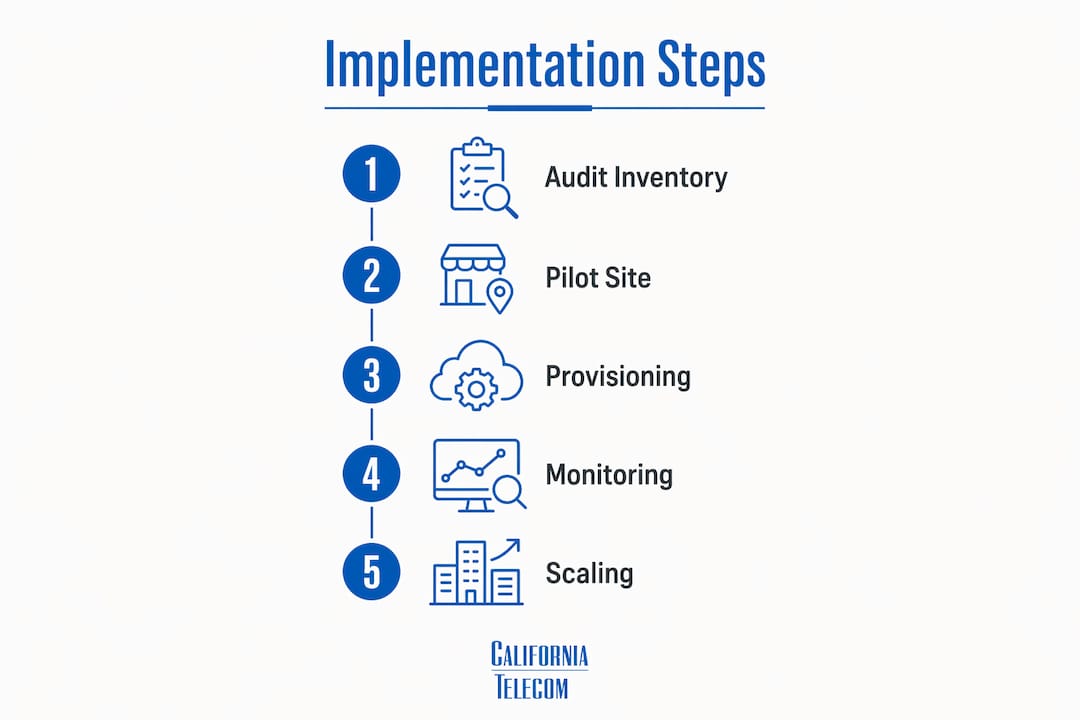
The foundation is a repeatable site onboarding process. Zero-touch provisioning and standard policy templates reduce engineering overhead and preserve consistency as new sites come online. Without a template, each site becomes a custom project. With one, adding a location is an execution task, not a design task.
Practical steps for a successful multi-site rollout:
- Audit existing circuits before signing a consolidated contract. Identify every active circuit, its term, and its exit cost. Surprises during migration are expensive.
- Define a standard site configuration covering routing, security policy, QoS settings, and voice parameters. Every new site deploys from this template.
- Negotiate contract flexibility for site additions and removals. Multi-location businesses open and close locations. The contract should accommodate that without penalty.
- Centralize monitoring from day one. A single dashboard showing performance across all sites is what makes the unified model operationally real.
| Implementation phase | Key action | Common failure point |
|---|---|---|
| Pre-migration audit | Inventory all circuits and terms | Missing circuits discovered post-contract |
| Template design | Define standard site config | Over-customizing per site |
| Provisioning | Deploy via zero-touch where possible | Manual configs that drift from standard |
| Ongoing management | Monitor from centralized platform | Siloed monitoring per site |
For businesses managing the transition from multiple vendors, switching providers without downtime requires a dual-WAN cutover strategy that keeps existing circuits live until the new ones are fully validated. Cutting over site by site, rather than all at once, reduces risk significantly.
Pro Tip: Treat the first site as a pilot. Validate the full provisioning workflow, monitoring integration, and support escalation path before rolling out to the remaining locations. Fixing a process gap on site one costs far less than fixing it on site fifteen.
Key takeaways
Single provider multi-location connectivity delivers the most value when it combines centralized lifecycle management, standardized architecture, and contract consolidation into one accountable operating model.
| Point | Details |
|---|---|
| Centralized lifecycle management | One team handles audits, provisioning, SLA enforcement, and renewals across all sites. |
| Contract consolidation creates leverage | Unified contracts unlock volume pricing and exit provisions unavailable in per-site agreements. |
| Architecture requires planning | VXLAN-based fabrics need MTU and IP addressing consistency confirmed before deployment. |
| Zero-touch provisioning scales rollouts | Automated site onboarding preserves policy consistency and cuts deployment time significantly. |
| Standardized frameworks improve operations | Uniform voice and data configurations reduce IT support complexity across every location. |
Why the single-provider model is the only one worth defending
I have worked with enough multi-location businesses to say this plainly: the fragmented model does not fail dramatically. It fails slowly, through accumulated friction. A ticket that takes three days instead of one. An invoice that nobody can reconcile. A site that runs at 60% of contracted bandwidth because the carrier's SLA only covers availability, not throughput, and nobody caught it during contract review.
The single-provider model does not eliminate those problems automatically. What it does is create the conditions where they can actually be solved. When one team owns the full network, they have the visibility and the contractual standing to act. That is not true when you have seven carriers and no one who sees all seven at once.
What I find underappreciated is the compounding effect on IT capacity. When your team stops spending hours each month chasing carrier tickets and reconciling invoices, that time goes somewhere more productive. The businesses I have seen make this transition consistently report that IT starts working on infrastructure improvements instead of infrastructure maintenance. That shift is worth more than the direct cost savings in most cases.
The long-term case for consolidation is also stronger than it looks at signing. As a business adds locations, the complexity of a fragmented model grows faster than the business does. The single-provider model scales linearly. That asymmetry becomes decisive at 10 or 15 sites, and it is worth building toward before you reach that point.
For businesses exploring what managed network services actually look like in practice, the architecture and the accountability model are inseparable. You cannot get one without the other.
— Jim
How Californiatelecom supports multi-location businesses nationwide
Californiatelecom is built specifically for businesses that need one provider to own the full network across every location. Headquartered in Chino, CA, Californiatelecom sources from 50-plus carriers, designs and deploys each site through its own engineers, and backs every service with a 24/7 U.S.-based NOC, a 99.99% uptime SLA on data, and 99.999% on voice.Customers get one bill, one contract, and one engineer's direct number instead of managing a roster of regional carriers with no cross-site accountability. Whether you are consolidating three locations or thirty, Californiatelecom's nationwide managed network services give you the centralized visibility, standardized architecture, and dedicated support that the single-provider model requires to actually deliver. See how Californiatelecom has done it for businesses like yours at the case studies page.
FAQ
What is single provider multi-location connectivity?
Single provider multi-location connectivity is the practice of managing all network circuits, contracts, and support for every business location through one unified service provider. It replaces per-site carrier relationships with centralized lifecycle management, standardized configurations, and a single point of accountability.
How does SD-WAN support multi-site network management?
SD-WAN platforms like Versa Secure SD-WAN provide centralized orchestration and zero-touch provisioning that automates site onboarding and enforces consistent security and routing policies across all locations. This reduces the engineering time required to bring new sites online and prevents configuration drift between locations.
What are the biggest risks when consolidating multi-location connectivity?
The most common risks are undiscovered circuit contracts with early termination fees and underlay networks that do not support the MTU requirements for VXLAN-based overlays. A thorough pre-migration audit of all existing circuits and underlay specifications prevents both problems before they become costly.
Can small multi-location businesses benefit from a single provider model?
Yes. The operational benefits of centralized management, volume pricing, and standardized configurations apply at any scale. Businesses with as few as three or four locations see measurable reductions in IT overhead and billing complexity when they consolidate under one provider.
What should a contract with a multi-location connectivity provider include?
A strong contract covers standardized SLAs across all sites, volume pricing tied to the full location footprint, exit clauses for individual sites, and provisions for adding or removing locations without penalty. These terms are negotiable when the contract covers the entire network rather than individual sites.