

How to Evaluate ISP Contracts for California EnterpriseEvaluating ISP contracts for California enterprise operations is a structured review of pricing, SLA terms, regulatory compliance, and contract mechanics to secure reliable connectivity across multiple sites. Without this process, multi-site organizations routinely overpay by 20% to 40% compared to current market rates. California adds a distinct layer of complexity: state regulations like AB 1414 directly affect how bulk internet agreements are written and enforced. Decision-makers who treat ISP agreements as set-and-forget documents absorb preventable costs, compliance exposure, and service gaps that compound across every location in their portfolio.
What are the critical ISP contract elements enterprises must assess in California?
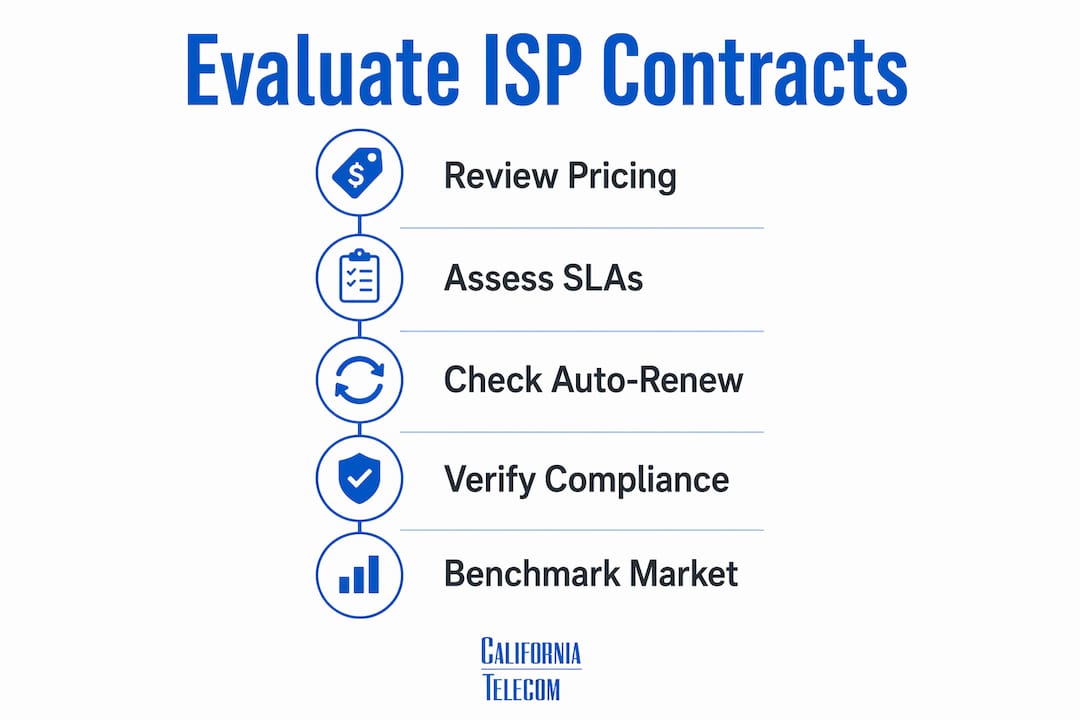
A well-structured enterprise ISP contract review starts with six core components. Each one carries financial or operational risk if left unexamined.
Pricing structures and hidden fees are the first place to look. Carriers routinely embed administrative fees, regulatory recovery surcharges, and equipment rental charges that inflate the monthly invoice well above the quoted rate. Require an itemized breakdown before signing.

Service level agreements define what you are actually buying. An SLA that promises 99.9% uptime sounds strong until you calculate that it permits roughly 8.7 hours of downtime per year. For a multi-site enterprise running real-time applications, that tolerance is unacceptable. Push for 99.99% uptime commitments with defined credit structures that trigger automatically, not on request.
Auto-renewal clauses are among the most costly overlooked terms. Many contracts auto-renew for 1 to 3 years if you miss the notice window, locking you into rates that may be 20% above market by the time the new term begins. Extending your review notice to 90 days or more gives you real leverage.
Volume discounts and multi-site consolidation provisions should appear explicitly in any agreement covering more than three locations. If they do not, you are leaving money on the table that a consolidated bid would recover.
Regulatory compliance language is non-negotiable in California. Contracts covering multi-dwelling units or mixed-use properties must reflect opt-out rights under AB 1414. Review the ISP contract compliance requirements for California before finalizing any bulk service agreement.
| Contract clause | Risk if ignored |
|---|---|
| Auto-renewal terms | Locked into above-market rates for 1 to 3 years |
| SLA uptime definition | Ambiguous credits that carriers dispute or delay |
| Price escalation caps | Uncapped annual increases of 3% to 8% |
| Termination penalties | Early exit fees equal to remaining contract value |
| AB 1414 opt-out language | Legal exposure and potential rent deduction claims |
Pro Tip: Request a redlined version of the carrier's standard contract before negotiations begin. The clauses they resist changing most aggressively are the ones that cost you the most.
How to benchmark ISP pricing and service levels against California market standards
Benchmarking transforms contract evaluation from a subjective review into a data-driven process. Without market comparisons, you have no basis to challenge a carrier's pricing or SLA terms.
Connection type determines your pricing baseline. Dedicated Internet Access (DIA) provides symmetric, SLA-backed bandwidth appropriate for high-demand enterprise sites. Enterprise DIA costs range from $500 to $7,500 or more per month depending on speed and SLA commitments. Broadband and fiber shared services cost significantly less but carry no guaranteed performance floor, making them unsuitable as primary circuits for latency-sensitive workloads.
Geography shapes pricing more than most decision-makers expect. Urban California markets like Los Angeles, San Francisco, and San Jose have dense carrier competition that drives DIA rates down. Rural and semi-rural sites in the Central Valley or North Coast face fewer provider options, which means higher prices and weaker SLA terms. Benchmarking each site individually against its local market is the only accurate method. Benchmarking individual site contracts against market rates reveals overpayments that aggregate pricing reviews miss entirely.
The Type 1 versus Type 2 access distinction directly affects both cost and accountability. Type 1 access uses direct network ownership, which avoids the markups that come with leasing last-mile infrastructure from a third party. Type 2 providers lease that infrastructure and pass the cost to you, often with an additional margin. Enterprises that specify Type 1 access in their RFPs consistently receive more competitive pricing and cleaner escalation paths when issues arise.
| Service class | Typical monthly range | SLA uptime | Best use case |
|---|---|---|---|
| DIA (100 Mbps) | $500 to $1,200 | 99.99% | Primary circuit, real-time apps |
| DIA (1 Gbps) | $1,500 to $4,000 | 99.99% | High-density enterprise sites |
| Fiber broadband (shared) | $150 to $500 | 99.9% | Secondary or backup circuit |
| Cable broadband | $80 to $300 | 99.5% | Low-priority or failover only |
Pro Tip: Run a telecom cost audit on every site 12 months before contract expiration. You need current market data in hand before the carrier opens renewal discussions, not after.
What California-specific legal and regulatory factors affect ISP contract evaluation?
California imposes requirements on ISP contracts that have no federal equivalent. Ignoring them creates legal exposure that no SLA credit will offset.
AB 1414 and Civil Code Section 1942.8 are the most consequential recent changes for enterprise buyers managing properties with tenants or residents. The law mandates that tenants in multi-dwelling units have a penalty-free opt-out from bundled internet services. Landlords who violate these opt-out rights expose themselves to rent deduction claims. For enterprises operating mixed-use campuses, residential towers, or managed office buildings, any bulk ISP agreement must include explicit language accommodating individual opt-outs without contract penalties.
The practical audit steps for AB 1414 compliance include:
- Review every bulk internet agreement covering properties with residential or mixed-use occupancy
- Confirm that opt-out procedures are documented and communicated to all affected tenants
- Verify that the ISP contract does not impose penalties on the enterprise when individual tenants exercise opt-out rights
- Check that billing structures can accommodate partial occupancy without triggering minimum commitment violations
- Document compliance steps in writing to create a defensible record if a dispute arises
The Certificate of Public Convenience and Necessity (CPCN) governs which ISPs have legal authority to operate on California public rights-of-way. Understanding a provider's CPCN status helps enterprises evaluate ISP legitimacy and the risk of service disruption if a provider loses its operating authority. Before committing to a long-term agreement, confirm that your ISP holds a valid CPCN for every jurisdiction where you need service.
California's regulatory environment also affects data privacy obligations embedded in service agreements. Contracts should specify data handling practices consistent with the California Consumer Privacy Act (CCPA), particularly for managed services that involve traffic inspection or network monitoring.
How to implement centralized ISP contract management and ongoing vendor performance monitoring
Fragmented contract management is the single largest source of avoidable telecom spend in multi-site enterprises. When each location manages its own ISP relationship, renewal dates get missed, billing errors go unchallenged, and volume leverage disappears entirely.
Centralizing ISP contract management requires four operational components working together:
- Build a complete contract inventory. Document every ISP agreement across all sites: provider, service type, bandwidth, monthly cost, contract start date, expiration date, and auto-renewal notice deadline. This inventory is the foundation of every other management activity.
- Implement automated renewal alerts. Tracking contract milestones with advance alerts prevents the costly default auto-renewals that lock enterprises into above-market terms. Set alerts at 12 months, 6 months, and 90 days before each expiration.
- Conduct systematic billing audits. Carriers regularly bill for services that were disconnected, apply incorrect rates after promotional periods expire, or charge fees that the contract does not authorize. Centralized telecom audits recover 15% to 25% in costs for multi-location enterprises. That figure represents real money returned to the operating budget, not theoretical savings.
- Establish vendor performance scorecards. Track uptime, mean time to repair, SLA credit fulfillment, and billing accuracy for each carrier on a quarterly basis. Scorecards create an objective record that supports both internal reporting and carrier negotiations.
Pro Tip: Assign a single internal owner for the telecom contract inventory. Shared ownership means no ownership. When renewal deadlines approach, one person should be accountable for the decision.
Ongoing vendor performance monitoring is not optional for enterprises managing distributed networks. It is the mechanism that converts contract terms into actual service delivery. Carriers respond to documented performance records differently than to verbal complaints. When you arrive at a renewal negotiation with 12 months of uptime data, SLA credit history, and billing discrepancy logs, the conversation shifts from the carrier's terms to yours.
What practical negotiation tactics help enterprises secure the best ISP contracts in California?
Negotiation leverage in ISP contracts comes from preparation, timing, and competitive pressure. Carriers expect most enterprise buyers to renew passively. The ones who do not get better deals.
Timing is the most underused lever. Starting the enterprise ISP contract negotiation process 6 to 9 months before expiration gives you time to solicit competitive bids, evaluate alternatives, and let the incumbent carrier know you are serious about switching. Waiting until 60 days out eliminates that pressure entirely.
Key negotiation priorities for California enterprise buyers:
- Secure competitive bids from at least three providers before engaging the incumbent. Multi-site contract consolidation can yield 15% to 25% volume discount improvements. The bid process itself signals to the incumbent that you have alternatives.
- Negotiate annual price escalation caps. Uncapped escalation clauses allow carriers to raise rates 3% to 8% per year without triggering renegotiation rights. Cap escalation at CPI or a fixed percentage not to exceed 2%.
- Clarify porting rights in writing. Explicit port-out terms prevent carriers from holding phone numbers or IP address blocks hostage during transitions. This protection costs nothing to negotiate but can be extremely expensive to litigate later.
- Build in technology upgrade provisions. Contracts signed today should include language allowing bandwidth upgrades or technology changes without triggering new term commitments or early termination fees.
- Reduce early termination fees. Push for prorated ETFs that decline over the contract term rather than flat penalties equal to the full remaining value.
- Avoid common pitfalls. Review common telecom contract mistakes before finalizing any agreement. The most expensive errors are the ones that look harmless in the contract language.
The goal of every negotiation is a contract that reflects current market pricing, protects you from unilateral changes, and gives you exit options if service quality deteriorates.
Key takeaways
Enterprises that evaluate ISP contracts with structured benchmarking, regulatory awareness, and centralized lifecycle management consistently outperform those that renew passively on carrier-driven terms.
| Point | Details |
|---|---|
| Benchmark every site individually | Market rates vary significantly by geography; urban and rural California sites require separate comparisons. |
| AB 1414 compliance is mandatory | Bulk internet contracts covering multi-dwelling properties must include penalty-free opt-out provisions for tenants. |
| Start negotiations 6 to 9 months early | Early engagement creates competitive pressure and time to solicit bids that improve your leverage. |
| Centralize contract inventory and alerts | Automated renewal tracking prevents costly auto-renewals and ensures no site renews on default terms. |
| Audit billing continuously | Systematic billing audits recover 15% to 25% in costs and enforce SLA credits carriers would otherwise withhold. |
What I've learned from watching enterprises renew ISP contracts the wrong way
I have reviewed hundreds of enterprise telecom contracts over the years, and the pattern that costs companies the most is not bad negotiation. It is no negotiation at all. The majority of multi-site enterprises in California renew ISP agreements on the carrier's schedule, with the carrier's standard terms, because no one internally owns the process.
The second most expensive mistake is treating the legal and technical review as separate workstreams. I have seen contracts that passed legal review but contained SLA definitions so vague that the carrier could never technically be in breach. The uptime guarantee was real on paper and meaningless in practice. The fix is simple: your technical team and your legal team need to review the same document at the same time, with a shared checklist.
AB 1414 is the clause that surprises California enterprise buyers most in 2026. Companies that operate mixed-use properties or manage bulk internet agreements for tenants often have no idea the opt-out obligation exists until a tenant raises it. At that point, the contract is already signed and the exposure is already there. Reviewing California broadband infrastructure obligations before signing is not a legal formality. It is risk management.
The enterprises that consistently get the best ISP contracts are the ones that treat vendor management as a continuous process, not a transaction. They audit, they benchmark, they track performance, and they show up to renewal negotiations with data. Carriers notice the difference immediately.
— Jim
How Californiatelecom helps enterprises optimize multi-site ISP contractsCaliforniatelecom is a managed network services provider headquartered in Chino, CA, sourcing from 50-plus carriers to design and manage connectivity for multi-location enterprises nationwide. The team handles contract audits, market benchmarking, carrier negotiations, and AB 1414 compliance reviews as part of a single managed engagement. Every site is deployed by Californiatelecom's own engineers and backed by a 24/7 U.S.-based NOC with a 99.99% uptime SLA on data. Instead of managing a fragmented portfolio of ISP agreements across dozens of locations, you work with one provider, one bill, and one engineer's number. Explore nationwide managed network services to see how Californiatelecom structures multi-site ISP contract optimization for California enterprises.
FAQ
What does it mean to evaluate ISP contracts for enterprise use?
Evaluating enterprise ISP contracts means reviewing pricing, SLA terms, auto-renewal clauses, regulatory compliance, and multi-site provisions to confirm the agreement delivers reliable service at a defensible cost. The process includes benchmarking current rates against market data and auditing billing for unauthorized charges.
How does AB 1414 affect California enterprise ISP contracts?
AB 1414 requires that tenants in multi-dwelling units have a penalty-free opt-out from bundled internet services. Enterprises managing bulk ISP agreements for properties with residential occupants must include explicit opt-out language in their contracts or face legal exposure.
What is the difference between DIA and broadband for enterprise sites?
DIA provides dedicated, symmetric bandwidth with SLA-backed uptime guarantees, making it appropriate for primary circuits at high-demand locations. Broadband shared services cost less but offer no guaranteed performance floor, which makes them unsuitable as sole connectivity for latency-sensitive enterprise applications.
When should an enterprise start renegotiating an ISP contract?
Start the renegotiation process 6 to 9 months before contract expiration. This timeline allows you to solicit competitive bids, evaluate alternatives, and apply meaningful pressure on the incumbent carrier before the auto-renewal window closes.
How much can a telecom audit save a multi-site enterprise?
Centralized telecom audits recover 15% to 25% in costs for multi-location enterprises by identifying billing errors, unauthorized charges, and rates that have drifted above current market benchmarks. The savings are typically recurring, not one-time recoveries.