

What Is a Business Telecom Audit? A Manager's GuideA business telecom audit is a structured review of telecom spending, contracts, and service inventory designed to identify billing errors, unused services, and cost optimization opportunities. Most business owners assume their telecom bills are accurate. They are not. Carriers routinely apply incorrect rates, charge for disconnected lines, and bill for services that were never activated. A telecom audit, also called a telecom expense review or telecommunications cost audit, gives you a documented, line-by-line picture of what you are actually paying for versus what you contracted to receive.
What does a business telecom audit include?
A comprehensive telecom audit covers four core workstreams: invoice analysis, usage review, contract examination, and service inventory validation. Each one targets a different category of waste or error.
Invoice analysis means pulling every telecom bill across every carrier and every location, then reconciling billed amounts against contracted rates. This step catches rate misapplication, duplicate charges, and taxes applied to non-taxable services.
Usage review compares actual call records and data consumption against the plan you are paying for. A business paying for a 500-seat voice plan that uses 310 seats is overpaying every month. Right-sizing that plan is a direct, recurring saving.

Contract examination verifies that every discount, SLA commitment, and renewal term in your signed agreements is actually reflected in your bills. Carriers frequently fail to apply negotiated discounts after contract renewals, and most customers never notice.
Service inventory validation is the most labor-intensive step and the most valuable. It maps every circuit, phone line, and data service across every location against what carriers say they are delivering. Discrepancies between your internal records and carrier records are where the largest billing errors hide.
- Build a complete service inventory independent of carrier data.
- Collect all contracts, amendments, and pricing schedules.
- Match each invoice line to a contracted rate and a verified service.
- Audit usage against provisioned capacity.
- Verify tax and surcharge calculations for accuracy.
- Flag unused or unrecognized services for disconnection review.
- Document all discrepancies before initiating carrier disputes.
When you hire an external auditor, they will require a Letter of Authorization (LOA) to act on your behalf with carriers. The LOA specifies the scope of authority and validity dates, which gives auditors the legal standing to pull account data and escalate disputes without delays.
Pro Tip: Never rely solely on carrier-provided inventory reports to build your service list. Carriers have a financial incentive to keep billing active services, and their records frequently include lines that were never properly decommissioned.
Why conduct a telecom audit? Benefits and cost savings
The financial case for a telecom audit is direct. Professional audits recover roughly 12 to 18% of annual telecom spend, with some engagements delivering 15 to 30% in immediate savings depending on how long billing errors have gone undetected. For a business spending $500,000 per year on telecom, that is $60,000 to $150,000 recovered.
The most common issues auditors find include:
- Overcharges on contracted rates. Carriers apply the wrong rate tier after a contract renewal or a plan change.
- Duplicate billing. The same circuit or service appears on two invoices, often from a billing system migration.
- Unused lines and ghost services. Lines that were never disconnected after an office closure or employee departure continue to generate monthly charges.
- Incorrect taxes and surcharges. Tax logic errors are common, particularly for businesses operating across multiple states with different telecom tax rules.
- Missing discounts. Volume discounts and promotional credits negotiated at signing are frequently not applied after the first billing cycle.
The operational benefits extend beyond the refund check. Audits produce a clean, verified service inventory that becomes the foundation for smarter procurement decisions, better vendor negotiations, and faster onboarding when you open new locations.
"Regular telecom audits identify unexpected billings and help businesses regain control over telecom expenses." — Enterprise Telecom Expense Audit Guide
The scale of savings possible in multi-location environments is significant. One travel services enterprise disconnected 7,100 redundant services across 1,000 locations, achieving $6.5 million in annual recurring savings and a 36% permanent reduction in telecom costs. The key was a controlled verification process that confirmed each service was genuinely unused before disconnection, preventing any operational disruption.
How to conduct a telecom audit: a step-by-step process
The business telecom audit process follows a logical sequence. Skipping steps, particularly inventory verification, is the most common reason audits fail to recover their full potential savings.
-
Build your own inventory first. Contact every carrier you pay and request a complete account listing. Then cross-reference that against your own records: switch configurations, network diagrams, and physical site surveys. The gaps between those two lists are your first set of findings.
-
Collect all contracts and amendments. Gather every signed agreement, pricing schedule, and contract amendment. Pay particular attention to auto-renewal clauses and rate change provisions, which carriers use to quietly increase prices.
-
Match invoices to contract terms. Pull 12 months of invoices for each carrier account. Compare billed rates to contracted rates line by line. Accurate root cause identification is critical here because carriers will not issue credits without specific documentation of the billing error and the correct rate.
-
Audit usage against provisioned services. Identify circuits, lines, and data services with zero or near-zero usage over the past 90 days. These are candidates for disconnection, but require verification before you act.
-
Verify taxes and surcharges. Telecom tax errors are common and often overlooked. Check that surcharges align with the service type and jurisdiction. Federal Universal Service Fund (USF) charges, state telecom taxes, and local franchise fees all have specific applicability rules.
-
Document every discrepancy. Before contacting a carrier, build a dispute file with the invoice line, the contract reference, and the calculated overcharge. Carriers respond faster and more accurately when disputes are specific and documented.
-
Manage disconnections carefully. Before canceling any service, verify that no active system, alarm, elevator, or point-of-sale terminal depends on that line. A controlled remediation workflow prevents the service disruptions that make businesses reluctant to act on audit findings.
Pro Tip: When disputing charges with a carrier, always reference the specific contract clause and the invoice date in the same communication. Vague disputes get routed to general customer service. Specific, documented disputes reach billing resolution teams that have authority to issue credits.
Common challenges and pitfalls in telecom audits
Most audits encounter predictable obstacles. Knowing them in advance lets you prepare rather than react.
- Incomplete inventory data. Carrier records and internal records rarely match. Building an accurate inventory requires physical verification at each location, not just a spreadsheet reconciliation.
- Disconnection risk. Cutting a line that supports a fire alarm panel, a security system, or a payment terminal creates immediate operational and compliance problems. Every disconnection decision needs a verification step.
- Complex contract language. Telecom contracts use carrier-specific terminology for pricing tiers, minimum revenue commitments, and early termination fees. Misreading a minimum commitment clause can turn a cost-saving disconnection into a penalty charge.
- Authorization gaps. Without a properly executed LOA, external auditors face delays when requesting account data from carriers. Prepare this document before the audit begins, not after.
- Over-reliance on automated tools. Software platforms can flag anomalies, but complex billing errors require human review to interpret contract language and build defensible dispute documentation.
Pro Tip: Assign one internal contact who owns the relationship with each carrier account. Audits stall when no one inside the business has the authority or the account credentials to pull billing records quickly.
You can avoid many of these issues by reviewing common telecom management mistakes before you start, particularly if your business has grown through acquisitions or added locations without a formal telecom procurement process.
How telecom audits fit into broader expense management strategy
A one-time audit recovers money. A continuous telecom expense management (TEM) program prevents overpayment from recurring. The distinction matters for how you allocate resources.
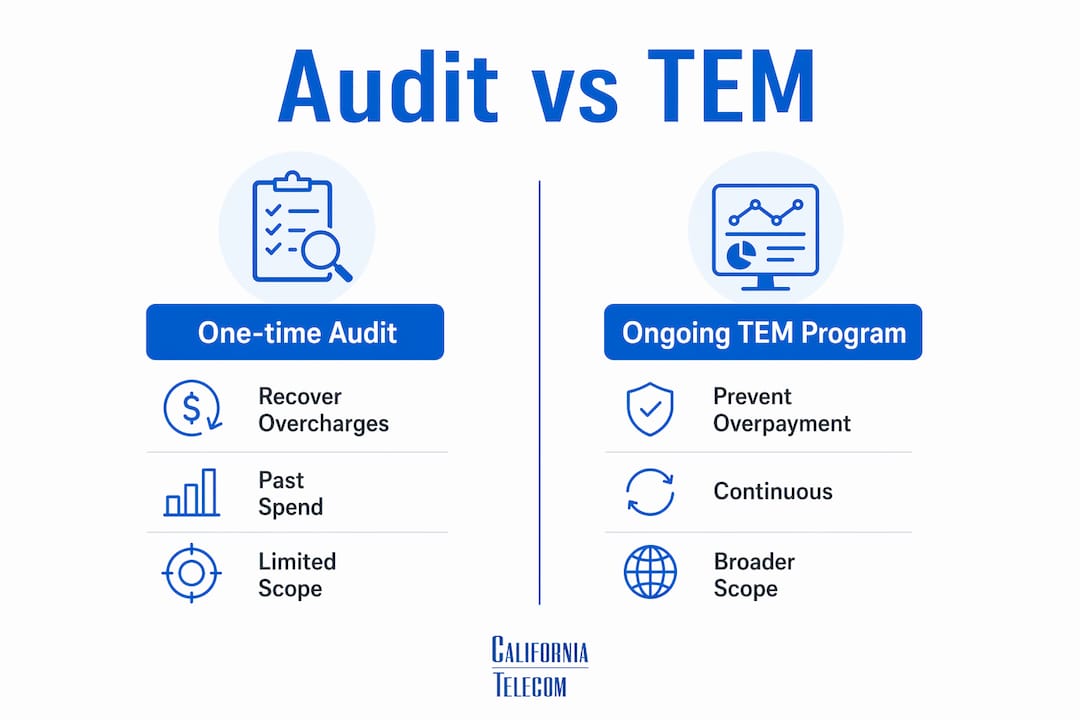
| Factor | One-time audit | Ongoing TEM program |
|---|---|---|
| Primary goal | Recover past overcharges | Prevent future billing errors |
| Frequency | Once or as needed | Monthly invoice validation |
| Scope | Historical billing review | Real-time inventory and contract tracking |
| Cost recovery | Immediate, lump-sum credits | Sustained, incremental savings |
| Best for | Businesses with no prior audit history | Businesses with complex, multi-vendor environments |
Connecting audit results to procurement discipline yields the biggest long-term savings. An audit tells you what you are paying. A TEM program tells you what you should be paying and flags the gap in real time. Businesses that treat the audit as a one-time project and then return to passive invoice payment typically rebuild the same billing errors within 18 to 24 months.
Multi-location businesses face an additional layer of complexity. Each site may have different carriers, different contract terms, and different service configurations. Consolidating telecom billing across locations reduces that complexity and makes ongoing validation far more manageable.
In regulated industries, telecom audits also carry compliance implications. Cybersecurity frameworks and industry regulations increasingly require documented evidence of network inventory and access controls, making audit readiness a compliance requirement, not just a cost management exercise.
Smaller organizations benefit from early audits before inefficiencies become systemic. A 20-person company with three carriers and two locations can complete a meaningful audit in days. A 500-person company with 40 locations and eight carriers needs weeks. Starting early keeps the scope manageable.
Key takeaways
A business telecom audit recovers an average of 12 to 30% of annual telecom spend by identifying billing errors, unused services, and contract violations that most businesses never detect on their own.
| Point | Details |
|---|---|
| Core audit scope | Review invoices, contracts, and service inventory across every carrier and location. |
| Typical savings range | Audits recover 12 to 30% of annual telecom spend through credits and disconnections. |
| LOA requirement | External auditors need a Letter of Authorization before carriers will release account data. |
| Disconnection risk | Verify every service before canceling to avoid disrupting alarms, payments, or communications. |
| Audit vs. TEM | A one-time audit recovers past overcharges; a TEM program prevents future ones. |
What I've learned from watching businesses skip this step
Most businesses that have never run a telecom audit assume their bills are roughly correct. After working with multi-location businesses across industries, I can tell you the opposite is almost always true. The longer a business goes without a formal review, the more billing errors accumulate, and the harder they become to unwind.
The insight that surprises most managers is how much of the savings come not from disputing carrier errors but from their own internal records being wrong. A line that "everyone knows" was disconnected two years ago is still on the bill. A location that closed during a lease restructuring still has active circuits. No one flagged it because no one owned it.
I also think businesses underestimate the value of the LOA. Preparing that document before the audit starts, rather than scrambling for it mid-dispute, cuts weeks off the credit recovery timeline. Carriers use procedural delays as a defense. Remove that defense before you start.
The other thing I would push back on is the idea that audits are only worth doing when you are in financial trouble. The best time to run a telecom audit is when business is growing. Growth adds services, locations, and vendors faster than procurement processes can track them. An audit during a growth phase catches inefficiencies before they compound. Waiting until the budget is tight means you are cleaning up years of accumulated errors instead of preventing them.
— Jim
How Californiatelecom helps businesses audit and optimize telecom costsCaliforniatelecom delivers managed network services to multi-location businesses nationwide, and telecom cost optimization is built into how we work. Our engineers audit your existing service inventory, validate contracts across all carriers, and identify billing errors before we design your network. We source from 50+ carriers, which means our recommendations are based on what actually fits your environment, not what one vendor wants to sell you. Businesses working with us get one bill, one point of contact, and a 24/7 U.S.-based NOC backing every service. If you want to see what a professional audit uncovers for your business, explore our nationwide managed network services or review our client results to see documented savings from real engagements.
FAQ
What is a business telecom audit?
A business telecom audit is a structured review of a company's telecom invoices, contracts, and service inventory to identify billing errors, unused services, and contract violations. The goal is to recover overcharges and reduce ongoing telecom costs.
How much can a telecom audit save my business?
Professional telecom audits recover 12 to 18% of annual telecom spend on average, with some engagements delivering up to 30% in immediate savings depending on audit scope and how long errors have accumulated.
How long does a telecom audit take?
A small business with one or two carriers can complete an audit in a few days. A multi-location enterprise with multiple carriers and complex contracts typically requires four to eight weeks for a thorough review and dispute resolution process.
Do I need an external auditor or can I do it internally?
Internal audits work for businesses with simple telecom environments and staff who understand contract terms. External auditors bring carrier-specific expertise, established dispute processes, and LOA frameworks that accelerate credit recovery, particularly in complex multi-vendor environments.
What is a Letter of Authorization in a telecom audit?
A Letter of Authorization (LOA) is a document that grants an external auditor legal authority to access your carrier accounts and act on your behalf during disputes. Without it, carriers delay account access, which slows the entire audit process.
Recommended
- Common California business telecom mistakes IT managers must avoid | California Telecom
- How to reduce telecom costs for your California company | California Telecom
- Why businesses choose a single telecom provider | California Telecom
- What is business-grade broadband for multi-location IT | California Telecom