

Why Consolidate Telecom Billing for Multi-Location BusinessesIf you manage telecom expenses across five, ten, or fifty locations, you already know the feeling: a stack of invoices from different carriers, mismatched billing cycles, and zero visibility into what you actually spent last quarter. Understanding why consolidate telecom billing decisions matter comes down to something most guides skip entirely. Fragmented billing is not just an administrative annoyance. It is a structural drag on your financial operations, and it gets worse every time you open a new site.
Table of Contents
- Key takeaways
- Why consolidate telecom billing: the core case
- Key benefits of consolidated telecom billing
- Common misconceptions about telecom consolidation
- How to implement telecom billing consolidation
- Real-world impact of billing consolidation
- My take on consolidation as a structural strategy
- How Californiatelecom supports billing consolidation
- FAQ
Key takeaways
| Point | Details |
|---|---|
| Billing errors are widespread | Telecom complaints rose 61% in early 2026, making invoice audits a financial necessity. |
| Consolidation cuts admin overhead | One bill and one contact point removes the friction of chasing multiple vendors and reconciling separate billing cycles. |
| Cost recovery is real | Invoice audits routinely uncover overcharges, helping businesses reduce telecom expenses by 20 to 40 percent. |
| Risk is managed through design | Single-provider consolidation does not increase vulnerability when infrastructure includes redundancy and failover planning. |
| Financial forecasting improves | Centralized billing data gives finance teams cleaner spend history and more accurate budget projections. |
Why consolidate telecom billing: the core case
Telecom billing consolidation means combining invoices from multiple service providers, locations, and service types into a single monthly statement managed under one contract or provider relationship. Instead of receiving separate bills for internet, voice, and networking at each of your locations, you receive one bill covering everything.
The mechanics vary by model. Some businesses consolidate by moving all services to a single managed provider. Others use a billing aggregator that pulls invoices from multiple carriers into one reporting view without changing underlying contracts. The most operationally sound approach involves a single provider who sources from multiple carriers on your behalf, designs the infrastructure, and owns the relationship end to end. That is the model that eliminates vendor finger-pointing entirely.
Here is what the structure typically looks like in practice:
- Single monthly invoice covering all locations and service types
- Centralized service catalog showing what each site uses and at what cost
- One escalation path for outages, billing disputes, and service changes
- Aligned billing cycles across all locations regardless of original carrier
Pro Tip: Before you consolidate, map every active telecom service by location, carrier, and contract end date. You cannot negotiate a good consolidation deal without knowing exactly what you are replacing.
Integrated telecom billing shortens credit-to-cash cycles and creates a direct connection between telecom spend and financial reporting. That connection is exactly what finance teams at multi-location businesses are missing when they operate with fragmented billing.

Key benefits of consolidated telecom billing
The benefits of telecom billing consolidation extend well beyond receiving fewer envelopes each month. The real value shows up in four specific areas that matter to finance and operations teams.
Operational clarity. When you have twelve locations and eight carriers, blame shifting between vendors during an outage is a real and costly problem. Vendor finger-pointing delays are eliminated when a single provider owns accountability across every site. You call one number. One team owns the resolution.

Cost recovery through error detection. Billing-related telecom complaints are not rare edge cases. Incorrect charges rose 66 percent as of 2026. When you are reviewing one consolidated invoice instead of fourteen separate bills, your accounts payable team has a fighting chance of actually catching those errors. Invoice audits regularly uncover overcharges and unused services that businesses have been paying for months or years without realizing it.
Administrative simplicity. Multiple contracts and billing cycles generate friction that compounds as you scale. Each new location adds another vendor, another billing cycle, and another escalation path your team has to manage. Consolidation removes that compounding overhead. Your team processes one invoice and manages one relationship.
Improved financial forecasting. This is the benefit that finance managers appreciate most. Telecom billing as a strategic function improves visibility into cash flow and profitability. When all your telecom spend sits in one place, you can compare location-by-location costs, spot anomalies quickly, and project future expenses with real confidence.
"Consolidation is more about operational clarity and simplifying infrastructure management than just chasing cost discounts." This reframe matters for every finance team building a business case for change.
There is also a payment behavior benefit worth noting. Single invoices get paid on time more reliably than distributed ones. That sounds simple, but late payments on telecom services at multiple locations can trigger service interruptions at the worst possible times.
Common misconceptions about telecom consolidation
The fears that hold businesses back from consolidating are predictable, and most of them dissolve under scrutiny.
Misconception 1: Consolidation creates a dangerous single point of failure. This is the most common objection, and it conflates two separate things: billing consolidation and network architecture. You can have one bill and one provider while still designing each location with redundant circuits, failover paths, and diverse carrier infrastructure underneath. Risk is better managed through infrastructure design than through spreading vendors across disconnected contracts. In fact, multiple vendors often make escalation harder, not safer, because no single party owns the full picture.
Misconception 2: Consolidation always means paying more for less flexibility. Finance teams sometimes assume that consolidation trades competitive pricing for convenience. That is not accurate. A provider sourcing from 50+ carriers can match or beat the pricing of individual carrier contracts, and they bring negotiating leverage you do not have on your own. Understanding common telecom mistakes includes assuming your current fragmented vendor mix is the lowest-cost option.
Misconception 3: The transition will cause service disruptions. Transitions do carry risk, but phased implementation manages that risk effectively.
- Audit your current environment: catalog every service, contract term, and renewal date across all locations.
- Identify low-risk sites for a pilot: start consolidation at one or two locations with flexible contract terms.
- Validate performance and billing accuracy before expanding to additional sites.
- Stagger transitions to align with contract expirations so you avoid early termination penalties.
- Confirm redundancy and failover are in place at each location before decommissioning the legacy setup.
Pro Tip: Contract misalignment is the biggest practical obstacle to consolidation. Pull all your telecom contracts and highlight renewal windows before your first vendor conversation. You will save yourself months of unnecessary penalties.
How to implement telecom billing consolidation
A structured approach to consolidation protects you from the two most common failure modes: rushing the transition and underestimating the audit phase.
Start with a full billing audit. Pull every telecom invoice from the last twelve months across all locations and catalog what you are paying, what you are using, and what you cannot explain. Telecom invoice audits regularly identify 20 to 40 percent in recoverable overcharges. That audit is not just a cleanup exercise. It establishes the baseline you need to evaluate any consolidation proposal honestly.
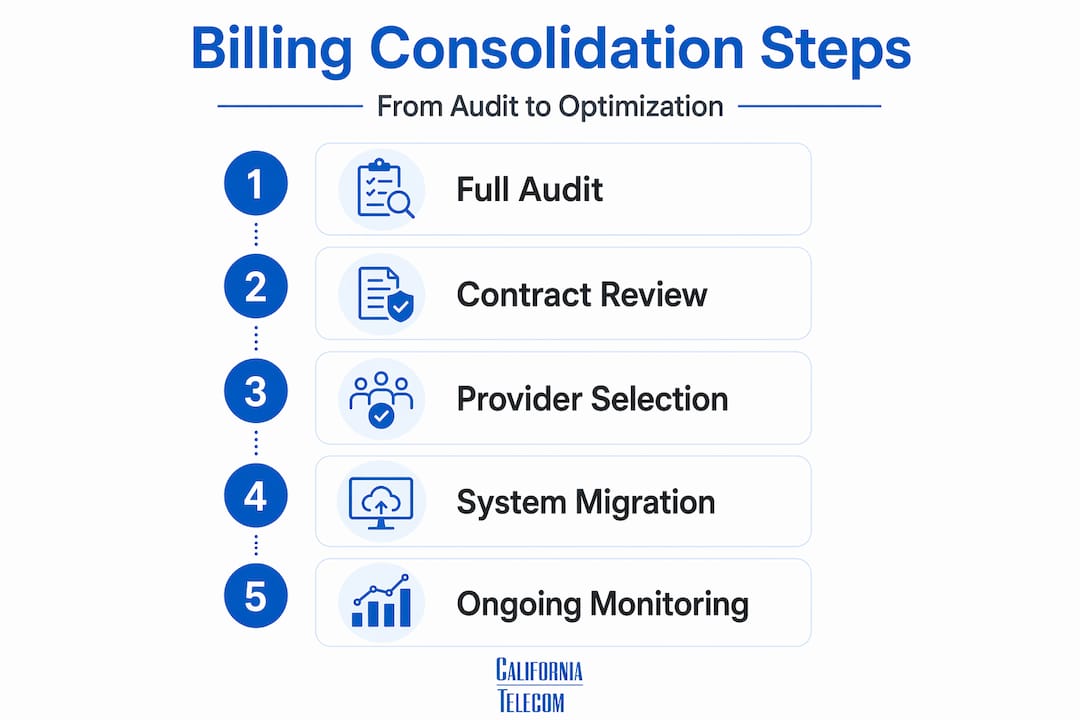
Next, assess your infrastructure dependencies. Some locations may be running legacy voice systems or specialized connectivity setups that require specific carrier relationships. Document these before you commit to a consolidation model that cannot accommodate them.
The following comparison helps frame your evaluation options:
| Approach | Best for | Trade-offs |
|---|---|---|
| Single managed provider | Multi-location businesses wanting full accountability | Requires vetting provider depth and carrier relationships |
| Billing aggregator only | Businesses not ready to change carriers | Adds visibility but does not eliminate finger-pointing |
| Phased carrier consolidation | Large enterprises with complex contract schedules | Slower results but lower transition risk |
After implementation, ongoing monitoring is where the real value compounds. Use telecom expense management solutions to validate invoices each month against contracted rates. Services change, locations open and close, and billing errors creep back in without consistent review. The businesses that sustain the highest savings from consolidation are the ones that treat it as an ongoing discipline, not a one-time project.
For teams exploring managed network services, the monitoring function is typically built in, which removes the need for a separate internal audit process.
Real-world impact of billing consolidation
The most convincing arguments for consolidation come from what actually happens when businesses make the change.
Consider a regional distribution company with fourteen locations across three states. Before consolidation, their accounts payable team spent roughly two full days each month reconciling telecom invoices. They had contracts with six different carriers, mismatched billing dates, and no reliable way to compare spend by location. After consolidating with a single managed provider, they recovered the AP time entirely and caught recurring overcharges that had been running for eighteen months undetected.
The financial forecasting impact is equally significant. When all telecom spend is visible in one place, finance teams can:
- Build accurate monthly telecom budgets by location and service type
- Identify locations that are overpaying relative to their usage profile
- Negotiate renewals from a position of real data instead of fragmented estimates
- Spot seasonal patterns in usage that inform infrastructure planning
A real example from Californiatelecom's work illustrates the accountability shift: a multi-location distributor that previously lost hours chasing separate carriers during outages now escalates everything through one engineer contact and receives resolution tracking in real time. The operational value of that single accountability point is difficult to overstate when a location goes down and revenue is at stake.
Incorrect telecom charges are not getting rarer. They rose 66 percent in 2026. The businesses that consolidate billing are the ones best positioned to catch those errors before they compound.
My take on consolidation as a structural strategy
I have worked with enough multi-location operations teams to say this with confidence: fragmented telecom billing is one of those problems that feels manageable until it suddenly is not. You absorb the friction for months, assume it is just part of the job, and then one day you realize your team is spending dozens of hours monthly on something that should take a few hours.
What I find most telling is how rarely businesses frame consolidation as a structural decision. They treat it as a cost project, run a quick comparison on monthly rates, and miss the bigger value entirely. The real case for consolidation is operational clarity. One contract, one contact, one invoice. That simplicity has downstream effects on everything from audit accuracy to outage response time to your ability to forecast telecom costs for next year's budget.
I have also seen the risk argument used to justify staying fragmented, and it rarely holds up. Managing risk through vendor diversity sounds logical until you are on a three-way call with two carriers who both insist the problem is on the other side. Redundancy in the network design is what actually protects you. Billing fragmentation just adds noise.
My recommendation: start with the audit before anything else. You will almost always find enough recoverable overcharges to fund the consolidation project and then some.
— Jim
How Californiatelecom supports billing consolidation
Managing telecom billing across multiple locations does not have to mean managing multiple vendors, billing cycles, and escalation paths. Californiatelecom works with multi-location businesses nationwide to design, deploy, and manage consolidated telecom infrastructure backed by a 24/7 U.S.-based NOC, 99.99% uptime SLA on data, and access to 50+ carrier relationships. You get one bill, one point of contact, and one engineering team that owns every location.If your finance or operations team is carrying the administrative weight of fragmented telecom billing, a free consultation with Californiatelecom's team will show you exactly where consolidation creates value in your specific environment. From reducing telecom costs to improving billing visibility across all your sites, the path forward starts with understanding what you are currently paying and why.
FAQ
What does telecom billing consolidation mean for businesses?
Telecom billing consolidation combines invoices from multiple carriers and locations into a single monthly bill, giving finance and operations teams one statement to review, approve, and pay instead of managing separate accounts with different billing cycles.
How much can businesses save by consolidating telecom billing?
Invoice audits consistently uncover overcharges and billing errors that reduce telecom expenses by 20 to 40 percent for multi-location organizations. Savings come from error recovery, administrative time reduction, and better contract negotiation leverage.
Does consolidating telecom services create a single point of failure?
No. Single-provider billing consolidation does not eliminate network redundancy. Providers like Californiatelecom design each site with failover and redundant circuits regardless of billing structure, so operational resilience is maintained independently of how invoices are managed.
How do you start consolidating telecom bills across multiple locations?
Begin with a full audit of all current telecom invoices, contracts, and renewal dates across every location. Identify contract windows where you can transition without penalties, then implement consolidation in phases starting with the lowest-risk sites before expanding.
Why do finance teams benefit most from telecom billing consolidation?
Consolidated billing gives finance teams a single source of spend data across all locations, which improves budget forecasting, makes cost anomalies easier to spot, and creates a cleaner audit trail for telecom expense reporting and compliance.