

How to reduce telecom costs for your California companyRunning 10, 50, or 200 locations across California means telecom bills pile up fast — and most of them are wrong. The average multi-site company overpays its carriers by thousands of dollars every month through billing errors, zombie lines, and contracts that quietly auto-renewed at rates negotiated years ago. If you are trying to reduce telecom costs for your California company without sacrificing the connectivity and voice reliability your operations depend on, this guide walks you through every step: from uncovering hidden waste, to deploying the right technology, to locking in savings that hold.
Table of Contents
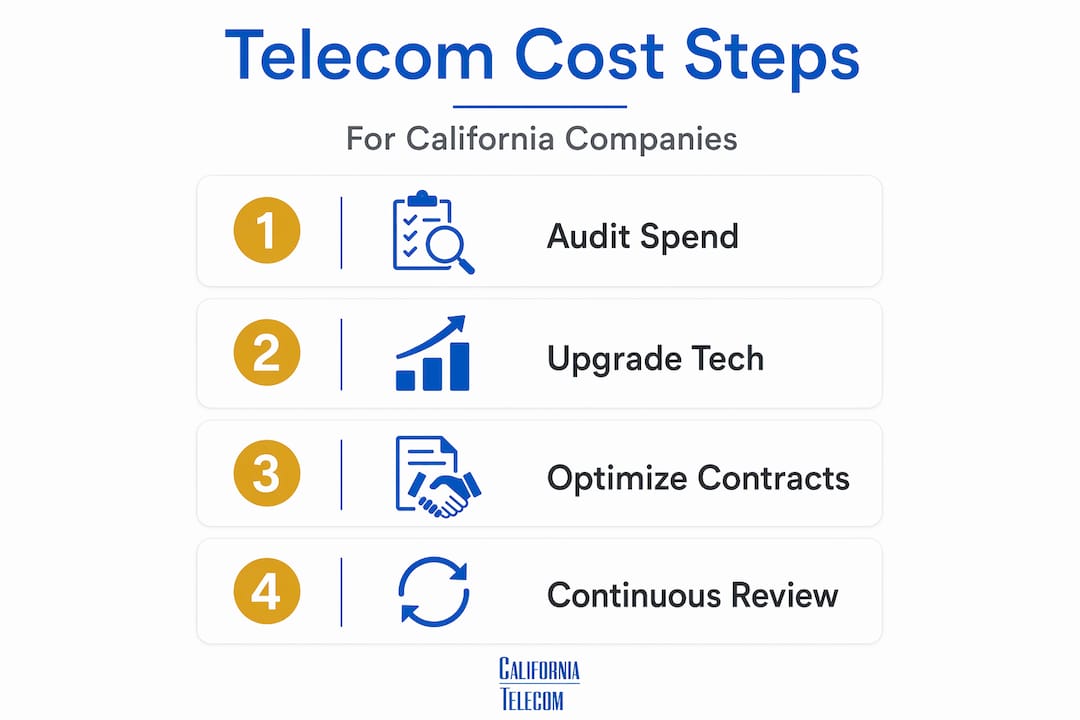
- Preparing to reduce telecom costs: audit and assessment
- Executing cost reductions by upgrading technology and connectivity
- Avoiding common pitfalls in telecom cost management
- Verifying and sustaining telecom cost savings over time
- Why focusing on operational efficiency matters more than just cutting bills
- Explore California Telecom's solutions for multi-location cost reduction
- Frequently asked questions
Key Takeaways
| Point | Details |
|---|---|
| Conduct a telecom audit | Start with a detailed telecom expense audit to identify errors and unused services that inflate costs. |
| Adopt SD-WAN and UCaaS | Upgrade to SD-WAN and UCaaS technologies to reduce connectivity and voice service expenses significantly. |
| Prepare your network | Ensure your network is optimized with Quality of Service settings before cloud voice deployment for call quality. |
| Avoid procurement pitfalls | Document vendor selections and follow compliant bidding processes to prevent disputes and funding loss. |
| Maintain ongoing management | Implement continuous telecom expense management to sustain 15–35% annual cost savings over time. |
Preparing to reduce telecom costs: audit and assessment
Before you can cut anything, you need to know what you are actually paying for. That sounds obvious, but in practice, most multi-location businesses have no single source of truth for their telecom environment. Invoices come from six different carriers, contracts live in a shared drive nobody updates, and the person who negotiated the original deal left two years ago.
A telecom expense audit fixes that. It pulls together four things: every invoice across all sites, every active contract, a full inventory of installed services (circuits, lines, SIP trunks, mobile devices), and actual usage data matched against what you are paying for. When those four data sets sit side by side, the waste becomes obvious.
Businesses that conduct a comprehensive telecom audit typically uncover 15–35% in immediate, recoverable overcharges. That number includes billing errors (carriers bill incorrectly more often than you would expect), services still on the books for closed locations, lines provisioned but never activated, and contract rates that were supposed to drop after a term commitment but never did.
What a thorough audit should cover:
- Invoice review across all carriers and all sites for the past 12–24 months
- Contract inventory with term dates, auto-renewal clauses, and committed spend thresholds
- Service inventory reconciled against physical locations (including any closed or downsized sites)
- Usage data per line, per circuit, and per site to flag underutilized or unused services
- Identification of applicable discount programs, including the California Teleconnect Fund for eligible organizations
Once the audit is complete, savings opportunities typically fall into two buckets:
| Category | Examples | Timing |
|---|---|---|
| Immediate recoverable savings | Billing errors, credits for closed sites, unused line cancellations | 30–90 days |
| Short-term optimization | Contract renegotiation, service right-sizing, vendor consolidation | 3–6 months |
| Long-term structural savings | Technology upgrades, UCaaS migration, SD-WAN deployment | 6–18 months |
| Ongoing TEM savings | Prevented billing drift, automated invoice validation, governance | Continuous |
Pro Tip: Document every service and contract detail you find during the audit, even the assets that look fine. When you go back to carriers to renegotiate, showing up with a complete, accurate inventory shifts the power dynamic. Carriers negotiate harder when they know you do not know what you have. When you do know, they get competitive fast.
Good audit preparation also sets the foundation for managed network services that can take over ongoing expense management once the initial cleanup is done.
Executing cost reductions by upgrading technology and connectivity
An audit tells you where the waste is. Technology upgrades eliminate the structural reasons it keeps coming back.

For multi-location businesses in California, two upgrades consistently deliver the biggest cost reductions: replacing MPLS circuits with SD-WAN, and replacing legacy phone systems with UCaaS.
SD-WAN vs. MPLS: the economics are not close
MPLS (Multiprotocol Label Switching) was the gold standard for connecting business locations for two decades. It is reliable and secure. It is also expensive, inflexible, and slow to provision. SD-WAN (Software-Defined Wide Area Networking) uses a software layer to route traffic intelligently across cheaper broadband, fiber, LTE, or any combination, with built-in failover between connections.
Transitioning from MPLS to SD-WAN can reduce inter-site connectivity costs by 30–50% while improving performance. For a company with 50 California locations, that is a material number. The savings come from replacing dedicated MPLS circuits with lower-cost broadband links, from reducing or eliminating expensive backup circuits, and from centralizing network management instead of paying for per-site configurations.

Our SD-WAN vs MPLS comparison goes deeper on the trade-offs, but here is the summary:
| Factor | Legacy MPLS | SD-WAN |
|---|---|---|
| Monthly cost per site | High (dedicated circuits) | 30–50% lower (broadband-based) |
| Provisioning time | Weeks to months | Days |
| Failover capability | Limited, manual | Automatic, sub-second |
| Scalability | Expensive to add sites | Add sites quickly |
| Application visibility | Low | High (application-aware routing) |
You can explore managed SD-WAN solutions built specifically for multi-site deployments if you want to understand what a full implementation looks like.
UCaaS: eliminating on-premise hardware costs at scale
UCaaS (Unified Communications as a Service) replaces physical PBX systems, desk phones, and on-site voice infrastructure with cloud-based voice, video, and messaging delivered as a monthly per-seat service. For multi-location businesses, the math is compelling: UCaaS cuts costs by 30–50% compared to traditional PBX systems and eliminates on-premise hardware costs entirely.
Beyond the direct cost reduction, UCaaS makes adding new locations dramatically cheaper. No hardware to ship, no technician to dispatch, no separate phone system to maintain. A new site gets voice service in hours, not weeks.
Our UCaaS voice services are built to work across all your California locations under a single management interface.
Pro Tip: Before you cut over to UCaaS, configure QoS (Quality of Service) on your network devices to prioritize voice traffic. Without QoS, voice packets compete with file downloads and video streams, and call quality degrades regardless of how much bandwidth you have. Get QoS right first, then migrate voice.
Avoiding common pitfalls in telecom cost management
The strategies above work. The reason many businesses do not see the full savings is execution errors, not strategy errors. Here are the mistakes that most consistently kill telecom cost reduction projects.
Skipping documentation during procurement
When you go to market for new telecom services, every step of the evaluation process should be documented. Failing to document bid evaluations and procurement steps can lead to disqualification from discount programs and disputes with vendors. This is especially true if you are applying for programs like the California Teleconnect Fund, where audit trails matter.
Deploying technology without network readiness checks
SD-WAN and UCaaS both require a network that is ready to handle them. Network readiness is critical before switching to cloud voice; missing QoS causes poor call quality regardless of available bandwidth. Companies that skip readiness assessments find out the hard way when their new phone system sounds like a radio in a tunnel.
Common mistakes to avoid:
- Signing multi-year contracts before auditing existing services (you lock in waste)
- Consolidating vendors without verifying service coverage at every California location
- Migrating to cloud voice without testing internet circuit quality at each site first
- Letting contracts auto-renew without renegotiating (carriers count on this)
- Treating telecom as a set-it-and-forget-it operational cost instead of an actively managed one
- Underestimating change management requirements when rolling out UCaaS to employees
"The businesses that fail to control telecom costs are not the ones that pick the wrong technology. They are the ones that underestimate the operational complexity of running a distributed network and try to manage it themselves without the right tools or expertise."
Pro Tip: Engage a managed service provider with multi-carrier access before you begin procurement. A provider that sources from 50-plus carriers will know which carriers actually perform in your specific California markets and can structure contracts that protect you, not the carrier. See what managed network services look like when the complexity is handled for you.
Verifying and sustaining telecom cost savings over time
Cutting costs once is not the same as keeping them cut. Billing errors come back. Contracts drift. Services get added without governance approval. The businesses that sustain telecom savings treat them as a process, not a project.
Tracking what you actually saved
Before you can manage savings, you need a baseline. Pull your total telecom spend per site from the 12 months before your audit. Then track actual monthly invoices against that baseline after changes are made. This sounds simple, and it is, but most multi-location companies never do it. Without a baseline, there is no way to know whether the savings are real or whether costs simply shifted.
Steps to establish ongoing telecom expense management:
- Set up centralized invoice collection across all carriers and all sites
- Validate every invoice against contracted rates before payment
- Review service inventory quarterly and flag any services added without approval
- Tie contract renewal dates to calendar alerts at least 90 days out
- Conduct a full audit annually, not just when you suspect a problem
- Use spend data to build the case for renegotiation at each contract renewal
Continuous TEM programs sustain annual cost reductions of 15–35% by preventing new billing errors and optimizing contracts. That is not a one-time win. That is ongoing California business telecom savings compounding year over year.
| Approach | Typical savings | Duration | Ongoing effort |
|---|---|---|---|
| One-time audit only | 15–35% initial recovery | Short-term | None (savings erode) |
| Audit plus TEM program | 15–35% initial, sustained annually | Long-term | Moderate |
| Audit plus technology upgrade plus TEM | 40–60% total reduction | Long-term | Moderate to low with automation |
Using spend data to renegotiate contracts is one of the most underused tools in telecom cost management for businesses. When you can show a carrier 24 months of usage data and a competitive quote from an alternative provider, the conversation changes. You stop being a passive customer and start being a buyer with options.
Pro Tip: Schedule telecom reviews to coincide with contract renewal windows, not at an arbitrary date on the calendar. Carriers are most flexible in the 60 to 90 days before a renewal. That is when your leverage is highest and when you can lock in better rates on managed SD-WAN solutions and voice services simultaneously.
Why focusing on operational efficiency matters more than just cutting bills
Here is the framing most telecom cost conversations miss entirely: the goal is not a lower invoice. The goal is a better-performing business that also happens to cost less to connect.
That distinction matters because the two objectives are not always the same thing. A company that slashes telecom costs by cutting redundant circuits and then experiences a network outage that shuts down five locations for four hours has not won anything. Real telecom cost reduction means your network is simultaneously cheaper, more reliable, and more capable than what it replaced.
UCaaS is the clearest example of this principle in practice. Cost reduction should be about improved operational efficiency, turning fixed expenses into scalable, flexible services. When you migrate from PBX to UCaaS, you are not just reducing hardware spend. You are converting a capital expense (servers, phones, maintenance contracts) into an operational expense that scales with headcount and shrinks when you downsize. You gain disaster resilience because voice routes through the cloud, not through a box in one location's server room. You get employee productivity improvements because your distributed teams now communicate on a unified platform instead of a patchwork of desk phones and personal cell numbers.
SD-WAN delivers the same dual benefit. Yes, it costs less than MPLS. But it also gives your network team application-aware routing, real-time visibility across all sites, and automatic failover that MPLS simply cannot match. That visibility catches performance problems before they become outages. It gives you data to make smarter decisions about where to invest in connectivity upgrades.
The businesses that extract the most value from telecom cost reduction are the ones that treat it as an infrastructure modernization project, not a cost-cutting exercise. They ask "what does our network need to look like to support our business in three years?" and then build a cost-effective path to get there. The bill goes down. The network gets better. That is the combination worth pursuing.
Explore California Telecom's solutions for multi-location cost reduction
If you are managing telecom across five or five hundred California locations, the operational complexity alone is a cost. Chasing carriers, decoding invoices, and troubleshooting connectivity issues at individual sites consumes time your team does not have.California Telecom handles every part of this for multi-location businesses: telecom expense audits, vendor sourcing from 50-plus carriers, site design and deployment by our own engineers, and 24/7 U.S.-based NOC support backed by a 99.99% uptime SLA on data and 99.999% on voice. One provider, one bill, one engineer's number.
Working with us means you get:
- Expert carrier negotiation across 50-plus carriers to secure competitive rates at every California location
- Proactive cost management through ongoing TEM that catches billing errors before you pay them
- Turnkey managed SD-WAN designed and deployed by engineers who build multi-site networks daily
- UCaaS voice services that replace legacy PBX hardware with cloud-delivered voice, video, and messaging
- Network readiness assessments before any technology migration to guarantee performance on day one
Reach out through our managed network services page to start with a no-obligation assessment of your current telecom environment.
Frequently asked questions
What is the first step to reducing telecom costs for multi-location businesses in California?
The first step is conducting a thorough telecom expense audit to surface billing errors, unused services, and contract issues. Businesses that run a complete telecom audit typically find 15–35% in immediately recoverable overcharges.
How much can switching from MPLS to SD-WAN reduce telecom costs?
Switching to SD-WAN can cut inter-site connectivity costs by 30–50% while also improving network performance, failover speed, and application visibility across all locations.
Why is network readiness important before adopting UCaaS?
Without proper QoS configuration on your network devices, cloud voice call quality degrades regardless of available bandwidth. Network readiness checks before migration prevent costly rollout failures.
How can continuous telecom expense management sustain cost reductions?
Continuous TEM programs monitor invoices, validate billing against contracted rates, and enforce governance controls that prevent new billing errors from erasing the savings you already captured.
Are there specialized funding programs to help California businesses reduce telecom costs?
Yes. The California Teleconnect Fund (CTF) provides eligible California businesses and organizations with discounts on broadband and telecom services. Confirming eligibility during your audit can add meaningful savings on top of what you recover through cost management alone.