

Why businesses choose a single telecom providerManaging telecom across multiple locations is messier than most IT leaders want to admit. The assumption that more providers equals more flexibility sounds logical until you're troubleshooting an outage and three separate vendor support desks are pointing fingers at each other. California enterprises with distributed workforces are increasingly moving away from fragmented setups, not because consolidation is trendy, but because the operational drag of juggling multiple contracts, billing cycles, and escalation paths is measurable and costly. This article breaks down why single-provider consolidation is gaining traction, what the real tradeoffs are, and how to build resilience into whichever model you choose.
Table of Contents
- The operational headaches of multiple telecom providers
- Key advantages of choosing a single telecom provider
- Single provider vs. multi-provider: Comparing strategies
- Avoiding single points of failure: Building resilience with technical diversity
- The uncomfortable truth about telecom consolidation
- Streamline and strengthen your business network with California Telecom
- Frequently asked questions
Key Takeaways
| Point | Details |
|---|---|
| Streamlining saves time | Consolidating under one telecom provider reduces administrative burden and speeds up support response. |
| Risk of single points of failure | Businesses must plan for technical diversity to avoid outages and continuity issues. |
| Simplicity can cost more | While easier management is valuable, single-provider solutions may carry added premiums or hidden fees. |
| Modern network architectures help | SD-WAN and SASE solutions pair well with consolidation strategies for multi-location businesses. |
| Layered resilience matters | Operational convenience does not guarantee network resilience; smart leaders deploy backups and redundancy. |
The operational headaches of multiple telecom providers
Picture a 40-location retail chain in California with five different telecom vendors handling internet, voice, MPLS, and wireless backup across various sites. Each vendor has its own contract renewal schedule, its own support portal, its own escalation timeline, and its own interpretation of what "priority incident" means. When a link goes down at a high-revenue location on a Friday afternoon, nobody owns the problem end-to-end.
That scenario is not hypothetical. It is the daily reality for a significant number of mid-sized enterprises. The operational friction shows up in several predictable ways:
- Multiple billing cycles and contracts: Tracking renewals across a dozen or more agreements pulls IT staff away from strategic work. Missed renewals mean auto-renewals at unfavorable rates.
- Fragmented accountability: When an outage spans network, voice, or security components owned by different vendors, coordination delays lengthen downtime.
- Upgrade complexity: Rolling out a new technology standard across all locations requires negotiating separately with each provider, creating inconsistent timelines and uneven user experiences.
- Shadow spend: Departments sometimes procure their own local ISP connections, creating off-catalog costs that finance can't track and IT can't secure.
"Many enterprises consolidate telecom under a single provider or MSP to reduce fragmentation: fewer vendors and contracts, clearer accountability, and easier coordination for incidents and upgrades — one place to start."
The accountability gap is particularly damaging. When your internal team has to mediate between competing vendors during a critical incident, you are essentially paying a hidden tax in staff hours and delayed resolution. Streamlining telecom expenses is one part of the value proposition, but the time savings in incident management and vendor oversight may matter even more. Businesses that start tracking engineer hours spent on vendor coordination often discover the number is startling, sometimes exceeding what they pay for the services themselves. That realization tends to accelerate consolidation decisions quickly.
Effective managing network services under a unified umbrella also changes how IT leadership interacts with the business. Instead of being constantly reactive, fielding complaints from regional managers about inconsistent service quality at different locations, your team can take a proactive stance with unified dashboards, centralized alerting, and a single escalation path that actually resolves issues.
Key advantages of choosing a single telecom provider
When businesses move past the frustration of fragmented telecom and start evaluating consolidation seriously, the benefits tend to cluster into five clear categories. Each one addresses a specific operational pain point and together they build a compelling case for change.
- Simplified purchasing and contract management: One master services agreement replaces a stack of individual contracts. Renewal dates are consolidated, negotiation leverage increases with volume, and compliance tracking becomes far more manageable.
- Unified support and clearer accountability: A single point of contact for all incidents means no more vendor finger-pointing. Your provider owns the problem from detection through resolution, regardless of which underlying component is involved.
- Modern architecture compatibility: Enterprises also use a single provider approach to simplify telecom purchasing and spending management by reducing complexity created by multiple providers, while pairing with modern network architectures like SD-WAN and SASE to avoid the "only-the-tools" problem where you have solutions but lack integration.
- Coordinated upgrades and rollouts: A single provider who knows every site can plan and execute upgrades with full context, reducing the risk of misconfigured handoffs between vendors.
- Spending transparency and control: One bill with consistent line-item formatting makes cost allocation cleaner and gives finance real data to work with rather than reconciling multiple invoices with different taxonomies.
A key insight on modern architectures: Pairing consolidation with SD-WAN for multi-location businesses is particularly powerful because SD-WAN abstracts the underlying transport, allowing your provider to optimize routing dynamically across different circuit types. This means you get the operational simplicity of one provider without sacrificing the transport flexibility that multi-location networks require. Similarly, adding SASE network security to the mix integrates security policy enforcement directly into the network fabric, eliminating the need for separate security vendor relationships at each site.
Statistic callout: Organizations that consolidate telecom vendors report measurable reductions in time-to-resolution for network incidents, primarily because there is no inter-vendor coordination delay when a single provider owns the full service chain.
Pro Tip: Before committing to a consolidation contract, ask your prospective provider for documentation on their average mean-time-to-restore (MTTR) across similar multi-location customer deployments. Compare that figure to your current MTTR across your fragmented provider set. The difference often becomes the single most persuasive data point in your internal business case.
Single provider vs. multi-provider: Comparing strategies
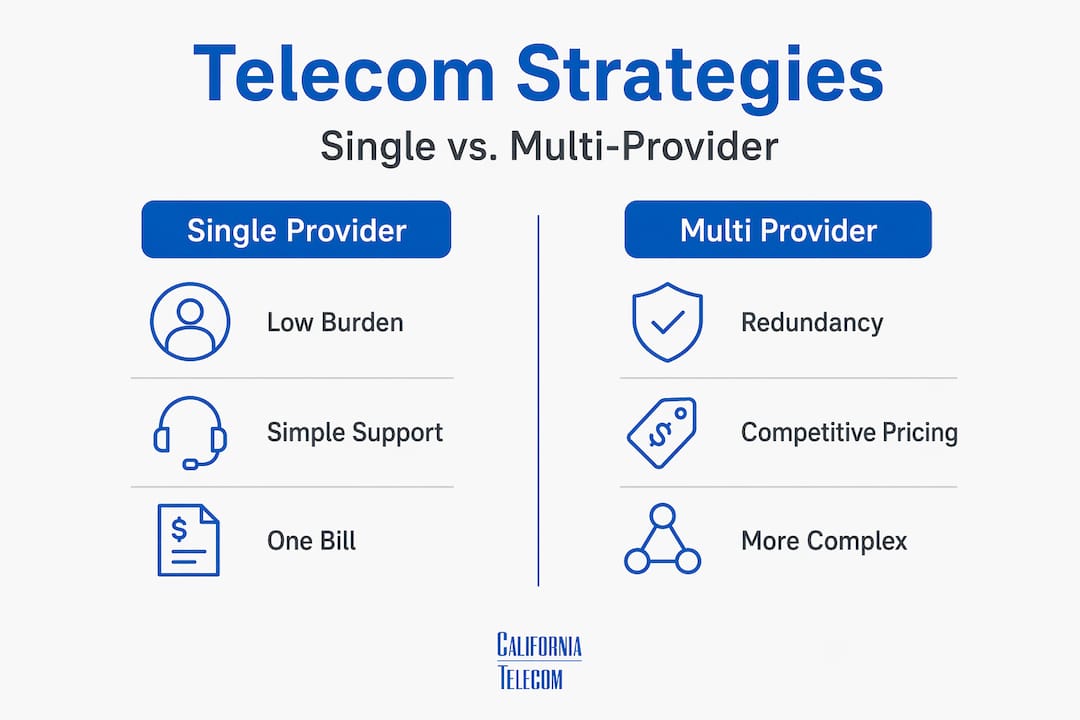
Choosing between a single-provider model and a deliberate multi-provider strategy is not purely a matter of preference. Each approach carries real tradeoffs that affect cost, control, resilience, and long-term flexibility. The right choice depends on your organization's risk tolerance, internal IT capacity, and geographic footprint.

Forrester notes that it is tempting to stick with a single telecom provider for simplicity, but this convenience can come at a premium. That premium is real and worth quantifying before you sign. However, the total cost of ownership calculation must include administrative overhead, not just service line pricing.
| Factor | Single provider model | Multi-provider model |
|---|---|---|
| Administrative burden | Low: one contract, one bill, one contact | High: multiple contracts, bills, escalation paths |
| Accountability clarity | High: one owner for all incidents | Low: vendors point fingers during outages |
| Pricing competitiveness | Moderate: leverage through volume, but limited bidding | High: best-of-breed pricing per service |
| Technical resilience | Risk if not architected carefully | Higher natural diversity if providers use separate infrastructure |
| Upgrade coordination | Streamlined through one vendor | Complex: requires cross-vendor project management |
| Vendor lock-in risk | Higher without exit planning | Lower: easier to swap individual services |
| Internal IT capacity needed | Lower: vendor handles coordination | Higher: your team absorbs the integration burden |
The vendor lock-in risk deserves direct attention. Going all-in on one vendor can create a single point of failure and increase vendor lock-in risk. Resilience strategies often recommend distribution and redundancy planning instead of assuming the single provider is always sufficient. This is not an argument against consolidation. It is an argument for architecting consolidation correctly.
There are also considerations specific to California's geography worth flagging. A state with seismic activity, wildfire risk, and significant regional variation in carrier infrastructure means that physical network diversity is not a luxury. A provider whose footprint in Southern California relies on a single backbone path can expose your entire operation to a localized event that would otherwise be contained.
When evaluating the SD-WAN vs. MPLS question alongside provider strategy, the key insight is that SD-WAN's ability to bond multiple underlying transports makes it a natural complement to consolidation. You can have one provider managing your SD-WAN overlay while engineering in transport diversity underneath, giving you the administrative simplicity of a single relationship without sacrificing redundancy.
Understanding business connectivity transformation and what modern network architectures actually deliver is essential before finalizing your provider strategy. IT leaders who treat this as a purely commercial decision without understanding the technical architecture often end up with consolidation agreements that look clean on paper but are fragile in practice. Resources on choosing network service providers can help you build the right evaluation criteria before you negotiate.
Avoiding single points of failure: Building resilience with technical diversity
Operational consolidation and technical resilience are not the same thing, and confusing the two is one of the most common mistakes IT leaders make during vendor simplification projects. You can work with one provider and still have a network that is genuinely resilient. You can also work with multiple providers and still have a single point of failure if they all share the same physical infrastructure.

Even if you choose a single commercial provider, you may still need technical diversity, including carrier diversity, redundant circuits, and wireless failover, to avoid single-point-of-failure outcomes. The operational benefits of consolidation do not automatically translate into physical or network resilience.
Here is a practical framework for building resilience within a consolidated model:
| Resilience strategy | What it does | Implementation consideration |
|---|---|---|
| Carrier diversity | Uses circuits from different underlying carriers | Confirm your provider sources from multiple carriers, not just resells one |
| Redundant circuits | Maintains active-active or active-passive links per site | Requires SD-WAN to manage failover intelligently |
| Wireless failover (LTE/5G) | Provides out-of-band path when wired links fail | Critical for locations in wildfire or seismic risk zones in California |
| Physical path separation | Ensures primary and backup circuits enter the building on different conduits | Often overlooked in planning; critical for true redundancy |
| Geographic route diversity | Routes backbone traffic across geographically separate paths | Important for California's long north-south corridor |
Pro Tip: When reviewing a provider's resilience architecture, ask specifically whether their primary and backup circuits enter each site on physically separate paths. Many providers count a primary fiber and a backup fiber that share the same conduit as "redundancy." A cable cut eliminates both simultaneously. True resilience requires physical separation from the last-mile entry point backward.
Wireless failover via LTE or 5G deserves special emphasis for California-based operations. Given the state's documented exposure to wildfire-related infrastructure damage, having a cellular backup path that activates automatically when the primary circuit fails can mean the difference between a branch location continuing to operate or going completely dark during a regional emergency. This is not a corner case. It is a genuine operational risk that continuity planning must address.
Real-world continuity planning also means testing failover regularly, not just designing it. A failover path that has never been exercised under load is an unknown quantity when you actually need it. Quarterly failover tests, verified by your provider's NOC with documentation, should be part of any consolidation agreement you sign.
The uncomfortable truth about telecom consolidation
Here is what most telecom guides avoid saying directly: consolidation solves an organizational problem, not an engineering problem. When businesses consolidate under a single provider, they fix the administrative chaos, the accountability gap, and the overhead of managing multiple relationships. Those are real wins that deserve credit. But they do not automatically fix the underlying network architecture.
We have seen California IT organizations celebrate a consolidation agreement as a finished project, only to discover six months later that they traded vendor complexity for architectural fragility. Their provider relationship is clean, but their network still has single paths, shared infrastructure, and no tested failover. The org chart got simpler. The network did not get more resilient.
The honest version of consolidation advice is this: treat the provider relationship and the network architecture as two separate dimensions of your strategy. Optimize them independently, then align them. Choose a provider who can support carrier diversity, redundant circuits, and modern overlay architectures like SD-WAN. Do not assume that because your provider relationship is consolidated, your network risk is managed.
California's geography makes this doubly important. The state's infrastructure, from the dense urban cores of Los Angeles and San Francisco to the agricultural corridors of the Central Valley, faces a combination of physical risks that most other states do not. Your network design has to account for that. Real-world business network case studies from organizations operating in similar environments are worth studying closely before finalizing your own architecture.
The other truth worth naming: not every business is ready for full consolidation on day one. A phased approach, consolidating voice first, then data, then security, often reduces risk and allows your team to build confidence in the provider relationship before committing the entire network. Consolidation is a strategy, not an event.
Streamline and strengthen your business network with California Telecom
Running a multi-location network should not mean managing a dozen vendor relationships, reconciling five different bills, and hoping your providers cooperate during an outage.California Telecom delivers the operational clarity of single-provider consolidation without sacrificing the technical resilience your business depends on. We source from 50+ carriers, design and deploy every site through our own engineers, and back every service with a 24/7 U.S.-based NOC, a 99.99% uptime SLA on data, and 99.999% on voice. Whether you need managed LAN/WAN solutions for a handful of California sites or nationwide managed network services across a distributed enterprise, we bring it all under one agreement, one bill, and one engineer's number. See how we have done it for businesses like yours in our business network case studies.
Frequently asked questions
What is the main reason businesses switch to a single telecom provider?
Most businesses consolidate to a single provider to reduce administrative friction, streamline support, and gain clearer accountability. As noted in consolidation research, fewer vendors means easier coordination for incidents and upgrades with one place to start.
Are there risks in using only one telecom provider?
Yes. Going all-in on one vendor can create a single point of failure and result in vendor lock-in unless technical redundancy strategies like carrier diversity, redundant circuits, and wireless failover are implemented deliberately.
Does consolidating providers reduce telecom costs?
Consolidation typically lowers administrative costs but may come at a premium on individual service lines. Businesses should evaluate total cost of ownership, including staff hours and incident management overhead, not just line-item pricing.
Can modern network solutions like SD-WAN help with provider consolidation?
Yes. SD-WAN and SASE architectures help optimize telecom setups by abstracting transport, enabling intelligent failover, and integrating security into the network fabric, which supports streamlined operations without sacrificing technical flexibility.