

What is business-grade broadband for multi-location ITMost IT managers running distributed networks have learned this the hard way: not all business internet is the same. What is business-grade broadband, and why does that distinction matter so much when you have 20, 50, or 200 locations depending on a stable connection? The answer goes well beyond speed tiers on a pricing sheet. A single location losing connectivity for four hours costs the average enterprise $9,000 per minute in productivity and transaction losses, and that risk compounds across every site in your network. This guide breaks down exactly what separates business-grade broadband from everything else, what the technical benchmarks look like, and how to apply that knowledge to your procurement decisions.
Table of Contents
- Understanding business-grade broadband and how it differs
- Key technical benchmarks and service guarantees of business-grade broadband
- How business-grade broadband supports multi-location businesses' complex network needs
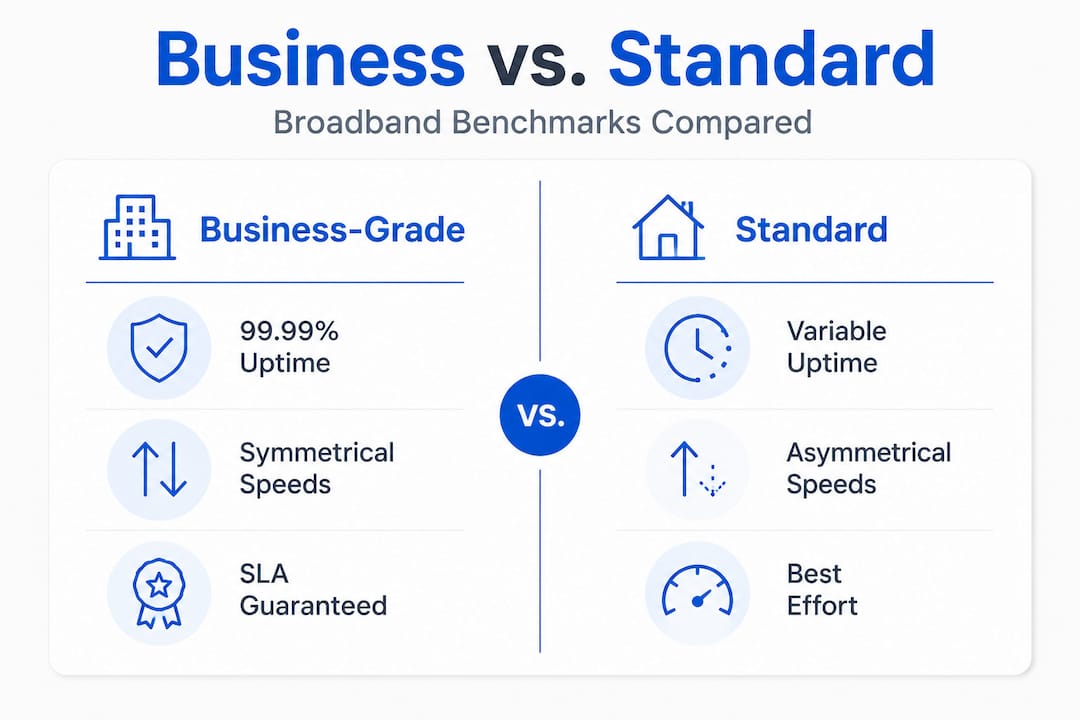
- Comparing business-grade broadband to residential and standard business internet
- Best practices for choosing and managing business-grade broadband for multi-location IT managers
- Why many businesses underestimate the importance of truly enterprise-grade broadband
- Explore business-grade broadband solutions for your multi-location network
- Frequently asked questions
Key Takeaways
| Point | Details |
|---|---|
| Definition | Business-grade broadband is a reliable, high-performance internet service designed for commercial operations with strict performance guarantees. |
| SLA importance | Service Level Agreements ensure accountability with uptime, repair, and performance guarantees crucial for multi-location businesses. |
| Redundancy | Combining independent connections like fiber, 5G, and satellite prevents outages and keeps multi-site networks online. |
| Comparison | Business-grade broadband offers faster repairs and better support than residential or standard business internet, minimizing downtime. |
| Management tips | IT managers should negotiate SLAs carefully and verify end-to-end coverage to protect their network investments. |
Understanding business-grade broadband and how it differs
The business broadband definition most providers use centers on a simple idea: internet service built to commercial performance standards, backed by contractual guarantees, and supported with resources residential lines never see. That sounds straightforward, but the gap between "business internet" marketed to a small office and a true business-grade connection engineered for an enterprise is enormous.
The core technical differences come down to four areas:
- Symmetrical speeds: Residential plans deliver fast download but throttled upload. Business-grade broadband provides equal upload and download speeds, which matters immediately when your locations are pushing VoIP traffic, syncing large files to cloud storage, or running video conferencing across every site simultaneously.
- Uptime architecture: Business connections are built on redundant infrastructure at the carrier level, not the same shared lines a neighborhood ISP routes through a single node.
- Dedicated or prioritized bandwidth: Consumer broadband is contended, meaning you share capacity with nearby users. Business-grade service either dedicates bandwidth to your circuit or guarantees it through traffic prioritization.
- Service Level Agreements (SLAs): This is the most overlooked difference. An SLA is a legal contract specifying minimum performance standards and what the provider owes you when they miss them.
As service stability and uptime define business-grade internet, a connection that looks fast on paper becomes a liability the moment it dips during peak hours. That instability, not raw speed, is what breaks multi-site operations. One location going down mid-shift disrupts your staff, your customers, and any application running on a centralized data path.
Understanding how does business broadband work in practice means recognizing that the "grade" in business-grade is not a marketing word. It describes infrastructure investment, carrier-level redundancy, and contractual accountability that standard residential or entry-level business plans simply do not include.
Key technical benchmarks and service guarantees of business-grade broadband
With a clear definition established, the next question is what specific numbers you should hold providers to. The features of business-grade broadband are not just qualitative. They are measurable, and you should be measuring them before you sign anything.
Enterprise-grade SLAs typically include dedicated fiber with symmetrical multi-gigabit speeds, guaranteed latency under 50ms, packet loss below 0.1%, and a mean time to repair (MTTR) of four hours, compared to 24 to 72 hours for standard broadband. Here is how those components break down across service tiers:
| SLA tier | Uptime guarantee | Annual downtime allowed | MTTR | Latency target |
|---|---|---|---|---|
| Entry business | 99.5% | ~44 hours | 24 hours | Under 100ms |
| Mid-tier business | 99.9% | ~8.7 hours | 8 hours | Under 75ms |
| Business-grade | 99.99% | ~52 minutes | 4 hours | Under 50ms |
| Enterprise dedicated | 99.999% | ~5 minutes | 2 hours | Under 20ms |
A fix time guarantee specifies the maximum time from fault report to service restoration, and it triggers service credits if the provider misses it. That credit clause is the enforcement mechanism, and without it, your SLA is just a document.
Beyond uptime and MTTR, these metrics belong in every SLA review:
- Packet loss: Anything above 1% degrades VoIP call quality noticeably. Above 3%, video conferencing becomes unreliable. Business-grade targets stay at or below 0.1%.
- Jitter: Variation in packet delivery time. Kept below 30ms for voice and real-time applications.
- Burst capacity: Whether your contract allows temporary speed bursts above your committed rate during traffic peaks.
- Proactive monitoring: Does the provider notify you of a fault before you call them? True business-grade service includes monitoring that triggers a ticket without you having to report it.
Pro Tip: Request the provider's historical uptime data for the specific circuit type and geographic area you are buying into, not their national average. A 99.99% national claim can mask a region where one carrier's last-mile infrastructure is aging and underperforming.
When evaluating a dedicated fiber vs broadband comparison, the SLA is often where the real difference lives. Speed numbers look similar on a spec sheet. The contract terms reveal which service will actually perform under pressure.
How business-grade broadband supports multi-location businesses' complex network needs
Multi-site operations face a category of network risk that single-location businesses never encounter. When any one site loses connectivity, it affects not just local productivity but potentially the entire network if that site hosts shared resources or connects to a hub. Business internet speed requirements at the individual site level matter less than the end-to-end architecture connecting all your sites.
Redundancy is the operating principle here. For most multi-location businesses, the right model layers connectivity types:
- Primary fiber: Provides high-capacity, low-latency main connectivity at each site
- Secondary connection: A separate carrier or technology type, such as cable broadband or fixed wireless, that activates automatically on primary failure
- Out-of-band backup: LTE or 5G cellular for emergency management access when both primary paths fail
Local outages drive roughly 80% of network issues for multi-location businesses, which makes last-mile coverage verification a mandatory step in any site deployment. Your carrier's backbone may be rock solid. If the physical line from the street to your building is a single copper pair maintained by a local utility, that last 500 feet is your actual vulnerability.
Some providers are addressing the redundancy challenge directly at the product level. T-Mobile's SuperBroadband combines 5G and Starlink to deliver a financially backed 99.99% uptime guarantee with built-in redundancy, which makes it a credible backup layer for sites where fiber installation is cost-prohibitive or physically constrained.
Practical redundancy planning for distributed networks also involves these factors:
- Diverse physical paths: Two fiber runs from the same carrier entering your building at the same conduit are not redundant. A backhoe outage takes both down simultaneously.
- Failover equipment: Software-defined WAN (SD-WAN) routers that detect primary path failure and cut over to backup in under a second, without manual intervention.
- Environmental risk at each site: Some locations face higher weather-related or infrastructure-related risk. A distribution center in a flood-prone area needs a different backup strategy than a suburban office park location.
Pro Tip: When reviewing wireless broadband backup options for your sites, always test signal strength with actual carrier equipment at the physical location before finalizing the contract. Coverage maps overstate real-world performance regularly, especially inside metal-roofed warehouses or facilities with thick concrete construction.
Comparing business-grade broadband to residential and standard business internet
The business broadband vs residential conversation often gets oversimplified. Many IT managers already know residential service is not an option. The real decision point is between standard business plans and genuinely business-grade connectivity, and that distinction carries serious financial consequences.

Quantum Fiber business internet offers 99.9% reliability, which translates to less than nine hours of downtime per year. That sounds acceptable until you apply it to a 50-location network where any single site going down affects regional operations. Standard broadband repair times of 24 to 72 hours contrast sharply with the four-hour response standard in business-grade service, which is the number that determines how long your staff sits idle.
| Feature | Residential | Standard business | Business-grade |
|---|---|---|---|
| Speeds | Asymmetric, shared | Asymmetric or light symmetric | Full symmetric, dedicated |
| Uptime SLA | None | 99.5% to 99.9% | 99.99% to 99.999% |
| Repair time | Best effort (days) | 24 to 72 hours | 2 to 4 hours |
| Support | Consumer queue | Business hours priority | 24/7 dedicated NOC |
| Packet loss guarantee | None | Rarely specified | 0.1% or below |
| Service credits | None | Limited | Contractual and enforceable |
The operational risks of running critical multi-site infrastructure on non-business-grade internet include:
- Compounding downtime exposure: One underperforming site can cascade into application timeouts across all locations sharing the same WAN.
- Support lag: Consumer and standard business support queues prioritize volume, not severity. A downed site may wait hours before a technician is even dispatched.
- No performance accountability: Without SLA penalties, providers have no financial incentive to resolve your outage faster than their standard queue allows.
- Compliance risk: Healthcare, financial services, and retail businesses with regulatory uptime requirements cannot rely on best-effort service to meet those standards.
The advantages of business-grade broadband are not theoretical. They show up in the real-world experience of a site staying operational during a regional carrier event because failover activated in under a second, or a technician arriving on-site within the SLA window because the contract enforced it.
Best practices for choosing and managing business-grade broadband for multi-location IT managers
Choosing the right types of business broadband plans is one part of the challenge. Managing those contracts actively over their life is where most IT organizations fall short. Here is what a disciplined approach looks like.
Before you sign:
- Require full SLA documentation, not a marketing summary. Read the exclusion clauses. Many SLAs carve out scheduled maintenance windows and brief outages under a threshold, which can eliminate the credits you thought you were earning.
- Ask for three years of historical outage data specific to the circuit type and geographic region. Providers who hesitate to share this are telling you something.
- Confirm last-mile coverage is included in the SLA. A backbone guarantee that stops at the provider's edge router does not protect your site.
Contract terms to negotiate:
SLAs that exclude brief dropouts or scheduled maintenance are common. Negotiating partial degradation clauses that address bandwidth drops and packet loss spikes, not just complete outages, gives you a more realistic and enforceable uptime commitment. Most IT managers accept the first draft without pushing back on these exclusions.
Priority 24/7 support with a four-hour repair response is standard in genuine business-grade contracts. If a provider will not put that in writing with credit provisions, their verbal assurance is worth nothing during an outage.
Active management after deployment:
- Monitor your own circuits independently. Do not rely solely on provider-reported uptime. Tools that measure latency, jitter, and packet loss continuously give you the data to validate or dispute SLA calculations.
- Request outage post-mortems after every significant event. Understanding root cause helps you identify whether a redundancy gap exists and whether the provider is investing in infrastructure in your region.
- Revisit contracts annually. Business internet speed requirements change as you add applications, users, and sites. Your 2023 bandwidth commitment may be a bottleneck by 2026.
Pro Tip: Build a simple internal scorecard tracking each site's actual uptime, repair response times, and support ticket resolution quality against contracted SLA terms. That data becomes your negotiating leverage at renewal, and it often reveals which sites need upgraded service before they cause a major incident.
Why many businesses underestimate the importance of truly enterprise-grade broadband
Here is what we have observed working with multi-location businesses across every industry: the organizations that have the worst connectivity experiences are rarely using the cheapest service. They are using mid-tier business plans they genuinely believed were business-grade, managed by IT teams who signed SLAs they did not fully read, from providers who structured those agreements to protect themselves rather than the customer.
The gap between an SLA that says 99.99% and an SLA that delivers 99.99% is enormous in practice. Businesses sign SLAs without fully understanding exclusion conditions, never negotiate for better terms, and rarely claim the service credits they are entitled to when outages occur. That pattern makes the SLA effectively meaningless as an accountability tool.
The harder truth is that redundancy planning on paper is not the same as redundancy that works under pressure. We have seen organizations that bought primary fiber and a secondary cable broadband backup, felt protected, and then discovered during an actual outage that their SD-WAN equipment was not configured to cut over automatically. Their backup existed. It just never activated.
What genuinely enterprise-grade connectivity requires is not just a product set. It requires a management layer that treats the network as a living system: monitoring it, responding to early warning signals, and adapting as the business adds locations or changes application workloads. That is the philosophy behind everything we publish in our business internet insights, and it is why we design each deployment rather than provision it from a template.
The best business broadband providers do not just sell circuits. They take responsibility for network outcomes, and that is a meaningful distinction when you are managing dozens of sites and cannot afford for any of them to go dark.
Explore business-grade broadband solutions for your multi-location network
If this guide clarified what your current connectivity may be missing, the next step is straightforward.California Telecom designs and deploys business-grade broadband for multi-location businesses nationwide, sourcing from 50+ carriers to match the right connection type to every site in your network. Our business fiber plans come backed by a 99.99% uptime SLA on data and a 24/7 U.S.-based NOC that monitors every circuit proactively. Our managed network services handle the operational complexity of a distributed network so your team focuses on the business instead of the infrastructure. Whether you are standardizing connectivity across 10 locations or building a network architecture for 200 sites, our engineers design it end-to-end. Explore our nationwide network solutions or request a free consultation to see what a truly business-grade network looks like for your specific footprint.
Frequently asked questions
What distinguishes business-grade broadband from standard internet service?
Business-grade broadband delivers guaranteed uptime, symmetrical speeds, priority 24/7 support, and a contractual four-hour repair response, none of which standard residential or entry-level business internet provides. The difference is accountability, not just speed.
Why is a Service Level Agreement (SLA) critical for multi-location businesses?
A well-structured SLA defines fix times, performance metrics, and financial penalties for missed standards, which transforms a provider relationship from informal to contractually accountable. For multi-site operations, that accountability is the difference between a four-hour repair and a two-day outage.
How does business-grade broadband ensure network redundancy?
It layers independent connectivity technologies, typically fiber as a primary with 5G or satellite as backup, so that a single path failure does not take a location offline. 5G and Starlink combined can deliver a financially backed 99.99% uptime guarantee when configured as a redundant system.
What should IT managers look for when negotiating broadband SLAs?
Push for explicit uptime and MTTR commitments, partial degradation clauses covering bandwidth drops and packet loss (not just complete outages), end-to-end last-mile coverage, and enforceable credit provisions. Do not accept the first draft as final.