

Why California broadband infrastructure matters for multi-location enterprisesNew fiber is being laid across California at a pace the state hasn't seen in decades, and the assumption that your enterprise will simply benefit by proximity is one of the most expensive mistakes a network manager can make. The real advantages of California's broadband expansion depend entirely on your ability to map infrastructure timelines to your own procurement cycles, layer in redundancy before you need it, and hold carriers to measurable service-level agreements. For mid-market and enterprise organizations running five, fifty, or five hundred sites, the gap between "fiber nearby" and "fiber delivering value" is where most operational risk hides.
Table of Contents
- How California's broadband infrastructure is transforming access for enterprises
- The backbone and the bottleneck: Navigating middle-mile versus last-mile
- Redundancy, risk, and rollout: Building resilient enterprise networks
- Procurement strategy: What broadband investments can—and can't—guarantee
- Why the true value of broadband infrastructure is unlocked only by strategic execution
- How California Telecom helps enterprises maximize broadband investments
- Frequently asked questions
Key Takeaways
| Point | Details |
|---|---|
| Backbone vs. last-mile clarity | Understanding the distinction helps enterprises align connectivity strategies and investment decisions. |
| Resilient rollouts matter | Enterprises should plan for phased migration, redundancy, and multi-provider strategies to ensure business continuity. |
| Infrastructure is leverage, not a guarantee | Treat new network investments as opportunities to negotiate better contracts—but validate real-world availability before committing. |
| Strategic execution required | Active planning and continuous optimization—not passive adoption—deliver the full value of broadband upgrades. |
How California's broadband infrastructure is transforming access for enterprises
California's broadband push is not a single project. It is a layered buildout spanning state-funded backbone networks, federal grant programs, and regional last-mile deployments. The state's Middle Mile Broadband Initiative (MMBI), authorized under SB 108, is constructing roughly 10,000 miles of open-access fiber across the state, with a specific mandate to serve unserved and underserved communities. For enterprises, that distinction matters. Open-access middle-mile fiber means that multiple service providers can ride the same backbone, which is what drives competition and, eventually, lower prices.

What is middle-mile infrastructure? Think of it as the highway system. It connects population centers, data hubs, and regional exchange points. It does not run to your office door. That final stretch, from the nearest carrier point of presence to your specific location, is the last-mile. For most large enterprises, last-mile is where both the cost and the complexity live.
The operational benefits of expanded infrastructure for multi-location businesses are concrete and measurable:
- Increased capacity: More backbone routes mean providers can offer higher-speed tiers at locations previously capped by congested links.
- Provider competition: Open-access infrastructure allows more carriers to serve the same geography, which gives your procurement team negotiating leverage it didn't have before.
- Resilience and redundancy: Additional routes create natural failover paths for backup circuits, a priority for any enterprise running critical applications across sites.
- Affordability at hard-to-reach sites: Infrastructure matters because it lowers barriers to serving remote and high-cost locations, directly supporting operational resilience through redundancy and improved pricing.
| Connectivity condition | Pre-infrastructure expansion | Post-infrastructure expansion |
|---|---|---|
| Provider options at rural sites | 1 to 2 incumbents | 3 to 5+ via open-access |
| Average bandwidth ceiling | 100 to 300 Mbps | 1 Gbps+ symmetrical |
| Redundant path availability | Limited or none | Multiple route options |
| Contract leverage for enterprise | Low | Moderate to high |
| Monthly cost per site (remote) | High, often fixed | Declining with competition |
The scale of this shift is significant. California's open-access middle-mile network, once fully operational, is designed to pass through and connect hundreds of communities that currently have enterprise broadband options limited to a single provider with no competitive pressure. For a distributed enterprise, that changes the math on total connectivity spend considerably.
The backbone and the bottleneck: Navigating middle-mile versus last-mile
The phrase "middle-mile" appears in press releases and policy documents constantly, but understanding what it means for your specific site-by-site strategy is what separates well-run enterprises from reactive ones. Here is a clean way to think about it: middle-mile is the interstate, and last-mile is the local road from the highway exit to your building. The state is widening the interstate. Whether your exit ramp gets repaved depends on a completely different set of decisions, budgets, and contractors.
Middle-mile attributes:
- Owned by state entities or large carriers
- Open-access design means multiple ISPs can use it
- Upgraded on a large-scale, multi-year schedule
- Reduces wholesale transport costs over time
- Bottleneck is capacity and route availability
Last-mile attributes:
- Owned by local carriers, cable companies, or CLECs
- Often a single-provider monopoly in rural areas
- Upgraded through grants, private investment, or regulatory pressure
- Directly affects your quoted price and service tier
- Bottleneck is physical infrastructure and carrier willingness to invest
Understanding where the backbone capacity is being opened helps enterprises align procurement with the markets where competition is developing fastest. That is where you have leverage.
For multi-location enterprises executing a network refresh or expansion, here is a structured approach:
- Map backbone coverage by site. Cross-reference each location against the MMBI route maps and known carrier points of presence. Sites that sit near new open-access fiber are your best procurement opportunities in the next 12 to 24 months.
- Identify last-mile project overlap. Research which last-mile grant projects, including CASF and BEAD-funded builds, are targeting the same geographies. This tells you when competitive last-mile options are likely to arrive.
- Sequence procurement steps accordingly. Lock in short-term contracts or month-to-month terms at sites where new competition is imminent. Sign longer terms at stable, well-served urban locations where pricing has already matured.
- Negotiate with open-access access in mind. Use the presence of nearby backbone infrastructure as a credible threat in carrier negotiations. If a provider knows you can switch when the next last-mile build completes, they price more competitively today.
For enterprises exploring business fiber connectivity or dedicated fiber at specific sites, this framework applies directly to your contract review cycle.
Pro Tip: Factor in which open-access middle-mile segments are going live soonest when you sit down to renegotiate contracts at your hardest-to-reach sites. Even the prospect of increased competition shifts the negotiating dynamic in your favor before a single new provider shows up.
This also matters for specialized verticals. Organizations managing networking for property managers with tenants across multiple commercial sites need to evaluate each building's last-mile status independently, even when backbone coverage looks promising on a map.
Redundancy, risk, and rollout: Building resilient enterprise networks
Here is where the operational reality gets uncomfortable. Even well-funded infrastructure programs face delays. Permitting alone can push a middle-mile segment's in-service date by six to eighteen months. Environmental reviews, easement negotiations, local utility coordination, and seasonal construction windows all create variance. When the backbone is delayed, the downstream last-mile builds waiting on that capacity also slip.

Permitting timelines can slip even when capacity is planned at the backbone level, which is why enterprise rollouts must account for timeline risk, not just technical specifications. The enterprises that have fared best through California's infrastructure transition are those that built a rollout plan assuming delays, not promising deadlines.
Practical strategies for a resilient rollout include:
- Phased migration: Move one site at a time. Validate performance before decommissioning legacy circuits. This limits blast radius if a new service underdelivers.
- Backup circuit requirements: Every critical site needs a secondary path on a different physical medium (fiber plus LTE, or two fiber providers using separate routes). This is non-negotiable for sites running real-time voice, POS systems, or cloud-dependent operations.
- Multi-provider redundancy: Avoid single-carrier dependencies across your entire portfolio. Even if one carrier is your primary everywhere, diversify the secondary circuits by carrier and technology type.
- Strict SLA tracking: An SLA without enforcement is marketing copy. Build escalation procedures, credit claim processes, and quarterly review cadences into your vendor agreements from day one.
- Fallback plans at every site: Document what happens if a new circuit fails to meet performance thresholds after cutover. This means keeping legacy circuits active longer than the optimistic project plan suggests.
Even the most robust new infrastructure is only as reliable as its weakest last-mile link. Planning around your best-case scenario is how outages become incidents instead of recoveries.
Pro Tip: Don't sunset your secondary connection until you've run live-site testing for at least a full quarter post-migration. Real-world traffic patterns, peak usage loads, and failover behavior often reveal issues that lab testing and initial cutover never expose.
For enterprises operating in major California markets, local conditions matter as much as state-level infrastructure progress. Businesses running connectivity in Los Angeles face a different set of last-mile variables than those managing Orange County solutions, where provider density and construction timelines differ significantly. Reviewing real-world enterprise case studies from comparable deployments gives your planning team a realistic baseline.
Procurement strategy: What broadband investments can—and can't—guarantee
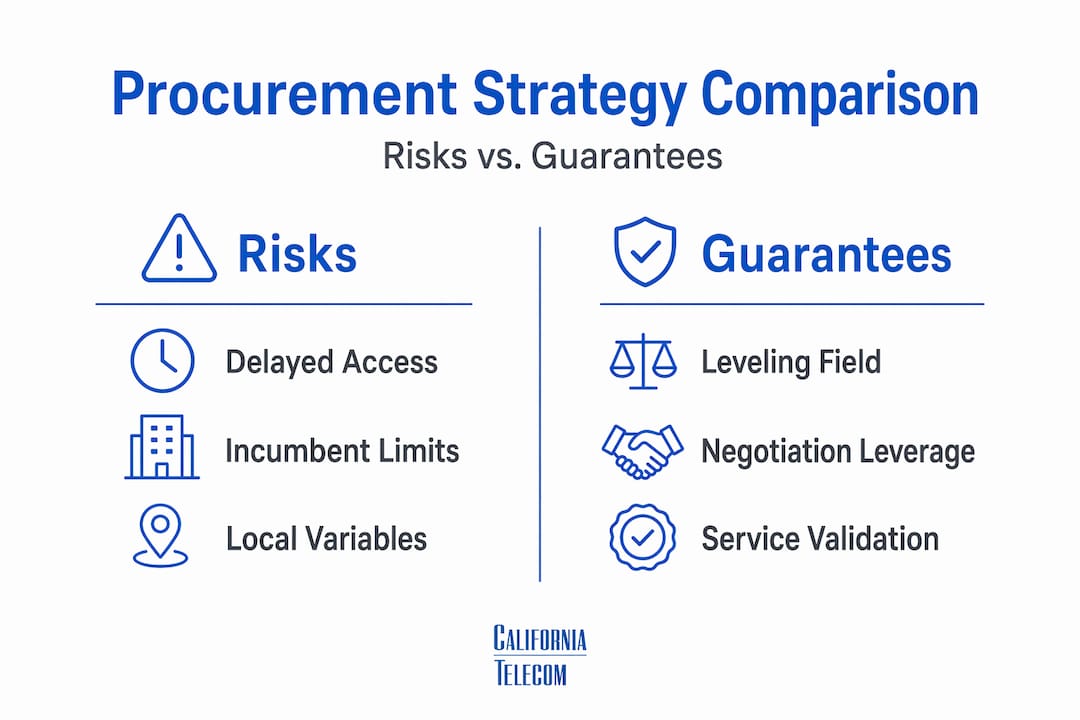
Infrastructure investment is a leading indicator, not a delivery promise. This distinction is critical for anyone making budget commitments or signing multi-year contracts based on where fiber is being built. The MMBI business plan is clear that enterprises may still depend on incumbents and on-the-ground last-mile availability, which means procurement strategy must account for the gap between infrastructure presence and service availability.
What broadband infrastructure investment provides:
- Increased backbone capacity that reduces wholesale transport costs over time
- Greater potential for provider competition, especially in historically underserved areas
- New negotiating leverage for multi-site enterprises in markets gaining open-access access
- A pathway to higher-speed tiers that were previously unavailable or cost-prohibitive
What it does not guarantee:
- Immediate last-mile availability at your specific address
- Price reductions from incumbent carriers who still hold your current contract
- Service-level guarantees on new builds before they have operating history
- Elimination of single-provider situations in rural or remote locations
Regulatory-driven network builds do level the playing field over time, but incumbent carrier contracts don't unwind overnight. A carrier with an existing five-year agreement has no contractual obligation to renegotiate because new fiber passed through the county. Your leverage exists at renewal, during competitive bids, and when you can credibly demonstrate that alternative providers are qualifying to serve your sites.
Keeping current on broadband industry insights is one practical way to stay ahead of which markets are seeing genuine new competition versus which ones are still years away from meaningful last-mile alternatives.
Pro Tip: Use infrastructure presence as negotiation leverage, but always validate service-level guarantees before committing. Ask any new provider for a reference customer with a similar site profile and comparable SLA terms. A provider who can't produce one hasn't yet proven they can perform at your scale.
For enterprises in Southern California, understanding the local competitive landscape in markets like San Diego business internet is essential before signing commitments that assume a specific competitive environment.
Why the true value of broadband infrastructure is unlocked only by strategic execution
Conventional wisdom says more fiber automatically means better connectivity. After working with California enterprises through multiple buildout cycles, we know that belief is where the most avoidable network failures start. The infrastructure is the foundation. It is not the building.
Enterprises that have successfully capitalized on California's broadband expansion share a specific set of behaviors. They mapped their sites against infrastructure timelines before procurement, not after. They maintained redundancy through every transition phase, even when the project plan said the new circuit was "stable." They held carriers to SLAs with actual remedies, not just aspirational language buried in a service agreement. And they treated every "go-live" announcement as the beginning of an operations phase, not the end of a project phase.
The enterprises that struggled took infrastructure announcements at face value. They assumed that because fiber was being built in their region, their sites would benefit automatically and on schedule. When permitting delays pushed timelines by nine months, they had already cut legacy circuits they could no longer recover. When new carriers entered the market but couldn't meet enterprise SLA requirements in the first year of operations, they had no fallback.
The honest insight is this: broadband infrastructure creates opportunity. Your planning, procurement discipline, and operational execution are what convert that opportunity into measurable business outcomes. Every success story in action we have seen from California enterprises comes back to the same principle: treat infrastructure as a foundation you build on, not a shortcut that does the work for you.
How California Telecom helps enterprises maximize broadband investments
Knowing the landscape is one thing. Having an experienced partner who can design, deploy, and manage your network across every site is what turns infrastructure opportunity into operational reality.California Telecom works with multi-location enterprises across California and nationwide to design network architectures that take full advantage of new broadband infrastructure without creating dependency on any single carrier or timeline. We source from managed network services across 50+ carriers, deploy each site through our own engineers, and back every service with a 24/7 U.S.-based NOC. Our SD-WAN for multi-location enterprises solutions build in the redundancy, failover logic, and SLA discipline that distributed networks demand. Whether you're managing five locations or five hundred, our nationwide enterprise solutions give you one provider, one bill, and one engineer's number to call.
Frequently asked questions
What is the difference between middle-mile and last-mile broadband?
Middle-mile is backbone capacity connecting communities and regional hubs, while last-mile is the access leg running from a local provider to your enterprise location. Most cost and availability issues for businesses sit in the last-mile segment.
How does new broadband infrastructure help with redundancy?
By increasing available network routes, expanded infrastructure lowers the barriers to adding backup circuits and makes it easier to qualify multiple providers at the same location for genuine failover capability.
Are infrastructure upgrades a guarantee of better service?
No. As the MMBI business plan confirms, enterprises may still depend on incumbents and on-the-ground last-mile availability, meaning infrastructure investment creates potential, not certainty.
What procurement strategy reduces risk during broadband rollouts?
Phased migration plans, multi-provider redundancy, and negotiated SLAs with enforcement remedies are the three elements that consistently reduce risk and keep distributed network downtime to a minimum during transitions.