

Internet Exchange Points Explained for IT DirectorsAn Internet Exchange Point (IXP) is a neutral, physical Layer 2 facility where independent networks, each operating as an Autonomous System (AS), connect directly to exchange traffic without routing it through a third-party transit provider. According to the Internet Society, IXPs can reduce latency and improve local access speeds significantly in some regions by creating shorter, direct traffic paths. For IT directors managing multi-location businesses, three outcomes matter most: lower transit spend through settlement-free peering, measurable latency and jitter improvements on regional traffic, and direct routing control to CDNs and local networks. One critical clarification up front: an IXP is infrastructure, not a service. It provides the switching fabric. Your team still owns BGP configuration, peering policies, and traffic engineering.
- Cost reduction: Direct peering eliminates per-Mbps transit fees on locally exchanged traffic.
- Performance: Shorter AS-paths cut round-trip time, jitter, and packet loss on regional flows.
- Routing control: You choose which peers to exchange routes with and how to tag traffic for path preference.
Table of Contents
- What is an internet exchange point, technically speaking?
- Why enterprises connect to IXPs: concrete business outcomes
- When should your enterprise consider connecting to an IXP?
- Operational checklist: what your team owns after connecting
- What does it cost, and how long does it take?
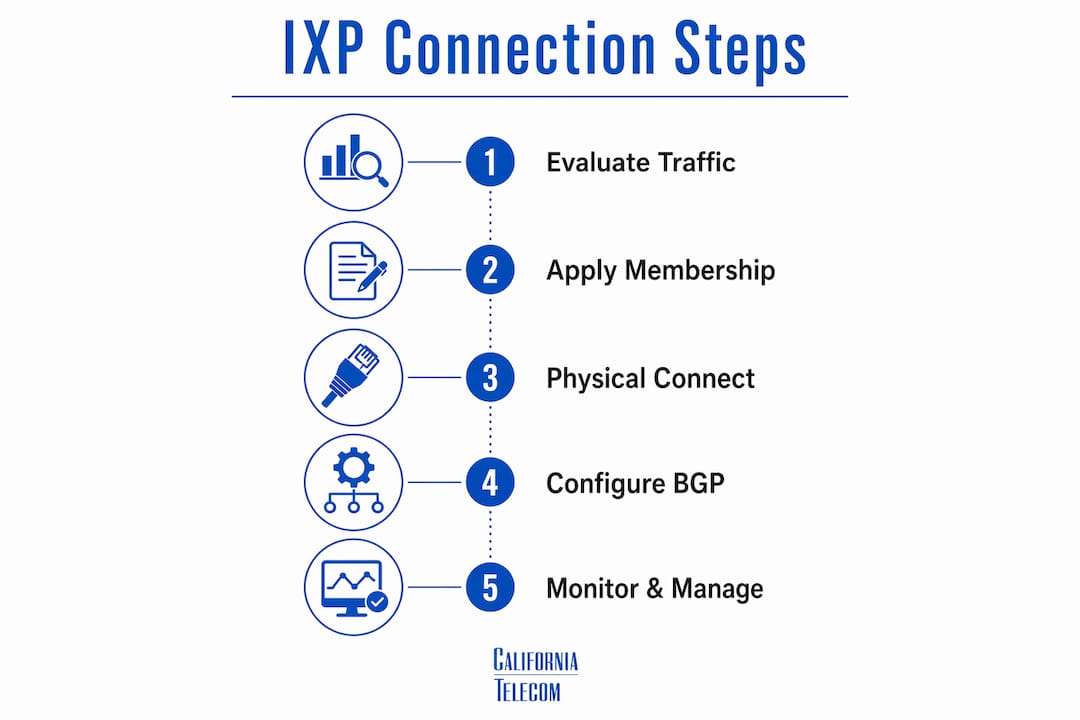
- How to get your enterprise connected, step by step
- A simple ROI example you can adapt
- Key Takeaways
- What operators get wrong about IXP connections
- Californiatelecom connects your multi-site network to IXPs
- Trusted sources for further reading
What is an internet exchange point, technically speaking?
At its core, an IXP is a Layer 2 peering LAN — a high-speed Ethernet switch fabric housed in a carrier-neutral colocation facility. Participants connect a router or switch to that fabric via a physical port and cross-connect. The IXP does not route traffic; it interconnects Autonomous Systems over a neutral LAN. Every routing decision stays with the participant.
Once physically connected, participants run BGP sessions across the peering LAN to announce their IP prefixes. A peer that accepts your prefix announcement can then send traffic destined for your address space directly to your router, bypassing any intermediate transit backbone. The net effect: fewer hops, lower jitter, and less exposure to congestion on shared transit links.
Most IXPs offer a route server, a BGP speaker that aggregates prefix announcements from all participants. Instead of maintaining bilateral BGP sessions with every peer, you establish one session to the route server and receive routes from all participants who opt in. Route servers dramatically reduce session counts at large exchanges with hundreds of members.
Public peering happens on the shared IXP fabric and suits traffic distributed across many peers at individually modest volumes. Private peering uses a dedicated cross-connect between two specific networks, typically justified when bilateral traffic to a single peer is high enough that a shared port becomes a bottleneck. Public peering is done at IXPs; private peering via direct links in carrier hotels or private interconnects.
Pro Tip: Before your first BGP session goes live, request the route server's filtering policy document. Some IXPs apply RPKI-based origin validation; others rely on participant-submitted prefix lists. Knowing which model your IXP uses changes how you configure your own prefix-list policies.
Why enterprises connect to IXPs: concrete business outcomes
The business case for peering rests on one arithmetic fact: transit costs money per Mbps, and direct peering at an IXP can be settlement-free or significantly cheaper. Shifting local traffic off long-haul transit can reduce local transit costs by 20% or more in some markets, depending on how much of your traffic is regional.

Beyond cost, the performance gains are structural. When your traffic no longer "trombs" — traveling hundreds or thousands of miles through an intermediate backbone to reach a destination a few cities away — round-trip times drop and jitter stabilizes. For latency-sensitive applications like VoIP, real-time collaboration, or financial data feeds, that stability has direct operational value. Low-latency connections also matter for latency-sensitive workloads beyond the obvious use cases.
Key measurable outcomes enterprises track after connecting:
- Round-trip time (RTT): Typically drops for regional peers once the AS-path shortens.
- Jitter and packet loss: Improve when traffic avoids congested transit backbones.
- CDN reach: Major content networks participate at most large U.S. IXPs, enabling direct delivery without transit intermediaries.
- Resilience: A peering path provides an alternative route if a transit provider has an outage.
The business case depends heavily on traffic distribution. If the majority of your traffic flows to international destinations or to networks not present at your regional IXP, the savings are smaller. CDN usage is often the fastest win: most large CDNs peer openly at U.S. exchanges.
When should your enterprise consider connecting to an IXP?
Peering is a strategic business decision driven by traffic patterns, not a default upgrade. Before committing to port fees and colocation costs, collect three months of flow data from your edge devices and answer these questions:
- What percentage of your egress traffic is destined for ASes present at a nearby IXP?
- What is your current cost per Mbps of transit, and how does it compare to the annualized port fee?
- Which CDNs account for the largest share of your inbound bytes, and do they peer at the IXP you are evaluating?
For multi-location businesses, regional IXPs offset transit costs for local Internet traffic and improve quality compared to default carrier routing. A useful threshold: if a significant portion of your traffic is destined for networks present at a regional IXP, the math usually favors connecting.
When evaluating a specific IXP, check participant density (more members means more settlement-free peers), neutral governance (nonprofit or operator-neutral structures reduce vendor lock-in risk), route server availability, and physical proximity to your regional hubs. PeeringDB is the standard tool for checking participant lists and peering policies before you commit.
Operational checklist: what your team owns after connecting
The IXP provides the fabric. Everything else is yours. That responsibility split surprises teams that are used to transit, where the provider manages capacity and routing. Unlike transit, peering requires the participant to monitor saturation and plan capacity increases.
Operational checklist before and after go-live:
- Port and cross-connect: Provision the physical port at the IXP and the cross-connect from your colocation cage to the exchange switch.
- BGP sessions: Configure sessions to the route server (multilateral) and any bilateral peers; set TTL security and MD5 authentication where the IXP recommends it.
- Prefix filters: Define inbound and outbound prefix-lists; set max-prefix limits per session to contain route leaks.
- Peering policy: Document which ASes you will peer with openly, selectively, or not at all.
- Monitoring: Track interface utilization, BGP session state, route count per peer, packet loss, latency percentiles, and BGP flap frequency.
Pro Tip: Set capacity alerts at 70% utilization on your IXP port, not 90%. Ordering a port upgrade takes weeks; discovering saturation during a traffic spike is too late.
Risk areas to address explicitly: DDoS response (coordinate a mitigation plan with your IXP operator before an event, not during), failover to transit if a peering session drops, and route-server behavior validation in a staging environment before production cutover.
What does it cost, and how long does it take?
| Cost Component | Type | Notes |
|---|---|---|
| IXP port fee | Recurring | Varies by port speed and exchange; billed monthly or annually |
| Colocation rack/cabinet | Recurring | Space and power in the carrier-neutral facility |
| Cross-connect | One-time + recurring | Physical fiber from your cage to the IXP switch |
| On-ramp router/switch | One-time capex | Hardware capable of BGP and the required port speed |
| Transport to IXP | Recurring | If your edge is not already in the same facility |
| Engineering and NOC | Recurring | Internal or managed; BGP ops, monitoring, incident response |
A realistic timeline for a first U.S. IXP connection runs 8–14 weeks: 2–3 weeks for IXP membership application and approval, 3–5 weeks for colocation provisioning and cross-connect installation, and 2–4 weeks for BGP configuration, testing, and traffic validation. Managed providers compress the middle phase significantly because they already have colo presence and established cross-connects at major exchanges.
The Internet Society notes that IXPs offer a more affordable alternative to sending local traffic over long-haul transit, and the cost advantage compounds as your traffic volume grows.
How to get your enterprise connected, step by step
- Identify target IXPs. Use PeeringDB to find exchanges with the participant mix that matches your top destination ASes. In the U.S., major exchanges operate in Los Angeles, New York, Chicago, Dallas, and Seattle.
- Verify participant and route-server availability. Confirm your top CDN and network peers are present and check the route-server filtering policy.
- Establish physical connectivity. Either place equipment in the IXP's colocation facility or use a managed provider with existing presence. For dedicated fiber on-ramps, consistent access link performance is critical.
- Provision port and cross-connect. Submit the IXP membership application, sign the peering agreement, and coordinate the cross-connect with the colo operator.
- Configure BGP sessions. Set up multilateral peering via the route server first; add bilateral sessions for high-volume peers afterward. Apply prefix-lists and max-prefix limits from day one.
- Monitor and tune. Baseline RTT and jitter before cutover, then compare at 30 and 90 days. Adjust community tagging and routing policies based on observed traffic distribution.
For teams without in-house BGP expertise, a managed provider handles steps 3–6 and provides ongoing NOC coverage. Ask any managed provider: What is your SLA for BGP session restoration? Do you have existing cross-connects at the IXP I am targeting? How do you handle DDoS escalation with the IXP operator?
When traffic to a single peer exceeds the economics of shared port capacity, move that relationship to private peering via a dedicated cross-connect while keeping the IXP port for the broader peer set.
A simple ROI example you can adapt
Assumptions: your enterprise pays $8 per Mbps per month for transit, consumes 500 Mbps of egress, and 40% of that traffic is destined for networks present at a regional IXP.
- Traffic eligible for peering: 200 Mbps
- Current monthly transit cost for that traffic: $1,600
- Estimated IXP port fee + colocation (monthly): $600–$800 (varies by exchange and port speed)
- Monthly savings: roughly $800–$1,000
- Payback on one-time setup costs (cross-connect, hardware, engineering): typically 3–6 months at this traffic level
The two variables that move this calculation most are the percentage of local/CDN-bound traffic and your current transit unit cost. If your transit rate is lower or your local traffic share is under 20%, the payback period extends. If your transit rate is higher or you have a large CDN footprint, savings compound faster. Peering value scales with traffic volume, so the business case strengthens as your network grows.
Key Takeaways
An IXP is a neutral Layer 2 fabric where your AS exchanges traffic directly with peers, cutting transit costs and latency while shifting routing responsibility entirely to your team.
| Point | Details |
|---|---|
| Measure traffic first | Collect 90 days of flow data; if 30–40%+ of egress targets IXP-present networks, the math usually favors connecting. |
| Cost shape | Port fees and colo are recurring; cross-connect and hardware are one-time; savings compound with traffic volume. |
| You own the routing | IXPs provide the fabric only; BGP config, prefix filters, peering policies, and capacity planning are your team's responsibility. |
| Route servers reduce overhead | One BGP session to the route server replaces dozens of bilateral sessions, but validate its filtering policy before production. |
| Californiatelecom as managed path | Californiatelecom handles colo, cross-connect, BGP ops, and 24/7 NOC monitoring for multi-location businesses pursuing IXP access. |
What operators get wrong about IXP connections
Most teams underestimate the operational surface area they are taking on. Signing up for an IXP port feels like buying a service. It is not. You are joining infrastructure, and the moment your BGP sessions go live, you own every routing decision, every capacity call, and every incident response.
The teams that struggle are the ones who treat the route server as a black box. They connect, accept the default routes, and never validate what the route server is actually advertising to them. A misconfigured max-prefix limit or a missing prefix-filter has caused real outages at enterprises that assumed the IXP's route server would protect them from bad routes. It will not.
Start with one regional IXP, instrument everything before you touch production traffic, and resist the urge to peer with every available AS on day one. A narrow, well-monitored peering set beats a broad, poorly understood one every time. The monitoring investment pays back faster than any port upgrade.
Californiatelecom connects your multi-site network to IXPs
Running BGP operations, managing colo cross-connects, and staffing a 24/7 NOC across multiple locations is a significant internal commitment. Californiatelecom handles that operational load for multi-location businesses nationwide, so your team focuses on the business outcomes rather than the infrastructure mechanics.Californiatelecom's managed network services include colo and cross-connect coordination at major U.S. exchanges, BGP and peering operations, real-time AI-powered monitoring through its Vergepoint platform, and multi-carrier SD-WAN integration that keeps your sites connected even when a peering path degrades. One engineer's number. One NOC. A 99.99% uptime SLA on data. For enterprises ready to pursue IXP access without building a dedicated peering team, get a free consultation to map your traffic patterns and identify which U.S. exchanges make sense for your footprint.
Trusted sources for further reading
- Internet Exchange Points — Internet Society: The clearest non-technical overview of IXP purpose, types, and global impact; good for stakeholder briefings.
- IXP Definition — Internet Exchange Federation (IX-F): The authoritative technical definition; use it to settle internal debates about what an IXP is and is not.
- IXP Tutorial — RIPE NCC: Detailed operational tutorial covering Layer 2 fabric, BGP configuration, and peering policy; the best starting point for network architects.
- Internet Exchange Point Overview — Juniper Networks: Vendor-neutral enough for architecture planning; strong on route-server mechanics and BGP session design.
- Five Reasons to Peer — APNIC Blog: Practical operator perspective on monitoring, capacity planning, and the real-world tradeoffs of peering.
- PeeringDB (peeringdb.com): The live database of IXP participants, peering policies, and facility data; check it before committing to any exchange.