

What Is Dedicated Internet Access for Business?If you're running operations across multiple locations and your internet connection still shares bandwidth with dozens of other businesses in your building or neighborhood, you're working with a structural disadvantage. Dedicated internet access, formally known as DIA, is exactly what it sounds like: a connection that belongs entirely to your organization. No contention, no slowdowns at 9 a.m. when everyone logs on, no sharing. For multi-site businesses where cloud applications, VoIP, and real-time data sync are everyday necessities, understanding what dedicated internet access delivers versus what shared broadband quietly costs you is not optional.
Table of Contents
- Key takeaways
- What dedicated internet access actually is
- Dedicated vs. shared internet: understanding the real difference
- Benefits of dedicated internet for multi-site operations
- How to choose a dedicated internet service
- How DIA fits into your overall network architecture
- My honest take on dedicated internet for multi-site businesses
- How Californiatelecom delivers dedicated internet nationwide
- FAQ
Key takeaways
| Point | Details |
|---|---|
| DIA means exclusive bandwidth | Your connection is not shared with other businesses, so performance is consistent at all hours. |
| SLAs back the promise | Vendor contracts include uptime guarantees and repair commitments that protect business continuity. |
| Multi-site operations need it most | Synchronized cloud access and VoIP across locations depend on predictable, low-latency connectivity. |
| DIA differs from cross-connects | A dedicated internet circuit reaches the public internet; a cross-connect stays private within a data center. |
| Managed options reduce IT burden | Many providers offer 24/7 monitoring and support alongside DIA, reducing your internal network overhead. |
What dedicated internet access actually is
Dedicated internet access is a private connection that serves a single customer exclusively. No neighbors, no building tenants, no competing traffic from other businesses. That single fact separates DIA from nearly every other form of commercial internet service you have likely encountered.
Physically, a DIA circuit is a fiber-optic line run directly from your internet service provider's Point of Presence (PoP) to your premises. The fiber terminates in hardware at your location, and that circuit is logically and physically reserved for you. When you purchase 500 Mbps of DIA, you get 500 Mbps symmetrically, meaning equal upload and download speeds, at any time of day.
Here is what many businesses do not realize when they first start comparing options:
- Business broadband is still a shared medium. Providers oversell bandwidth across many customers and rely on statistical probability that not everyone needs peak speed simultaneously.
- Residential internet carries similar contention with fewer business-grade service protections, as explained in this comparison of business vs. residential internet.
- Business-grade broadband offers some prioritization and support tiers, but it still flows through shared infrastructure at the provider level.
- DIA is the only category where the bandwidth figure in your contract is a guaranteed floor, not a theoretical ceiling.
Pro Tip: When evaluating any internet service for business use, ask the provider directly: "Is this an uncontended circuit?" If they hesitate or redirect the conversation to "up to" speed language, you are not looking at true dedicated access.
The symmetrical speed component matters more than most IT teams initially budget for. Cloud backups, video conferencing, and VoIP all generate significant upstream traffic. Shared broadband products typically deliver asymmetric speeds, with upload being a fraction of download, which creates bottlenecks in exactly the workflows your teams depend on most.
Dedicated vs. shared internet: understanding the real difference
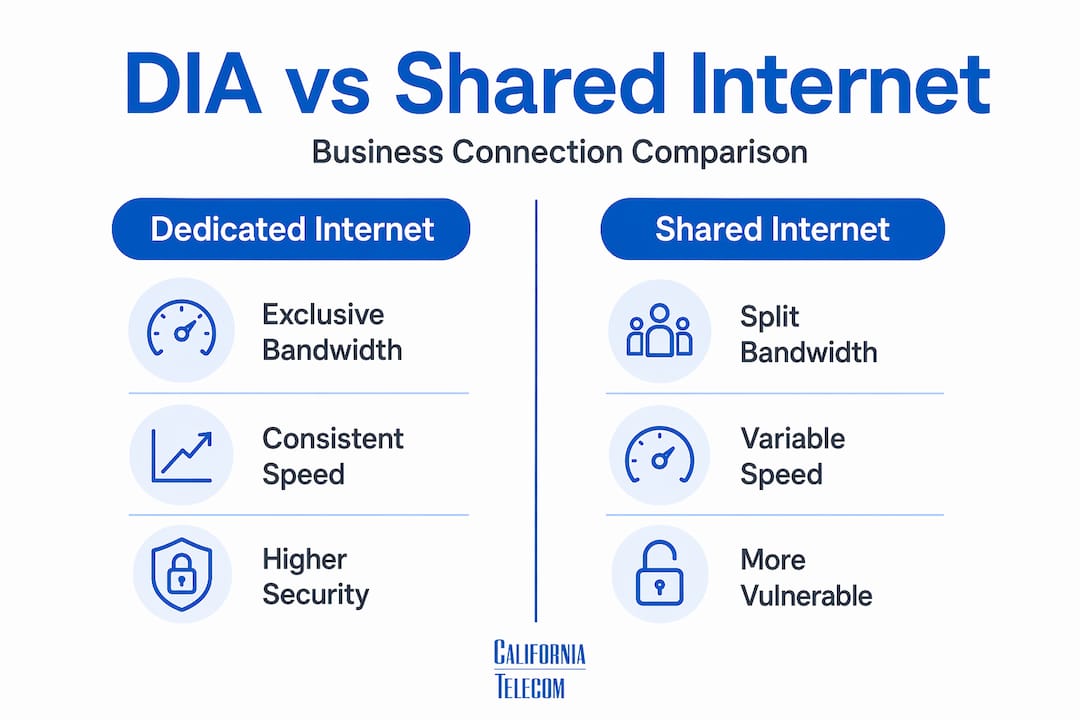
The distinction between dedicated and shared internet becomes concrete when you look at what happens during peak hours. Shared broadband is subject to contention and slowdowns that DIA eliminates by design.

| Factor | Dedicated Internet (DIA) | Shared Broadband | Business-Grade Broadband |
|---|---|---|---|
| Bandwidth guarantee | Yes, contractual floor | No, "up to" maximum | Partial, may include burst |
| Contention | None | High during peak hours | Moderate |
| Upload/download symmetry | Symmetric | Asymmetric | Usually asymmetric |
| SLA uptime commitment | Yes, 99.9% or higher | Rarely included | Sometimes included |
| Security isolation | High, private circuit | Low, shared path | Moderate |
| Typical use case | Multi-site enterprise, cloud-heavy | Small office, low criticality | Mid-market, moderate needs |
| Cost relative to bandwidth | Higher per Mbps | Lower per Mbps | Moderate |
You may also encounter the term "direct internet access" in architecture documentation. What is direct internet access in that context? It typically refers to routing internet-bound traffic directly from a branch or site without backhauling through a central data center. That is an architectural design decision, not a connection type. DIA and direct internet access are related concepts but are not interchangeable. A branch site can use DIA as its physical connection type while also implementing a direct internet access architecture in its routing policy.
Pro Tip: If your business uses a SD-WAN architecture, pairing DIA circuits at each site with local breakout routing is where you extract the most performance. The DIA provides the physical guarantee; the SD-WAN provides the intelligent path selection on top of it.
Security is another factor where the comparison is not close. Private dedicated lines reduce the attack surface by isolating your traffic from shared public network paths. On shared broadband, your traffic enters a common pool. With DIA, that pool does not exist.
Benefits of dedicated internet for multi-site operations
The benefits of dedicated internet compound as your organization adds locations. A single office with 20 employees might tolerate shared broadband with minor frustration. A 10-location operation running synchronized inventory systems, cloud-hosted ERP, and VoIP between sites cannot absorb that variability without operational consequences.
Multi-site operations rely on DIA for predictable bandwidth and the network stability that cloud services and VoIP require. Here is how that plays out in practice:
- Consistent cloud performance. Microsoft 365, Salesforce, and similar SaaS platforms require steady upload throughput. A shared connection degrading at peak hours creates application timeouts, sync failures, and user complaints that compound across every location simultaneously.
- VoIP call quality. Voice over IP is sensitive to jitter and packet loss far more than to raw bandwidth. DIA's low-latency, uncontended path removes the primary cause of degraded call quality in business phone systems.
- Backup and disaster recovery. Offsite backups running over a dedicated circuit complete on schedule. On shared broadband, large backup jobs often throttle other traffic or fail to complete within the backup window entirely.
- Real-time applications. Point-of-sale systems, telehealth platforms, and manufacturing control systems all require the kind of low, predictable latency that only a dedicated circuit provides.
The financial case is equally direct. Research shows that downtime costs businesses thousands of dollars per minute in lost productivity and revenue. When your 10 locations all lose connectivity because the shared provider is congested or experiencing an outage with a vague repair timeline, those costs multiply across the entire organization.
How to choose a dedicated internet service
Choosing the right dedicated internet service requires evaluating more than the headline bandwidth number. Here are the critical factors to assess:
-
SLA commitments. A credible DIA provider backs the circuit with a formal service level agreement. Reliable vendor SLAs specify uptime guarantees, mean time to repair, and performance metrics. Anything below 99.9% uptime for a business-critical circuit deserves scrutiny. Californiatelecom backs its data circuits with a 99.99% uptime SLA.
-
Symmetrical bandwidth tiers. Confirm that the upload speed matches the download speed you are contracting. Ask for the committed information rate (CIR) in writing, not just the port speed.
-
Installation timeline and infrastructure. DIA installs involve running dedicated fiber from the provider to your office and setting up termination hardware. Timelines vary from a few weeks to several months depending on whether fiber already passes your building. Build this into your project planning.
-
Scalability. Your bandwidth needs in 12 months will likely exceed today's requirements. Choose a provider who can upgrade your circuit without a full reinstall or a contract renegotiation battle.
-
Managed service options. Many providers offer managed DIA with 24/7 monitoring and support. For multi-site organizations, this is often more cost-effective than staffing internal network engineers at every location.
-
Vendor consolidation. Running 10 locations with 10 different ISPs means 10 support relationships, 10 contracts, and 10 billing cycles. A single managed network provider who sources, deploys, and supports DIA across all your sites removes that operational drag entirely.
Pro Tip: Always request a carrier diversity option for critical sites. If your primary DIA circuit uses one physical path into the building, a second circuit from a different carrier on a different physical route protects you from the most common single point of failure: the fiber cut outside your door.
How DIA fits into your overall network architecture
Understanding where DIA lives in your broader network design prevents expensive misconfigurations. The table below shows how DIA relates to other common connectivity components.
| Component | What it connects | Reaches public internet? | Typical use |
|---|---|---|---|
| Dedicated Internet Access (DIA) | Business premises to ISP PoP | Yes | Primary internet path for all sites |
| Cross-connect (data center) | Two endpoints within same facility | No | Private link between collocated equipment |
| MPLS private WAN | Site to site via carrier backbone | No (private) | Inter-site private traffic |
| SD-WAN overlay | Multiple circuits, any type | Depends on design | Traffic steering across multiple paths |
A cross-connect in a data center is a private cable linking two endpoints locally inside the same facility. It does not provide internet access. DIA connects your business directly to the internet, while cross-connects link within data centers for internal network access only. Confusing the two when designing a multi-site network leads to architectures that lack proper internet egress or bypass security controls unintentionally.
In a hybrid cloud architecture, DIA typically serves as the internet egress path at each site, allowing local breakout to SaaS applications without backhauling traffic to a central hub. This reduces latency for cloud-hosted applications and eliminates the bandwidth bottleneck that hub-and-spoke WAN designs create. For businesses migrating from legacy MPLS networks to modern SD-WAN, adding DIA at each site is often the first physical change that makes the performance improvement visible to users.
My honest take on dedicated internet for multi-site businesses
I have worked with dozens of multi-location businesses that were convinced their internet problems were software problems. Application slowdowns, VoIP complaints, backup failures. They had already replaced their firewall, upgraded their switches, and called their SaaS vendor three times. The problem was almost always the circuit.
What I've consistently found is that businesses underestimate how much shared broadband degrades across a week, not just at obvious peak hours. Traffic patterns shift, upstream congestion builds invisibly, and your Monday morning performance is rarely your Thursday afternoon performance. When you run 10 sites on shared connections, you are flying blind on the reliability that your operations actually depend on.
The mistake I see most often is treating internet access as a commodity line item to minimize rather than an infrastructure investment to protect. A company will spend $50,000 on a new ERP platform and then try to run it over a $150-per-month cable business connection. That math does not work.
My advice: calculate what one hour of connectivity downtime costs your organization across all sites in productivity, lost transactions, and staff time. Then look at the price difference between shared broadband and DIA. In most cases, the gap is smaller than the risk. For multi-site operations running any combination of cloud, VoIP, or real-time applications, DIA is not a luxury tier upgrade. It is the baseline your infrastructure requires.
— Jim
How Californiatelecom delivers dedicated internet nationwide
Californiatelecom designs and deploys dedicated internet circuits for multi-location businesses across the country, sourcing from more than 50 carriers to find the right physical path for every site.Every circuit is backed by a 99.99% uptime SLA on data and supported by a 24/7 U.S.-based NOC, so you have one engineer's number regardless of which carrier infrastructure underlies your connection. Californiatelecom's nationwide managed network services cover everything from initial design to ongoing monitoring, and pair naturally with managed LAN/WAN solutions that extend the same reliability from your circuit into your internal network. If you are ready to replace carrier juggling with a single managed solution across all your sites, schedule a free consultation with Californiatelecom's engineering team.
FAQ
What is dedicated internet access in simple terms?
Dedicated internet access is a business internet connection that is reserved exclusively for one organization, delivering guaranteed bandwidth with no sharing. Unlike shared broadband, the speed you contract is the speed you get at any time of day.
How does dedicated internet work physically?
A DIA circuit is a fiber-optic line run directly from your provider's Point of Presence to your business premises. The circuit is physically and logically unshared, meaning no other customers compete for its bandwidth.
What is the main difference between dedicated vs. shared internet?
Shared internet distributes bandwidth across many customers simultaneously, which creates congestion during peak hours. Dedicated internet guarantees your contracted bandwidth exclusively to your organization, with no contention from other users.
Do I need a dedicated internet connection for multiple locations?
Multi-site businesses running cloud applications, VoIP, or synchronized data systems benefit significantly from dedicated circuits at each location, because consistent bandwidth and low latency across all sites is what keeps those systems performing reliably.
What should I look for in a dedicated internet service provider?
Look for a formal SLA with at least 99.9% uptime, symmetrical bandwidth with a committed information rate, a realistic installation timeline, and managed service options with 24/7 support. Vendor consolidation across all your sites is an additional factor that reduces operational complexity significantly.
Recommended
- Why Dedicated Fiber Beats Broadband: Save Your Business from $9,000 Per Minute Downtime | California Telecom
- Business Internet vs Residential Internet: What You Need to Know | California Telecom
- Dedicated Fiber Internet — Internet Services | California Telecom
- What is business-grade broadband for multi-location IT | California Telecom