

The Role of Edge Networking Explained for IT ManagersEdge networking is a distributed architecture that processes data near its source rather than routing it to a central data center, reducing latency and improving real-time performance across every location in your enterprise. 72% of enterprises have deployed edge networks in 2026, making it one of the fastest-adopted infrastructure shifts in recent memory. That adoption rate reflects a hard operational truth: when your branches, warehouses, or retail sites depend on a central data center for every transaction, you pay for it in lag, downtime, and bandwidth costs. The role of edge networking, explained simply, is to move intelligence closer to where work actually happens.
How does edge networking improve connectivity and operational efficiency?
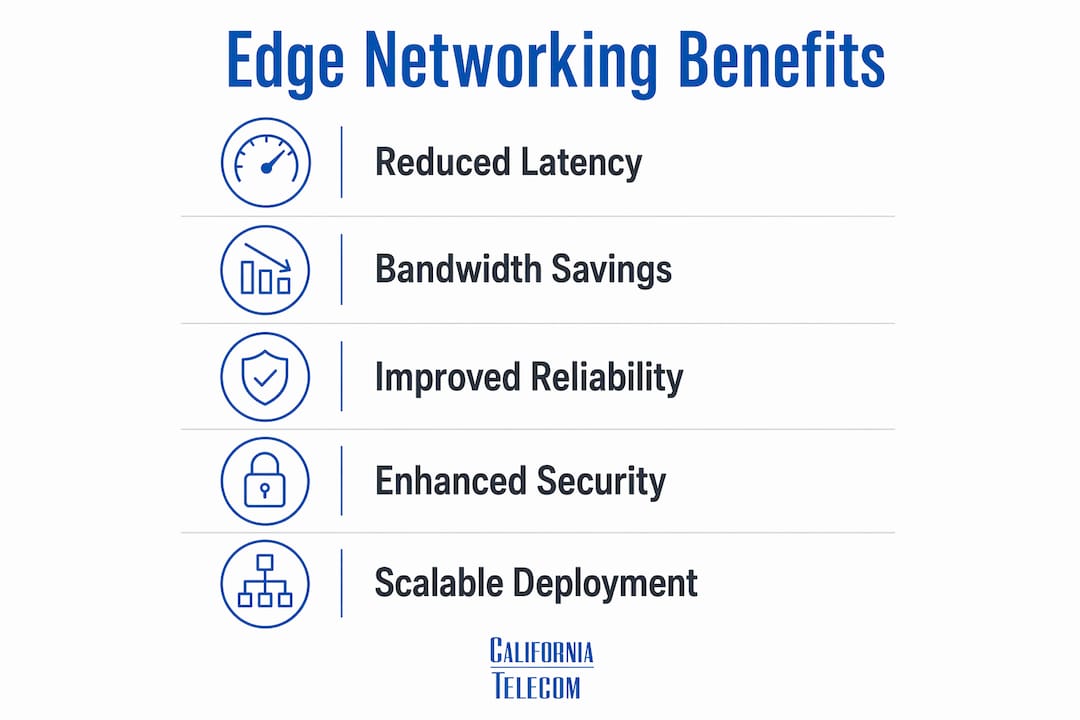
Edge networking cuts latency by eliminating the round trip to a central data center. When a sensor, camera, or point-of-sale terminal processes data locally at an edge node, the response time drops from hundreds of milliseconds to single digits. For real-time applications like AI-enabled IoT sensors on a factory floor or live inventory analytics in a distribution center, that difference is the gap between a system that works and one that fails under load.
Bandwidth savings are equally significant. Local data handling at the edge reduces backhaul bandwidth by 50–70%. That means your MPLS or broadband circuits carry only the traffic that genuinely needs to reach headquarters or the cloud, rather than every raw data packet from every site. For a business running 20 or 50 locations, that reduction translates directly into lower carrier costs and more headroom on existing circuits.

Reliability also improves because edge nodes operate independently. A WAN outage at headquarters does not take down a branch that can process transactions and enforce policies locally. This local autonomy is one of the most underappreciated edge computing benefits for multi-location IT teams managing sites across different geographies and carrier footprints.
Pro Tip: Deploy edge nodes with local caching and failover logic before you need them. Retrofitting redundancy after an outage costs far more than building it in from day one.
Key mechanisms that drive these gains include:
- Local processing: Edge nodes handle compute tasks on-site, so only summarized or actionable data travels upstream.
- Traffic prioritization: Edge routers apply quality-of-service policies locally, protecting voice and video from competing with bulk data transfers.
- Autonomous operation: Sites continue functioning during WAN disruptions because critical applications run at the edge.
- Real-time analytics: AI workloads like predictive maintenance and computer vision run at the source, not in a distant cloud region.
What are the security considerations and advancements in edge networking in 2026?
Distributed architectures expand the attack surface. Every edge node is a potential entry point, and traditional perimeter defenses built around a single data center do not scale to 30 or 100 branch locations. The industry has responded with a clear architectural shift.
40–60% of new edge deployments now use software-defined perimeter (SDP) architectures, replacing legacy VPN tunnels that granted broad network access once a user authenticated. SDP grants access to specific applications, not the network itself. That distinction matters because a compromised credential at a branch no longer opens a path to every system across your enterprise.
"Edge routers in 2026 act as policy engines enforcing authentication, encryption, and access controls, with zero-trust and SDP concepts integrated directly at the perimeter." This means security is no longer a function you bolt on at headquarters. It lives at every node, enforced consistently regardless of where a user or device connects.
Zero-trust architecture pairs naturally with micro-segmentation. Each workload or device sits in its own network segment, and lateral movement between segments requires explicit policy approval. Edge secure networks combine VPNs, zero-trust access, micro-segmentation, and edge-focused policy enforcement to protect distributed workloads from both external threats and internal compromise.
The practical security checklist for edge deployments includes:
- Identity-aware access: Every user and device authenticates before reaching any application, regardless of physical location.
- Encrypted tunnels: All traffic between edge nodes and the core travels over encrypted channels, not open WAN links.
- Dynamic policy enforcement: Access rights adjust in real time based on device posture, user role, and location context.
- Centralized visibility: A single dashboard monitors security events across all edge nodes so anomalies surface quickly.
Modern security practices for edge networks have moved well beyond perimeter firewalls. The organizations that get this right treat every branch as a security enforcement point, not just a connectivity endpoint.
Pro Tip: Audit your edge nodes quarterly for configuration drift. A node that was compliant at deployment can silently diverge from policy as firmware updates and local changes accumulate.
What are common challenges and best practices for deploying edge networking across multiple locations?
The most common mistake in multi-location edge deployments is over-connecting sites. When every branch has direct links to every other branch, you create a mesh topology that is difficult to troubleshoot and fragile under failure. A hub-and-spoke model limits east-west traffic and reduces troubleshooting complexity significantly. Traffic flows to a regional hub or the core, not sideways between branches, which keeps failure domains small and predictable.
Configuration drift is the second major operational risk. At scale, managing dozens of edge nodes as individual devices is unsustainable. Treating distributed edge fleets as single software-defined entities managed through centralized pipelines eliminates the drift problem. When a policy change deploys from a central controller to all nodes simultaneously, no site falls behind.
Define explicit site boundaries and failure behaviors before deployment to avoid expensive retrofits. This means deciding in advance what each site does when the WAN link drops, which applications run locally, and which require cloud connectivity. Answering those questions on paper costs nothing. Answering them during an outage costs everything.
Pro Tip: Use declarative infrastructure tools to define your edge configuration as code. Version-controlled configs make rollbacks fast and audits straightforward.
The table below maps common deployment challenges to their recommended mitigations:
| Challenge | Recommended mitigation |
|---|---|
| Mesh topology complexity | Adopt hub-and-spoke architecture to contain east-west traffic |
| Configuration drift at scale | Manage edge fleet through centralized, software-defined pipelines |
| Integration conflicts | Define site boundaries and failure behaviors before deployment |
| Expanded attack surface | Apply zero-trust and SDP at every edge node |
| Troubleshooting complexity | Centralize logging and monitoring across all edge locations |
- Map your traffic patterns first. Understand what data each site generates, where it needs to go, and how much of it can stay local before selecting hardware or topology.
- Choose topology before choosing gear. Hub-and-spoke or regional hub models should be locked in before vendor selection, not after.
- Automate policy deployment. Manual configuration at scale guarantees drift. Use centralized management platforms from day one.
- Test failure scenarios in staging. Simulate WAN outages and node failures before going live at any production site.
How can multi-location businesses implement edge networking effectively?
Effective implementation starts with selecting the right connectivity options for each site type. SD-WAN is the most common underlay for edge deployments because it abstracts the physical circuit and applies application-aware routing policies automatically. SD-WAN and SASE platforms converge networking and security, enabling identity-aware services and consistent policy enforcement across every edge location. For sites that need guaranteed throughput, MPLS remains a viable option as a primary or backup circuit alongside broadband.
Hybrid models work best for most enterprises. Edge nodes handle local processing and enforce security policies, while cloud platforms and centralized data centers handle analytics, storage, and applications that require broad data access. The SD-WAN deployment model used by enterprise retail chains illustrates this well: each store processes transactions and enforces access policies locally, while inventory and reporting data sync to the cloud on a scheduled basis.
Provisioning automation is non-negotiable at scale. When a new location opens, zero-touch provisioning should bring the edge node online, pull its configuration from a central repository, and enforce policy without requiring an on-site engineer. That capability reduces deployment time from days to hours and removes the human error that manual configuration introduces.
Key implementation steps for multi-location IT teams:
- Assess each site's traffic profile before selecting edge hardware or connectivity type.
- Standardize on a single management platform that covers configuration, monitoring, and policy enforcement across all locations.
- Integrate edge nodes with your cloud environment using defined APIs and consistent identity providers.
- Automate provisioning so new sites inherit the correct configuration from a central template without manual intervention.
- Validate security posture at each node before go-live using automated compliance checks against your zero-trust policy baseline.
Key Takeaways
Edge networking is the most direct path to lower latency, higher reliability, and reduced bandwidth costs for multi-location enterprises, provided you deploy it with centralized management and a zero-trust security model from the start.
| Point | Details |
|---|---|
| Enterprise adoption is mainstream | 72% of enterprises have deployed edge networks in 2026, making it a baseline expectation. |
| Bandwidth savings are measurable | Local data processing reduces backhaul bandwidth by 50–70%, cutting carrier costs directly. |
| Security requires zero-trust at the edge | SDP and micro-segmentation protect distributed nodes where traditional perimeter defenses fail. |
| Topology choice determines complexity | Hub-and-spoke models reduce troubleshooting complexity and contain failure domains at scale. |
| Centralized management prevents drift | Treating edge fleets as unified software-defined infrastructure keeps all sites in policy compliance. |
Why I think most edge deployments fail before they go live
The failure mode I see most often is not technical. It is organizational. IT teams spend weeks evaluating edge hardware and connectivity options, then deploy without ever defining what each site should do when the WAN goes down. The edge node sits there, connected to everything, with no local failure policy. When the circuit drops, the branch stops working. That is not an edge networking problem. That is a planning problem.
Branches should be treated as policy-enforced application access nodes, not generic gateways. Each site has a unique traffic profile, a unique set of applications, and a unique set of users. Applying a single template across all locations because it is easier to manage is how you end up with a branch running manufacturing IoT traffic on the same policy as a corporate office running video conferencing.
The organizations that get edge networking right share one habit: they define the policy before they touch the hardware. They know which applications are local, which are cloud-dependent, and what the site does autonomously when connectivity to the core is lost. That clarity makes every subsequent decision faster and cheaper.
The future of distributed enterprise IT is built on edge networking as a foundation. The businesses that treat it as a connectivity upgrade will keep patching problems. The ones that treat it as an architecture decision will build something that actually scales.
— Jim
Californiatelecom's managed edge networking for multi-location businesses
Multi-location businesses that need edge networking done right have one core problem: too many vendors, too many circuits, and no single point of accountability when something breaks.Californiatelecom solves that directly. As a nationwide managed network services provider, Californiatelecom designs, deploys, and manages edge network infrastructure across all your locations through its own engineers, backed by a 24/7 U.S.-based NOC and a 99.99% uptime SLA on data. From managed LAN/WAN solutions to SD-WAN and security integration, every site runs on a single platform with one bill and one engineer's number. Contact Californiatelecom for a free consultation to assess your edge networking readiness.
FAQ
What is edge networking in simple terms?
Edge networking is a distributed architecture that processes data near its source, at branch offices, factories, or retail sites, rather than sending all traffic to a central data center. This reduces latency and improves reliability for real-time applications.
How does edge networking reduce latency?
Edge nodes process data locally, eliminating the round trip to a distant data center. Response times drop from hundreds of milliseconds to single digits, which is critical for AI, IoT, and real-time analytics workloads.
What security model works best for edge networks?
Zero-trust architecture combined with software-defined perimeter (SDP) is the current standard. Between 40–60% of new edge deployments use SDP, granting access to specific applications rather than broad network access after a single authentication.
What is the biggest mistake in multi-location edge deployments?
Over-connecting sites into a mesh topology creates fragile, hard-to-troubleshoot networks. A hub-and-spoke model limits east-west traffic and keeps failure domains small and manageable across multiple locations.
How does SD-WAN relate to edge networking?
SD-WAN serves as the connectivity layer that makes edge networking practical at scale. It abstracts physical circuits, applies application-aware routing, and integrates with SASE platforms to enforce consistent security policy across every edge location.