

How Enterprise Retail Uses SD-WAN Across LocationsSoftware-defined wide area networking, known as SD-WAN, is the primary technology enterprise retailers use to centralize network control, guarantee uptime, and deploy digital services across hundreds or thousands of store locations simultaneously. Retailers like Deichmann and East of England Co-op have already proven the model at scale. Deichmann, working with Telefónica, rolled out SD-WAN across roughly 4,700 stores, gaining centralized visibility and the ability to push application updates to every location from a single console. That kind of control is exactly what enterprise retail IT teams need when managing distributed networks where a single point-of-sale outage translates directly to lost revenue.
How enterprise retail uses SD-WAN to control distributed networks
SD-WAN gives retail IT teams four core capabilities that legacy WAN architectures simply cannot match: centralized management, dynamic traffic routing, integrated security, and measurable cost reduction. Understanding each one is the foundation for evaluating whether your current network infrastructure is holding your stores back.
Centralized management and real-time visibility are the most immediate advantages. With SD-WAN, every store's network status appears in a single dashboard. IT teams can push policy changes, firmware updates, and new application configurations to all locations simultaneously, without dispatching a technician to each site.

Automatic failover is where SD-WAN separates itself from basic broadband setups. East of England Co-op reduced failover time from 90 seconds to instantaneous across more than 200 sites after deploying managed SD-WAN. That improvement alone eliminates the transaction losses and customer frustration that accompany even brief connectivity gaps during peak trading hours.
The SD-WAN benefits for retail extend to cost structure as well. East of England Co-op also achieved 10–15% operational savings through vendor consolidation and improved bandwidth efficiency. Consolidating multiple carrier contracts into a single managed service removes the administrative overhead of chasing separate invoices and support queues across dozens of providers.
Security is the fourth pillar. SD-WAN applies centrally managed firewall policies and network segmentation across every store from one control plane. Payment environments stay isolated from guest Wi-Fi and IoT devices, reducing the attack surface without requiring store-level IT staff to configure anything manually.
SD-WAN vs. MPLS vs. DIY broadband: which wins for retail?
Enterprise retailers evaluating network architecture face three realistic options: MPLS circuits, SD-WAN over broadband, or unmanaged broadband at each site. The differences in cost, performance, and flexibility are significant.
| Criteria | MPLS | SD-WAN (Managed) | DIY Broadband |
|---|---|---|---|
| Monthly cost per location | $500–$1,500+ | $150–$250 | $50–$150 |
| Uptime SLA | 99.9% | 99.7–99.9% | No SLA |
| Failover capability | Limited | Automatic, sub-second | Manual or none |
| Deployment time | 60–90 days | 2–4 weeks per location | ~1 week |
| Centralized management | No | Yes | No |
| Traffic prioritization | Basic QoS | Policy-driven, per-app | None |
MPLS delivers reliability but at a price point that becomes unsustainable across hundreds of locations. DIY broadband is cheap but leaves store managers responsible for connectivity problems they are not equipped to solve. Managed SD-WAN sits in the middle on cost while exceeding MPLS on flexibility, deployment speed, and management capability.
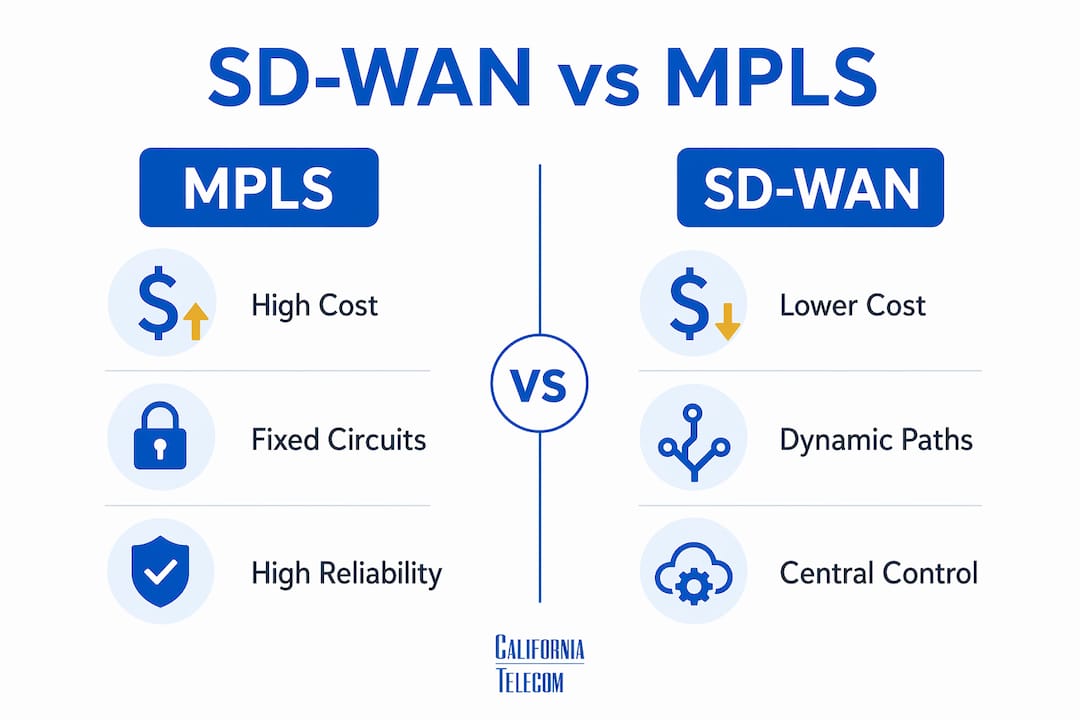
The performance gap comes down to dynamic path selection. MPLS routes traffic over fixed circuits regardless of current conditions. SD-WAN monitors all available links in real time and shifts traffic to the best-performing path automatically. For a retailer running POS transactions, inventory lookups, and customer-facing Wi-Fi simultaneously, that intelligence prevents any single application from degrading the others.
Pro Tip: When comparing SD-WAN vendors, ask specifically about path selection logic. Some platforms prioritize latency, others prioritize packet loss. For retail POS environments, packet loss sensitivity matters more than raw latency.
For a deeper look at how these architectures compare in practice, Californiatelecom's breakdown of SD-WAN versus MPLS covers the decision criteria most relevant to multi-location operations.
What does SD-WAN deployment look like across enterprise retail stores?
A phased, standardized approach is the proven method for deploying SD-WAN across enterprise retail at scale. One documented deployment migrated 1,200 retail stores to SD-WAN in just 6 weeks, compared to the 9 months a traditional network upgrade would have required. That speed comes from disciplined preparation, not shortcuts.
Here is the sequence enterprise retail IT teams follow:
-
Standardize hardware across all locations. Using identical SD-WAN appliances and Wi-Fi access points at every store means any technician can service any location using the same process. It also simplifies compliance enforcement and firmware management.
-
Configure zero-touch provisioning before shipping hardware. Zero-touch provisioning allows a replacement unit to be shipped directly to a store, plugged in by non-technical staff, and fully configured remotely within minutes. Deichmann's deployment with Telefónica demonstrated that hardware replacement downtime drops below 30 seconds with this approach.
-
Define traffic policies before go-live. POS systems and payment processors must receive bandwidth guarantees. Without explicit prioritization, guest Wi-Fi can consume bandwidth that starves critical systems during peak hours, even when failover is working correctly.
-
Run a pilot with 5–10 stores before full rollout. Phased rollouts with pilot stores surface policy conflicts, cabling issues, and broadband provisioning delays before they affect hundreds of locations. Most deployment delays trace back to broadband installation timelines or outdated in-store cabling, not the SD-WAN technology itself.
-
Establish post-deployment monitoring baselines. Track uptime per location, failover event frequency, application latency by store, and bandwidth utilization by traffic class. These metrics tell you whether your traffic policies are working and where to adjust.
-
Consolidate vendor contracts. Once SD-WAN is live, audit all existing carrier agreements. Eliminating redundant circuits and consolidating billing through a single managed provider removes ongoing administrative drag.
How does SD-WAN protect retail payment data and support compliance?
SD-WAN is not just a connectivity tool. It is a security enforcement layer that operates at every store simultaneously. For enterprise retailers subject to PCI DSS requirements, that centralized enforcement capability changes the compliance equation significantly.
The key security capabilities SD-WAN delivers in retail environments include:
- Network segmentation at scale. SD-WAN centrally manages segmentation policies to isolate PCI payment environments, keeping payment traffic on a separate logical network from guest Wi-Fi, digital signage, and IoT devices like smart shelving or HVAC sensors.
- Zero trust alignment. Segmenting payment systems from IoT devices aligns with zero trust principles outlined in NIST guidance, reducing the blast radius of any single compromised device.
- Centralized firewall policy enforcement. Security rules are written once and applied to every store. There is no risk of a store-level misconfiguration creating a compliance gap.
- Encrypted tunnels across all links. SD-WAN encrypts traffic across every connection type, whether the store is using fiber, cable broadband, or LTE backup, without requiring store staff to manage certificates or VPN configurations.
Pro Tip: Treat your SD-WAN segmentation policy as a living document. As you add new IoT devices, digital payment terminals, or self-checkout kiosks, update the segment assignments before the hardware goes live. Retroactive segmentation is far more disruptive than proactive planning.
A managed SD-WAN provider maintains the security posture across all locations through a network operations center. That means threat detection, policy updates, and incident response happen without requiring your store IT staff to act. For retailers with lean IT teams, this is the most practical path to consistent security across a large store footprint. Californiatelecom's managed SD-WAN services are built around exactly this model, with a 24/7 U.S.-based NOC monitoring every connected location.
Key takeaways
Enterprise retail SD-WAN deployments succeed when they combine standardized hardware, centralized policy management, and phased rollouts that prioritize POS reliability and payment security from day one.
| Point | Details |
|---|---|
| Failover speed matters | East of England Co-op cut failover from 90 seconds to instantaneous, protecting transactions at 200+ sites. |
| Cost advantage is real | Managed SD-WAN runs $150–$250 per location monthly, well below MPLS, with a guaranteed uptime SLA. |
| Standardize hardware first | Identical appliances across all stores reduce support complexity and accelerate troubleshooting at any location. |
| Traffic prioritization is non-negotiable | POS and payment systems need explicit bandwidth guarantees, or guest Wi-Fi will degrade them during peak hours. |
| Phased rollouts prevent large-scale failures | Pilot stores catch policy and cabling issues before they affect the full network. |
SD-WAN has become the backbone of retail IT strategy
I have worked with enough multi-location retailers to know that the network conversation used to start and end with "is the internet up?" That question has gotten more expensive to answer poorly. When a POS system goes down during a Saturday afternoon rush, the cost is not just the lost transaction. It is the customer who leaves, the staff who cannot process returns, and the manager who calls IT instead of running the floor.
What I find most significant about SD-WAN in retail is not the technology itself. It is what the technology makes possible organizationally. When your network is centrally managed and consistently configured, your IT team stops being reactive and starts being strategic. You can deploy a new payment application to every store in a day. You can add a new IoT sensor network without touching your POS segment. You can onboard a new store location in weeks instead of months.
The retailers I have seen get the most value from SD-WAN are the ones who treated it as infrastructure for digital transformation, not just a connectivity upgrade. Deichmann's deployment across 4,700 stores with Telefónica is the clearest example. Connectivity is now a strategic prerequisite for retail growth, and SD-WAN is the architecture that makes that connectivity manageable at scale.
The one mistake I see repeatedly is underinvesting in the traffic policy design phase. Organizations spend months selecting the right SD-WAN vendor and then rush the policy configuration. That is where POS reliability problems originate. Get the prioritization rules right before you go live, and the technology will perform exactly as advertised.
For retail IT leaders evaluating their options, the types of retail network connectivity solutions available in 2026 make this a genuinely good time to reassess your architecture.
— Jim
How Californiatelecom supports enterprise retail SD-WAN deploymentsCaliforniatelecom designs and deploys managed SD-WAN for multi-location retailers nationwide, sourcing from more than 50 carriers to build the right connectivity mix for each store footprint. Every deployment is engineered by Californiatelecom's own team, backed by a 24/7 U.S.-based NOC, and covered by a 99.99% uptime SLA on data. Retailers work with one provider, one bill, and one engineer's direct number, eliminating the vendor management overhead that slows down distributed network operations. If you are evaluating SD-WAN for your store network, Californiatelecom's nationwide managed network services are built specifically for enterprise organizations managing connectivity across multiple locations.
FAQ
What is SD-WAN and why do retailers use it?
SD-WAN is a software-defined networking approach that centralizes control of wide area network connections across multiple locations. Retailers use it to guarantee uptime, prioritize POS traffic, and manage hundreds of store networks from a single platform.
How long does SD-WAN deployment take in a retail environment?
Managed SD-WAN typically deploys in 2–4 weeks per location, and phased enterprise rollouts have completed 1,200 stores in as little as 6 weeks using zero-touch provisioning. Traditional network upgrades covering the same scope can take 9 months or longer.
Does SD-WAN help with PCI compliance in retail stores?
SD-WAN enforces centralized segmentation policies that isolate payment environments from guest Wi-Fi and IoT devices, directly supporting PCI DSS compliance. This approach aligns with zero trust principles outlined in NIST guidance and removes the risk of store-level misconfiguration.
How does SD-WAN compare to MPLS for enterprise retail?
Managed SD-WAN costs $150–$250 per location monthly versus $500–$1,500 or more for MPLS, while delivering comparable uptime and superior flexibility. SD-WAN also supports automatic failover and dynamic path selection that fixed MPLS circuits cannot provide.
What happens to store operations if the SD-WAN connection fails?
SD-WAN automatically fails over to a secondary link, such as LTE or a secondary broadband circuit, with sub-second switching times in properly configured deployments. East of England Co-op reduced failover time from 90 seconds to instantaneous across 200 sites after deploying managed SD-WAN.