

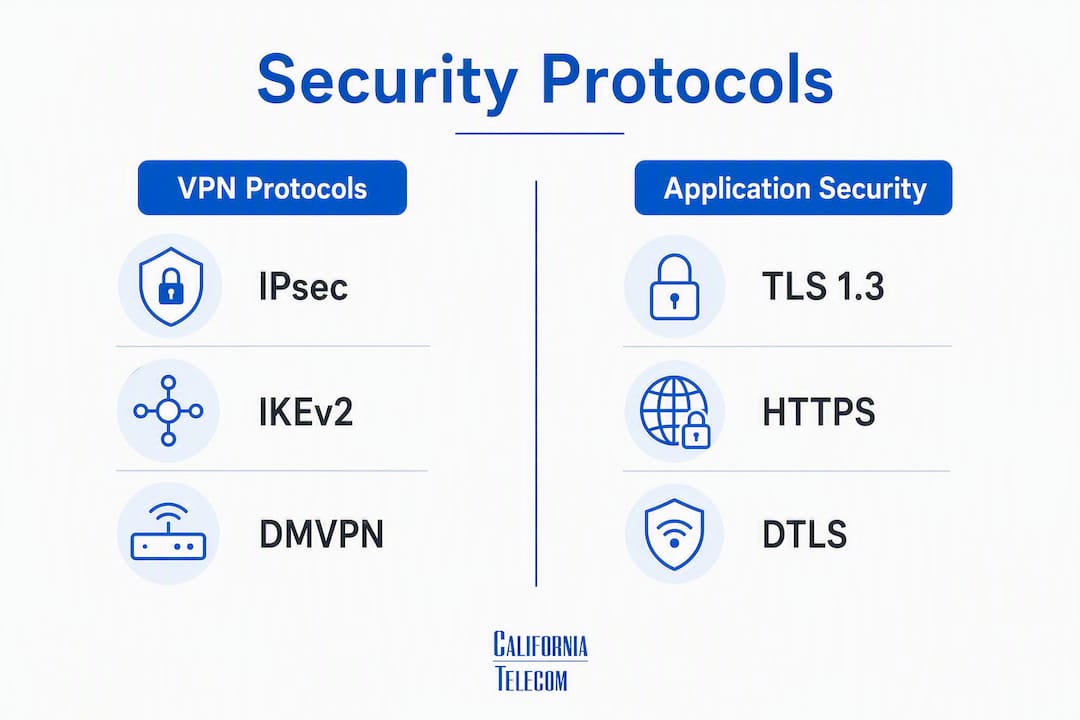
Network Security Protocols Explained for IT ProsThe protocols that matter most in a modern enterprise network are TLS 1.3 for web and application encryption, IPsec with IKEv2 for network-layer VPNs, WPA3 for wireless, SSH for remote administration, and SNMPv3 for device management. Each one addresses a specific threat surface, and choosing the wrong one for a job creates gaps that attackers reliably find.
Here is the short version before the deep dive:
- TLS 1.3 — encrypts client-server sessions; the current standard for HTTPS, APIs, and any application traffic crossing untrusted networks
- IPsec with IKEv2 — secures IP traffic at the network layer; the right choice for site-to-site VPNs and encrypted WAN links; NIST SP 800-77 recommends IKEv2 over legacy IKE for its reduced exchange complexity and stronger cryptographic resilience
- WPA3 — the current Wi-Fi security benchmark; CISA recommends pairing it with wireless intrusion detection and prevention (WIDS/WIPS) in enterprise environments
- SSH — authenticated, encrypted channel for remote shell access, file transfer, and port forwarding
- Kerberos — ticket-based authentication for internal enterprise services (Active Directory, file shares, databases)
- SNMPv3 — the only version of SNMP with real authentication and encryption; earlier versions send credentials in plaintext
- S/MIME — cryptographic signing and encryption at the email message layer
- DTLS / QUIC — datagram-oriented security for real-time media, DNS-over-QUIC, and HTTP/3
NIST and CISA both publish guidance on which variants to deploy. The short answer: if you are still running SSL, TLS 1.0/1.1, IKEv1, WPA2, or SNMPv1/v2c on production systems, those are your most urgent remediation targets.
Table of Contents
- What are network security protocols, and what do they actually cover?
- How do security protocols map to the OSI model?
- A deep look at each major protocol
- How do the major protocols compare for common use cases?
- Real-world deployment patterns that actually work
- What the research and current guidance actually say
- Key Takeaways
- When should you manage protocols in-house vs. use a managed service?
- Californiatelecom handles the protocol complexity so your team doesn't have to
- Useful sources and further reading
What are network security protocols, and what do they actually cover?
Network security protocols are formalized rules that govern how data is protected as it moves across a network. They define the mechanisms for confidentiality (encryption), integrity (tamper detection), authentication (identity verification), and in some cases non-repudiation (proof of origin). Without them, data in transit is readable, modifiable, and attributable to no one.
The distinction worth drawing early: not every network protocol is a security protocol. HTTP moves web content. DNS resolves names. BGP routes traffic. None of those were designed with security as a primary goal, which is exactly why TLS, DNSSEC, and BGPsec exist as overlays. The protocols covered here are the ones that provide the security functions themselves, not the application protocols they protect.
The scope of this guide covers:
- IPsec (ESP, AH, IKEv2, DMVPN, GETVPN)
- TLS/HTTPS (TLS 1.3, certificate management, QUIC/HTTP/3)
- DTLS and QUIC (datagram and multiplexed transport security)
- SSH (remote access, tunneling, key management)
- Kerberos (enterprise authentication)
- SNMPv3 (secure network management)
- S/MIME (email security)
- WPA3 (wireless security)
- ZTNA / SDP (Zero Trust access patterns)
Two authoritative bodies set the baseline for U.S. enterprise guidance: NIST (National Institute of Standards and Technology) through its Cybersecurity Framework and special publications, and CISA (Cybersecurity and Infrastructure Security Agency) through its operational advisories. Californiatelecom's engineers work within these frameworks when designing and deploying managed network architectures for multi-location clients.
How do security protocols map to the OSI model?
Where a protocol operates in the OSI stack determines what it can and cannot protect. IPsec at Layer 3 encrypts every IP packet regardless of which application generated it. TLS at Layer 4/5 protects a specific application session but leaves IP headers visible. That difference matters for threat modeling, firewall design, and troubleshooting.

| Protocol | OSI Layer | Typical Ports / Transport | Primary Security Functions |
|---|---|---|---|
| IPsec (ESP/AH) | Layer 3 (Network) | IP Protocol 50; UDP 4500 | Encryption, integrity, authentication, anti-replay |
| IKEv2 | Layer 3 (Network) | UDP 4500 | Key exchange, mutual authentication |
| TLS / HTTPS | Layer 4–5 (Transport/Session) | TCP 443 | Encryption, integrity, certificate-based auth |
| DTLS | Layer 4 (Transport) | UDP (varies) | Datagram encryption, integrity |
| QUIC | Layer 4 (Transport) | UDP 443 | Multiplexed encrypted transport, 0-RTT |
| SSH | Layer 7 (Application) | — | Encrypted shell, file transfer, tunneling |
| Kerberos | Layer 7 (Application) | — | Ticket-based authentication |
| SNMPv3 | Layer 7 (Application) | UDP 161 | Auth, encryption for device management |
| S/MIME | Layer 7 (Application) | N/A (email payload) | Message encryption, digital signing |
| WPA3 | Layer 2 (Data Link) | wireless | Wireless auth, per-session encryption |

Why layer placement matters operationally: IPsec protects all traffic between two endpoints, including DNS, ICMP, and routing updates, which is why it is the standard for site-to-site VPNs. TLS protects only the specific application session, so a misconfigured service on the same host can still leak data. Layer 2 WPA3 protects the wireless segment but does nothing once traffic hits the wired LAN, which is why WPA3 Enterprise pairs with 802.1X and downstream TLS.
Interoperability friction shows up at the edges. IPsec and NAT have a long history of conflict; IKEv2 with NAT-T (UDP 4500 encapsulation) resolves most of it. Multicast traffic does not traverse standard IPsec tunnels cleanly, which is one reason GETVPN exists. QUIC's reliance on UDP 443 can confuse firewalls configured to inspect only TCP 443 for TLS.
A deep look at each major protocol
IPsec with IKEv2
IPsec is a framework, not a single protocol. It combines ESP (Encapsulating Security Payload) for encryption and integrity, AH (Authentication Header) for integrity-only, and IKE for key exchange and SA negotiation. In practice, ESP is almost always the right choice; AH provides no confidentiality and is rarely deployed alone.

Tunnel mode wraps the entire original IP packet inside a new one, making it suitable for site-to-site VPNs where the endpoints are gateways. Transport mode encrypts only the payload, leaving the original IP header intact, and is used for host-to-host communications.
IKEv2 replaced IKEv1 for good reasons: fewer message exchanges, built-in NAT traversal, EAP support for remote access, and better resistance to denial-of-service attacks. Any new IPsec deployment should use IKEv2 exclusively.
For scale, point-to-point tunnels become unmanageable fast. DMVPN (Dynamic Multipoint VPN) uses multipoint GRE and NHRP to let spokes build dynamic spoke-to-spoke tunnels without static mappings, which is how large retail and logistics networks avoid maintaining thousands of individual tunnel configurations. GETVPN with G-IKEv2 takes a different approach: it distributes group keys (TEKs and KEKs) to all members, enabling efficient multicast and unicast encryption across an MPLS WAN without tunneling overhead.
Common limitation: pre-shared keys (PSKs) are operationally dangerous at scale. Rotating a PSK across 50 sites is error-prone, and a compromised PSK exposes all tunnels sharing it. Certificate-based authentication with a centralized PKI is the correct answer for any multi-site IPsec deployment.
Pro Tip: Avoid PSKs for any IPsec deployment with more than two or three sites. Stand up an internal CA, issue device certificates, and configure IKEv2 to authenticate via those certificates. The operational overhead of PKI is far lower than the blast radius of a compromised shared key.
TLS 1.3 and HTTPS
TLS is the protocol securing the majority of internet traffic. Version 1.3, standardized in RFC 8446, eliminated weak cipher suites, reduced the handshake to one round trip (with 0-RTT resumption for returning clients), and made forward secrecy mandatory. The Canadian Centre for Cyber Security is explicit: TLS 1.3 is the target; TLS 1.2 is acceptable only with a documented plan to phase it out; SSL and TLS 1.0/1.1 should be disabled immediately.
HTTPS is simply HTTP over TLS. Certificate-based authentication is what makes HTTPS trustworthy: the server presents a certificate signed by a trusted CA, and the client verifies the chain. Mutual TLS (mTLS) extends this by requiring the client to present a certificate too, which is increasingly common in zero-trust service meshes and API gateways.
QUIC and HTTP/3 build TLS 1.3 directly into the transport layer, eliminating the separate TCP handshake and enabling multiplexed streams without head-of-line blocking. QUIC runs over UDP 443 and is now the default for many major web properties.
DTLS
DTLS (Datagram TLS) applies TLS-equivalent security to UDP traffic. It is the right choice for real-time applications like VoIP, video conferencing, and WebRTC where TCP's retransmission behavior would introduce unacceptable latency. DTLS handles the packet-loss and reordering problems that make standard TLS unsuitable for datagrams.
SSH
SSH (Secure Shell) replaced Telnet and rlogin by providing an encrypted, authenticated channel for remote administration. Beyond interactive shell access, SSH supports SCP and SFTP for file transfer, port forwarding for tunneling other protocols, and X11 forwarding for remote graphical sessions.
Key management is where SSH deployments go wrong. Default installations often allow password authentication, which is vulnerable to brute force. The correct configuration: disable password auth, require public-key authentication, rotate keys on a schedule, and audit authorized_keys files regularly. For large fleets, a secrets management platform (HashiCorp Vault, AWS Secrets Manager) handles key distribution at scale.
Kerberos
Kerberos is the authentication backbone of Active Directory environments. A client authenticates once to the Key Distribution Center (KDC), receives a Ticket Granting Ticket (TGT), and uses that TGT to request service tickets for specific resources without re-entering credentials. The protocol provides mutual authentication: both the client and the service verify each other's identity.
Its limitation is scope: Kerberos works well inside a domain but does not extend naturally to cloud services or external partners. Federation protocols (SAML, OAuth 2.0, OIDC) handle those cases, often with Kerberos as the backend authenticator.
SNMPv3
SNMPv3 added authentication (HMAC-MD5 or HMAC-SHA) and encryption (AES) to a protocol that previously sent community strings in plaintext. Running SNMPv1 or SNMPv2c on production devices is equivalent to leaving a management backdoor open. SNMPv3 with authPriv mode (both authentication and privacy enabled) is the only configuration appropriate for production use.
Isolate SNMP traffic on a dedicated out-of-band management network or VRF. Exposing UDP 161 to the general network is a common misconfiguration that gives attackers a reconnaissance path.
S/MIME
S/MIME (Secure/Multipurpose Internet Mail Extensions) provides encryption and digital signing at the email message layer. Unlike TLS-in-transit protection, S/MIME encryption travels with the message: it remains encrypted at rest in the recipient's mailbox and through any relay. The sender's private key signs the message; the recipient's public key encrypts it.
The operational challenge is certificate distribution. Every sender needs the recipient's public certificate before they can encrypt, which requires either a public certificate directory or an internal PKI that publishes certificates to a shared LDAP store.
WPA3
WPA3 replaced WPA2 as the Wi-Fi Alliance's current security standard. WPA3-Personal uses Simultaneous Authentication of Equals (SAE) instead of the four-way handshake, eliminating offline dictionary attacks against captured handshakes. WPA3-Enterprise adds 192-bit mode with Suite B cryptography for high-security environments.
For enterprise deployments, WPA3 Enterprise with 802.1X and a RADIUS server provides per-user authentication and per-session encryption keys. CISA recommends pairing WPA3 with WIDS/WIPS to detect rogue access points and deauthentication attacks. See enterprise Wi-Fi design considerations for deployment specifics.
ZTNA and Software-Defined Perimeter
Zero Trust Network Access (ZTNA) and Software-Defined Perimeter (SDP) architectures do not replace the protocols above; they change how and when those protocols are invoked. Resources are invisible until a user and device pass continuous verification. NIST SP 800-215 describes SDP as making resources undiscoverable until authentication and authorization succeed, which is a fundamentally different posture than a perimeter firewall that blocks traffic to known addresses.
How do the major protocols compare for common use cases?
| Protocol | OSI Layer | Primary Use Case | Security Functions | Common Ports | Key Advantage | Main Limitation | Recommended Variant |
|---|---|---|---|---|---|---|---|
| IPsec (ESP) | 3 | Site-to-site VPN, encrypted WAN | Encryption, integrity, auth, anti-replay | UDP 4500; IP 50 | Protects all IP traffic regardless of app | NAT complexity; PSK risks at scale | IKEv2 + certificate auth |
| TLS | 4–5 | Web, APIs, app sessions | Encryption, integrity, cert-based auth | TCP 443 | Ubiquitous; mandatory forward secrecy in 1.3 | Application-layer only; cert management overhead | TLS 1.3 |
| DTLS | 4 | VoIP, WebRTC, real-time media | Datagram encryption, integrity | UDP (varies) | Works with UDP; tolerates packet loss | Less mature tooling than TLS | DTLS 1.3 |
| QUIC | 4 | HTTP/3, low-latency web | Multiplexed encrypted transport | UDP 443 | 0-RTT, no head-of-line blocking | Firewall/DPI visibility challenges | HTTP/3 over QUIC |
| SSH | 7 | Remote admin, file transfer | Encrypted shell, auth, tunneling | — | Strong auth with public-key; versatile | Key sprawl if unmanaged | Key-based auth; disable passwords |
| Kerberos | 7 | Enterprise SSO, AD auth | Ticket-based mutual auth | — | No password re-entry; mutual auth | Domain-bound; not cloud-native | Kerberos v5 with AES |
| SNMPv3 | 7 | Device management, monitoring | Auth + encryption | UDP 161 | Secure management at scale | Complex config vs v1/v2c | authPriv mode only |
| S/MIME | 7 | Secure email | Message encryption, signing | N/A (payload) | End-to-end; survives relay | Certificate distribution friction | PKI-backed certificates |
| WPA3 | 2 | Enterprise Wi-Fi | Wireless auth, per-session keys | wireless | SAE eliminates offline attacks | Requires compatible hardware | WPA3-Enterprise + 802.1X |
Picking the right protocol for the job:
- Enterprise wireless: — WPA3-Enterprise with 802.1X and RADIUS
Combining protocols in the same stack is normal and expected. A site-to-site IPsec tunnel carries HTTPS traffic that is independently TLS-encrypted. That is not redundant; it is defense in depth. The IPsec layer protects the transport path; TLS protects the application session end-to-end. If the IPsec tunnel is compromised, TLS still protects the payload. The AWS Well-Architected Framework formalizes this as layered protection: security groups, micro-segmentation, and protocol controls working together reduce the blast radius of any single failure.
Real-world deployment patterns that actually work
Most enterprise networks use several protocols simultaneously, each covering a different segment or threat surface. Here is how they fit together in practice.
Multi-site retail or logistics chain: IPsec with IKEv2 and DMVPN for encrypted site-to-site links; TLS 1.3 for customer-facing web and payment processing; WPA3-Enterprise with 802.1X for store Wi-Fi; SNMPv3 for centralized device management; SSH for out-of-band router and switch access. The enterprise network design principles that govern this kind of architecture emphasize segmentation from the start.
Remote workforce: ZTNA or IKEv2-based remote access VPN for device-to-cloud connectivity; TLS 1.3 for SaaS applications; Kerberos or SAML federation for SSO; WPA3-Personal for home Wi-Fi (with the understanding that corporate policy should not rely on home network security).
Healthcare or financial services: mTLS for internal service-to-service API calls; IPsec for inter-facility links; WPA3-Enterprise for clinical Wi-Fi; S/MIME for regulated email communications; SNMPv3 with out-of-band management for medical device network monitoring.
Key operational insight: Encryption is not a substitute for segmentation. A flat network where all devices share the same broadcast domain is vulnerable even when every link is encrypted, because a compromised endpoint can reach everything else. Micro-segmentation and security groups limit lateral movement; protocols handle confidentiality and integrity. Both are required.
Operational considerations that teams underestimate:
- Certificate lifecycle: TLS and IPsec PKI certificates expire. Automated renewal (ACME protocol for public certs, SCEP or EST for internal PKI) prevents outages from forgotten expirations.
- Key rotation: SSH authorized_keys files accumulate stale entries. Audit and rotate on a defined schedule.
- Patching: Protocol libraries (OpenSSL, BoringSSL, strongSwan) have vulnerabilities. Treat them like any other software dependency.
- DMVPN scaling: When spoke count grows past a few hundred, hub CPU becomes the bottleneck. Plan for hub redundancy and load distribution early.
Pro Tip: For large IPsec deployments, run a parallel DMVPN Phase 3 design from the start rather than migrating later. Phase 3 with NHRP shortcut switching lets spokes communicate directly after the first packet, cutting hub load significantly at scale.
What the research and current guidance actually say
NIST CSF 2.0 Asset Management control ID.AM-03 requires organizations to maintain documented baselines of authorized network communication, including ports, protocols, and services. That baseline is not a compliance checkbox. It is the operational foundation for anomaly detection: you cannot identify unauthorized traffic if you have not defined what authorized traffic looks like.
The modern variant recommendations from NIST, CISA, and the Canadian Centre for Cyber Security converge on the same short list: IKEv2 for IPsec, TLS 1.3 for web and application traffic, WPA3 for wireless, SNMPv3 for device management. Deprecated versions (SSL, TLS 1.0/1.1, IKEv1, WPA/WPA2, SNMPv1/v2c) should be disabled, not just deprioritized.
From NIST guidance on Zero Trust: Zero Trust Architecture shifts the assumption from "trust the network perimeter" to "verify every device and user continuously." Protocol choice must support that model: identity-based access policies, certificate-based authentication, and session-level verification rather than IP-address-based rules.
Zero Trust has a direct implication for protocol configuration. An IPsec tunnel authenticated with a PSK and a shared IP range is a perimeter-model artifact. The same tunnel authenticated with device certificates, scoped to specific traffic selectors, and monitored for anomalous flows is closer to a Zero Trust posture. The protocol is the same; the configuration philosophy is different.
Visibility is the gap most teams underestimate. Encryption protects data from external interception, but it also obscures malicious traffic from internal inspection tools. Encrypted C2 channels, data exfiltration over HTTPS, and lateral movement over SSH all look legitimate to a firewall that only checks whether the protocol is allowed. Pairing protocol controls with real-time network telemetry and endpoint posture checks closes that gap.
Pro Tip: Build your protocol baseline before you need it for incident response. Document every authorized protocol, port, and service per network segment in a CMDB or network management platform. When an incident occurs, the difference between "we know what normal looks like" and "we don't" determines how fast you contain it.
Key Takeaways
Modern enterprise security depends on deploying the right protocol variant at each layer: TLS 1.3 for application sessions, IKEv2/IPsec for network-layer VPNs, WPA3 for wireless, and SNMPv3 for device management, paired with continuous visibility and a Zero Trust posture.
| Point | Details |
|---|---|
| Use current protocol variants | TLS 1.3, IKEv2, WPA3-Enterprise, and SNMPv3 authPriv are the minimum acceptable standards; disable deprecated versions immediately. |
| PKI over PSKs for IPsec | Certificate-based authentication scales safely; pre-shared keys create a single point of compromise across all tunnels that share them. |
| Baseline authorized protocols | NIST CSF 2.0 ID.AM-03 requires documented baselines of ports, protocols, and services — the foundation for anomaly detection. |
| Encryption needs visibility | Encrypted traffic can hide malicious behavior; pair protocol controls with real-time telemetry and endpoint posture checks. |
| Californiatelecom for managed deployment | Californiatelecom designs and operates multi-site IPsec, WPA3, and TLS architectures with 24/7 NOC monitoring and PKI lifecycle management. |
When should you manage protocols in-house vs. use a managed service?
The honest answer is that protocol configuration is not the hard part. The hard part is operating it continuously: rotating certificates before they expire, patching protocol libraries when CVEs drop, monitoring encrypted flows for anomalous behavior at 2 AM, and scaling the architecture when the business adds 20 new sites in a quarter.
In-house control makes sense when you have a dedicated network security team, an internal PKI already in operation, and the tooling to maintain visibility across all segments. For organizations with those resources, owning the configuration gives you the fastest response time and the deepest customization.
The signals that point toward a managed service are specific. Multi-site scale where each location needs consistent IPsec, WPA3, and TLS configuration. High-availability SLAs that require 24/7 monitoring and rapid failover. Certificate lifecycle management across dozens of devices and services. Carrier redundancy requirements that no single in-house team can source and manage efficiently.
Californiatelecom's engineers design and deploy these architectures for multi-location businesses across the country, sourcing from 50+ carriers and backing every deployment with a 24/7 U.S.-based NOC. The value is not just the initial configuration; it is the operational continuity: one engineer's number, one bill, and a team that already knows your network when something goes wrong.
Californiatelecom handles the protocol complexity so your team doesn't have toDesigning a secure multi-site network means getting IPsec, TLS, WPA3, and SNMPv3 right simultaneously, then keeping them right as your business grows, certificates expire, and threats evolve. Californiatelecom delivers managed LAN/WAN services that include protocol architecture design, PKI and certificate lifecycle management, WPA3 Enterprise wireless, and 24/7 NOC monitoring across all your locations.
The difference from a traditional IT approach: you get a single provider who sources from 50+ carriers, deploys through its own engineers, and monitors your network continuously through AI-powered observability that catches anomalies before they become incidents. One bill, one point of contact, and a 99.99% uptime SLA on data.
If your organization is running multiple sites and needs a protocol architecture that actually holds up under audit and under attack, talk to a Californiatelecom engineer about a managed network assessment.
FAQ
What are network security protocols?
Formalized rules that govern how data is protected as it moves across a network — the mechanisms for confidentiality (encryption), integrity (tamper detection), and authentication (identity verification).
Which security protocol belongs at which layer?
TLS 1.3 for application sessions, IKEv2/IPsec for network-layer VPNs, WPA3 for wireless, and SNMPv3 for device management — paired with continuous visibility and a Zero Trust posture that controls when each is invoked.
What did TLS 1.3 change?
Standardized in RFC 8446, it eliminated weak cipher suites, reduced the handshake to one round trip with 0-RTT resumption for returning clients, and made forward secrecy mandatory.
Why is WPA3 better than WPA2?
WPA3-Personal replaces the four-way handshake with Simultaneous Authentication of Equals (SAE), eliminating offline dictionary attacks against captured handshakes.
Is it safe to keep running SNMPv1 or SNMPv2c?
No. Both send community strings in plaintext, which is equivalent to leaving a management backdoor open. SNMPv3 adds authentication and AES encryption and should be the floor on production devices.
Useful sources and further reading
The primary standards and guidance documents referenced throughout this article:
- NIST SP 800-77r1: Guide to IPsec VPNs — NIST's authoritative reference for IPsec configuration, IKEv2 recommendations, and VPN architecture guidance
- NIST Cybersecurity Framework (CSF) 2.0 — includes ID.AM-03 on baselining authorized network ports, protocols, and services
- NIST: Implementing a Zero Trust Architecture — practical guidance on ZTA consistent with NIST SP 800-207
- NIST SP 800-215: Guide to Zero Trust and SDP Concepts — covers Software-Defined Perimeter and Zero Trust Network Access architectures
- CISA: Securing Enterprise Wireless Networks — WPA3 deployment guidance and WIDS/WIPS recommendations
For managed implementation: Californiatelecom's network compliance resources for California businesses and managed network services overview provide context for organizations looking to align protocol deployments with regulatory and operational requirements.