

Network Compliance Requirements for California BusinessesNetwork compliance requirements for California businesses are defined by mandatory annual independent cybersecurity audits under regulations enforced by the California Privacy Protection Agency (CPPA). As of january 1, 2026, qualifying businesses must assess 18 detailed control areas covering network monitoring, encryption, access controls, and vulnerability management. The California Consumer Privacy Act (CCPA) and CPPA regulations apply across all industries, making this one of the broadest state-level cybersecurity mandates in the country. For multi-location operators, the stakes are especially high because cross-site data flows multiply both exposure and audit complexity.
What are the network compliance requirements for California businesses?
Network compliance, in the California regulatory context, refers to the full set of cybersecurity controls, audit obligations, and documentation requirements that businesses must meet to protect consumers' personal information. The formal industry term is "cybersecurity program compliance," and it encompasses technical controls, governance policies, and independent third-party verification. The CPPA enforces these requirements under CCPA regulations, and non-compliance carries penalties up to $7,500 per intentional violation. That figure applies per violation, not per audit cycle, so a pattern of gaps can produce significant liability.
The audit scope covers Intrusion Detection Systems (IDS), Data Loss Prevention (DLP) tools, encryption protocols, and access control frameworks. Each of these must be documented, tested, and verified by an independent auditor. Verbal assurances from management carry no weight in this process. The CPPA expects evidence: logs, workflows, test results, and signed certifications.

Which businesses must comply with California's cybersecurity audit rules?
California's cybersecurity audit rules apply to any business that meets at least one of three thresholds:
- Processes personal information of 250,000 or more consumers or households annually
- Processes sensitive personal information of 50,000 or more consumers or households
- Derives 50% or more of annual revenue from the sale or sharing of personal information
These thresholds apply regardless of industry. A logistics company, a professional services firm, and a retail chain all face the same rules if they cross the same data volume lines. California audits apply broadly across all sectors, unlike federal frameworks such as HIPAA or PCI DSS that target specific industries.
Compliance deadlines are staggered based on business size and revenue. Larger businesses with higher data volumes face earlier deadlines. Multi-location businesses face added complexity because data processed across multiple sites is aggregated for threshold purposes. A business with five California locations each processing 60,000 consumer records is well above the 250,000 threshold in total. Compliance officers at multi-site operations should map cross-location data flows before assuming they fall below the threshold.
Pro Tip: If your business uses a centralized CRM or customer data platform across locations, count all records processed through that system, not just those at a single site.
What are the 18 cybersecurity control areas in the California audit?
The 18 control areas required in the annual cybersecurity audit cover both technical and governance domains. Each area requires documented evidence, not just policy statements. The audit also evaluates third-party service providers that process personal information on the business's behalf, including their contractual compliance with California requirements.
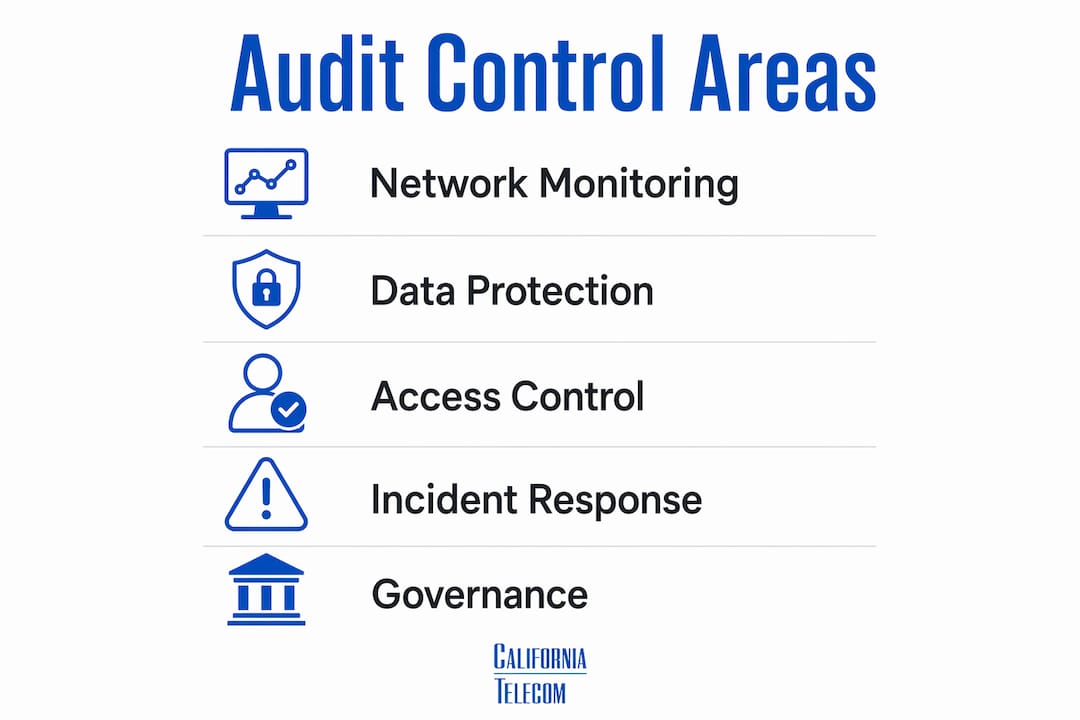
| Control area | What auditors examine |
|---|---|
| Network monitoring and defenses | IDS/IPS deployment, alert logs, response records |
| Encryption | Data at rest and in transit, key management practices |
| Access controls | Role-based access, least privilege, MFA enforcement |
| Vulnerability management | Scan frequency, patch timelines, remediation records |
| Incident response | Written plan, tabletop exercises, historical incident logs |
| Data inventory and mapping | Records of personal information flows across systems |
| Employee training | Training logs, phishing simulation results, completion records |
| Third-party oversight | Vendor contracts, due diligence documentation, audit rights |
| Physical security | Access controls to server rooms and data centers |
| Logging and monitoring | Log retention policies, SIEM configurations |
| Change management | Documented change control procedures and approvals |
| Business continuity | Backup procedures, recovery time objectives, test results |
| Risk assessment | Formal risk register, assessment methodology |
| Secure development | Code review practices, vulnerability disclosure program |
| Data minimization | Policies limiting collection to stated purposes |
| Retention and disposal | Documented schedules, verified disposal records |
| Identity and authentication | Phishing-resistant MFA for privileged accounts |
| Governance and oversight | Board or executive accountability for cybersecurity program |
Audit workpapers and supporting documentation must be retained for five years. That retention window means businesses cannot reconstruct evidence after the fact. Logs, incident records, and training completions must exist as they occur.
Pro Tip: Assign a control owner to each of the 18 areas now. When auditors request evidence, you need a named person who can produce it within days, not weeks.
How can California businesses prepare for the cybersecurity audit?
Audit readiness requires starting 12 to 18 months before certification deadlines. That timeline is not conservative. Several control areas require months of existing operational evidence, including historical audit logs and incident response records. You cannot generate that evidence retroactively.
A practical preparation sequence looks like this:
- Conduct a gap assessment. Map your current controls against all 18 required areas. Identify which controls exist, which are partially implemented, and which are absent.
- Build your evidence base. Start generating logs, training records, and test results immediately. Auditors need to see longitudinal data, not a snapshot from the week before the audit.
- Formalize written policies. Documented internal policies covering data training and retention reduce liability risk even where not explicitly required by a specific control area.
- Map existing frameworks. Organizations with mature ISO 27001 or NIST CSF programs can reduce compliance work by approximately 30% by mapping existing controls to California-specific requirements. The mapping is not automatic. California adds specific requirements such as vulnerability disclosure programs and phishing-resistant MFA that ISO 27001 does not explicitly mandate.
- Select and engage an independent auditor. California requires auditor independence. Documented auditor qualifications and objectivity safeguard audit validity. Engage your auditor early so they can advise on evidence collection before the formal audit begins.
- Evaluate third-party vendors. Review contracts with any service provider that processes personal information on your behalf. Confirm they meet California requirements and that your agreements include audit rights.
The most common mistake compliance officers make is treating the audit as a point-in-time project. The CPPA expects evidence of an ongoing, operational security program. A business that builds controls in the 90 days before the audit will not produce the longitudinal evidence auditors require.
Pro Tip: Use your network monitoring platform to generate automated, timestamped logs from day one. Auditors treat automated logs as stronger evidence than manually compiled reports.
For multi-location businesses, managing consistent controls across sites adds another layer of complexity. A guide on multi-location network management can help compliance officers understand how to standardize security controls across distributed infrastructure.
What are the documentation and certification requirements?
Businesses must submit a written certification of audit completion to the CPPA by april 1 of the year following the audit period. The certification must be signed under penalty of perjury by a senior executive with direct oversight of the cybersecurity program. That signature requirement is significant. It places personal legal accountability on a named executive, not just the organization.
The documentation businesses must maintain and be prepared to submit includes:
- The full audit report with findings and remediation plans
- Audit workpapers retained for a minimum of five years
- Evidence supporting each of the 18 control areas
- Third-party vendor assessments and contract documentation
- Incident response records and logs from the audit period
- Employee training completion records
- Risk assessment documentation with supporting analysis
The CPPA can request documentation on short timelines during enforcement reviews. Businesses that cannot produce records quickly face compounding risk. Organizing documentation by control area and audit year from the start makes retrieval far faster than searching through unstructured file systems.
Website security best practices for smaller California businesses provide a useful baseline for organizations building their first formal documentation program.
Key Takeaways
California's network compliance requirements demand ongoing, documented cybersecurity programs across 18 control areas, with annual independent audits and executive-signed certifications due to the CPPA by april 1 each year.
| Point | Details |
|---|---|
| Audit thresholds | Businesses processing 250,000+ consumer records or deriving 50%+ revenue from data sales must comply. |
| 18 control areas | Each area requires documented evidence; verbal assertions and retroactive logs are not accepted. |
| Preparation timeline | Start audit readiness 12–18 months before deadlines to build valid longitudinal evidence. |
| Certification deadline | A senior executive must sign the annual certification under penalty of perjury by april 1. |
| Framework mapping | ISO 27001 or NIST CSF programs reduce compliance work but must be supplemented with California-specific controls. |
What I've learned watching businesses rush this process
The businesses that struggle most with California's cybersecurity audit requirements are not the ones with weak security programs. They are the ones with decent security programs that were never documented. I have seen organizations with solid technical controls fail audit readiness reviews because no one wrote anything down. Auditors cannot credit what they cannot verify.
The second pattern I see repeatedly is over-reliance on existing certifications. ISO 27001 is a strong foundation, but it does not cover California-specific requirements like phishing-resistant MFA for privileged accounts or a formal vulnerability disclosure program. Compliance officers who assume their ISO certification closes the gap are in for a difficult audit.
For multi-location businesses, the real challenge is consistency. A control that exists at headquarters but not at a regional office is a gap. The CPPA does not grade on a curve for distributed operations. Every site that processes personal information is in scope. Building a centralized compliance program with site-level accountability is the only approach that holds up under scrutiny.
My practical advice: treat the April 1 certification deadline as a forcing function to build a permanent security operations discipline, not a one-time filing. The businesses that do this well stop thinking about compliance as an annual event and start running it as a continuous program. That shift is what separates organizations that pass audits from those that scramble through them.
— Jim
How Californiatelecom supports your compliance program
California businesses managing multi-location networks face the hardest version of this compliance challenge. Consistent controls, centralized monitoring, and documented evidence across every site require infrastructure that most internal IT teams were not built to manage alone.Californiatelecom delivers managed LAN/WAN services designed for multi-location California businesses, including continuous network monitoring, intrusion detection, and compliance-ready documentation support. Every network is designed and deployed by Californiatelecom's own engineers and backed by a 24/7 U.S.-based NOC. One provider, one bill, and one engineer's number replaces the vendor sprawl that makes compliance documentation nearly impossible to maintain. Contact Californiatelecom to discuss how managed network services can support your cybersecurity audit program.
FAQ
What is network compliance for California businesses?
Network compliance for California businesses refers to the cybersecurity controls, audit obligations, and documentation requirements mandated by the CPPA under CCPA regulations. Qualifying businesses must complete annual independent audits covering 18 control areas and submit a signed certification by april 1 each year.
Which businesses are required to complete the California cybersecurity audit?
Businesses that process personal information of 250,000 or more consumers, process sensitive personal information of 50,000 or more consumers, or derive 50% or more of annual revenue from data sales must comply. These thresholds apply across all industries, not just technology or healthcare.
What happens if a business fails to comply with California's cybersecurity audit requirements?
The CPPA enforces compliance actively and can impose penalties up to $7,500 per intentional violation. Businesses that cannot produce required documentation on short notice face compounding enforcement risk during CPPA reviews.
How long must California businesses retain cybersecurity audit records?
Audit workpapers and supporting documentation must be retained for a minimum of five years. This includes evidence for all 18 control areas, incident response records, vendor assessments, and employee training logs.
Does ISO 27001 certification satisfy California's cybersecurity audit requirements?
ISO 27001 reduces compliance preparation work but does not fully satisfy California's requirements. Businesses must supplement existing certifications with California-specific controls such as phishing-resistant MFA and formal vulnerability disclosure programs.