

5 Minutes 15 Seconds a Year: Is Five Nines Uptime Worth It for SREs?Five nines (99.999% uptime) allows roughly 5 minutes 15 seconds of downtime per year. That is not a typo, and it is not negotiable once you sign a contract promising it. Getting there costs real money and real engineering discipline, and for most systems, it is overkill; for a payment gateway, a 911 dispatch line, or a trading platform, it is the minimum viable answer.
TL;DR:
- Achieving five nines uptime requires accepting about 5 minutes 15 seconds of downtime annually, emphasizing rapid detection and automated recovery.
- The actual availability depends heavily on minimizing MTTR and ensuring detection within roughly 90 seconds to stay within the budget.
- Redundant dependencies must be physically independent; sharing fiber or power sources can easily reduce the overall system availability below five nines.
- Vendor uptime claims often exclude scheduled maintenance and customer-side issues; verification with third-party reports is essential before trusting promises.
- For most organizations, improving incident response and recovery speed delivers more reliable uptime than striving solely for the five-nines target.
Table of Contents
- What Five Nines Uptime Actually Means, Compared to the Rest
- The Math Behind Five Nines: MTTF, MTTR, and Your Error Budget
- Why Redundancy Alone Won't Get You There
- SLIs, SLOs, and SLAs: What Counts as Downtime
- Engineering for Five Nines: Architecture, Automation, and Testing
- Should You Even Pursue Five Nines? A Cost Checklist
- Verifying Vendor Uptime Claims and What to Put in Your SLA
- Runbooks That Actually Protect Your Uptime Budget
- When Five Nines Is Worth It (and When It's Not)
- Getting Your Network Closer to Five Nines With California Telecom
- Sources
- FAQ
What Five Nines Uptime Actually Means, Compared to the Rest
Five nines uptime is shorthand for 99.999% availability, and the exact downtime budget works out to about 5 minutes 15 seconds per year, roughly 26 seconds per month, and under a second per day. Compare that to what most contracts actually promise, and the gap gets uncomfortable fast:
- 99% ("two nines"): 3.65 days of downtime per year
- 99.9% ("three nines"): 8.76 hours per year
- 99.99% ("four nines"): 52.6 minutes per year
- 99.999% ("five nines"): 5 minutes 15 seconds per year
Each additional nine cuts your allowed downtime by roughly 10 times, which is why the jump from four nines to five nines feels so much harder than the jump from three to four. There is also a measurement nuance that trips up a lot of teams: a rolling 30-day window and a fixed calendar month produce different numbers, especially in February. If your SLA doesn't specify which one applies, you're arguing about math during an outage instead of before one.
The Math Behind Five Nines: MTTF, MTTR, and Your Error Budget
Availability comes down to one formula: availability = MTTF / (MTTF + MTTR), where MTTF is mean time to failure and MTTR is mean time to recovery. This is the actual calculus behind service availability, and it means you can hit five nines either by failing less often or recovering faster. Both work. Most teams underestimate how little room MTTR leaves them.
Run the numbers. Three incidents a year at 2 minutes each burns 6 minutes, already over your annual budget of roughly 5 minutes 15 seconds. One incident lasting 5 minutes wipes out the entire year in a single event. That's the uncomfortable truth about five nines: it's not really about preventing every failure. It's about detecting and recovering from failures faster than your budget drains.
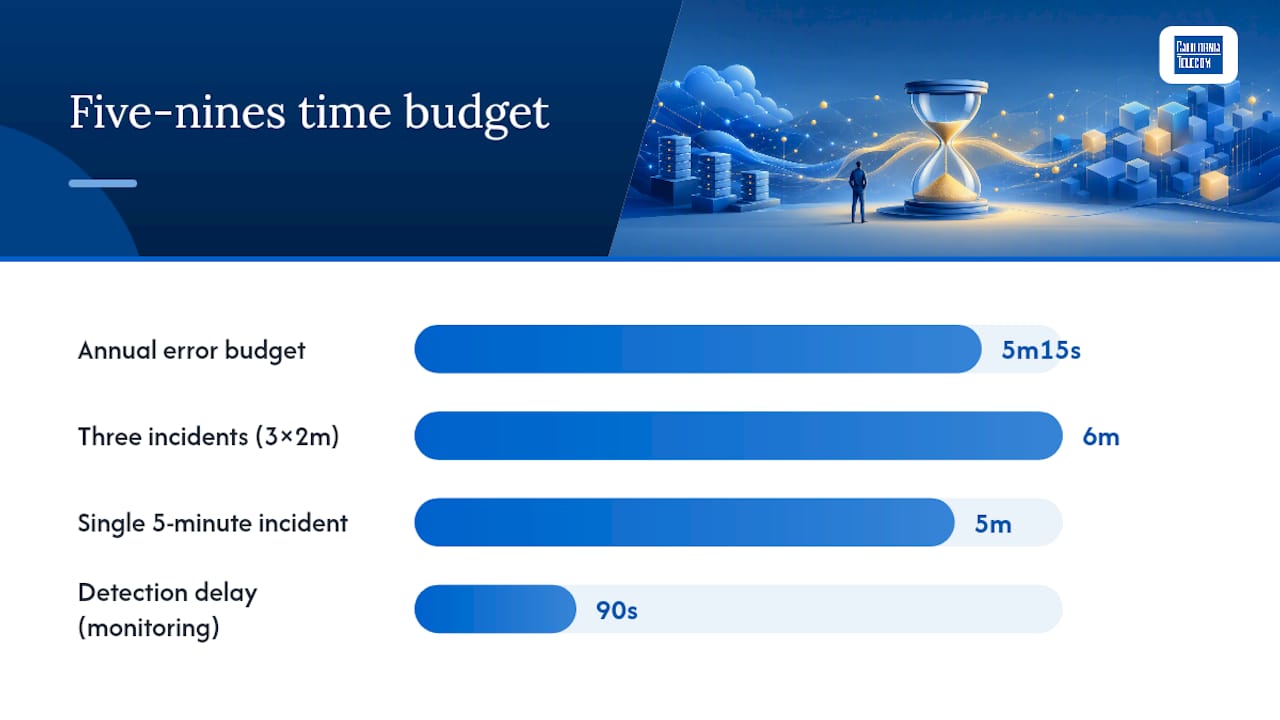
Detection eats into that window before recovery even starts. If your monitoring takes 90 seconds to notice a service is down, you've already spent nearly a third of your annual budget before anyone touches a keyboard. That's why teams chasing five nines obsess over alert latency as much as fix time.
Why Redundancy Alone Won't Get You There
Availability multiplies across dependencies, not adds. If your service depends on three independent components each running at 99.99%, your combined availability isn't 99.99%. It's closer to 99.97%, because the failure probabilities stack. This is the logic behind what's known as the rule of the extra nine: any dependency your five-nines service relies on should typically run one nine higher than your own target, or its failures will drag your number down regardless of how good your own code is.
Redundancy fixes some of this, but only when the redundant paths fail independently. Cisco's own network availability guidance notes that a well-designed redundant network can reach five nines even when individual links or devices are only moderately reliable, provided the topology genuinely isolates failure domains. That's the catch most teams miss. Two "redundant" internet circuits from the same carrier, riding the same fiber conduit, sharing the same regional power grid, aren't redundant at all. They're one failure waiting to happen twice. Shared DNS providers, shared configuration management tools, and shared power feeds are the usual culprits behind outages that were supposed to be impossible.

SLIs, SLOs, and SLAs: What Counts as Downtime
Three acronyms, three different jobs. An SLI (service level indicator) is what you actually measure, like request latency or error rate. An SLO (service level objective) is the internal target your team holds itself to. An SLA (service level agreement) is the contractual promise you make to a customer, usually with financial penalties attached. Splunk's framing of this relationship is worth internalizing: you can't manage what you haven't defined, and five nines as a marketing claim means nothing without an SLI methodology behind it.
Here's where vendor claims get slippery. Scheduled maintenance windows, "force majeure" events, and issues attributed to a customer's own network often get carved out of the downtime calculation entirely. A vendor advertising five nines might be measuring only its own data center uptime, not the full path to your users. Ask specifically what's excluded before you trust the number.
Verification matters as much as definition. You need detection latency budgets tight enough to catch problems inside your error window, logging retention long enough to reconstruct disputed incidents, and ideally a way to verify uptime claims independently rather than taking a vendor's self-reported dashboard at face value.
Engineering for Five Nines: Architecture, Automation, and Testing
At five nines, you don't get to fix things manually. Human response time, even a sharp engineer paged at 2 a.m., is almost always too slow to fit inside a five-minute annual budget. That single fact drives most of the architecture decisions that separate four-nines shops from five-nines ones.
Design for graceful degradation, not perfection. Build small blast radii so a single component failure doesn't cascade. Separate data durability from data availability. A system that's temporarily read-only during a write-path failure is still "up" in a way that matters to most users, even if it isn't fully functional.
Automate failover until it's deterministic. Subsecond, scripted failover beats a human running a checklist every time. Feature isolation lets you disable a misbehaving subsystem without taking down the whole platform, and safe, automated rollback means a bad deploy gets reversed before it burns your annual budget.
Test the failure, don't just plan for it. Chaos engineering, dependency isolation tests, and rehearsed runbooks under realistic load are how you find out your failover takes 40 seconds instead of the 4 seconds you assumed. Operational readiness means the runbook has actually been executed, timed, and revised, not just written and filed away.
On the network side specifically, this means carrier diversity across genuinely separate physical paths, SIP trunk failover fast enough that a voice call doesn't drop mid-sentence, and a NOC watching the signal, not just the dashboard.
Pro Tip: Time your actual failover during a scheduled test, then subtract that number from your annual downtime budget before you promise anything to a customer. If the math doesn't leave room for a real incident on top of it, your SLA is aspirational, not operational.
Should You Even Pursue Five Nines? A Cost Checklist
The cost curve from four nines to five nines isn't linear, it's exponential. Doubling redundancy might buy you one more nine, but it also doubles infrastructure spend, requires round-the-clock staffing, and slows down every release because change becomes the enemy of uptime. One CTO's account of making that jump describes it as as much an organizational shift as a technical one.
Five nines earns its cost when downtime translates directly into lost revenue per minute, regulatory penalties, or safety risk: payment processing, emergency communications, trading systems, hospital networks. It's usually wasted effort for an internal tool, a marketing site, or anything where a five-minute blip costs you nothing but embarrassment.
Before committing, ask: What does one minute of downtime actually cost in revenue or liability? Do our dependencies already run a nine above our target? Can our team detect and recover inside a five-minute annual budget, not per incident? If a four nines target already covers the business risk, chasing the fifth nine is vanity engineering.
Verifying Vendor Uptime Claims and What to Put in Your SLA
Don't take "five nines" at face value. Ask any vendor for historical uptime reports with a stated measurement methodology, ideally third-party verified, not self-reported. Ask specifically what's excluded from the downtime calculation: scheduled maintenance, DNS propagation, customer-side network issues, and force majeure clauses are the usual places vendors hide.
Push for narrow, specific downtime definitions in the contract itself, and make sure remedies actually mean something. A 5% service credit on a monthly bill rarely covers the cost of a checkout page going dark for an hour. Look for termination triggers tied to repeated breaches, not just one-time credits, and insist on an independent verification path, whether that's a third-party monitoring service or a shared dashboard you can audit.
Runbooks That Actually Protect Your Uptime Budget
Documentation only helps if it's rehearsed. California Telecom's firewall high availability runbook walks through a five-step failover sequence built to shrink MTTR on the most common point of enterprise outages. The SIP trunk failover runbook does the same for voice, proving failover in seconds rather than assuming it. The SD-WAN failover runbook covers the multi-carrier pathing that keeps a single circuit outage from becoming a full site outage.
A 24/7 U.S.-based NOC and sourcing from more than 50 carriers reduces the correlated failure risk covered earlier: no single upstream provider, power grid, or support queue becomes your one point of failure. If you want a second set of eyes on your own failover assumptions, request a runbook review.
When Five Nines Is Worth It (and When It's Not)
My take, after walking through the math: most companies chasing five nines don't need it, they need better MTTR. A four-nines system with a 90-second detection window and automated failover often outperforms a "five nines on paper" system with sloppy incident response, because the paper number means nothing during a real outage.
Ask what a minute of downtime actually costs before you fund the fifth nine. If the answer is a rounding error, spend that budget on faster recovery instead. If the answer is your business, build for five nines and rehearse the failover until it's boring.
— Jim
Getting Your Network Closer to Five Nines With California Telecom
Most of the gap between "we promise five nines" and "we deliver five nines" comes down to two things: whether your carrier paths are genuinely independent, and whether your team can see a problem before your customers do. California Telecom sources from more than 50 carriers, which means your redundant paths are actually redundant instead of two circuits sharing the same upstream failure point. Every deployment is designed and installed by California Telecom's own engineers, backed by a 24/7 U.S.-based NOC and a 99.99% uptime SLA on data, 99.999% on voice.If your current setup relies on a single carrier, a single WAN link, or a monitoring stack that only tells you about an outage after your customers already noticed, that's a correlated-failure problem worth fixing before it costs you a five-minute budget in one incident. Managed SD-WAN with carrier diversity and automated failover addresses the redundancy side. Netverge monitoring and the 24/7 NOC address the detection side, so your MTTR stays inside your error budget instead of blowing past it. Request a free consultation to get a runbook review of your current failover setup and find out where your actual availability gap is.
Sources
- The Calculus of Service Availability — Communications of the ACM
- Enterprise Network Availability: How to Calculate and Improve - Cisco Blogs
- 99.999% Uptime (Five Nines): Downtime Per Day, Month & Year
- What Is Five 9s in Availability Metrics? - Splunk
FAQ
How Many Nines of Uptime Is Good?
Five nines makes sense only when downtime carries direct revenue, safety, or regulatory consequences, since it demands automated failover and round-the-clock operational discipline most systems don't need.
How Much Downtime Is Allowed Annually With Five Nines?
Five nines (99.999%) allows about 5 minutes 15 seconds of downtime per year, roughly 26 seconds per month. That budget covers detection and recovery combined, which is why fast, automated failover matters more than preventing every possible failure.
What Is Six Nines of Availability?
Almost no application infrastructure realistically targets or verifies six nines, since the measurement and engineering overhead outweighs the benefit for nearly every use case.
How Much Downtime Does 99.7% Availability Allow?
That's meaningfully looser than the three-nines (99.9%) benchmark of 8.76 hours per year, so it's worth checking which tier a vendor is actually quoting before comparing it to a five-nines claim.
Does California Telecom Guarantee Five Nines?
Current pricing and service details are available directly on the Managed SD-WAN and UCaaS pages.