

Four Nines Uptime: What 99.99% Means and How to Hit ItFour nines uptime means your systems are available 99.99% of the time, which caps allowed downtime at roughly 4 minutes and 22 seconds per 30-day month. That's the whole definition. The operational reality is harder: a monthly error budget of about 4 minutes is shorter than the time it takes a human on-call engineer to get paged, open a laptop, and start troubleshooting. If your recovery plan depends on a person noticing something broke, you've already blown the budget before anyone touches a keyboard.
That's why four nines is fundamentally an automation commitment, not a hardware one. Site Reliability Engineering (SRE) teams track this budget deliberately, treating it as a currency to spend on releases and risk rather than a target to hit passively. A provider like California Telecom that backs connectivity with a 99.99% uptime SLA is making the same bet: detection and failover have to happen without waiting on a human.
- Daily allowance: about 8.6 seconds
- Monthly allowance (30 days): about 4 minutes 22 seconds
- Annual allowance: about 52 minutes 36 seconds
Key Takeaways
| Point | Details |
|---|---|
| Four nines defined | 99.99% availability allows about 4 minutes 22 seconds of downtime per 30-day month. |
| Automation is mandatory | A budget that small requires automated failover; manual on-call response can't keep pace. |
| Architecture must align | Multi-region redundancy, fast-convergence routing, and zero-downtime deploys work together, not separately. |
| SLA fine print matters | Measurement windows, maintenance exclusions, and percentile reporting can make a strong-sounding SLA weaker in practice. |
| California Telecom as reference | Backs connectivity with a 99.99% uptime SLA and a 24/7 U.S.-based NOC. |
Table of Contents
- What Is Four Nines Uptime, Exactly?
- How Do You Calculate Allowed Downtime at 99.99%?
- What Does Four Nines Actually Buy You?
- What Changes Operationally to Hit 99.99%?
- Which Architectural Patterns Actually Support Four Nines?
- How Is Uptime Actually Measured, and Where Do SLAs Hide Weakness?
- Is Four Nines Worth the Cost and Complexity?
- What Should You Require From a Vendor Promising 99.99%?
- Get 99.99% Uptime Without Building the NOC Yourself
- Frequently Asked Questions
- Sources
What Is Four Nines Uptime, Exactly?
"Four nines" refers to the four 9s in 99.99%, and it's shorthand used across SRE, telecom, and cloud infrastructure to describe a specific reliability tier. It sits between 99.9% (three nines, the common baseline SLA) and 99.999% (five nines, the aspirational tier reserved for telecom carrier cores and life-safety systems). The gap between each tier looks small on paper, but is enormous in practice, because every additional 9 removes roughly 90% of your allowed downtime.
The standard term you'll see in vendor contracts and SRE literature is availability, expressed as a percentage of uptime over a defined measurement window.
How Do You Calculate Allowed Downtime at 99.99%?
The formula is simple: Allowed Downtime = Total Time in Window × (1 − Availability%). Small rounding differences show up across calculators depending on whether they use 30-day months, calendar months, or 365.25-day years, so treat any figure as an approximation within a few seconds.
Here's the quick-reference table worth bookmarking, based on standard downtime conversion tables:
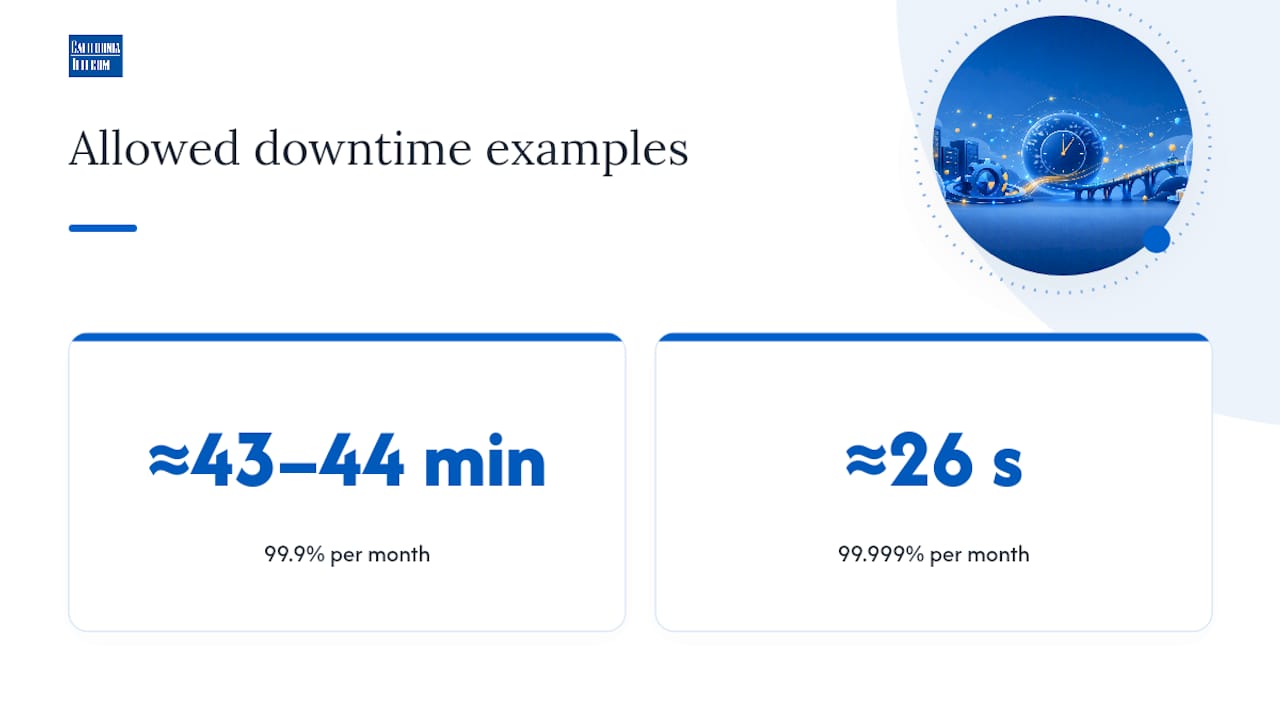
For comparison, that same source's table puts 99.9% (three nines) at roughly 43 to 44 minutes per month, and 99.999% (five nines) at around 26 seconds per month. If you want to sanity-check your own numbers or model a custom window, plenty of free SLA calculators do the arithmetic for you. Just confirm which day-count convention they use before you quote a figure to a vendor or a board.
What Does Four Nines Actually Buy You?
Three nines tolerates a rough patch: 43 to 44 minutes of monthly downtime is enough to absorb a botched deploy, a flaky dependency, or a slow database failover, and still hit the target. Four nines tolerates almost none of that. A single 10-minute outage blows through more than twice the monthly budget.
That difference matters most for specific categories of service:
- B2B SaaS platforms where an outage during business hours halts customer operations, not just your own.
- Payment gateways and financial transaction systems, where downtime translates directly into lost revenue and compliance exposure.
- Multi-location retail and healthcare networks, where a single site losing connectivity can mean lost sales or delayed patient care.
- Business continuity and disaster recovery services, where the whole value proposition collapses if the backup system isn't actually available when needed.
Consider two outage patterns. A logistics company that suffers one unplanned 45-minute outage per year, but otherwise runs clean, might actually still clear four nines on an annual basis, depending on how the rest of the year measured out. The lesson isn't "more redundant servers." It's that moving up a tier changes which failure modes you can tolerate and which ones now require a completely different response.
What Changes Operationally to Hit 99.99%?
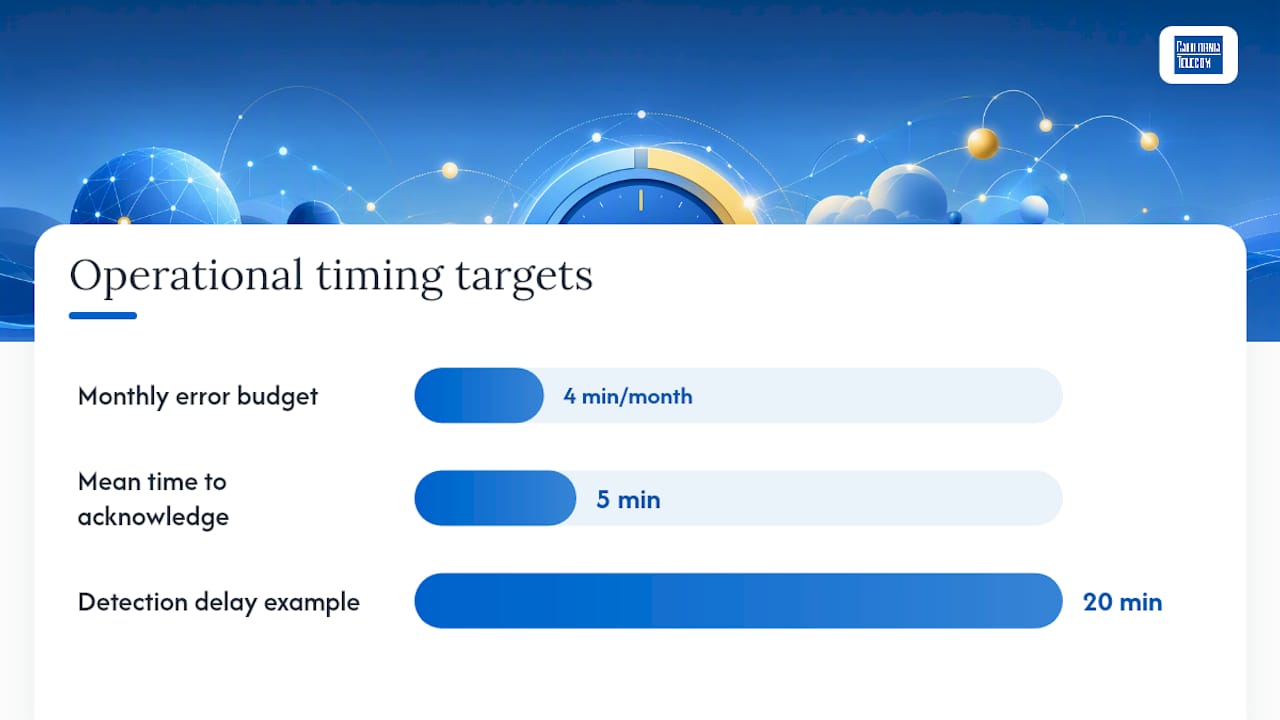
A 4-minute monthly error budget forces a specific kind of discipline. SRE teams treat that budget as a resource to spend, not a report card to fear. Once it's exhausted, the answer isn't "try harder." It's "stop shipping risky changes until the budget resets." That reframing alone changes how teams prioritize incident response and how they cover on-call practically.
The infrastructure side of the equation follows from the automated recovery requirement, but the practices matter more than the tools:
- Automated rollbacks that trigger on error-rate thresholds, not on someone noticing a dashboard spike.
- Progressive rollouts (canary or blue-green deploys) that limit blast radius before a bad change reaches every user.
- Synthetic checks from multiple geographic locations, catching regional outages that a single monitoring point would miss.
- Runbooks codified as automation scripts, not documents a human reads at 3 a.m. while half-awake.
On-call policy has to reflect reality here. If your mean time to acknowledge an incident is 5 minutes, you've already exceeded the entire monthly budget on one event. That's not a staffing problem you solve with more people, it's an architecture problem you solve by removing the pager from the critical path entirely for the most common failure types.
Pro Tip: If you're budgeting engineering time toward four nines, spend it on detection and automated failover before you spend it on additional redundancy. A second data center does nothing if it takes 20 minutes to notice the first one is down.
Which Architectural Patterns Actually Support Four Nines?
Reaching four nines is less about buying more infrastructure and more about designing the whole environment so infrastructure, traffic management, and recovery work as one system instead of three separate projects. Redundancy without automated traffic shifting just gives you a second thing that can also silently fail.
The technical checklist that shows up consistently across high-availability architecture guidance includes:
- Multi-zone or multi-region deployment, running active-active or hot-standby, with automated traffic shifting rather than manual DNS changes.
- Fast-convergence routing using BFD alongside BGP or OSPF, so link failures are detected in milliseconds instead of the minutes default timers allow.
- Resilient DNS design and automated certificate renewal, since an expired certificate or a slow DNS TTL has taken down more "highly available" systems than actual hardware failure.
- Data replication with quorum-based consistency, so a failed node doesn't force a choice between availability and data integrity.
- Zero-downtime deployment pipelines, eliminating maintenance windows as a routine cause of planned downtime.
Redundant internet circuits and dual-ISP failover deserve a specific mention, since connectivity is usually the single point of failure that architecture reviews skip. A dual ISP failover setup with automated route switching closes a gap that no amount of application-layer redundancy fixes on its own.
Pro Tip: Run a procurement review against this list before signing any managed services contract, not after. Ask specifically how traffic shifts during a failure, in seconds, and get the answer in writing.
How Is Uptime Actually Measured, and Where Do SLAs Hide Weakness?
The percentage on a contract means less than the measurement method behind it. A calendar-month window and a rolling 30-day window can produce different reported numbers from identical outage data, and rounding conventions compound the gap further. Some vendors report average availability across a fleet of customers; others report per-customer figures, which is the number that actually matters to you.
What counts as "downtime" is where most disputes happen. Total outages are easy to agree on. Degraded performance, like a service responding but three times slower than normal, often isn't counted at all unless the contract defines a specific response-time threshold.
Percentile reporting adds another wrinkle.
The gap between a contract's advertised percentage and a customer's actual experience almost always lives in the fine print: what's excluded, what window it's measured over, and who gets to declare an incident "resolved."
Watch for wide, unbounded maintenance windows, exclusions tied to a single upstream provider's failure, and vague language about when an outage "starts" and "ends" for billing purposes. Pairing your own network monitoring with whatever the vendor reports is the only way to know if the numbers match.
Is Four Nines Worth the Cost and Complexity?
Every additional nine costs disproportionately more than the last one. Three nines is achievable with decent hardware and a competent ops team. Four nines requires automation, redundant architecture, and a genuine SRE discipline. Five nines often demands specialized infrastructure and exponentially higher spending, the kind of investment that only makes sense for telecom cores, stock exchanges, or emergency services.
For most enterprise services, four nines is where the curve bends favorably: real protection against the outages that actually cost money, without the five-nines price tag.
If your business would survive a 45-minute annual outage without a serious revenue or trust hit, 99.9% might be enough. If four minutes a month is your real tolerance, budget for automation, not just bigger contracts.
Weigh engineering effort, vendor complexity, and procurement cost against your actual downtime tolerance before committing to a number in a contract you'll have to defend later.
What Should You Require From a Vendor Promising 99.99%?
Before signing anything, get specifics in writing. A percentage alone is marketing copy until it's backed by clauses that actually protect you:
- Exact measurement method and endpoints: rolling versus calendar window, and where availability gets measured (edge, origin, or per-site).
- Remedies and service credits: tied to actual measured downtime, not vague "best effort" language.
- Maintenance-window definitions: bounded, scheduled, and excluded from the calculation only within reasonable limits.
- Proof of automated failover testing: ask when they last tested it and what the recovery time was, not just whether redundancy exists.
- Synthetic monitoring from multiple geographies and published incident response time commitments.
This is exactly the kind of scrutiny worth applying to any provider, including one offering managed LAN/WAN services or nationwide network design, and it's a fair illustration of the standard: a 24/7 U.S.-based NOC and documented multi-carrier redundancy are checklist items you can verify, not just claims to take on faith.
An operator's honest take
Most organizations underestimate four nines because they budget for servers and skip the automation. The fix that matters most: invest in detection and automated recovery before you add another data center. Then push your MSP to show you the failover test logs, not just the SLA number.
Get 99.99% Uptime Without Building the NOC Yourself
Everything covered above, multi-region redundancy, automated failover, synthetic monitoring, a 4-minute error budget with no room for manual response, is exactly what California Telecom builds and operates for multi-location businesses every day.That matters most if you're currently patching together connectivity across several sites and discovering the gaps only when something breaks. California Telecom's engineers design and deploy each location directly, so the failover testing, routing convergence, and monitoring described in this article aren't theoretical, they're the deployment standard. If you're evaluating whether your current setup could survive a four-minute monthly budget, start with a look at nationwide managed network services and get a specific answer for your sites instead of a percentage on a slide deck.
Frequently Asked Questions
What is four nines uptime in plain numbers?
For most business-critical services, yes.
How is uptime percentage calculated? Allowed downtime equals the total time in your reporting window multiplied by (1 minus the availability percentage).
It depends entirely on the contract. Many SLAs exclude scheduled maintenance windows from downtime calculations, which is why it's worth confirming exactly what counts as an outage before signing.
Sources
- 99.99% uptime guide
- How to achieve 99percent uptime checklist
- 99.9% vs 99.99% Uptime: Real Downtime Numbers | Xitoring
Recommended
- Why Dedicated Fiber Beats Broadband: Save Your Business from $9,000 Per Minute Downtime | California Telecom
- MTTR vs MTBF: A Practical Guide for Engineering Managers | California Telecom
- What Is Network Throughput? A Clear Technical Guide | California Telecom
- Dedicated Fiber Internet — Internet Services | California Telecom