

How to Audit Telecom Spend Across Multiple LocationsRun a centralized telecom audit that inventories every circuit and invoice per site, reconciles bills to contracts, and targets zombie services and bandwidth right-sizing first. That sequence, done systematically, is where multi-location businesses recover the most money fastest.
Companies with distributed sites routinely overpay by 15–30% due to decentralized billing, ghost services, and contracts that no one is actively managing. The discipline that fixes this is called Telecom Expense Management (TEM), and a structured audit is where it starts.
Start here in the next 7–14 days:
- Pull three months of invoices across all locations and map each line to an active service in your inventory.
- Appoint a single owner (finance or IT) who has authority to contact carriers and pull contracts.
- Flag your top three zombie-service candidates: disconnected locations still billed, unused DID blocks, and POTS lines no one has touched in 12 months.
- Request a no-cost benefits analysis from Californiatelecom to get an outside benchmark before you commit to a full internal effort.
Key Takeaways
A structured multi-location telecom audit typically recovers 12–18% of annual spend through billing error correction and zombie service removal, with managed providers delivering results in 60–120 days.
| Point | Details |
|---|---|
| Start with invoices and inventory | Pull 12–24 months of invoices and map every line to an active service before anything else. |
| Target zombie services first | Unused DIDs, disconnected-site billing, and idle POTS lines are the fastest credits to recover. |
| Benchmark rates before renegotiating | Carrier rates from 3+ years ago rarely reflect market pricing; use multi-carrier data to negotiate. |
| Measure net recurring savings | Annualized recurring cost delta is the primary KPI; one-time credits are a bonus, not the goal. |
| Californiatelecom for managed execution | Californiatelecom runs inventory, disputes, consolidation, and ongoing TEM governance under one engagement. |
Table of Contents
- What does a complete multi-location telecom audit include?
- How to run a multi-location telecom audit step by step
- Where is telecom money actually leaking across distributed sites?
- How do you calculate ROI for a multi-location telecom audit?
- In-house audit or managed provider: which is right for your organization?
- A real example: what consolidation delivers in practice
- What questions should you ask vendors before signing?
- Californiatelecom runs your multi-location audit from start to finish
- Sources
What does a complete multi-location telecom audit include?
A thorough telecom expenditure audit covers every billable service at every site. Missing even one location creates gaps that billing errors hide in.
Per-site inventory checklist:
- Circuit IDs, account numbers, and service type (internet, MPLS, SD-WAN, voice/VoIP, mobile, UCaaS, POTS/DID)
- Vendor account IDs and billing entity names
- Contract start and end dates, auto-renewal clauses, and early-termination fees
- Billing frequency, payment method, and tax/jurisdiction codes
- Usage metrics: bandwidth utilization, call volume, pooled data consumption
Pooled services and shared-minute plans need special handling. A pool that looks fully utilized at the account level often masks individual sites that are dramatically over- or under-provisioned. Third-party cloud voice and UCaaS seats require a separate license reconciliation against active users, not just seat counts.
Review at least 12–24 months of invoices. Billing errors compound over time, and carriers rarely issue credits beyond 12 months unless you can document the error's origin date.
Data fields to collect and validate:
| Field | Source | Validation Check |
|---|---|---|
| Rate per unit | Signed contract | Match billed rate to contracted rate |
| Quantity billed | Invoice line | Compare to active service inventory |
| Tax and surcharge codes | Invoice | Verify jurisdiction applicability |
| Usage metrics | Carrier portal / CDR | Reconcile against billed usage |
| Contract term / expiry | Contract document | Flag auto-renewals within 90 days |
TEM is the standard discipline that owns this scope. Organizations implementing comprehensive TEM practices typically remove a substantial portion of recurring spend. Multi-location complexity compounds errors: location churn and pooling miscalculations create disproportionately more billing problems as site counts grow.
How to run a multi-location telecom audit step by step
The sequence is: map, collect, reconcile, dispute, optimize, govern. Enterprise audits typically run 60–120 days; a first internal pass for a smaller estate can close in 4–8 weeks.
The 10-step playbook:
- Stakeholder kickoff. Assign a finance owner, IT lead, and procurement contact. Define scope: which sites, which service types, which vendors.
- Invoice and contract collection. Pull 12–24 months of invoices and all active contracts. Request carrier account summaries.
- Inventory build. Create a master service inventory: one row per circuit or service, per site.
- Reconciliation. Match every invoice line to an inventory record. Flag unmatched lines as potential zombie services.
- Rate benchmarking. Compare contracted rates to current market rates by region and service type.
- Dispute filing. Submit billing error disputes to carriers with documentation. Track dispute status and expected credits.
- Remediation. Disconnect confirmed zombie services, right-size overprovisioned circuits, and consolidate duplicate vendors.
- Contract renegotiation. Use benchmark data and consolidated volume to negotiate better rates at renewal.
- Implementation. Execute service changes, coordinate with site managers, and validate new invoices against updated contracts.
- Governance handover. Establish monthly invoice review cadence, assign ongoing TEM ownership, and set KPI targets.
Role time allocation (approximate):
- Finance owner: 30–40% of audit hours (invoice review, dispute tracking, ROI reporting)
- IT lead: 25–35% (inventory build, circuit validation, implementation coordination)
- Procurement: 10–15% (contract pulls, vendor negotiation support)
- External auditor/managed provider: absorbs 50–70% of total effort when engaged
For large estates, run location batches in parallel. Group sites by carrier or region to concentrate dispute filings and negotiation leverage. Multi-state operations need jurisdiction-level tax validation since surcharge structures vary by state.
Pro Tip: Coordinate site-level contacts before the audit starts. A single spreadsheet with each location's on-site manager, their phone number, and the local carrier account rep compresses the inventory phase by weeks.
Where is telecom money actually leaking across distributed sites?
The five highest-impact savings levers, ranked by typical recovery size across multi-site enterprises:
- Billing error recovery. Carriers bill incorrectly more often than most finance teams realize. A structured first audit against contracted rates typically finds errors in the 8–15% range of audited spend.
- Zombie service removal. Disconnected locations still on billing, unused DID blocks, and POTS lines with zero call volume are pure waste. These are often the fastest credits to recover.
- Contract renegotiation and benchmarking. Rates negotiated three or more years ago rarely reflect current market pricing. Batching renewals across sites creates volume leverage that a single-site negotiation never achieves.
- Vendor consolidation to a single bill. Fragmented vendors mean fragmented visibility. Consolidating telecom billing across locations reduces invoice-processing overhead and surfaces cross-site pricing inconsistencies.
- Bandwidth right-sizing and UC migration. Overprovisioned circuits and legacy voice infrastructure (POTS, PRI) carry significant monthly costs. Migrating to UCaaS or SD-WAN often cuts per-site voice and connectivity costs while improving performance.
Pro Tip: * Pool-based licensing for VoIP phone systems for multi-site and remote offices across all locations lets you buy to your average concurrent usage rather than your peak per-site headcount.
How do you calculate ROI for a multi-location telecom audit?
The primary KPI is net recurring cost delta after remediation, annualized. Everything else supports that number.

| KPI | What It Measures |
|---|---|
| Gross recoveries | One-time credits from billing error disputes |
| Recurring monthly savings | Ongoing cost reduction after remediation |
| Time to first recovery | Days from audit start to first credit received |
| Audit cost | Internal hours + any external fees |
| ROI multiple | (Annual savings + recoveries) ÷ audit cost |
| Invoice error rate | % of invoice lines with billing discrepancies |
| Zombie service count | Number of inactive services identified and removed |
| Invoice processing time | Hours per month to process and approve invoices |
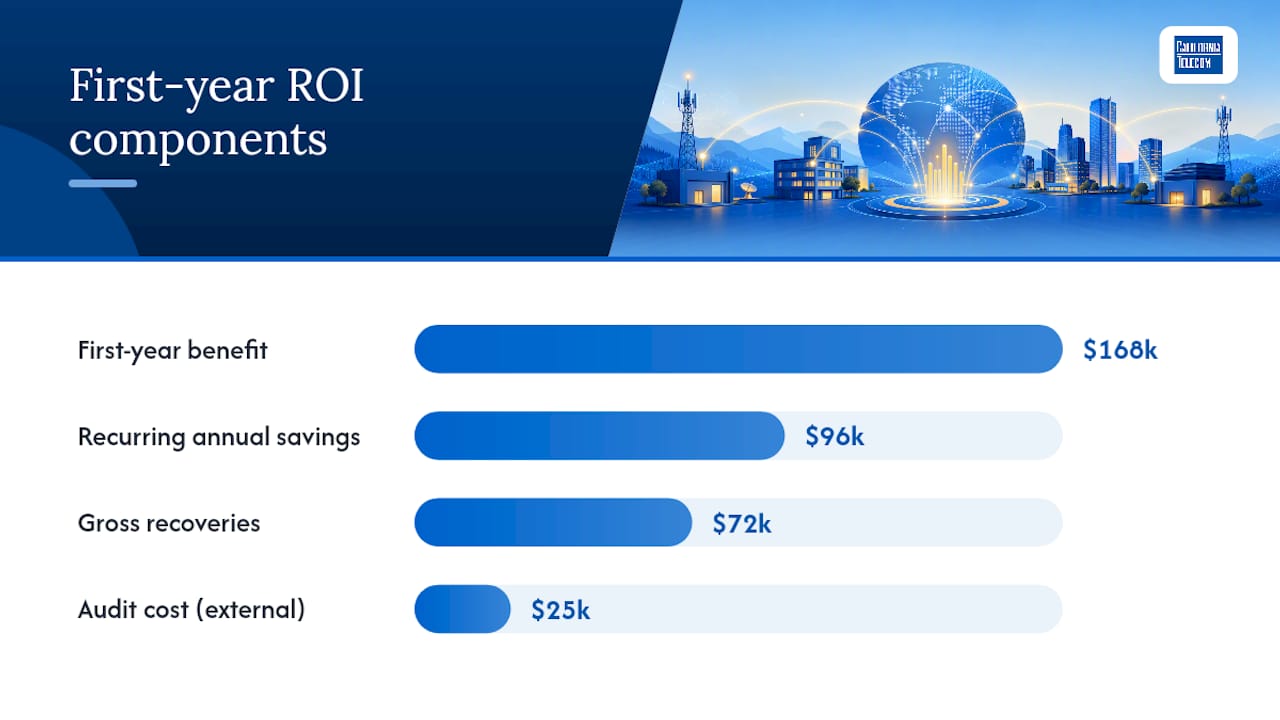
Sample ROI calculation:
A 15-location business with $600,000 in annual telecom spend runs a 90-day audit. Using conservative recovery estimates from enterprise audit benchmarks, billing error recovery at 12% of audited spend yields $72,000 in one-time credits. Recurring savings from zombie removal and right-sizing add $8,000/month, or $96,000 annualized. Total first-year benefit: $168,000. Audit cost (external managed provider): $25,000.
TEM also delivers operational ROI beyond direct savings. Invoice automation alone reduces processing time by roughly 60% across enterprise clients, freeing finance staff for higher-value work.
In-house audit or managed provider: which is right for your organization?
Hire a managed provider when you lack a single dedicated owner, current market benchmark data, or negotiating leverage across many locations. Internal audits work when you have all three.
| Dimension | In-House | Managed Provider |
|---|---|---|
| Savings impact | 8–15% (first pass) | 15–30% (with benchmarks + dispute expertise) |
| Time to deploy | 8 weeks | 4–10 weeks |
| Staff overhead | High (finance + IT hours) | Low (provider absorbs most effort) |
| Dispute handling | Limited carrier leverage | Established carrier relationships |
| Ongoing governance | Requires dedicated headcount | Included in service model |
| One-bill consolidation | Not available | Available with right provider |
A high-quality managed provider delivers: a complete service inventory, dispute recovery with documented results, carrier negotiation using real market benchmarks, monthly governance reporting, and a single bill across all locations. The multi-site network management complexity alone justifies outside expertise for most organizations above 10 locations.
Californiatelecom fits this model specifically: 50+ carrier relationships, engineer-led design and deployment at each site, a 24/7 U.S.-based NOC, and a single-bill model that eliminates the vendor-juggling that creates billing errors in the first place.
A real example: what consolidation delivers in practice
A multi-location wholesale distributor operating across multiple states ran a full telecom consolidation engagement with Californiatelecom. The case study results show what a structured audit and remediation produces in a real distributed environment.
Before the engagement: Multiple carriers, fragmented billing, no centralized inventory, and significant spend on legacy voice infrastructure. After: Single-provider model, consolidated billing, zombie services removed, and bandwidth right-sized to actual utilization. Recurring savings landed in a range around one-fifth, with implementation completed within several months.
Before/after summary:
Primary levers: billing error recovery, zombie service removal, vendor consolidation, and bandwidth right-sizing. The single-bill model also cut invoice-processing time significantly, consistent with the 60% processing reduction seen across enterprise TEM engagements.

What questions should you ask vendors before signing?
Top three vendor selection priorities: documented recovery results, a neutral and transparent methodology, and a clear SLA and governance model.
Required documentation before you sign:
- Sample audit methodology and deliverable format
- References from multi-location clients with comparable site counts
- SLA details: NOC coverage hours, uptime guarantees, dispute resolution timelines
- Evidence of multi-carrier sourcing relationships (not a single-carrier reseller)
- Sample ROI report from a completed engagement
Questions to ask every vendor:
- What percentage of audited spend do you typically recover, and can you show documented examples?
- How do you handle carrier disputes, and what is your average resolution time?
- Do you provide a single consolidated bill across all locations?
- Is your NOC U.S.-based and available 24/7?
- How do you source services: do you have direct relationships with multiple carriers?
- What does ongoing governance look like after the initial audit?
Red flags:
- Vendor is funded by a single carrier (creates bias in recommendations)
- No engineer-led deployment; relies entirely on carrier self-install
- Support is offshore or limited to business hours
- Cannot provide documented dispute success rates
- No clear methodology for ongoing invoice validation
For additional guidance on choosing a managed network provider for multi-site environments, Californiatelecom's resource covers the full evaluation framework.
Why finance leaders tend to prefer managed consolidation
The speed of ROI is what usually settles this decision. An internal audit that takes six months to produce its first credit is a harder sell to a CFO than a managed engagement that delivers documented recoveries in 60–90 days. Finance leaders also value a single point of accountability: when billing errors recur, there is one call to make, not a carrier-by-carrier investigation across a dozen account teams.
The operational simplicity compounds over time. A single bill, a single engineer contact, and a monthly governance report replace the distributed overhead of managing telecom across sites. Change management across locations is also easier when a managed provider coordinates site-level transitions directly, rather than routing every change through an already-stretched internal IT team.
Californiatelecom runs your multi-location audit from start to finish
Californiatelecom delivers the full audit and remediation sequence: inventory build, invoice reconciliation, dispute management, prioritized remediation, and ongoing TEM governance, all under one managed engagement.What's included in the baseline audit:
- Complete service inventory across all locations
- 12–24 month invoice reconciliation against contracted rates
- Dispute filing and carrier negotiation for identified errors
- Prioritized remediation plan with dollar-quantified findings
- Implementation option: Californiatelecom's engineers execute the changes
With nationwide managed network services and sourcing across 50+ carriers, Californiatelecom brings the benchmark data and carrier leverage that internal teams rarely have.
Request a free benefits analysis at Californiatelecom to see estimated recoveries for your specific site footprint before committing to a full engagement.
FAQ
How much does a multi-location telecom audit typically recover?
A structured audit typically recovers 12–18% of annual telecom spend, mostly through billing error correction and removal of zombie services — lines and features still billed at sites that no longer use them.
How long does a telecom audit take?
Enterprise audits typically run 60–120 days end to end. A first internal pass over a smaller estate can close in 4–8 weeks.
What are the steps in a multi-location telecom audit?
The sequence is: map every site and service, collect invoices and inventory, reconcile billing against contracts, dispute errors, optimize rates and services, then set up ongoing governance so the estate doesn't drift again.
Should you audit in-house or hire a managed provider?
Hire a managed provider when you lack a single dedicated owner, current market benchmark data, or negotiating leverage across many locations. Internal audits work when you have all three. Speed of ROI usually settles it — documented recoveries in 60–90 days beat a six-month internal effort.
Sources
- Telecom Audit Checklist for Multi-Location Businesses (Reduce Costs 15-30%)
- Enterprise Telecom Expense Audit: Complete Guide + 47 Common Billing Errors | Socium
- How to Run a Telecom Expense Audit | Pure IP
This article is general information, not a substitute for advice from a qualified financial advisor. Consult a qualified financial professional about your own circumstances before acting on anything here.