

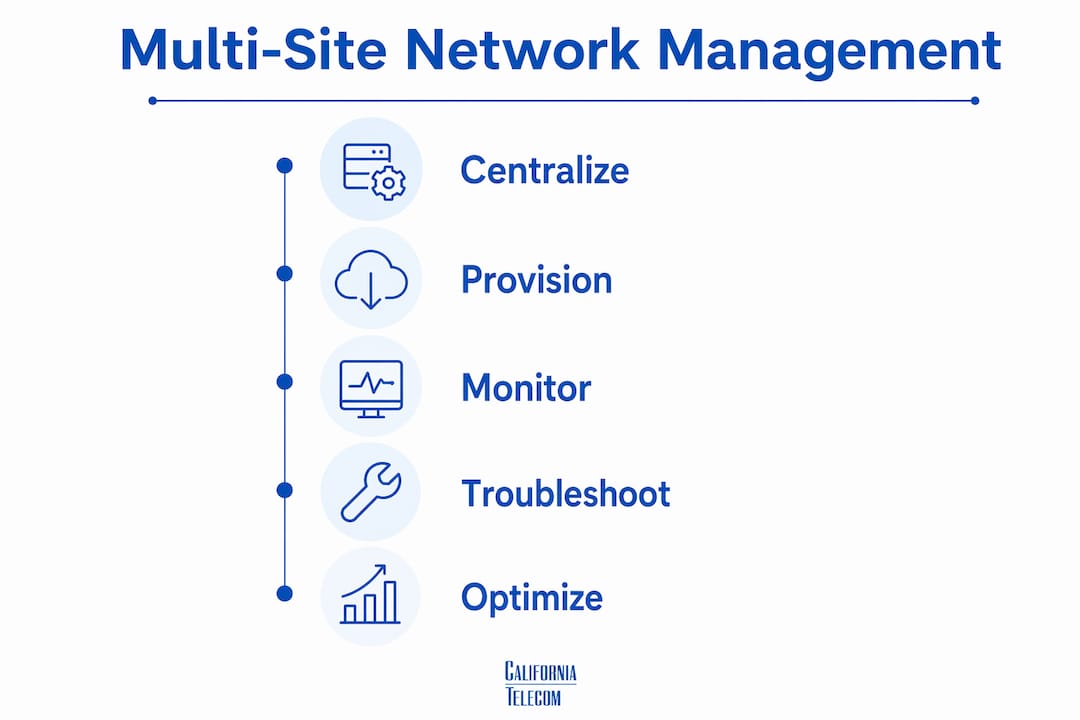
Multi-Site Network Management Explained for IT LeadersThe single most effective approach to managing a network across multiple locations is a centrally governed, template-driven model built on SD-WAN overlays, a centralized controller, and a 24/7 NOC with documented SLAs. Everything else, including the architecture choices, the deployment timeline, and the security controls, flows from that core decision.
Here is why that matters operationally:
- 84.9% of organizations that adopted centralized management reported fewer on-site visits and interventions.
- Survey data from multi-location network operations professionals consistently flags two primary pain points: limited situational awareness across sites and a heavy on-site troubleshooting burden.
- SLA benchmarks worth demanding from any provider include very high availability on data circuits and voice, along with encrypted site-to-site tunnels using IPsec AES-256 and TLS 1.3 for application traffic.
If your organization runs more than three locations and still relies on per-site configuration or reactive break-fix support, the operational drag is costing you more than a managed model would.
Table of Contents
- What is multi-site network management and why does it matter?
- What are the core architecture components you need to evaluate?
- What operational challenges should you expect across sites?
- Managed, DIY, or hybrid: which operational model fits your organization?
- How do you choose the right provider or model?
- What does a typical deployment look like, and what drives cost?
- Which KPIs should you track for multi-site network performance?
- How do security and compliance requirements apply across distributed sites?
- What does a repeatable site onboarding playbook look like?
- How does centralized management reduce on-site burden in practice?
- Key Takeaways
- What IT leaders consistently underestimate about multi-site networks
- Californiatelecom delivers the managed network model this guide recommends
- Selected sources and further reading
What is multi-site network management and why does it matter?
Multi-site network management is the centrally governed set of policies, templates, and tools that connect and operate WAN, LAN, Wi-Fi, and voice infrastructure across geographically dispersed locations. The goal is a consistent, predictable user experience at every site, regardless of whether that site is a flagship office or a small retail branch.
"Consistent internet performance across sites requires centralized management, standardized hardware and templates, provider consolidation where practical, and redundancy through automated failover." — multi-location connectivity guidance
The business value is concrete. Centralized management lowers mean time to repair (MTTR) because engineers diagnose issues remotely instead of dispatching a technician. It simplifies vendor and carrier management by consolidating contracts. It enforces a uniform security posture across every site rather than leaving branch configurations to local staff. And it makes adding a new location a repeatable process rather than a one-off project.
The named building blocks decision-makers must account for: SD-WAN, MPLS, edge routers, access switches, Wi-Fi controllers, centralized orchestrators, and a NOC that monitors the whole estate.
What are the core architecture components you need to evaluate?
| Layer | Components | Key Decision |
|---|---|---|
| WAN overlay | SD-WAN, MPLS, dedicated fiber, IPsec VPN | Latency, cost, and redundancy tradeoffs |
| Edge stack | CPE routers/SD-WAN appliances, switches, APs, firewalls | Standardize hardware SKUs across sites |
| LAN/Wi-Fi | Access switches, Wi-Fi controllers, VLANs | Segmentation and consistent policy push |
| Voice/UC | UCaaS gateways, SIP trunks, hosted PBX | Integration with centralized dial plan |
| Orchestration | Cloud or on-prem controller, ZTP, policy templates | Single pane of glass for all sites |
Multi-site connectivity architectures fall into four topologies: hub-and-spoke, full mesh, partial mesh, and ring. Each carries distinct latency, redundancy, and cost profiles. Hub-and-spoke is the most common starting point for branch-heavy organizations; full mesh suits latency-sensitive workloads like real-time voice and video.
Design insight: For large deployments scaling to hundreds of sites, a hierarchical SD-WAN control plane using Master Control Nodes and Regional Control Nodes keeps administration manageable by region while preserving central policy authority.
Zero-touch provisioning (ZTP) is the operational multiplier here. A new site ships pre-configured hardware; the controller pushes the template on first boot. No truck roll required for initial configuration.

What operational challenges should you expect across sites?
The two problems that surface most consistently in network operations surveys are limited situational awareness and a heavy on-site maintenance burden. These are not abstract concerns. When your NOC cannot see a site's link quality in real time, the first sign of a problem is often a call from a branch manager.
The operational impact breaks down like this:
- Many teams report network issues at individual sites more than once a month.
- Incidents frequently take one to two hours or longer to resolve when engineers lack remote visibility.
- Without centralized logs and alerting, troubleshooting requires a physical visit, which drives up both MTTR and operational cost.
Where centralized management closes the gap: remote diagnostics, automated alerting on threshold breaches, centralized log aggregation, and proactive incident detection before users notice. The 84.9% of adopters who reported fewer on-site visits is the measurable payoff of solving these two problems at once.
Pro Tip: Track truck rolls per site per quarter as a KPI from day one. It is the single most direct measure of whether your centralized management investment is working.
Managed, DIY, or hybrid: which operational model fits your organization?
| Model | Best Fit | Watch Out For |
|---|---|---|
| Fully managed | Mid-market, limited in-house staff, rapid site growth | Vendor lock-in; review contract exit terms |
| DIY/insourced | Large enterprise with deep network staff and scale | High headcount cost; local troubleshooting burden |
| Hybrid | Organizations migrating from legacy MPLS; want policy control | Requires clear RACI between internal team and provider |
Managed provides a single vendor accountable for uptime, a NOC that monitors continuously, and predictable monthly operating expense. The tradeoff is less direct control over day-to-day configuration decisions.
DIY makes sense when you have the staff depth and site volume to justify building your own NOC. The savings are real at scale, but so is the headcount requirement and the on-site burden when something breaks at 2 AM.
Hybrid is the practical middle ground for organizations mid-migration. You retain ownership of network design and policy, while outsourcing monitoring, alerting, and break-fix response. This is common when a company is moving off MPLS and wants to preserve institutional knowledge while offloading operational overhead.
Standardized bandwidth tiers and site categories reduce under- or over-provisioning and simplify procurement across dozens of ISPs, regardless of which model you choose.
How do you choose the right provider or model?
Evaluation criteria to score every proposal against:
- SLA guarantees: minimum 99.99% availability on data, 99.999% on voice, with documented RTO commitments.
- Carrier diversity: does the provider source from multiple carriers, or are you exposed to a single-carrier outage?
- Single-pane observability: one dashboard covering all sites, not a patchwork of carrier portals.
- Security capabilities: NAC, micro-segmentation, and DLP where sensitive data is present.
- Support model: 24/7 U.S.-based NOC with named escalation paths, not a ticket queue.
Questions to ask every vendor:
- Show me a sample SLA with MTTR commitments, not just availability percentages.
- How does your zero-touch provisioning work for a net-new site? Walk me through the steps.
- What does your pilot scope look like, and what does success look like at the end of it?
- How do you integrate with our existing UCaaS or on-premises phone system?
Red flags that should end a conversation:
- Opaque pricing with license tiers that are hard to map to your site count.
- Limited carrier options that create single-carrier dependency.
- No reference deployments at comparable scale.
- Offshore or business-hours-only NOC.
For a structured vendor evaluation checklist, the managed network provider selection guide covers these criteria in depth.
What does a typical deployment look like, and what drives cost?
| Phase | Typical Duration | Key Activities |
|---|---|---|
| Audit and requirements | 1–2 weeks | Site surveys, circuit inventory, hardware assessment |
| Pilot / proof of concept | 2–6 weeks | Deploy 1–3 sites, validate templates and ZTP |
| Regional rollout waves | 4–12 weeks per wave | Staged cutover, carrier circuit installs, QA |
| Steady-state operations | Ongoing | NOC monitoring, SLA reporting, change management |
Carrier circuit lead times are the most common schedule killer. Fiber installs in particular can run 6–12 weeks depending on the market. Build that into your plan before you commit to a go-live date.
Primary cost drivers:
- CPE hardware per site (routers, switches, access points, firewalls).
- Carrier circuit installation fees and monthly recurring charges.
- Labor for physical site installs and cabling.
- License or subscription fees for SD-WAN orchestration and management platforms.
- Recurring managed-service operating expense.
Structured site surveys and standardized cabling reduce long-term troubleshooting costs and make each subsequent site faster to deploy. The first site in a wave is always the slowest; by site five, your team should be running on a repeatable playbook.
For guidance on scaling network infrastructure to new locations, the operational considerations are consistent regardless of the provider model you choose.
Which KPIs should you track for multi-site network performance?
| KPI | What It Measures | Target Benchmark |
|---|---|---|
| Availability per site | Uptime against SLA | 99.99% data / 99.999% voice |
| MTTR | Time from incident detection to resolution | Under 4 hours for P1 incidents |
| MTBF | Frequency of failures per site | Trending upward over time |
| Bandwidth utilization | Capacity headroom per circuit | Below sustained peak |
| Packet loss / jitter | Voice and video quality indicators | <1% loss, low jitter for UCaaS |
Your monitoring stack should include SNMP and NetFlow for device and traffic telemetry, synthetic tests for application-layer performance, and centralized logging for incident correlation. For UCaaS specifically, per-call quality metrics matter as much as raw bandwidth numbers.
Real-time centralized logging is the operational foundation for all of this. Without it, you are correlating incidents manually across site-specific logs, which is slow and error-prone. Automated daily dashboards and SLA trend reports give leadership the visibility they need without requiring an engineer to build a report every week.
How do security and compliance requirements apply across distributed sites?
Every site in your network is an attack surface. The controls to standardize across all locations:
- Encrypted site-to-site tunnels using IPsec AES-256.
- TLS 1.3 for all application traffic traversing the WAN.
- Network Access Control (NAC) to enforce device posture before granting network access.
- Micro-segmentation to isolate workloads and limit lateral movement.
- DLP policies where sites handle sensitive customer or patient data.
"Consistent policy deployment across sites, including VLANs, access rules, and firmware, is the operational foundation for maintaining a uniform security posture at scale." — centralized multi-site network control guidance
For U.S.-specific compliance: HIPAA applies to any site that stores, processes, or transmits protected health information. PCI DSS applies wherever credit card data is present, including retail branches and payment kiosks. Both frameworks require documented data flows, network segmentation evidence, and audit logs. State data-breach notification laws add a third layer that varies by jurisdiction.
Centralized patching, role-based administrative access, and regular compliance audits mapped to site categories are the operational practices that keep you audit-ready. Healthcare network deployments carry the highest compliance burden and benefit most from a managed provider with documented HIPAA controls.
This article is general information, not legal or compliance advice. Confirm current regulatory requirements with a qualified professional for your specific situation.
What does a repeatable site onboarding playbook look like?
- Site audit and survey: Document existing circuits, hardware, cabling, and power. Use a tool like Findle to track hardware assets and site inventory across your estate.
- Template selection: Match the site to a predefined tier (small branch, regional hub, data-sensitive location) and assign the corresponding configuration template.
- Circuit and hardware procurement: Order carrier circuits early. Ship pre-staged CPE to the site.
- ZTP and pilot: Hardware connects to the network; the controller pushes the template automatically. Validate connectivity, QoS, and failover before cutover.
- Cutover and QA: Migrate production traffic, confirm SLA enrollment, and run synthetic tests across all critical applications.
- Documentation and SLA enrollment: Update the CMDB, assign the site to its NOC monitoring tier, and document the local breakout rules and failover paths.
Pro Tip: Operationalize ZTP with link-tagging and path-quality profiles so the orchestrator enforces failover and QoS automatically. Manual per-site changes at scale are where configuration drift starts.
For a detailed walkthrough of managed network onboarding procedures, the process maps directly to this checklist.
How does centralized management reduce on-site burden in practice?
The operational pattern is consistent across multi-site rollouts. Before centralized management, a branch network issue triggers a ticket, an engineer attempts remote diagnosis with limited visibility, and a truck roll follows. After centralized management, the NOC detects the anomaly before the branch calls, isolates the fault layer remotely, and resolves most incidents without dispatching anyone.
"Centralized managed network services provide single-point accountability, carrier aggregation, and 24/7 NOC-backed SLA commitments — the combination that closes the situational awareness gap at scale." — California Telecom managed services
The measurable outcomes from a well-executed rollout:
| Metric | Before Centralized Management | After Centralized Management |
|---|---|---|
| On-site interventions | Frequent; reactive | Reduced; 84.9% of adopters report fewer visits |
| Incident detection | User-reported | Proactive NOC alerting |
| MTTR | 1–2+ hours typical | Faster remote resolution |
| Carrier management | Multiple vendor contacts | Single point of contact |
Single dashboard observability, carrier aggregation across 50+ providers, and a 24/7 U.S.-based NOC are the three operational features that drive these outcomes. Multi-site deployment examples show how these elements combine in practice across different industries and site counts.
Key Takeaways
A centrally governed, template-driven model with SD-WAN, ZTP, and a 24/7 NOC is the most reliable way to close situational awareness gaps and reduce on-site maintenance burden across multiple locations.
| Point | Details |
|---|---|
| Centralized management cuts truck rolls | 84.9% of adopters reported fewer on-site visits after implementing centralized management. |
| SLA benchmarks to demand | Require 99.99% data availability and 99.999% voice availability with documented MTTR commitments. |
| ZTP and templates reduce deployment risk | Standardized site templates and zero-touch provisioning make each new site faster and more consistent. |
| Track MTTR and truck rolls from day one | These two KPIs directly measure whether your centralized management investment is delivering. |
| Californiatelecom maps to this checklist | Multi-carrier sourcing, single-dashboard observability, and a 24/7 U.S.-based NOC back every managed deployment. |
What IT leaders consistently underestimate about multi-site networks
The architecture conversation gets most of the attention. SD-WAN vs. MPLS, hub-and-spoke vs. full mesh, managed vs. DIY. Those decisions matter, but they are not where multi-site rollouts actually fail.
They fail on change management. A branch manager who does not understand why the network is changing will route around it. A local IT contact who was not trained on the new ticketing process will call the old carrier directly. A regional director who never saw the SLA report will not know the network improved. The technical architecture can be perfect and the rollout can still underperform because the people at the sites were not brought along.
The second thing leaders underestimate is how much operational drag comes from carrier fragmentation before any managed solution is in place. When you are managing 20 sites across 8 carriers with separate portals, separate contacts, and separate billing cycles, a significant portion of your IT team's time disappears into vendor coordination rather than actual network improvement. Consolidating to a single provider with carrier aggregation behind the scenes is not just a convenience. It is a structural fix to a time-sink that most organizations have normalized.
Prioritize visibility and SLA-backed support over minor initial cost savings. The cheapest managed option that lacks a 24/7 NOC will cost more in incident response time within the first year than the price difference.
Californiatelecom delivers the managed network model this guide recommends
Running a distributed network across dozens of locations without a single point of accountability is the operational problem this guide is built around. Californiatelecom solves it directly: multi-carrier sourcing from 50+ providers, custom Vergepoint hardware for single-dashboard observability, and a 24/7 U.S.-based NOC backing every deployment with a 99.99% data SLA and 99.999% voice SLA.You get one provider, one bill, and one engineer's number. No carrier-chasing, no fragmented vendor relationships, no reactive break-fix cycle. The managed LAN/WAN services include zero-touch provisioning, centralized orchestration, and carrier redundancy built in from day one. Whether you are adding three locations or thirty, the deployment model scales without adding headcount.
Request a scoped pilot or site audit through Californiatelecom's nationwide managed network services page and ask for MTTR commitments in writing before you sign anything.
Selected sources and further reading
| Source | Relevance |
|---|---|
| Third News — multi-location network ops survey | Survey data on situational awareness gaps and on-site burden |
| Multi-Site Connectivity Guide — MedianWifi | Architecture topologies and transport tradeoffs |
| SD-WAN Deployment Guide — Telecomate | Hierarchical control plane design for large-scale SD-WAN |
| Consistent Internet for Multi-Location Companies — Infinet Networks | Standardization and provider consolidation guidance |
| Network Design for Multi-Location Businesses — Ascio Wireless | Site survey and cabling standardization best practices |
| Californiatelecom Managed Services | Managed network capabilities, ZTP, and NOC proof points |
Recommended
- Multi-Site Network Deployment Examples for IT Leaders | California Telecom
- How Managed Network Onboarding Works for Multi-Site IT | California Telecom
- Managed network guide for California multi-location IT | California Telecom
- How to Choose a Managed Network Provider for Multi-Site | California Telecom