

Observability First Makes AI Useful for IT Teams' Network MonitoringAI for network monitoring uses machine learning models to parse telemetry, flag anomalies before they become outages, and pinpoint root cause without a human scrolling through log files. Done right, teams see faster detection, far fewer false-positive alerts, and routine fixes that run themselves. Success looks like a smaller on-call rotation and shorter outages, not a dashboard full of unread alerts.
TL;DR:
- Effective AI models require comprehensive, normalized telemetry sources like NetFlow, SNMP, Syslog, and distributed traces, integrated into a central data lake.
- Supervised models improve accuracy after six to twelve months of labeled incident data, but early deployment mainly relies on unsupervised anomaly detection.
- Low false-positive alerts and faster response times are proven benefits, especially when AI is integrated with automated remediation, reducing MTTR from hours to seconds.
- Incomplete telemetry, model drift, overautomation, and data privacy issues are common pitfalls that can hinder successful AI deployment in network management.
- Starting with explainable models, staged validation, and phased automation, along with properly prepared telemetry, is crucial for sustainable AI-driven network monitoring.
Table of Contents
- What AI Does in Network Monitoring: Telemetry and Preprocessing
- Core AI Capabilities: Detection, Prediction, and Automated Response
- Benefits and Limitations: What to Actually Expect
- Implementation Checklist and Readiness Steps
- Deployment Patterns: Edge, Cloud, and Distributed AI
- Measuring Success: KPIs That Actually Matter
- California Telecom's Approach to AI-Driven Network Monitoring
- Compliance and Data Privacy Considerations
- An Operations Leader's Take on AI Monitoring
- Get Help Implementing AI Network Monitoring
- Where to Read More
- Sources
What AI Does in Network Monitoring: Telemetry and Preprocessing
AI models are only as good as the telemetry feeding them. Before any anomaly detection or prediction happens, the raw data has to be collected, cleaned, and correlated across sources that rarely speak the same format natively.
Most networks feed AI systems from a mix of:
- NetFlow/IPFIX for traffic volume and conversation patterns
- SNMP polling for device health and interface counters
- Syslog for event and error messages
- Device metrics like CPU, memory, and queue depth
- Distributed traces for application-layer latency
- Configuration data to flag drift or unauthorized changes
Once collected, the data goes through sampling to control volume, enrichment to add context (site, device role, business criticality), normalization so a Cisco syslog entry and a Juniper one look the same to a model, and labeling for supervised training sets. Skip any of these steps and the model either drowns in noise or misses the signal entirely.
This is why a centralized observability platform matters more than any individual algorithm. A model trained on fragmented, uncorrelated telemetry will hallucinate patterns that do not exist. Correlated data, pulled into one data lake, is what separates a monitoring tool that predicts real problems from one that just generates more alerts.
Core AI Capabilities: Detection, Prediction, and Automated Response
Four capabilities do most of the heavy lifting in modern AI-driven network management, and each rests on a different technical foundation.
- Anomaly detection. Unsupervised models (clustering, autoencoders) work well when you have no labeled failure history, which describes most networks. Supervised models perform better once you have enough tagged incidents to train against, typically after six to twelve months of curated data.
- Predictive analytics. Time-series forecasting models flag capacity exhaustion or hardware degradation days or weeks out, using trends in bandwidth, error rates, or temperature that a human would never catch by eyeballing a dashboard.
- Root-cause analysis. Correlation engines link a spike in latency at one site to a specific upstream change, distinguishing causal signals from coincidental ones. Explainability matters here: a model that says "this is the cause" without showing its reasoning is not trustworthy during an actual outage, according to peer-reviewed guidance on explainable AI in operational settings.
- Automation. The safest pattern starts human-in-loop, with the model suggesting a remediation playbook for an engineer to approve. Closed-loop automation, where the system acts without approval, should be reserved for low-risk, well-tested actions like restarting a stalled service, not for anything touching production routing.
Benefits and Limitations: What to Actually Expect
The upside is real, but so are the ways teams trip over their own deployment.
Organizations that integrate AI-driven visibility with automated remediation report incident response times dropping from hours to seconds in mature deployments, according to Network World's reporting on enterprise AI adoption. Reduced false positives means engineers stop ignoring alerts altogether, which is its own quiet win. Stealthy issues, like slow memory leaks or intermittent packet loss, get caught weeks before they'd trigger a traditional threshold alert.
Pro Tip: If your team currently silences more than a handful of alert types out of habit, that's your best signal AI-driven prioritization will pay off immediately.
The failure modes are just as concrete:
- Incomplete telemetry produces models that miss entire classes of failure
- Model drift sets in as network topology and traffic patterns change over months
- Overautomation on unproven models causes self-inflicted outages
- Privacy concerns arise when packet-level data crosses regulatory boundaries
Only a minority of organizations report full success applying AI to network operations, and that gap tracks directly with data readiness and centralized data lake adoption. Explainability and staged validation are what close that gap, not a bigger model.
Implementation Checklist and Readiness Steps
Getting AI network monitoring right is less about picking a vendor and more about sequencing the work correctly.
- Inventory your telemetry. Map every data source against your network diagram and flag the blind spots. Most teams find gaps at branch sites first.
- Build a normalized pipeline. Route everything into a central data store so models see one consistent format instead of five dialects of the same event.
- Choose explainable models. Start pilots with algorithms that show their reasoning, not black-box scoring you can't defend to a skeptical on-call engineer.
- Define validation loops. Set a cadence for checking model accuracy against real outcomes and feed corrections back in.
- Plan compute placement. Decide early whether training and inference run centrally, at the edge, or both, because retrofitting this later is expensive.
Pro Tip: Run your first pilot on a single region or business unit for a sufficient period to catch typical traffic patterns before expanding. It's long enough to catch seasonal traffic patterns without risking your whole network on an unproven model.
Fixing tool sprawl and telemetry gaps before investing heavily in automation is the most consistent recommendation from industry practitioners working through AI-driven NetOps rollouts, and it's the step most teams try to skip.
Deployment Patterns: Edge, Cloud, and Distributed AI
Where you run inference depends on latency tolerance, bandwidth cost, and data sensitivity, not just budget.
Edge inference makes sense when a decision needs to happen in milliseconds, when raw data can't leave a site for privacy or contract reasons, or when backhaul bandwidth is too expensive to justify streaming everything centrally. The dominant pattern in production networks is hybrid: train models centrally on aggregated data, then push lightweight inference to edge devices or network edge locations for real-time decisions.
- Co-locating preprocessing at routers or edge nodes reduces both latency and bandwidth demand
- Sampling and statistical sketches cut data volume before it hits the model
- Model quantization shrinks a model's footprint so it runs on modest edge hardware
- APIs into ticketing and orchestration systems turn a detection into an actual work order
Coupling processing placement with network topology and device capability is a core design consideration that most vendor pitches gloss over entirely.
Measuring Success: KPIs That Actually Matter
Pick metrics before the pilot starts, not after, or you'll end up justifying the tool with vanity numbers.
- MTTR (mean time to resolution), tracked before and after AI deployment on comparable incident types
- Detection-to-action time, the gap between an anomaly appearing and a human or system acting on it
- False positive rate, measured as a percentage of total alerts, tracked weekly
- Automation coverage, the share of remediation steps handled without manual intervention
Run an A/B comparison where one region gets AI-assisted triage and a similar region continues with legacy alerting, then compare MTTR after 90 days. Report results monthly to stakeholders in plain operational terms: incidents caught early, hours of downtime avoided, alerts suppressed.
California Telecom's Approach to AI-Driven Network Monitoring
California Telecom runs Netverge Monitoring as a managed layer over multi-carrier connectivity, giving multi-location businesses a single dashboard instead of five vendor portals to reconcile during an outage.
- A network operations center watches telemetry around the clock, not just during business hours
- Visibility spanning multiple circuit types at every site helps close the blind spots most pilots stumble on
- Uptime service-level agreements on data service back the monitoring with an operational commitment
- Design and deployment run through engineers at each site, which helps keep telemetry formats consistent from day one
For IT teams that want the readiness steps above handled by someone else, this is the managed-service version of the same checklist.
Compliance and Data Privacy Considerations
Network telemetry often contains more sensitive data than teams realize: source and destination IPs can reveal customer locations, packet payloads can include personally identifiable information, and configuration logs can expose security architecture if they leak.
Regulatory frameworks like HIPAA for healthcare networks or PCI DSS for payment environments impose specific rules on how monitoring data gets stored, who can access it, and how long it's retained. Before feeding raw packet captures into an AI pipeline, confirm whether your industry requires anonymization or tokenization of identifying fields, and whether that processing needs to happen before data leaves a regulated environment.
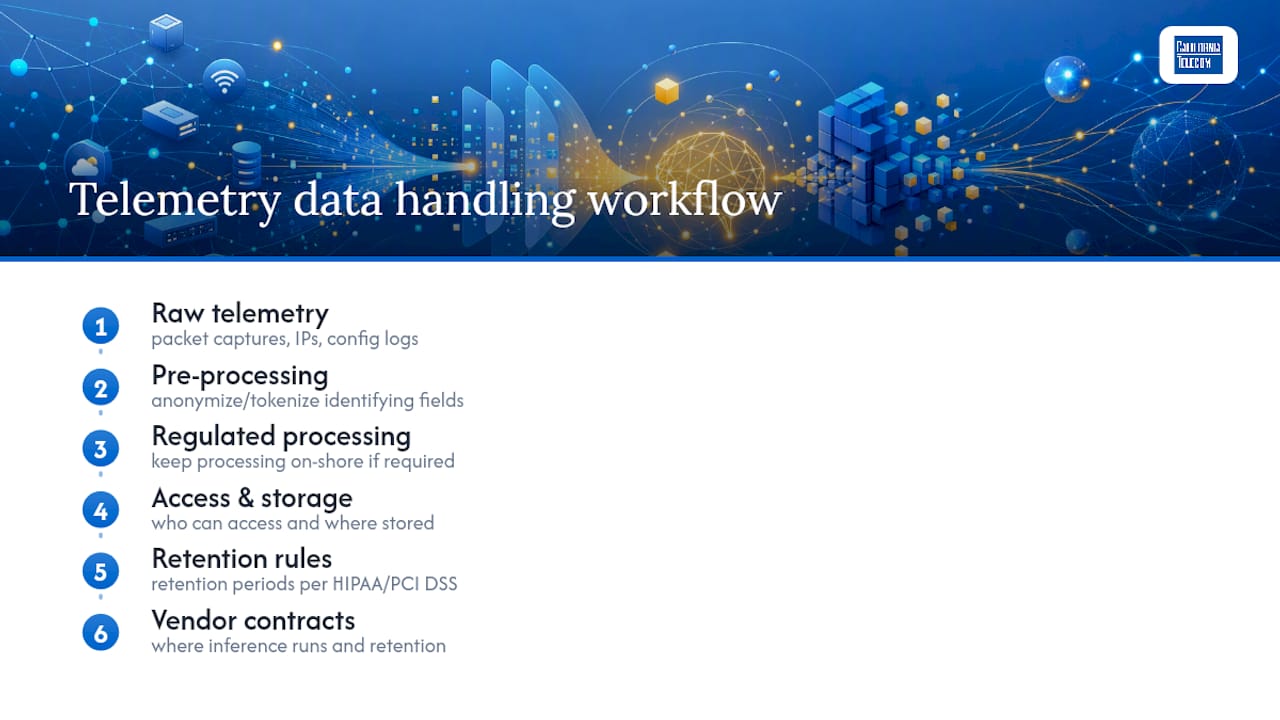
Cross-border data flow adds another layer. If your AI processing runs in a cloud region outside where the traffic originates, you may need contractual safeguards or on-shore processing depending on your industry and the jurisdictions involved. This is precisely where explainable models pay off: when a compliance officer asks why a specific data field was flagged or retained, "the model decided" isn't an acceptable answer during an audit.
Vendor contracts deserve the same scrutiny. Ask any AI monitoring provider exactly where inference runs, how long raw telemetry is retained, and whether your data trains models used by other customers. Teams that skip this step during procurement tend to discover the answer during their first compliance review, which is the worst possible time.
An Operations Leader's Take on AI Monitoring
Most teams get the order backwards. They shop for an AI model before fixing the telemetry gaps that would make any model useless anyway. Observability comes first, always. Start pilots with explainable models specifically because operators need to trust a recommendation before they'll act on it during a real outage, without long delays to prove vendor claims. The roadmap that works is boring: pilot small, validate accuracy and safety against real incidents, then expand automation one confirmed use case at a time. Skipping steps here doesn't save time. It just moves the failure to a worse moment.
— Jim
Get Help Implementing AI Network Monitoring
Reading the checklist is one thing. Building normalized telemetry pipelines across a dozen sites while still running daily operations is another. Teams wanting an observability-first approach without hiring a data science team to build it from scratch may consider external managed service providers.A free consultation covers a review of your current telemetry sources and where the gaps are, a pilot scope for AI-assisted monitoring on one region or business unit, and a rough sketch of the MTTR and alert-reduction returns you can expect based on your current setup. For multi-location businesses, the Nationwide Managed Network Services program pairs that monitoring with the carrier redundancy and 24/7 NOC support that makes AI-driven detection actually actionable instead of just another dashboard. If you're further along and want to see monitoring paired with LAN/WAN management specifically, the Managed LAN/WAN page covers that combination directly. Book the consultation and bring your current alert volume. That single number usually tells us where to start.
Where to Read More
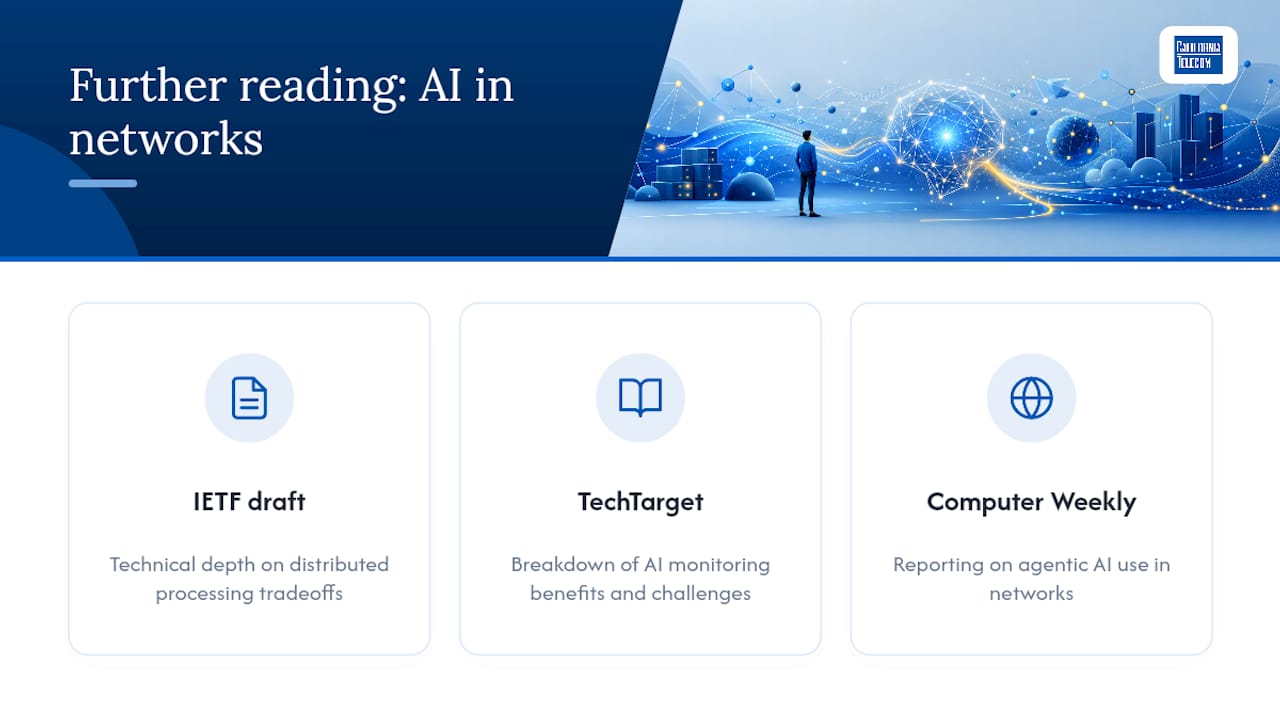
The IETF's draft on AI challenges in network management covers distributed processing tradeoffs in technical depth. TechTarget's breakdown of AI monitoring benefits and challenges and Computer Weekly's reporting on agentic AI in networks round out the operational and industry context.
Sources
- AI-driven network management gains enterprise trust — Network World
- Explainable AI recommendations for operational systems — PMC article
- Draft: Challenges for applying AI to network management — IETF (NM group)
- EMA AI-driven NetOps study (executive summary) — Broadcom / EMA
- The benefits and challenges of AI in network monitoring — TechTarget