

Why Multi-Location Retailers Need Centralized NetworkingCentralized networking is defined as the practice of managing, monitoring, and configuring every store location's network from a single platform. For multi-location retailers, this is not a convenience. It is the operational foundation that separates chains running at full capacity from those constantly reacting to outages, inconsistent configurations, and mounting IT costs. Understanding why multi-location retailers need centralized networking starts with one fact: distributed retail networks fail in predictable ways, and centralization addresses every one of them. The industry term for this discipline is centralized network management, and it applies equally to five-store regional chains and 500-location national brands.
Why multi-location retailers need centralized networking to run efficiently
Centralized network management eliminates the single largest cost driver in distributed retail IT: the truck roll. IT teams can manage hundreds of store networks remotely without ever dispatching a technician on site. That shift alone removes scheduling delays, travel costs, and the window of downtime that opens while a store waits for help to arrive.
The operational gains go deeper than cost savings. Template-driven orchestration propagates logical configurations automatically, so every store operates under identical network policies regardless of its physical hardware. A new firewall rule, a VLAN change, or a quality-of-service update applies to all locations the moment it is pushed from the central console. No store gets left behind on an outdated policy.
Proactive alerting is the third pillar of operational efficiency. Centralized dashboards identify failing ISP circuits or congested devices minutes before customers notice any degradation. That window is the difference between a silent fix and a line of customers unable to complete a transaction.
- Remote troubleshooting: Resolve most incidents without a site visit, cutting mean time to resolution from hours to minutes.
- Policy uniformity: Push configuration changes to all locations simultaneously through template-driven orchestration.
- Proactive alerts: Receive automated notifications about circuit failures or device congestion before they affect store operations.
- Reduced IT burden: Free your internal team from reactive firefighting so they can focus on growth projects.
Pro Tip: Schedule configuration pushes during off-peak hours, such as early morning before store open, to avoid any brief disruption to active sessions.
How does network reliability affect distributed retail operations?
Payment reliability is non-negotiable in retail. SD-WAN enables intelligent traffic prioritization, ensuring point-of-sale transactions move ahead of background processes like software updates or security scans. The result is 99.99% POS uptime through load balancing and automatic failover to a secondary circuit when the primary link degrades.
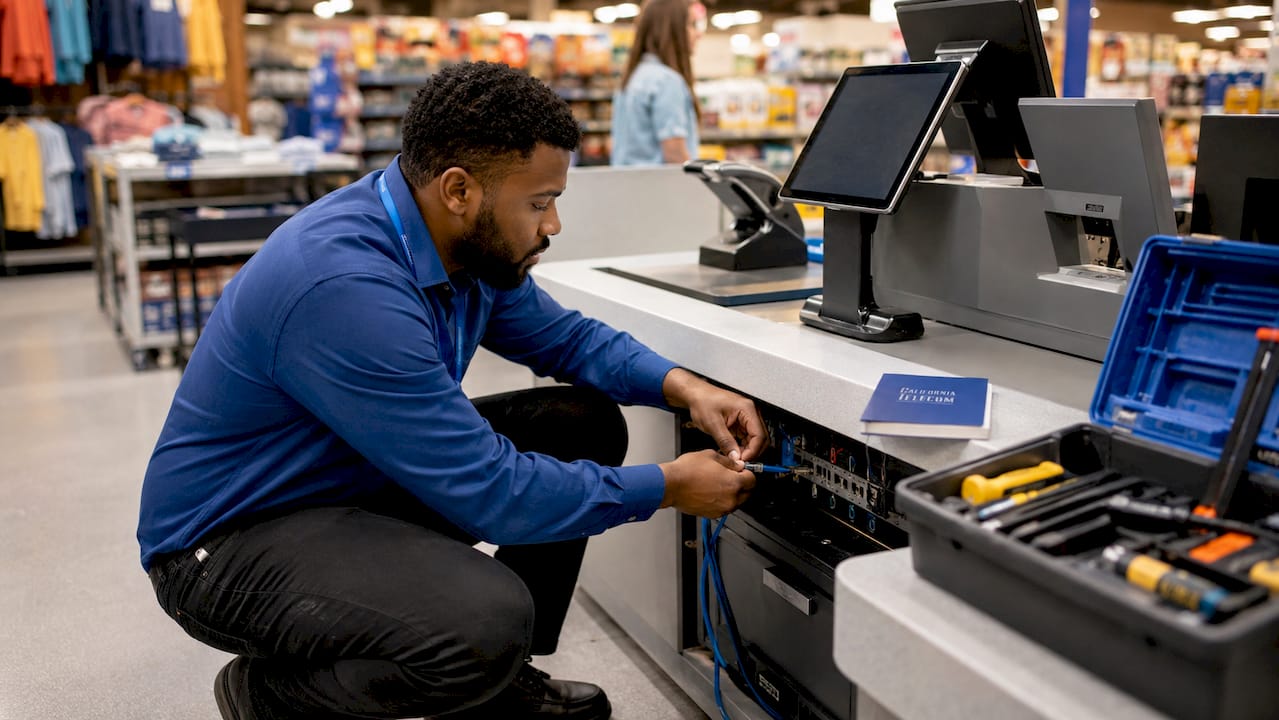
Real-time monitoring gives IT teams granular visibility into network performance and capacity across every location during peak hours. Black Friday traffic spikes, holiday promotions, and inventory scanning events no longer catch the network off guard. The central team sees the load building and can act before a store goes dark.
Compliance is a direct beneficiary of centralized visibility. PCI DSS requires network segmentation between cardholder data environments and general store traffic. Centralized firewall management applies segmentation consistently across the entire network portfolio, removing the risk that one store's misconfigured switch creates a compliance gap. For a deeper look at how SD-WAN supports retail networks, the architecture choices matter as much as the technology itself.
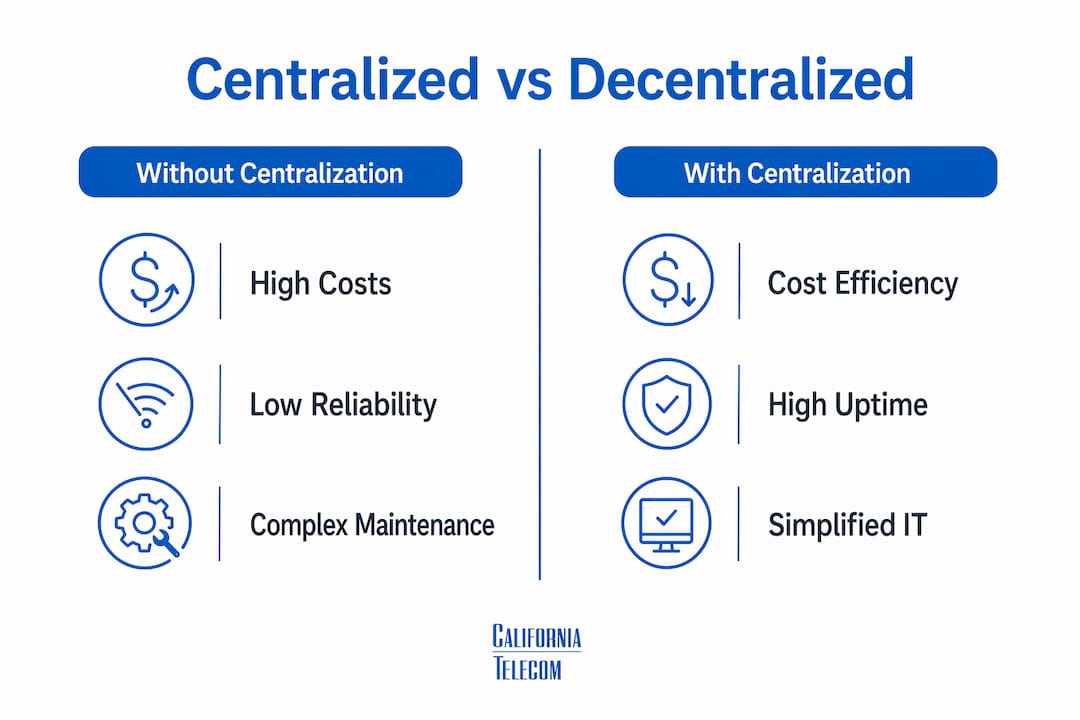
| Network function | Without centralization | With centralized management |
|---|---|---|
| POS uptime | Dependent on local IT response | 99.99% via SD-WAN failover |
| Incident detection | Store staff reports the problem | Automated alerts before impact |
| PCI DSS segmentation | Applied store by store, inconsistently | Enforced uniformly across all sites |
| Peak traffic handling | Reactive bandwidth requests | Proactive capacity monitoring |
What challenges do multi-location retail networks face without centralization?
Legacy wide-area networks create operational friction at scale. Multi-location retailers face unique WAN complexity that requires flexible yet standardized connectivity templates. When each store has its own carrier contract, its own hardware configuration, and its own support escalation path, the IT team spends most of its time managing inconsistency rather than improving the network.
Scaling without a centralized design compounds the problem. Scaling retail networks without centralized design leads to frequent costly misconfigurations and outages. Opening a new region means replicating a fragmented architecture, not deploying a proven template. Each new store adds risk rather than adding capacity.
Rollout complexity is a specific pain point that centralization solves through pre-staging. Pre-staging equipment reduces on-site installation times from days to plug-and-play hours. The device arrives at the store pre-configured. The local staff plugs it in, and the network comes up already aligned with corporate policy.
- Audit your current WAN contracts. Identify stores running on inconsistent carrier agreements and flag them for consolidation into a unified connectivity template.
- Map your configuration drift. Compare active configurations across locations to find stores that have deviated from the standard policy baseline.
- Pre-stage all new hardware centrally. Configure devices before they ship to the store so installation requires no local IT expertise.
- Plan rollouts after hours. Schedule upgrades outside business hours to protect POS operations during the transition.
- Centralize security oversight. Move firewall rule management to a single console to eliminate the compliance gaps that store-level administration creates.
Pro Tip: Maintaining a global connectivity checklist mindset applies directly to multi-site retail. Treat every new store opening like a deployment with defined connectivity standards, not an improvised setup.
How does centralized networking support retail growth and long-term strategy?
Network architecture either enables growth or quietly limits it. Network design unknowingly limits business growth when it is built for today's footprint rather than tomorrow's expansion. Centralized management removes that ceiling. Adding a new store means deploying a proven template, not engineering a custom solution from scratch.
Executives increasingly treat networking as a strategic asset. Visibility into device health and operational stability links network state to retail site financial performance. A store with a degraded network processes fewer transactions, delivers slower service, and loses revenue that never shows up in a network report. Centralized management makes that connection visible and measurable.
Cloud security alignment is another growth enabler. Unified governance means security policies follow the network as it expands, rather than being applied retroactively after a breach. For retailers expanding their network as a service model, centralized management is the architecture that makes cloud-first retail operations possible.
"Executives now view networking as a strategic asset rather than just IT infrastructure, linking it directly to financial and operational performance. The shift from reactive to proactive network management is what separates retailers who scale efficiently from those who absorb the cost of their own complexity."
The benefits of unified communication extend naturally from a centralized network. When voice, data, and application traffic all flow through a managed, monitored infrastructure, the IT team gains a single source of truth for every performance question. That clarity accelerates decisions and reduces the time between identifying a problem and resolving it.
Key Takeaways
Centralized network management is the single most effective way for multi-location retailers to reduce downtime, control costs, and build a network that supports growth rather than limiting it.
| Point | Details |
|---|---|
| Eliminate truck rolls | Remote management resolves most incidents without dispatching a technician to the store. |
| Enforce policy uniformity | Template-driven orchestration pushes identical configurations to every location simultaneously. |
| Protect POS uptime | SD-WAN traffic prioritization and automatic failover maintain 99.99% payment reliability. |
| Pre-stage for fast rollouts | Pre-configured hardware reduces store installation from days to hours with no local IT needed. |
| Treat the network as a growth asset | Centralized visibility links network performance directly to store-level financial outcomes. |
What I've learned watching retailers manage distributed networks
The retailers who struggle most are not the ones with the oldest hardware. They are the ones who standardized hardware without standardizing logic. I have seen chains where every store runs the same router model but every store has a different VLAN scheme, a different firewall rule set, and a different support contact. That is not a network. That is 200 separate networks that happen to share a brand name.
The shift that actually changes outcomes is moving from hardware standardization to logical configuration management. When the configuration is the standard, not the box, you can swap hardware without rebuilding policy. You can onboard a new store without a site visit. You can push a security patch to every location in minutes instead of weeks.
After-hours rollout planning is underrated. Most retailers schedule upgrades during slow periods, which is correct. But the ones who do it best pre-stage everything off site, ship a ready-to-run device, and have the central team monitoring the cutover in real time. The store manager plugs in a cable. The network team confirms the connection. The whole process takes under an hour. That is what network performance in retail looks like when the architecture is designed for it from the start.
The future of retail IT is not more technicians in more stores. It is fewer technicians with more visibility, managing more locations from a single console. The retailers building that capability now will open new stores faster, respond to incidents faster, and spend less doing both.
— Jim
Californiatelecom's managed network services for retail chains
Multi-location retailers need a network partner who has already solved the problems described above, not one who will learn on your stores.Californiatelecom delivers nationwide managed network services purpose-built for distributed retail environments. The team sources connectivity from 50+ carriers, designs and deploys each site through its own engineers, and backs every service with a 24/7 U.S.-based NOC. Retailers get a 99.99% uptime SLA on data and 99.999% on voice, with one provider, one bill, and one engineer's direct number. Whether you are managing 10 stores or 500, Californiatelecom's managed LAN/WAN services give your team the centralized control and real-time visibility your operations require. Contact Californiatelecom to schedule a consultation.
FAQ
What is centralized network management for retail?
Centralized network management is the practice of monitoring, configuring, and troubleshooting all store locations from a single platform. It replaces store-by-store IT management with unified control that reduces costs and improves response times.
How does SD-WAN improve POS reliability across locations?
SD-WAN prioritizes POS traffic over background processes and automatically fails over to a secondary circuit when the primary link degrades. This maintains 99.99% uptime for payment transactions even during ISP outages.
How does centralization help retailers scale to new locations?
Centralized management uses pre-configured templates that deploy to new stores without requiring local IT expertise. Pre-staging hardware off site reduces installation time from days to hours.
What compliance benefits does centralized networking provide?
Centralized firewall management enforces PCI DSS network segmentation consistently across every location. This eliminates the compliance gaps that occur when individual stores manage their own security configurations.
How does centralized networking reduce IT costs for retailers?
Remote management eliminates most truck rolls, cutting travel costs and reducing the time stores spend waiting for on-site support. Automated alerts also catch issues before they escalate, lowering the total number of incidents that require intervention.