

Network-as-a-Service for Retail: A Manager's GuideNetwork-as-a-Service (NaaS) for retail is defined as a cloud-based subscription model that delivers networking infrastructure, including connectivity, routing, security, and management, as an on-demand service across multiple store locations. Instead of buying and maintaining physical hardware at each site, retail managers subscribe to a fully managed network delivered and supported by a provider. 47% of enterprise technology leaders plan to adopt NaaS now, with projections of 90% enterprise adoption by 2030. That shift signals a fundamental change in how distributed retail operations think about connectivity. Understanding what is network-as-a-service for retail means understanding why hardware ownership is no longer the right model for chains with dozens or hundreds of locations.
What does network-as-a-service for retail actually include?

NaaS bundles the full networking stack into a single subscription. Retail managers stop buying separate hardware, contracts, and support agreements. Instead, one provider delivers everything the network needs to run.
The core components of a retail NaaS offering include:
- WAN and last-mile connectivity. The provider sources and manages the physical circuits connecting each store to the internet and to corporate systems. Californiatelecom, for example, sources from 50+ carriers to deliver the best available circuit at each location.
- Software-defined networking (SDN). Routing and switching are handled through software rather than physical appliances. This means configuration changes happen remotely, not through a technician visit.
- Security services. Firewall as a Service (FWaaS) and DDoS mitigation are built into the subscription. Retailers get enterprise-grade protection without buying dedicated security hardware per site.
- Centralized management portals and APIs. Providers offer self-service portals and APIs to provision connectivity, define routing and security policies, and monitor performance in real time. This gives IT teams full visibility across every location from a single screen.
- SLA-backed support and performance monitoring. Uptime guarantees and 24/7 monitoring are included. Californiatelecom backs its data services with a 99.99% uptime SLA and its voice services with 99.999%.
The practical result is that retail IT teams stop managing a collection of individual store networks and start managing one logical network that spans all locations. That shift changes everything about how you scale, troubleshoot, and secure your infrastructure.
What are the benefits of NaaS for multi-location retail operations?
The advantages of NaaS for retailers operating across multiple sites go well beyond cost savings. The model changes the operational structure of retail IT.
-
Lower operational costs. NaaS shifts networking from fixed capital investment to operational expense with pay-as-you-go pricing. Retailers stop buying routers, switches, and firewalls for every new store. That capital stays available for inventory, staffing, or store improvements.
-
Faster location onboarding. Opening a new store no longer requires shipping hardware, scheduling technician visits, and manually configuring equipment. Templated network configurations push remotely to new sites. A location that once took weeks to bring online can be ready in days.
-
Standardized branch architecture. Treating all retail locations as a single logical network enables centralized configuration pushes and reduces truck rolls. Every store runs the same policies, the same security rules, and the same performance standards. Troubleshooting becomes predictable because the environment is consistent.
-
Improved uptime and resilience. Store-level downtime during network changes is eliminated when configurations push remotely. A failed router at one location does not require an emergency site visit. The provider's network operations center handles it remotely.
-
Centralized visibility. IT managers see every store's network health, traffic patterns, and security events from one dashboard. That visibility replaces reactive firefighting with proactive management.
-
Built-in security improvements. Network segmentation, cloud-native firewall policies, and zero-trust principles are applied consistently across all locations. Guest Wi-Fi, point-of-sale (POS) terminals, and back-office systems stay isolated from each other by default.
Pro Tip: Before signing a NaaS contract, ask the provider to demonstrate their centralized management portal with a live multi-site view. If they cannot show you real-time visibility across simulated locations, their platform is not mature enough for a retail chain.
The retail connectivity options available in 2026 make this a genuinely competitive market. Retail managers have real choices, and the right NaaS provider delivers measurable operational gains from day one.
How is NaaS implemented in retail with minimal disruption?
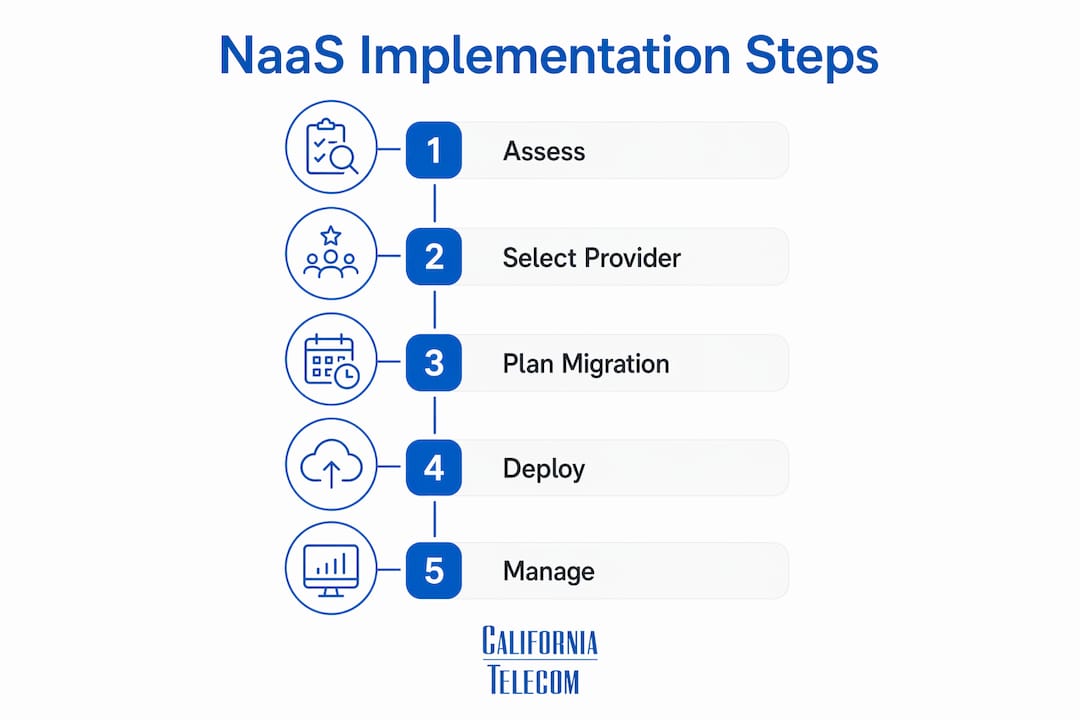
Zero-downtime migration is the standard expectation for retail NaaS deployments. Achieving it requires a disciplined approach.
Retail zero-downtime migrations require phased cutovers over weeks rather than all-at-once switches to avoid disrupting payment flows and legacy hardware. The phased approach works like this:
- Assessment and templating. The provider audits each location's current hardware, circuit, and configuration. A standard network template is built that covers all store types in the chain.
- Pilot deployment. Two or three low-risk locations go live first. The team validates that POS systems, back-office applications, and guest Wi-Fi all function correctly under the new architecture.
- Micro-segmentation setup. VLANs are created for POS terminals, back-office systems, and guest networks before the cutover. This isolation protects payment data during and after the transition.
- Phased rollout. Remaining locations migrate in batches. Each batch runs in parallel with the old network briefly to confirm stability before the legacy connection is decommissioned.
- Remote configuration push. Templated configurations deploy to each site without a technician on the ground.
The results of this approach are significant. Retail migration to templated modern networks reduces transition timelines from 9 months to 6 weeks with zero site downtime. That is not a marginal improvement. It means a 50-store chain can complete a full network modernization in a single quarter.
Pro Tip: Map your PCI-DSS compliance requirements before the migration starts, not after. Your NaaS provider should produce a network segmentation diagram that your QSA (Qualified Security Assessor) can review before any store goes live.
Payment system resilience is non-negotiable. PCI-DSS requires that cardholder data environments stay isolated from other network traffic. A well-executed NaaS deployment makes that isolation automatic and auditable, not a manual configuration task that varies by store.
What security considerations should retail managers know when adopting NaaS?
NaaS handles network-layer security. It does not handle everything. Retail managers who conflate the two create gaps that attackers exploit.
NaaS providers manage network-layer security like firewalls and secure connectivity, but they do not typically handle identity-based user authentication. Retailers must integrate their own identity management. That means deploying cloud-native authentication tools such as RADIUS servers or certificate-based access alongside the NaaS platform.
The security responsibilities break down clearly:
- NaaS provider handles: Firewall policies, DDoS mitigation, encrypted tunnels, VLAN segmentation, and network performance monitoring.
- Retailer handles: User authentication, device certificates, employee access policies, and integration with identity providers such as Active Directory or cloud-based SSO platforms.
- Shared responsibility: Incident response, log review, and compliance documentation require coordination between both parties.
Automated VLAN segmentation meets PCI-DSS compliance requirements by keeping POS data isolated without requiring extra firewalls at each location. That automation is one of the strongest security arguments for NaaS in retail. Manual VLAN configuration at 50 locations introduces human error. Automated, template-driven segmentation does not.
The most common security failure in retail NaaS deployments is not a firewall gap. It is a retailer assuming the provider handles user authentication when it does not. Clarify the shared responsibility model in writing before deployment begins.
Zero-trust principles apply naturally to NaaS architectures. Every device, every user, and every application must authenticate before accessing network resources. Retailers who build their identity management layer correctly get zero-trust enforcement across all locations without buying additional security products.
How can retail IT teams use NaaS for ongoing network management?
NaaS is not a set-and-forget solution. The teams that get the most from it treat the management platform as an active operational tool.
The network performance management capabilities built into NaaS platforms give retail IT teams tools that were previously available only to large enterprises with dedicated network staff.
Key ongoing management capabilities include:
- Unified multi-site monitoring. Every store's uptime, latency, and bandwidth utilization appears in one dashboard. IT managers spot problems before store staff report them.
- Automated policy updates. Security patches, firewall rule changes, and routing policy updates push to all locations simultaneously. No site visits. No version drift between stores.
- Consistent scaling. Adding a new location means applying the existing template. The new store inherits all security policies, VLAN configurations, and performance settings automatically.
- SLA tracking and analytics. Providers report on uptime, packet loss, and latency against contractual commitments. Retail managers can hold providers accountable with data, not anecdotes.
- SD-WAN integration. Many NaaS deployments include SD-WAN across locations as a software-defined overlay. SD-WAN adds intelligent traffic routing, sending critical POS traffic over the most reliable path at any moment.
The operational model that NaaS enables is one where a small IT team manages a large, distributed network without proportionally increasing headcount. That ratio improves as the chain grows, because the template-driven architecture scales without adding complexity.
Key Takeaways
NaaS for retail is the most direct path from a fragmented, hardware-heavy store network to a centrally managed, subscription-based infrastructure that scales with the business.
| Point | Details |
|---|---|
| NaaS replaces hardware ownership | Retailers subscribe to networking as a service, shifting capital expense to predictable operational expense. |
| Phased migration prevents downtime | Templated deployments cut transition timelines from 9 months to 6 weeks with zero store disruption. |
| Security is a shared responsibility | NaaS handles firewalls and segmentation; retailers must add their own identity and authentication layer. |
| Standardized architecture scales cleanly | One network template pushes to every location, eliminating configuration drift and reducing truck rolls. |
| Centralized visibility changes IT operations | A single dashboard covering all stores lets small IT teams manage large networks without adding headcount. |
What I've learned from watching retail NaaS migrations go right and wrong
The retailers who get the most from NaaS are not the ones with the biggest budgets. They are the ones who treat the migration as an architecture project, not a vendor swap. I have seen chains spend months negotiating a NaaS contract and then hand the deployment to a project manager who had never drawn a network diagram. The result is predictable: stores go live with inconsistent configurations, POS systems drop during peak hours, and the IT team spends the next six months in reactive mode.
The underestimated complexity is always identity management. Every retail NaaS deployment I have reviewed that ran into serious security problems had the same root cause: the team assumed the provider handled user authentication. It does not. Building the RADIUS or certificate infrastructure before the first store goes live is not optional. It is the difference between a secure network and a network with a firewall in front of an open door.
Standardized branch architecture is the single biggest operational win I have seen in practice. When every store runs the same template, a junior network engineer can troubleshoot any location in the chain. That knowledge transfer is worth more than any individual feature the NaaS platform offers.
My advice to retail managers evaluating NaaS providers is to ask one question: "Show me how you push a policy change to 50 locations simultaneously." The answer tells you everything about the maturity of their platform and their operational model. Providers who hesitate or describe a manual process are not ready for a serious retail deployment.
— Jim
Californiatelecom's managed network services for retail chains
Retail managers running multi-location operations need a network partner who has already solved the problems described in this article, not one learning alongside them.Californiatelecom designs and deploys managed network services nationwide for multi-location businesses, including retail chains that need consistent, POS-resilient connectivity across every store. The company sources circuits from 50+ carriers, deploys templated architectures through its own engineers, and backs every site with a 24/7 U.S.-based NOC. Retail managers work with one provider, one bill, and one engineer's direct number. The result is a network that scales with your store count without scaling your IT overhead. Contact Californiatelecom for a free consultation to see how a managed network fits your retail operation.
FAQ
What is NaaS in retail?
NaaS in retail is a subscription-based model that delivers networking infrastructure, including connectivity, routing, security, and management, as a cloud service across multiple store locations. Retailers pay an operational expense instead of buying and maintaining physical hardware at each site.
How does NaaS help retail chains with many locations?
NaaS lets retail IT teams manage all store networks from a single platform, push configuration changes remotely, and onboard new locations using pre-built templates. This reduces transition timelines from months to weeks and eliminates the need for technician visits at each site.
Is NaaS compliant with PCI-DSS for retail payment systems?
NaaS platforms automate VLAN segmentation that isolates POS terminals from guest Wi-Fi and back-office systems, meeting PCI-DSS network segmentation requirements. Retailers must still manage their own identity and authentication layer to achieve full compliance.
What is the difference between NaaS and traditional managed network services?
Traditional managed network services typically involve provider-owned hardware installed at each location with manual configuration. NaaS delivers the same functions through software-defined infrastructure with centralized management, automated policy updates, and consumption-based pricing.
How long does a retail NaaS migration take?
A phased retail NaaS migration using templated network configurations typically takes 6 weeks for a multi-location chain, compared to 9 months for traditional network upgrades. The phased approach protects payment flows and avoids store downtime during the transition.