

What Is Network as a Service for Multi-Location ITNetwork as a service is reshaping how enterprises buy, manage, and scale their connectivity. If you still think networking means buying hardware, racking it in a closet, and hoping it lasts five years, you are looking at a model that is increasingly rare. The NaaS market is projected to reach $50 billion by 2028, a number that reflects a fundamental rethinking of how businesses consume network infrastructure. For IT leaders running distributed operations across multiple sites, understanding this shift is not optional. It is the difference between a network that holds you back and one that moves as fast as your business does.
Table of Contents
- Key takeaways
- What is network as a service and how does it work
- Key benefits of network as a service for enterprise IT
- NaaS vs traditional networking: what actually changes
- NaaS, SASE, and security for distributed teams
- How to evaluate NaaS providers and plan your rollout
- My take on NaaS after watching enterprises get it wrong
- How Californiatelecom delivers NaaS for multi-location businesses
- FAQ
Key takeaways
| Point | Details |
|---|---|
| NaaS is subscription-based networking | You consume network infrastructure as a service, paying monthly instead of buying hardware upfront. |
| Provisioning speed changes entirely | NaaS enables provisioning in minutes, compared to months with traditional networking models. |
| Security is built in | 69% of NaaS providers bundle cybersecurity directly into their service offerings. |
| SASE alignment amplifies value | Pairing NaaS with SASE frameworks unifies networking and security under one subscription policy. |
| Vendor selection is critical | Prioritize platforms with architectural freedom and strong SLA visibility to avoid lock-in and blind spots. |
What is network as a service and how does it work
The NaaS definition, stripped of marketing language, is straightforward. Network as a service is a cloud-delivered subscription model that lets businesses consume network infrastructure, bandwidth, and connectivity without owning or maintaining the underlying hardware. Instead of buying routers, switches, and MPLS circuits and waiting months for deployment, you subscribe to a service layer that provides all of that functionality on demand.
The technical backbone of how NaaS works sits on two foundations. The first is software-defined networking (SDN), which decouples the control plane from the data plane so the network can be managed through software rather than physical device configurations. The second is SD-WAN, which applies that same principle across wide area networks to intelligently route traffic across multiple connection types. NaaS is delivered via software-defined platforms managed through APIs and centralized orchestration, replacing the manual command-line interface configurations that traditionally required specialized engineers on-site.
Here is what that means practically for a multi-location business:
- Centralized orchestration: Your entire network, across every site, is managed from a single software console rather than through individual device logins at each location.
- API-driven control: Network policies, bandwidth adjustments, and security rules are applied programmatically, which means changes that once took a technician a day can be executed in minutes.
- Virtualized infrastructure: Physical hardware at the edge is minimal and standardized. The intelligence lives in software, which means upgrades do not require truck rolls.
- Consumption-based billing: You pay for what you use and scale up or down as your needs change, just like you do with cloud compute.
Pro Tip: When evaluating NaaS providers, ask specifically whether the orchestration layer is proprietary or built on open standards. Open standards give you significantly more flexibility to change vendors or add services later.
The contrast with traditional networking is stark. Legacy networks are capital expenditure projects. You design, procure, deploy, and then manage hardware for a five to seven year depreciation cycle. NaaS moves that entire model into operating expenditure, which also means your IT team stops spending time on physical maintenance and starts focusing on policy and performance.
Key benefits of network as a service for enterprise IT
Understanding the benefits of network as a service requires looking beyond the cost conversation, because cost is actually the least interesting advantage once you see the full picture.
-
CAPEX to OPEX conversion. Eliminating the hardware purchasing cycle frees capital for strategic investment. More practically, it makes network expansion a budget line item rather than a capital approval process. Adding a new office location no longer requires a procurement cycle, a hardware order, and a two-month deployment timeline.
-
Provisioning speed. This is where the operational difference becomes visceral. NaaS enables bandwidth and connectivity provisioning in minutes rather than the months that traditional hardware deployments require. For a business opening new sites or responding to sudden bandwidth demands, that speed is a genuine competitive advantage.
-
Integrated security. Buying networking and security from separate vendors, with separate consoles and separate policies, creates gaps. 69% of NaaS providers now bundle integrated cybersecurity into their platforms, which means firewall policies, access controls, and threat monitoring come with the network itself rather than as a separate procurement.
-
AI-driven automation and efficiency. 50% of NaaS providers use AI-driven automation, yielding up to 28% efficiency gains in network operations. That efficiency shows up as reduced mean time to resolution, fewer manual configuration errors, and smarter traffic routing without human intervention.
-
Centralized visibility across all sites. Managing 20 locations through a single pane of glass is not just convenient. It changes the speed at which your team can identify problems, enforce policies, and report on performance. If you run distributed IT with a small team, this visibility shift is often the benefit that matters most.
Stat to know: AI-driven NaaS automation can deliver up to 28% efficiency gains in network operations, according to current provider data. For a lean IT team supporting dozens of locations, that number translates directly into fewer escalations and faster resolution times.
For multi-location businesses, NaaS enables fast, secure expansion supporting hybrid work and multi-cloud adoption without infrastructure redesign at every site. You can also explore how managed SD-WAN solutions layer on top of NaaS architecture to give you more granular traffic control across locations.
NaaS vs traditional networking: what actually changes

The NaaS versus traditional networking conversation often gets framed around cost, but the deeper differences are operational and cultural.
| Factor | Traditional networking | Network as a service |
|---|---|---|
| Capital investment | High upfront CAPEX for hardware | Subscription-based OPEX model |
| Provisioning time | Weeks to months for new sites | Minutes to hours via software |
| Management model | CLI-based, device-by-device | Centralized, API-driven orchestration |
| IT skill requirements | Hardware configuration, on-site maintenance | Software orchestration, API management |
| Scalability | Constrained by procurement cycles | Elastic and on-demand |
| Vendor flexibility | Hardware-tied, difficult transitions | Varies; open platforms allow more freedom |
The ownership model shift goes deeper than it looks. In traditional networking, your IT team's expertise is tied to specific hardware platforms. They know how to configure that brand's routers and troubleshoot that vendor's firmware. NaaS fundamentally shifts this from hardware maintenance to software-defined platform skills, requiring API and orchestration knowledge instead. That is not a problem. It is an upgrade. But it requires deliberate training and a realistic transition plan.
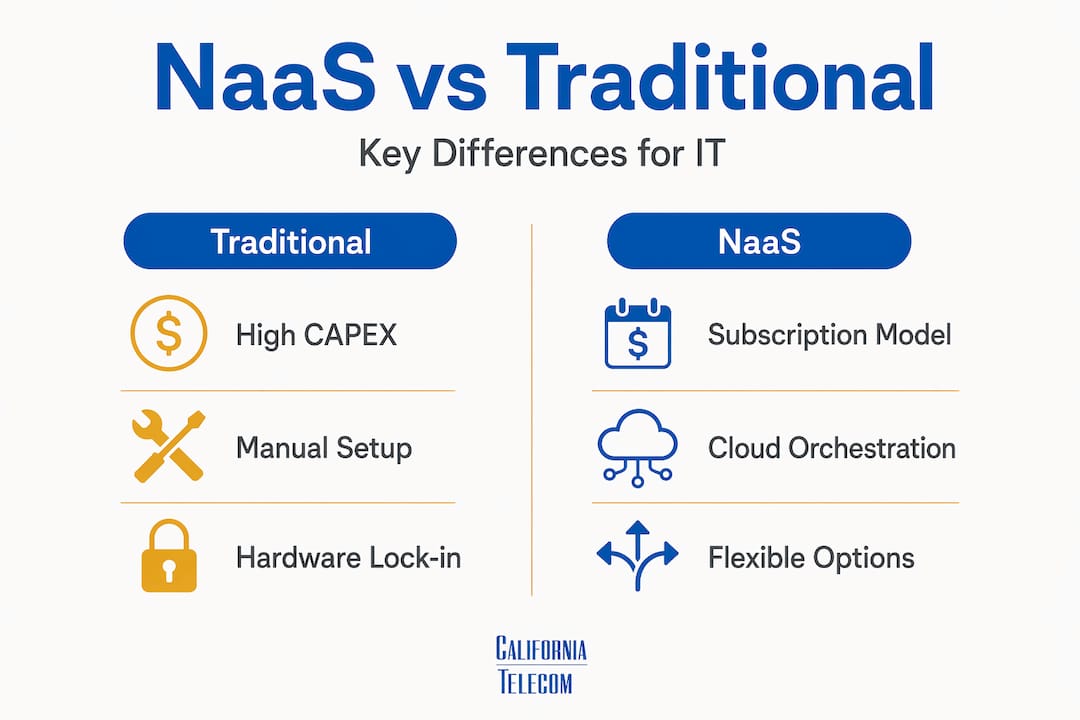
Vendor lock-in is a legitimate risk in both models. In traditional networking, you are locked into hardware. In NaaS, you can be locked into a proprietary platform if you do not choose carefully. Architectural freedom prevents vendor lock-in and allows flexible adaptation as your business needs evolve. Before signing a multi-year NaaS agreement, verify that the platform supports open standards and that your underlying connectivity can be ported.
Pro Tip: Ask every NaaS candidate how you would exit the contract if needed. A provider confident in their service quality will give you a straight answer. One that hedges or avoids the question is telling you something important.
NaaS, SASE, and security for distributed teams
This is where NaaS stops being a networking conversation and starts being a business transformation conversation. Secure Access Service Edge, or SASE (pronounced "sassy"), is a framework that combines wide area networking with security services like secure web gateway, cloud access security broker, zero trust network access, and firewall as a service into a single cloud-delivered model.
Experts view NaaS as a strategic upgrade within SASE frameworks, consolidating networking and security as unified cloud services under a single subscription. The practical result is that your security policies travel with the network. Whether a user is at a branch office, a home office, or a coffee shop, the same rules apply.
For multi-location businesses, this convergence addresses several real problems:
- Consistent policy enforcement: Security rules are applied uniformly across all sites without manual configuration at each location. A policy change in the console pushes everywhere simultaneously.
- Zero trust access: Users and devices are verified before gaining access to applications, regardless of where they connect from. This is not a feature anymore. It is an expectation for any distributed workforce.
- Simplified multi-cloud connectivity: As applications move to cloud platforms, SASE-aligned NaaS routes traffic directly to those platforms without backhauling it through a central data center, which reduces latency significantly.
- Reduced attack surface: When networking and security are managed through the same platform, the gaps between tools shrink. Most breaches exploit the seams between separate systems.
For organizations exploring how these frameworks layer together, managed SASE solutions show how unified policy and connectivity can work across a distributed estate. Multi-location retail and professional services businesses can also see how screen management simplification at distributed sites depends on exactly this kind of reliable, policy-consistent connectivity underneath.
How to evaluate NaaS providers and plan your rollout
Knowing what NaaS is and deciding whether NaaS is right for your business are two separate exercises. Here is where IT decision-makers often stall, because the vendor landscape is large and the sales conversations can feel indistinct.
Start with these evaluation criteria before you take a single demo:
- SLA specifics on visibility and troubleshooting. High-quality NaaS SLAs include strong visibility and troubleshooting features to quickly identify whether a performance issue is the network or an application. If a vendor cannot show you what that looks like in their platform, pass.
- Architectural freedom. Can you swap underlying carriers without rebuilding your configuration? Can you integrate with other tools via APIs? Choosing platforms with architectural freedom is the best structural defense against lock-in.
- Support model. Who do you call at 2 a.m. when Site 14 goes down? Is it a ticket queue or a direct engineer? That answer matters more than the feature list.
- Carrier diversity behind the service. A NaaS provider built on a single underlying carrier is a single point of failure with a software wrapper on top. Look for providers who source from multiple carriers.
- Skills gap planning. Your team will need to learn new tools. The best providers offer onboarding and documentation, not just a console login.
Pro Tip: Run a parallel pilot at one or two sites before committing to a full rollout. The pilot will surface integration issues, skill gaps, and SLA realities that no sales conversation will reveal.
For a deeper look at what separates good managed network providers from average ones, the managed network services provider guide covers the evaluation questions that often get skipped.
My take on NaaS after watching enterprises get it wrong
I have watched a lot of organizations treat NaaS as a cost-cutting exercise and then wonder why the transition was painful. Here is what I have actually learned from seeing this play out.
NaaS is not outsourced connectivity with a nice dashboard. It is a different operating model. The IT teams that succeed with it are the ones that lean into software skills early, before the contract is signed. The ones that struggle are the ones that expected the vendor to handle everything while the internal team stayed in maintenance mode.
The vendor lock-in risk is real, but it is also largely self-inflicted. I have seen companies sign five-year NaaS agreements without ever asking about exit terms or platform openness. That is a procurement failure, not a technology failure.
What I find genuinely exciting is the SASE convergence. When your network and your security posture are managed together through a single consistent policy layer, you stop fighting the seams between tools. That is where the strategic upgrade potential of NaaS becomes undeniable. The future of enterprise networking is not faster hardware. It is smarter software with the right partner behind it.
— Jim
How Californiatelecom delivers NaaS for multi-location businessesCaliforniatelecom does exactly what the NaaS model promises but rarely delivers: one provider, one bill, one engineer's number. For multi-location businesses running distributed networks across dozens of sites, that simplicity is not a luxury. It is a multiplier on everything else your team does.
Californiatelecom sources connectivity from 50+ carriers, which means the underlying network is never dependent on a single provider's performance. Every site is designed and deployed by Californiatelecom's own engineers, backed by a 24/7 U.S.-based NOC and a 99.99% uptime SLA on data. The nationwide managed network services offering covers everything from fiber and SD-WAN to unified communications and AI-driven network monitoring through the Netverge platform.
If you are evaluating managed network options or planning a NaaS transition, the managed LAN/WAN solutions and real customer case studies are the fastest way to see how this works in practice for businesses like yours.
FAQ
What is the NaaS definition in simple terms?
Network as a service is a subscription model where businesses consume network infrastructure, bandwidth, and connectivity as a cloud-delivered service rather than buying and managing their own hardware.
How does network as a service differ from traditional networking?
Traditional networking requires upfront hardware purchases and manual configuration, while NaaS uses software-defined platforms for centralized management with provisioning that takes minutes rather than months.
What are the biggest benefits of network as a service for multi-location businesses?
The main benefits include faster site provisioning, built-in security, reduced capital expenditure, centralized visibility across all locations, and AI-driven automation that improves operational efficiency by up to 28%.
What should I look for in NaaS providers?
Look for providers that offer strong SLA visibility and troubleshooting tools, architectural freedom to avoid lock-in, multi-carrier diversity behind the service, and a direct support model with named engineers rather than ticket queues.
Is NaaS right for my business if I already have managed services?
Yes. NaaS and managed network services are complementary. A managed services provider who delivers NaaS-style architecture gives you the software flexibility of NaaS combined with the accountability and support of a dedicated partner.