

Network Performance in Retail Stores: 2026 GuideNetwork performance in retail stores is defined as the measurable ability of a store's network infrastructure to support point-of-sale systems, inventory platforms, IoT devices, and customer connectivity without degradation or failure. For multi-location retailers, this is not a background IT concern. Network downtime costs retailers $2,300 to $9,000 per minute, and 90% of organizations confirm that downtime directly hurts revenue. Understanding what is network performance retail stores means translating technical metrics into financial outcomes your leadership team can act on.
What is network performance in retail stores?
Network performance in retail stores covers every measurable dimension of how well your connectivity infrastructure delivers data between store systems and their destinations. That includes your POS terminals talking to payment processors, your inventory software syncing with a cloud ERP, your security cameras streaming to a central server, and your guest WiFi keeping shoppers connected. Each of those flows has a performance profile, and when any one of them degrades, the business feels it.
The industry term for this discipline is network performance management, and it goes well beyond checking whether a circuit is up. A healthy circuit does not guarantee a healthy transaction path. A store's internet connection can show green on a basic monitoring dashboard while a SaaS application is timing out because of DNS resolution delays or API latency between the branch and the cloud. That distinction matters enormously in retail, where a 10-second delay at checkout translates directly to abandoned carts and frustrated staff.
For multi-location retailers, the stakes multiply with every site you add. A regional chain with 50 stores does not have 50 independent network problems. It has a distributed system where a misconfiguration at one location, or a carrier outage affecting a corridor, can cascade across the entire operation. That is the context in which network performance management becomes a strategic priority, not just a help desk function.

What are the key retail network performance metrics?
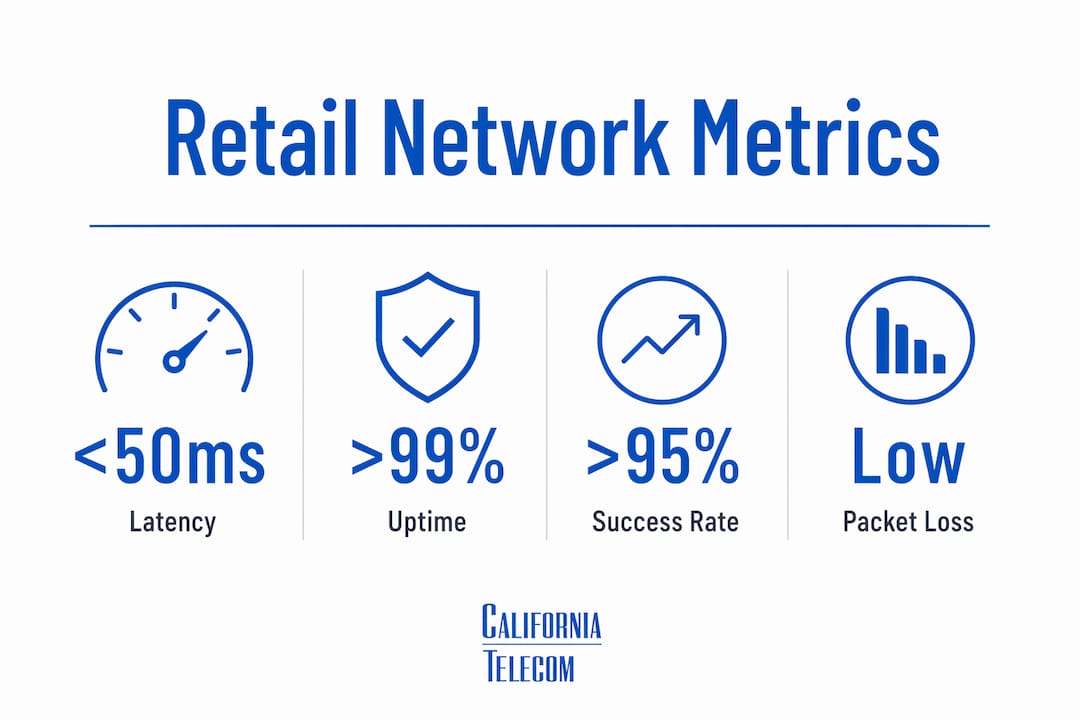
Retail IT teams need to track five core metrics to get a complete picture of network health across store locations.
- Latency: The round-trip time for data to travel from a store device to its destination and back. High latency slows POS transactions and makes cloud applications feel unresponsive. Anything above 100ms on a business circuit warrants investigation.
- Packet loss: The percentage of data packets that fail to reach their destination. Packet loss can turn a 1ms latency into 50–100ms delays and trigger retransmission cascades that choke throughput. Even 1% packet loss is significant in a retail transaction environment.
- Uptime: The percentage of time your network is fully operational. A 99.9% uptime SLA sounds strong but still allows nearly 9 hours of downtime per year. Retail operations need 99.99% or better.
- Throughput: The actual volume of data your network delivers per second under real load conditions. Throughput tells you whether your bandwidth is sufficient for peak traffic periods like holiday weekends.
- Transaction success rate: The percentage of end-to-end transactions, from store terminal to payment processor or cloud application, that complete without error. This is the metric that matters most for retail network health, and most basic monitoring tools do not track it.
Beyond these five, retail networks should also monitor DNS resolution times, API response times for SaaS platforms like Salesforce Commerce Cloud or NetSuite, and WiFi session quality for customer-facing networks.
| Metric | What It Measures | Retail Threshold |
|---|---|---|
| Latency | Round-trip data travel time | Under 50ms for POS |
| Packet Loss | Failed data packet rate | Under 0.1% |
| Uptime | Network availability | 99.99% minimum |
| Throughput | Actual data delivery rate | Matches peak load demand |
| Transaction Success Rate | End-to-end completion rate | 99.9% or higher |
Pro Tip: Track visitor dwell time through your WiFi analytics platform. Shoppers who stay longer than 8 minutes spend 2 to 3 times more than those who leave quickly. WiFi performance is a direct revenue lever, not just a customer amenity.
How does network performance impact store operations?
Poor network performance in retail does not just slow things down. It creates a chain of operational failures that compounds across every hour of a business day.
At the POS, latency above 200ms causes transaction timeouts that force staff to retry payments, creating lines and eroding customer trust. IoT sensors on inventory shelves lose sync with warehouse management systems, producing phantom stock counts that lead to either overordering or stockouts. Digital signage fails to update, serving customers outdated pricing. Each failure is individually minor. Together, they define a store experience that customers do not return to.
"Network performance optimization in retail protects brand trust by ensuring uninterrupted POS and IoT sessions." — Bigleaf Networks
The customer WiFi dimension is often underestimated. Enterprise-grade WiFi analytics show that engaged visit rates above 15% correlate with measurable revenue gains. When your guest network is slow or drops connections, shoppers leave sooner. That is a direct revenue impact you can quantify and present to finance.
Brand reputation carries its own cost. A shopper who experiences a failed payment or a frozen self-checkout kiosk does not distinguish between a network fault and a software bug. They experience a broken store. That perception sticks, and it travels to review platforms and social media faster than any IT ticket gets resolved.
What challenges affect multi-location retail networks?
Multi-location retail networks face a specific set of challenges that single-site businesses rarely encounter. Understanding these barriers is the first step toward fixing them.
-
Outdated centralized network models. Many retail chains still route all branch traffic through a central data center before it reaches the internet or cloud. This hub-and-spoke architecture was designed for on-premises software. It creates unnecessary latency for cloud-native applications and makes every store dependent on a single choke point.
-
Packet loss from localized hardware failures. Packet loss is often localized to specific network interfaces or faulty cabling, and basic tools like ping will not detect it. A store can report "the internet is slow" for weeks while the actual cause is an overloaded NIC in the back office switch.
-
Misdiagnosed application issues. Retail networks frequently misattribute network faults as software defects. When a cloud ERP times out, the first call goes to the software vendor. The real cause is often a degraded WAN path between the store and the cloud region. Without full transaction path visibility, you waste hours chasing the wrong problem.
-
Inconsistent connectivity across sites. A 50-store chain might have fiber at flagship locations, cable broadband at suburban stores, and DSL at rural sites. Each has different performance characteristics, and a single monitoring policy does not fit all three.
-
Limited on-site IT resources. Most retail locations do not have dedicated IT staff. When a network issue surfaces, the store manager is the first responder. Without remote visibility tools and a 24/7 NOC behind them, resolution times stretch from minutes into hours.
Pro Tip: Map the full transaction path for your top three critical applications, from the store terminal through your WAN, to the cloud destination. That map will show you where your actual risk lives, not just where your circuit terminates.
What strategies optimize retail network performance?
Modern retail network optimization requires a combination of architecture changes, technology upgrades, and monitoring discipline. The following approaches address the specific challenges multi-location retailers face.
Sd-wan and 5g for distributed retail
SD-WAN and 5G provide flexible, scalable solutions for multi-location retail networking. SD-WAN lets you prioritize POS and payment traffic over lower-priority applications like software updates or guest streaming. It also enables automatic failover to a secondary connection, such as LTE or 5G, when a primary circuit degrades. For a retailer running 100 stores, that means no single carrier outage takes down a location.
5G adds a new dimension for stores in areas where fiber is unavailable or too expensive. It delivers low-latency, high-throughput connectivity that supports IoT sensors, digital signage, and mobile POS devices simultaneously. Explore the full range of retail connectivity options to understand which combination fits your store footprint.
Real-time visibility across all stores
Unified network visibility tools are the difference between reactive and proactive network management. Large retailers achieve real-time KPI dashboards across hundreds of stores, which allows operations teams to identify path degradations and distinguish internal failures from third-party carrier issues before they affect customers.
The key capability is end-to-end transaction path monitoring, not just circuit uptime. You need to see whether your POS terminal can successfully reach your payment processor, not just whether your router is online.
Managed lan/wan for operational consistency
| Approach | Best For | Key Benefit |
|---|---|---|
| Managed LAN/WAN | Multi-site chains with limited IT staff | Consistent configuration and 24/7 monitoring |
| SD-WAN overlay | Sites with multiple ISP connections | Automatic failover and traffic prioritization |
| Business-grade broadband | Stores needing dedicated bandwidth | Guaranteed throughput with SLA backing |
| 5G backup | Remote or rural locations | Carrier-independent resilience |
Managed LAN/WAN solutions remove the burden of per-site network management from your internal team. A managed provider handles configuration, patching, monitoring, and incident response across every location. For retail chains with 20 or more sites, this model consistently outperforms the alternative of managing each site independently through separate vendors. Learn more about business-grade broadband as a foundation for reliable store connectivity.
Key takeaways
Network performance in retail stores is a direct financial variable, and measuring the right metrics is what separates proactive management from costly reactive firefighting.
| Point | Details |
|---|---|
| Define performance correctly | Track transaction success rates and DNS latency, not just circuit uptime. |
| Quantify the financial risk | Downtime costs retailers up to $9,000 per minute, making network investment easy to justify. |
| Map full transaction paths | Diagnose issues at every hop from store terminal to cloud, not just at the WAN edge. |
| Deploy SD-WAN and 5G | Use traffic prioritization and automatic failover to protect POS and IoT reliability. |
| Centralize monitoring | Real-time dashboards across all locations cut incident response time and reduce downtime. |
Network performance is a p&l issue, not just an IT issue
I have spent years watching retail IT teams fight the same battle: they know the network is the problem, but they cannot get budget approval because they cannot prove the financial impact. The CFO sees a line item for network infrastructure and asks why it needs to increase. The IT director points to uptime percentages and latency graphs. The conversation stalls.
Treating network performance as a financial risk variable changes that conversation entirely. When you translate a 0.5% packet loss rate into projected transaction failures per day, and then multiply that by average transaction value across 50 stores, you get a number that belongs in a board presentation. That is the number that unlocks budget.
The other pitfall I see constantly is misdiagnosis. A store manager calls in saying the POS software is broken. The software vendor runs diagnostics and finds nothing wrong. Three hours later, someone finally checks the WAN path and finds a degraded circuit between the store and the cloud region. Three hours of lost sales, all because no one had visibility into the full transaction path from the start.
The retailers who get this right treat their network operations center the same way they treat their loss prevention team. It is a function that protects revenue, not a cost center that supports IT. That mental shift is what separates chains that absorb network failures quietly from those that catch them before the first customer notices.
— Jim
How Californiatelecom supports retail network performance
Californiatelecom designs and manages network infrastructure for multi-location retail businesses across the United States. Every deployment is engineered by Californiatelecom's own team, backed by a 24/7 U.S.-based NOC, and covered by a 99.99% uptime SLA on data circuits.For retail chains managing 10 to 500 locations, Californiatelecom delivers nationwide managed network services that include managed LAN/WAN, SD-WAN, business-grade broadband, and real-time network visibility. You work with one provider, one bill, and one engineer's direct number. No vendor juggling, no carrier blame games, and no store manager left troubleshooting a downed POS terminal alone. If your stores need network infrastructure that performs like a business asset, Californiatelecom is built for exactly that.
FAQ
What is network performance in a retail store?
Network performance in a retail store is the measure of how reliably and efficiently the store's network delivers data between POS systems, inventory platforms, IoT devices, and cloud applications. It includes metrics like latency, packet loss, uptime, throughput, and transaction success rate.
How does poor network performance affect retail revenue?
Network downtime costs retailers $2,300 to $9,000 per minute in direct revenue impact. Slow networks also reduce customer dwell time and increase transaction failures at checkout.
What is the most important retail network performance metric?
Transaction success rate is the most valuable metric for retail network health. A circuit can show 100% uptime while a SaaS application fails repeatedly due to DNS or API latency issues that basic monitoring tools do not detect.
How can multi-location retailers improve network reliability?
SD-WAN with automatic failover, business-grade broadband with SLA guarantees, and centralized real-time monitoring across all store locations are the three most effective tools for improving network reliability at scale.
What causes packet loss in retail store networks?
Packet loss is most often caused by overloaded network interface cards, faulty cabling, or misconfigured switches at the store level. It frequently goes undetected by basic tools like ping, which is why localized hardware diagnostics are required to identify the root cause.