

Why Businesses Use Multiple Carriers: 2026 GuideA multi-carrier strategy is defined as routing shipments across two or more carriers based on cost, speed, geography, and service requirements rather than committing all volume to a single provider. Businesses that adopt this approach report 15–25% reductions in shipping costs and 20–30% improvements in first-attempt delivery rates. That combination of savings and reliability is the core reason why businesses use multiple carriers. Platforms like ShipStation, EasyPost, and Shippo have made the model accessible to mid-market operators, while national carriers like FedEx and USPS Ground Advantage remain the backbone of most blended networks. For multi-site operations, the stakes are higher because a single carrier failure can disrupt dozens of locations simultaneously.
What are the primary benefits of using multiple carriers?
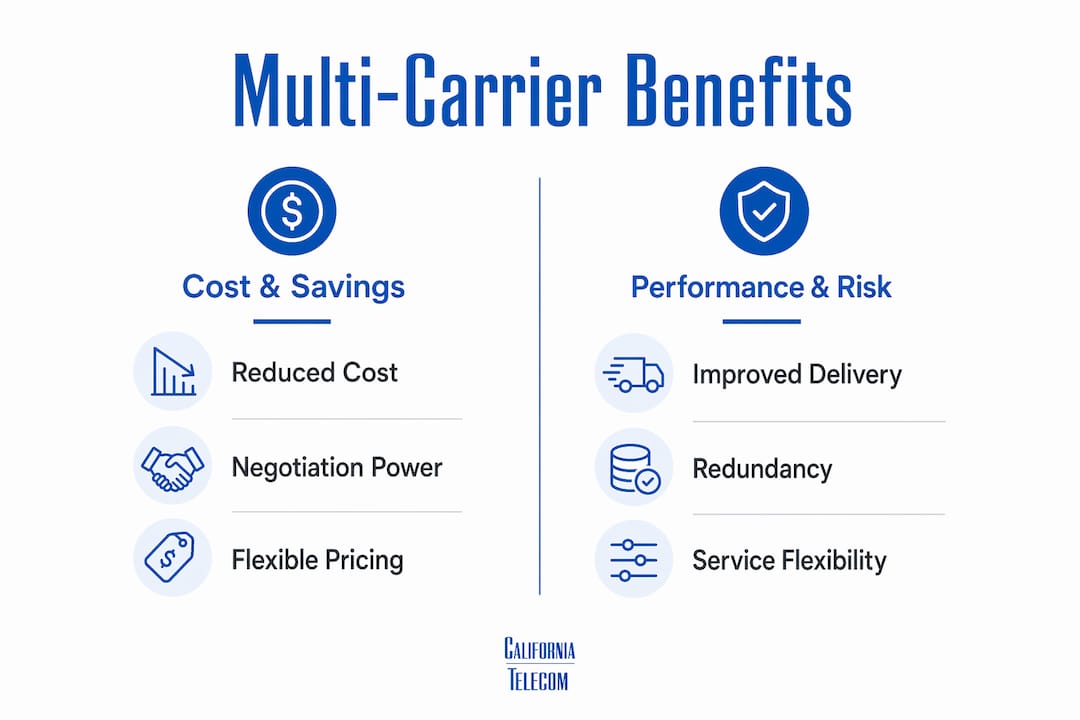
Carrier diversity converts shipping from a fixed cost into a managed variable. The financial case is direct: high-volume shippers who route 30% of volume to USPS Ground Advantage and 20% to regional carriers reduce blended rates by roughly 14%, saving over $19,000 monthly at 10,000 orders. That is not a rounding error. It is a structural cost advantage that compounds over time.
The benefits extend well beyond the invoice:
- Cost reduction. Regional carriers consistently undercut national rates in high-density zones. Blending them into your network lowers your average cost per shipment without sacrificing coverage.
- Risk mitigation. A single carrier strike, weather event, or capacity crunch can halt your entire operation. Spreading volume across carriers means one disruption does not stop all deliveries.
- Improved delivery performance. Multi-carrier routing improves first-attempt delivery rates by 20–30% and cuts peak-season delays by 40–60%. Customers notice.
- Service tailoring. High-value shipments may warrant FedEx overnight. Lightweight parcels going to rural addresses may route better through USPS. A single carrier cannot be the best option for every shipment type.
Pro Tip: Map your top 10 shipping lanes by volume and cost before adding a second carrier. You will find the highest-impact routes to redirect within the first hour.
Carrier diversity also shifts the power dynamic in contract negotiations. Carrier mix optimization creates a team of specialists, allowing businesses to use competition between providers to secure better rates and service-level agreements. Single-carrier shippers have no leverage. Multi-carrier shippers do.

How does technology enable effective multi-carrier management?

Managing two or more carriers manually above 500 monthly shipments is not practical. Automated multi-carrier platforms become necessary at that threshold because the volume of routing decisions, label generations, and tracking updates exceeds what any team can handle without software.
Platforms like ShipStation, Shippo, and EasyPost handle the core functions:
- Real-time rate shopping. The platform pulls live rates from all connected carriers at checkout or order creation and selects the lowest qualifying option automatically.
- Shipping rule automation. Rules route orders by weight, zone, delivery promise, or product type without manual intervention.
- API integrations. Label creation, tracking updates, and carrier communication run through a single API layer, keeping data consistent across systems.
- Performance monitoring. Transit times, damage rates, and tracking accuracy are logged per carrier, creating the comparative data that single-carrier operations never see.
That last point matters more than most operators realize. Diversification yields comparative performance data on transit times, damage rates, and tracking accuracy that is simply unavailable when you ship with one carrier. You cannot improve what you cannot measure, and you cannot measure what you have no baseline to compare against.
Pro Tip: Set a 90-day performance review cadence for each carrier in your network. Pull transit time accuracy and damage rate data by lane. Underperforming carriers get volume pulled; strong performers earn more.
For multi-site businesses, the network layer matters too. Reliable connectivity between sites is what keeps carrier APIs, warehouse management systems, and order management platforms talking to each other in real time. Without it, automated routing breaks down at the worst possible moment.
What strategies do businesses use to choose and optimize their carrier mix?
Building a carrier mix is not a one-time decision. It is an ongoing process driven by data, volume thresholds, and geography. The most effective approach follows a structured framework.
- Build a carrier matrix. Map each carrier's strengths against your order profile: weight bands, delivery zones, service promises, and price points. Assign carrier priority by shipment type rather than defaulting to one provider for everything.
- Pair national carriers with regional specialists. Combining national carriers with regional last-mile experts in high-density zones delivers cost savings and transit speed advantages that generalist carriers cannot match. A national carrier handles broad coverage; a regional carrier wins on cost and speed in its home territory.
- Protect your discount tiers. Spreading volume too thin across too many carriers erodes the volume discounts that make each individual contract valuable. Concentrate enough volume with each carrier to maintain meaningful pricing leverage.
- Adjust for seasonality. Peak periods like Q4 require pre-negotiated capacity commitments and the ability to shift volume quickly. Automated carrier controls that turn carriers on or off based on performance and capacity prevent operational overload during surges.
| Carrier type | Best use case | Key advantage |
|---|---|---|
| National (FedEx, UPS) | Broad coverage, time-sensitive | Reliability, tracking depth |
| USPS Ground Advantage | Lightweight, residential | Cost on last mile |
| Regional carriers | High-density metro zones | Speed and cost combined |
| Specialty carriers | Oversized, fragile, or high-value | Handling expertise |
Pro Tip: Do not add a carrier just because a sales rep offers a discount. Add a carrier because it solves a specific gap in your current network, then measure whether it actually closes that gap.
Many shippers also miss cost savings by ignoring regional carriers for return logistics and consolidation hubs. Returns are a high-cost, high-frequency problem. Regional carriers often handle reverse logistics more cheaply than national providers in their core geographies.
What are common pitfalls in multi-carrier deployment?
The biggest mistake in multi-carrier programs is adding carriers without adding governance. Adding carriers without performance monitoring increases complexity and lowers resilience. More carriers without more data creates more failure points, not fewer.
The most common pitfalls to avoid:
- No carrier matrix. Routing decisions made by habit or convenience rather than data produce inconsistent costs and unpredictable service levels.
- Ignoring peak controls. Carriers that perform well in normal conditions can collapse under Q4 volume. Pre-set volume caps and automatic rerouting rules prevent a single carrier's failure from cascading across your network.
- Underusing competition. Carrier diversification turns shipping from a cost center into a competitive advantage by maintaining control through strategic carrier competition. Businesses that never pit carriers against each other leave money on the table.
- Skipping the data layer. Without tracking accuracy, damage rates, and transit time data per carrier, you are managing by instinct. Instinct does not scale.
Pro Tip: Before peak season, run a tabletop exercise: if your primary carrier goes down for 72 hours, which orders reroute automatically and which ones stall? Fix the stalls before october.
Carrier diversification requires disciplined data analysis and automation to realize its benefits without creating operational drag. The discipline is the point. Without it, you get complexity without control.
How do multi-carrier strategies affect scalability and customer experience?
Multi-carrier networks scale in ways that single-carrier operations cannot. As a business adds locations, products, or geographies, a blended carrier network absorbs that growth by routing new volume to the best available option rather than forcing it through a single provider's capacity constraints.
The customer experience impact is direct. Shipment visibility improves because multiple carriers provide redundant tracking data, and customers receive more accurate delivery windows. When one carrier experiences delays, orders reroute to a performing carrier before the customer notices a problem. That kind of quiet reliability builds trust faster than any marketing message.
| Business outcome | Single-carrier model | Multi-carrier model |
|---|---|---|
| Cost per shipment | Fixed, limited leverage | Variable, negotiable |
| Peak-season resilience | Dependent on one provider | Distributed risk |
| Customer delivery visibility | One tracking system | Redundant data sources |
| Geographic coverage | Carrier's network limits | Best-fit by zone |
For multi-site operators specifically, the logistics and distribution network connecting each site must support real-time data exchange between carrier APIs, order management systems, and warehouse platforms. A network that drops packets or goes offline during peak hours does not just slow operations. It breaks the automated routing that makes multi-carrier programs work. Connectivity is the infrastructure layer that the carrier strategy runs on top of.
Industry leaders rely on comprehensive performance data across carriers to continuously refine their networks, differentiating on reliability and cost. That continuous refinement is what separates a mature multi-carrier program from a collection of disconnected carrier contracts.
Key takeaways
Multi-carrier strategies deliver measurable cost savings, stronger delivery performance, and genuine resilience only when they are built on a carrier matrix, automated routing technology, and continuous performance monitoring.
| Point | Details |
|---|---|
| Cost savings are real but conditional | Blended carrier routing saves 14–25% only when volume is allocated by data, not habit. |
| Technology is not optional | Automated platforms like ShipStation or EasyPost are required above 500 monthly shipments. |
| Governance prevents complexity creep | Adding carriers without a performance matrix increases risk rather than reducing it. |
| Regional carriers unlock hidden value | Pairing national providers with regional specialists cuts costs and improves transit times in dense zones. |
| Connectivity underpins everything | Multi-carrier automation depends on reliable network infrastructure across every site. |
What I have learned running multi-carrier programs in the real world
After working with multi-site operators across dozens of network deployments, the pattern I see most often is this: companies invest in the carrier contracts and the shipping platform, then underinvest in the data layer and the network infrastructure that ties everything together. The routing software works perfectly in a demo. It breaks in production when a site's connection goes down at 11 p.m. on a tuesday in november.
The second thing I have learned is that carrier diversification is not a set-it-and-forget-it program. The businesses that actually capture the 15–25% cost savings are the ones running monthly carrier performance reviews and adjusting routing rules based on what the data shows. The ones that set it up once and walk away end up with a more complex version of their old single-carrier problem.
The third thing, and this one surprises people: the negotiating leverage that comes from multi-carrier programs is often worth more than the direct cost savings. When a carrier knows you can move 20% of your volume to a competitor in 48 hours, the conversation about rates and service-level commitments changes completely. That leverage does not exist when you are locked into one provider.
For 2026, the operators who will pull ahead are the ones treating their network infrastructure with the same rigor they apply to their carrier contracts. You can have the best routing logic in the industry. If the pipe carrying that data is unreliable, the logic never executes. Evaluating ISP contracts with the same discipline you apply to carrier contracts is not optional for multi-site businesses. It is the foundation.
— Jim
How Californiatelecom supports multi-carrier operations at scale
Multi-carrier programs run on network infrastructure. When that infrastructure is unreliable, automated routing fails, carrier APIs time out, and the cost savings you built your strategy around disappear.Californiatelecom delivers nationwide managed network services to multi-site businesses, sourcing from 50+ carriers and backing every connection with a 99.99% uptime SLA on data and 99.999% on voice. Every site is designed and deployed by Californiatelecom's own engineers, and a 24/7 U.S.-based NOC monitors performance around the clock. You get one provider, one bill, and one engineer's number. That is the infrastructure layer your multi-carrier strategy depends on. Explore managed network solutions or schedule a free consultation to see what a purpose-built network looks like for your operation.
FAQ
Why do businesses use multiple carriers instead of one?
Multiple carriers reduce cost, improve delivery reliability, and eliminate single-point-of-failure risk. Businesses using blended carrier networks report 15–25% lower shipping costs and 20–30% better first-attempt delivery rates compared to single-carrier operations.
When does a multi-carrier strategy make financial sense?
Businesses shipping fewer than 200 orders monthly can often manage with a single carrier. Above 500 monthly shipments, automated multi-carrier routing becomes cost-effective and protects margins against carrier rate increases and service failures.
What technology do you need to manage multiple carriers?
A multi-carrier shipping platform like ShipStation, EasyPost, or Shippo handles real-time rate shopping, label generation, and tracking across all carriers through a single API layer. Manual management is not practical above 500 shipments per month.
How do regional carriers fit into a multi-carrier strategy?
Regional carriers deliver cost and speed advantages in high-density zones that national carriers cannot match. Pairing a national provider like FedEx or UPS with regional specialists reduces blended shipping rates and improves transit times on specific lanes.
What is the biggest risk in a multi-carrier program?
Adding carriers without performance monitoring increases complexity without improving resilience. A structured carrier matrix matched to your order profile, combined with ongoing data review, is what separates a high-performing multi-carrier program from an expensive management problem.
Recommended
- Types of Business Internet Connections: 2026 Guide | California Telecom
- Single Provider Multi-Location Connectivity: A Business Guide | California Telecom
- Why Businesses Consolidate Telecom Vendors in 2026 | California Telecom
- California Business Internet Provider Options in 2026 | California Telecom