

Why Businesses Consolidate Telecom Vendors in 2026Telecom vendor consolidation is the strategic process of reducing the number of telecom service providers a multi-location business uses to drive cost savings, simplify management, and enhance communication efficiency. For companies operating across multiple sites, the case for consolidation is direct: fragmented vendor relationships multiply billing errors, create accountability gaps, and drain IT staff time. 68% of IT organizations plan vendor consolidation in 2026, targeting roughly 20% fewer suppliers. That number reflects a broad recognition that managing a dozen carriers across 30 locations is not a communications strategy. It is an operational liability.
Why businesses consolidate telecom vendors: the core financial case
The most immediate reason businesses consolidate telecom vendors is cost. Multi-carrier environments generate billing complexity that compounds with every additional location and provider. Different invoice formats, mismatched contract terms, and inconsistent service catalogs make it nearly impossible to verify what you are actually paying for.
Multi-carrier billing complexity forces finance and IT teams to reconcile invoices manually, a process that routinely misses overcharges. Telecom expense management (TEM) platforms automate invoice validation by comparing charges against contracts and service inventories, but those tools work best when the underlying vendor count is manageable. The more carriers you have, the wider the gap between what you owe and what you pay.
Consolidating to fewer providers gives your organization real contract leverage. A single provider handling 40 locations is a far more valuable customer than one handling three, and carriers price accordingly. That leverage translates directly into lower per-unit costs, better SLA terms, and more favorable renewal conditions.
- Automated invoice validation catches billing errors before payment, not after disputes
- Synchronized service inventories prevent paying for circuits that were decommissioned months ago
- Fewer contracts mean fewer renewal deadlines to track and fewer opportunities for auto-escalation clauses to go unnoticed
Pro Tip: Build a telecom service inventory before you negotiate a single contract. You cannot defend savings you cannot document, and carriers will not credit overcharges you cannot prove.
Aligning invoices, contracts, and service records before consolidation prevents billing disputes from surfacing mid-migration, when your leverage is lowest. This groundwork is not optional. It is the difference between a consolidation that delivers measurable savings and one that simply shifts complexity from many vendors to one messy relationship.
How consolidation improves communication efficiency across locations
Vendor consolidation does more than reduce invoices. It changes how your organization communicates internally and how IT manages the infrastructure that supports that communication.

Unified communications as a service (UCaaS) is the clearest example. When voice, messaging, video, and collaboration tools run through a single provider, centralized governance and integration become achievable. Identity management, access controls, and call routing policies apply consistently across every site rather than varying by whichever carrier happened to win that location's contract three years ago.
Fragmented tooling is a hidden productivity tax. When employees at your Chicago office use one phone system and your Dallas team uses another, even basic tasks like transferring calls or checking presence status require workarounds. Consolidating onto a single UCaaS platform eliminates those friction points at scale.
"Vendor consolidation enables centralized administration and clearer provisioning visibility, reducing errors and improving troubleshooting effectiveness across distributed locations."
The operational clarity that comes from a unified vendor relationship also accelerates incident response. When a circuit goes down at a remote site, your IT team contacts one NOC, references one ticket system, and works within one escalation path. With five carriers, the same incident requires five calls, five ticket numbers, and five different definitions of "resolved."
- Single source of truth for network topology and service status
- Consistent provisioning workflows across all locations
- Faster mean time to resolution because accountability is unambiguous
- Simplified onboarding for new sites because the playbook already exists
What risks come with consolidating telecom vendors?
Consolidation is not without risk, and decision-makers who treat it as a straightforward cost-cutting exercise typically discover the hard way that it is not. The risks are real, manageable, and worth understanding before you commit.
The most cited concern is vendor dependency. Fewer vendors increase pricing power for the provider side of the relationship, which can erode the cost savings that motivated consolidation in the first place. A carrier that knows you have no near-term alternative has less incentive to compete on price at renewal.
Integration gaps between operational systems and workflows extend consolidation timelines and add costs that were not in the original business case. Most organizations underestimate this. A migration that looks like a six-month project on paper routinely runs 18 to 24 months once you account for legacy system dependencies, user retraining, and parallel-running costs.
Service disruption during cutover is a legitimate operational risk, particularly for locations that handle customer-facing transactions. A 30-minute outage at a call center or retail location has a measurable revenue cost that rarely appears in consolidation ROI models.
| Risk | Impact | Mitigation |
|---|---|---|
| Vendor pricing power | Higher renewal costs | Multi-year contracts with fixed escalation caps |
| Integration complexity | Extended timelines, cost overruns | Phased migration with dedicated project teams |
| Service disruption | Revenue loss, customer impact | Parallel running periods and tested rollback plans |
| Vendor lock-in | Reduced agility | Exit clauses and documented portability requirements |
| Compliance gaps | Audit exposure in regulated industries | Identity and authorization data migration with audit trails |
Pro Tip: Set measurable performance SLAs with financial penalties before you sign. An SLA without teeth is a marketing document. Your contract should specify uptime thresholds, response times, and credit structures that make the vendor's financial interest align with yours.
The single vendor telecom consolidation guide for IT leaders published by Californiatelecom covers the specific contract terms and exit strategy elements that protect multi-location businesses from the dependency trap.
Multi-vendor vs. consolidated telecom: which model fits your business?
The right answer depends on your company's size, geographic footprint, regulatory environment, and internal IT capacity. Neither model is universally superior, but the trade-offs are well defined.

Multi-vendor environments offer flexibility and redundancy. If one carrier fails to deliver in a specific region, you have alternatives already contracted. For companies with highly specialized compliance requirements in certain states or countries, local carriers sometimes offer capabilities that national providers cannot match. The cost of that flexibility is complexity: more contracts, more contacts, more billing reconciliation, and more opportunities for service gaps to fall between vendor responsibilities.
| Factor | Multi-vendor | Consolidated |
|---|---|---|
| Billing complexity | High: multiple formats and cycles | Low: single invoice, unified reporting |
| Contract leverage | Low: smaller spend per vendor | High: total spend concentrated |
| Accountability | Fragmented: disputes between vendors | Clear: one provider owns the outcome |
| Technology integration | Difficult: proprietary systems rarely align | Straightforward: single platform, unified APIs |
| Flexibility | High: swap vendors by region | Moderate: dependent on provider's coverage |
| IT management overhead | High: multiple NOCs and escalation paths | Low: one relationship, one escalation path |
Consolidated models perform best for companies with 10 or more locations, standardized technology requirements, and IT teams that are already stretched thin managing vendor relationships instead of delivering business value. The reasons to consolidate telecom services become more compelling as location count grows, because the management overhead of a multi-vendor model scales linearly while the benefits do not.
How to consolidate telecom vendors across multiple locations
Execution separates successful consolidation programs from expensive migrations that deliver no measurable benefit. The process is predictable when you follow a structured approach.
- Audit your current state. Build a complete inventory of every telecom service, contract, circuit, and vendor across all locations. Include contract expiration dates, auto-renewal clauses, and current pricing. You cannot consolidate what you have not mapped.
- Define your consolidation goals explicitly. Cost reduction, simplified management, and technology standardization are all valid goals, but they require different vendor selection criteria and different migration sequencing. Conflating them produces a program that partially achieves all three and fully achieves none.
- Select a vendor based on coverage, capability, and SLA structure. Evaluate providers against your actual location footprint, not their marketing coverage maps. Require references from customers with comparable multi-site deployments. A vendor selection checklist helps formalize criteria before you enter negotiations.
- Phase the migration. Start with locations that have simple, standardized requirements and expiring contracts. Defer complex sites with legacy systems or compliance dependencies until the new vendor relationship is proven. Successful programs run multiple parallel workstreams with dedicated teams rather than treating consolidation as a side project.
- Communicate with stakeholders throughout. User resistance is a real project risk. IT staff who built relationships with existing vendors, and employees who rely on specific tools, need clear timelines, training plans, and a visible escalation path during transition.
- Monitor performance against defined SLAs from day one. Do not wait for problems to surface organically. Establish baseline metrics before cutover and measure against them weekly for the first 90 days.
Pro Tip: Avoid common telecom management mistakes by assigning a dedicated internal owner to the consolidation program. Projects without a named accountable leader consistently run over budget and over schedule.
The 30 to 36-month timeline that most consolidation programs require is not a failure of planning. It reflects the genuine complexity of migrating distributed infrastructure while keeping the business running. Build that timeline into your business case from the start.
Key takeaways
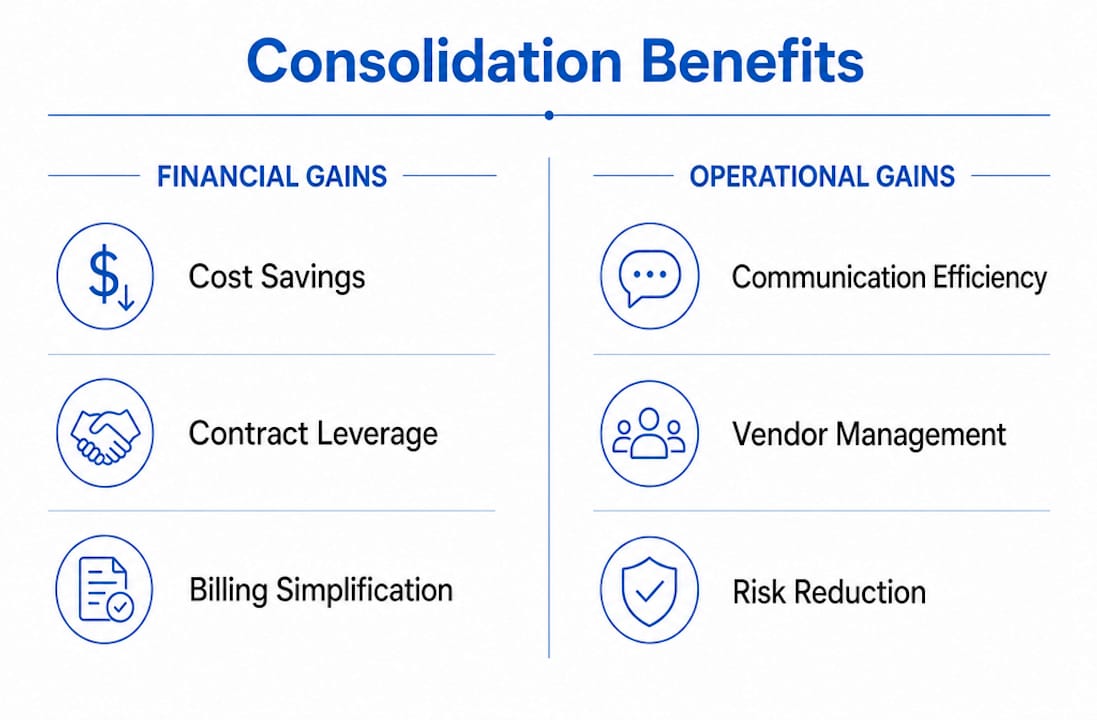
Businesses consolidate telecom vendors to reduce billing complexity, gain contract leverage, and achieve the operational clarity that fragmented multi-carrier environments cannot deliver at scale.
| Point | Details |
|---|---|
| Cost savings require groundwork | Build a synchronized service inventory before consolidation to make savings measurable and defensible. |
| Communication efficiency improves | Unified UCaaS platforms eliminate cross-vendor friction and accelerate incident resolution across all sites. |
| Risks are real but manageable | Vendor dependency and integration complexity require exit clauses, phased migration, and SLAs with financial teeth. |
| Multi-vendor vs. consolidated | Consolidated models outperform for companies with 10-plus locations and standardized technology requirements. |
| Timeline is longer than expected | Most consolidation programs take 30 to 36 months to fully realize savings; plan accordingly. |
What I've learned from watching consolidation projects succeed and fail
I have seen consolidation programs that delivered exactly what the business case promised, and I have seen programs that consumed two years of IT capacity and produced a single vendor relationship that was no better than the five it replaced. The difference is almost never the vendor. It is the clarity of goals going in.
The organizations that succeed treat consolidation as an architectural decision, not a procurement exercise. They define what "better" looks like before they issue an RFP, and they hold that definition through contract negotiations, migration planning, and the inevitable pressure to cut corners when timelines slip.
The organizations that struggle treat consolidation as cost-cutting with a project plan attached. They select a vendor based on price, underestimate integration complexity, and discover six months in that the savings they projected assumed a clean migration that does not exist in their environment. Integration gaps between legacy systems and new platforms are the single most common reason consolidation programs run over budget. This is not a new finding. It is a pattern that repeats because decision-makers consistently underestimate it.
My honest advice: if your primary goal is cost reduction, start with telecom expense management and contract renegotiation before you commit to a full consolidation. You may recover 15 to 20% of spend without migrating a single circuit. If your primary goal is operational simplicity, consolidation is the right move, but build your business case around management efficiency, not just line-item savings. The financial case will follow.
Vendor lock-in is a legitimate concern, but it is a solvable problem. Exit clauses, documented portability requirements, and performance SLAs with real financial consequences give you the leverage to hold a consolidated vendor accountable. The risk is not consolidation itself. The risk is consolidating without the contractual protections that keep the relationship honest.
— Jim
How Californiatelecom supports multi-location consolidation
Multi-location businesses that are ready to consolidate telecom vendors need more than a carrier. They need a provider that designs, deploys, and manages the network across every site with a single point of accountability.Californiatelecom delivers managed network services nationwide for multi-location companies, sourcing from 50-plus carriers while acting as the single provider your IT team works with. One bill, one NOC, one engineer's number. Services include Managed LAN/WAN, UCaaS, and full telecom expense management, all backed by a 99.99% uptime SLA on data and 99.999% on voice. If your organization is evaluating consolidation and wants a clear picture of what the transition looks like, Californiatelecom's engineers build that plan with you before you commit to anything.
FAQ
What is telecom vendor consolidation?
Telecom vendor consolidation is the process of reducing the number of telecom service providers a business uses, typically to lower costs, simplify billing, and improve service management across multiple locations.
How long does telecom vendor consolidation take?
Most consolidation programs take 30 to 36 months to fully realize savings, primarily because integration complexity and migration work consistently exceed initial estimates.
What are the biggest risks of consolidating telecom vendors?
The primary risks are vendor dependency, integration complexity, and service disruption during migration. Businesses mitigate these by negotiating exit clauses, setting SLAs with financial penalties, and using a phased migration approach.
When does consolidating telecom providers make the most sense?
Consolidation delivers the strongest return for companies with 10 or more locations, standardized technology requirements, and IT teams spending significant time managing vendor relationships rather than delivering business value.
How do you choose a telecom vendor for consolidation?
Evaluate providers against your actual location footprint, require references from comparable multi-site customers, and prioritize SLA structure and NOC responsiveness over headline pricing.