

Single Vendor Telecom Consolidation Guide for IT LeadersManaging telecom across ten, twenty, or fifty locations without a single vendor telecom consolidation guide is the kind of operational drag that quietly erodes margins. You're chasing down five different carriers when a circuit goes down, reconciling billing discrepancies across vendor portals, and watching your IT team burn hours on coordination instead of strategy. Major cost savings and simplified workflows are achievable through consolidation, but only when it's executed with clear governance, realistic timelines, and financial controls built in from day one. This guide gives you the practical framework to get there.
Table of Contents
- Key takeaways
- Single vendor telecom consolidation guide: where to start
- Executing your consolidation: a step-by-step approach
- Risks of single vendor consolidation and how to manage them
- Measuring outcomes and sustaining value
- My honest take on what actually drives consolidation success
- How Californiatelecom supports your consolidation
- FAQ
Key takeaways
| Point | Details |
|---|---|
| Governance comes first | Assign decision rights and cross-functional ownership before any migration work begins. |
| Freeze baselines early | Define your cost and service baselines before pilots to measure real savings accurately. |
| Pilot before scaling | Test your approach at a small number of sites before committing to a full rollout. |
| Vendor lock-in is a real risk | Build modular, API-driven architecture into your contract requirements to protect future flexibility. |
| KPIs must span IT and finance | Track uptime, billing accuracy, churn, and run-rate savings together in a single measurement framework. |
Single vendor telecom consolidation guide: where to start
Before any vendor conversations happen, the preparation phase determines whether your consolidation program delivers real value or just reorganizes complexity under a single brand name.
Define your objectives first
Start by writing down what success looks like in concrete terms. Are you eliminating redundant services? Reducing the number of monthly invoices from twenty-two to one? Targeting a specific cost reduction percentage? Consolidation programs that start with vague goals tend to drift in scope and lose executive sponsorship within the first six months.
Set a clear target end-state for your network: which services you want unified, which locations are in scope, and what your acceptable timeline looks like. This gives every subsequent decision a filter.
Map your current vendor landscape
Pull every active telecom contract across all locations. Document service type, monthly cost, contract expiration date, and the internal owner for each. Most multi-location businesses discover overlapping services, forgotten circuits, and contracts that auto-renewed years ago when they do this exercise. That waste becomes the first financial argument for consolidation.
Key data points to capture for each vendor relationship include:
- Service type (WAN, voice, internet, SD-WAN, conferencing)
- Monthly recurring cost and contract term
- Location served and internal dependencies
- SLA commitments and recent performance history
- Penalty clauses and exit conditions
Pro Tip: Have legal review your exit clauses before you map your consolidation timeline. An early termination fee you missed can delay the whole program by a quarter or more.
Build cross-functional alignment
Governance and cross-functional oversight with KPIs tied to critical deliverables is what separates programs that deliver from those that stall. This is not an IT project. Finance needs to own cost measurement. Procurement needs to manage contract negotiations. Operations needs to validate that service changes at each site do not interrupt business processes.
Appointing delivery-capable leaders before any consolidation work begins is a governance essential often skipped in favor of moving fast. Assign decision rights clearly. The people who built the original vendor relationships are not always the right people to lead the migration. You need execution-focused owners who are accountable to a board-level sponsor and measured against defined KPIs from week one.
Executing your consolidation: a step-by-step approach
Once preparation is solid, the execution phase benefits from a structured timeline with defined phases and clear checkpoints.
-
Days 0 to 15: Freeze your baselines. Baseline freezing before pilots is what separates real savings from the noise of transitional service variance. Lock in current costs and service levels with finance sign-off so that any future measurement has a clean starting point.
-
Days 1 to 30: Rank and prioritize. Score your existing vendors and services by value delivered versus cost and risk to the business. High-cost, low-value vendors with expiring contracts are your first decommission targets. Systems with deep operational dependencies get pushed to later phases.
-
Days 31 to 60: Run pilots. Select two to four representative locations that cover the range of your network complexity. Test your single vendor's service delivery, support response, and billing consolidation at those sites. Identify gaps before they become a 50-location problem.
-
Days 61 to 90: Scale with visibility. Expand the rollout using weekly KPI dashboards shared across IT and finance. Transparent reporting keeps stakeholders aligned and catches issues before they compound. NMS Consulting's 90-day integration framework consistently shows that programs with visible metrics outperform those managed by periodic status updates.
-
Negotiate unified terms. Once you have consolidated volume on a single vendor, you have real buying power. Use it. Negotiating based on committed spend across all locations is a materially different conversation than renewing site by site.
Pro Tip: Ask your chosen vendor for a per-location service-level addendum during contract negotiations. A master SLA sounds good in a presentation, but it rarely covers the site-specific nuances that cause disputes later.
Realistic timelines matter here. Aggressive integration schedules increase cost risk and reduce the probability of realizing projected synergies. A 12 to 18 month timeline for a multi-location consolidation is not cautious. It's credible.

Risks of single vendor consolidation and how to manage them
No honest guide to telecom unification ignores the downsides. The same consolidation that simplifies your operations can also create new vulnerabilities if you don't plan for them.
Vendor lock-in and dependency
High renewal costs and reduced vendor choice are documented consequences of poorly structured single vendor arrangements. When your entire network runs through one provider and that provider knows you have minimal exit leverage at renewal, pricing power shifts entirely to their side.

The mitigation is architectural, not just contractual. Build requirements for modular, API-driven interfaces into your vendor selection criteria. Vendor concentration as a risk problem should be managed with the same discipline as any other operational risk, with clear escalation procedures and documented exit scenarios.
Key risk factors to evaluate and track throughout consolidation include:
- Contract renewal leverage and exit penalty terms
- Vendor financial stability and ownership changes
- SLA penalties and enforcement mechanisms
- Architecture portability and data access rights
- Innovation roadmap alignment with your business needs
Underestimating integration complexity
Top-down assumptions without granular site-level data are one of the most common reasons telecom consolidation programs overshoot their budgets. Lease expiry dates, physical infrastructure constraints, and local service availability all affect actual migration timelines at individual sites. Build in a contingency buffer of at least 20% on both time and cost.
"Vendor concentration should be managed as a risk problem, ensuring architectural flexibility and modularity to avoid entrapment and cost escalation." — Evergent
The companies that handle this best treat integration costs as a separate budget line from the ongoing savings projection. Conflating the two makes it impossible to tell whether the program is on track financially until it's too late to correct.
Innovation slowdown
Large consolidated vendors often deprioritize niche capabilities in favor of standardized offerings. If your business depends on specialized integrations or rapid feature adoption, evaluate whether a single vendor can genuinely match that pace or whether a primary vendor plus select specialist partners is a better model.
Measuring outcomes and sustaining value
Consolidation programs that don't transition into a steady-state measurement discipline tend to see their savings erode within two years as usage expands, contracts quietly inflate, and governance weakens.
Build a unified measurement framework
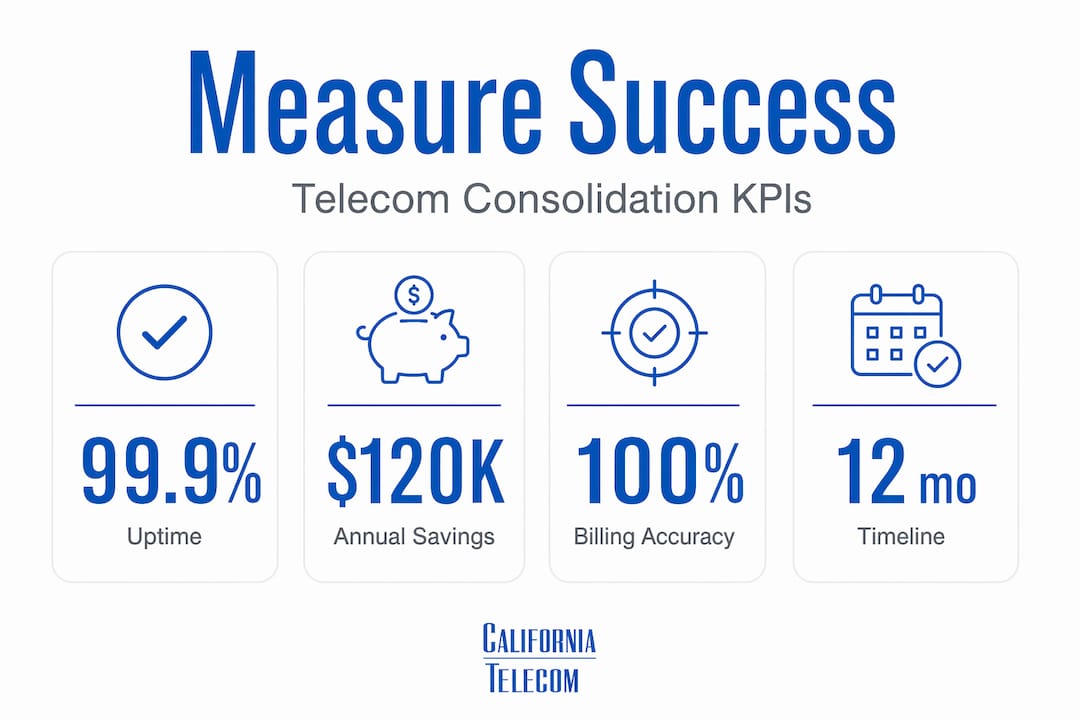
KPI dashboards tracking uptime, churn, billing accuracy, and run-rate savings should be shared across finance, IT, and vendor management from the moment the first site goes live. A unified value map across IT and finance is not optional. Without it, each team declares success against its own metrics and the organization loses sight of the actual outcomes.
| Metric category | What to track | Review cadence |
|---|---|---|
| Financial | Run-rate savings, billing accuracy, invoice volume | Monthly |
| Service quality | Uptime, mean time to repair, SLA adherence | Weekly |
| User experience | Ticket volume, escalation rate, satisfaction scores | Monthly |
| Vendor performance | Contract compliance, roadmap delivery, support responsiveness | Quarterly |
Transition governance appropriately
Board-level oversight is right for the first 12 to 18 months of a consolidation program. Once the network reaches stability and savings are being realized consistently, governance should transition to operational management. Keep the measurement framework intact. The disciplines that delivered the savings are the same disciplines that protect them.
Pro Tip: Schedule a formal consolidation review at the 18-month mark with both IT and finance present. This single meeting prevents the common pattern of savings quietly eroding as the program loses attention.
For teams consolidating telecom billing across multiple locations, the post-consolidation period is actually where the most durable financial benefits are locked in through contract optimization and disciplined vendor performance management.
My honest take on what actually drives consolidation success
What I've seen repeatedly is that the strategy document is rarely what determines the outcome of a telecom consolidation. The execution quality does.
I've worked through enough of these programs to know that the organizations that treat governance as a formality, or assume that a good vendor contract substitutes for clear internal accountability, almost always end up chasing savings they announced but never fully realized. The programs that work have someone in the room who owns delivery, not just the relationship.
Realistic timelines are another place where I've watched companies sabotage themselves. There's a real pressure to show fast results, and I understand it. But integration timelines should reflect site-level realities, not a roadmap built to satisfy a board presentation. Cutting the timeline by 30% to look decisive usually costs you 50% of your projected savings when the migration drags into unplanned phases.
My take on the lock-in risk: it's real, but it's manageable if you're honest about it upfront. The businesses that get trapped are the ones that treated consolidation as purely a cost play and never asked what their exit looked like. Build the exit scenario into the contract before you sign. It costs nothing in the negotiation and protects you significantly in years three through five.
The future-proofing question is the one I'd encourage every IT leader to push harder on. The vendor you choose today will be operating in a different technology context within five years. Make sure your chosen provider's approach includes a credible architecture that keeps your options open as SD-WAN, AI, and cloud connectivity continue to evolve.
— Jim
How Californiatelecom supports your consolidation
Multi-location telecom consolidation is exactly the kind of program where the right partner makes the difference between realized savings and a stalled initiative.Californiatelecom works with multi-location businesses nationwide as a single provider for data, connectivity, voice, unified communications, and managed network services. Californiatelecom sources from 50+ carriers and designs each site deployment through its own engineers, which means the consolidation planning and the execution are handled by the same team. Every service is backed by a 24/7 U.S.-based NOC, a 99.99% uptime SLA on data, and 99.999% on voice. Explore nationwide managed network solutions or schedule a free consultation to discuss your consolidation program with a Californiatelecom engineer.
FAQ
What is single vendor telecom consolidation?
Single vendor telecom consolidation is the process of moving all telecom services across multiple business locations to one provider. The goal is to reduce cost, simplify management, and improve service accountability.
How long does telecom consolidation typically take?
For multi-location businesses, a realistic consolidation timeline runs 12 to 18 months. Aggressive timelines increase cost risk and reduce the probability of realizing projected savings.
What are the biggest risks of telecom vendor consolidation?
The primary risks are vendor lock-in, underestimated integration costs, and innovation slowdown. Modular architecture requirements, documented exit clauses, and realistic budget contingencies address all three.
How do you measure the success of telecom consolidation?
Track run-rate savings, billing accuracy, uptime, and customer experience metrics through a unified dashboard shared across IT and finance. Continuous KPI measurement post-consolidation verifies savings and catches service quality issues early.
When should governance transition from board-level to operational management?
Governance can transition once the network reaches stability and projected savings are being realized consistently, typically 12 to 18 months post-implementation. The measurement framework should remain in place regardless of the governance level.