

What Is a NOC? How It Keeps Networks Up and Who Needs OneA Network Operations Center (NOC) is a physical or virtual command post where technicians monitor and manage an organization's network infrastructure around the clock. Its job is simple to state and hard to execute: keep everything running, catch problems before employees or customers notice, and get systems back online fast when something breaks. A NOC typically watches:
- Routers and switches
- Firewalls and load balancers
- Servers, both physical and virtual
- WAN and LAN connections linking offices, data centers, and cloud environments
TL;DR:
- A NOC is essential for real-time detection and rapid resolution of network issues, requiring skilled staff, clear processes, and integrated monitoring platforms.
- Companies should evaluate NOC providers based on explicit SLA terms, carrier redundancy, and direct escalation contacts to ensure reliable support.
- An in-house NOC offers control but is costly to staff, while outsourced and hybrid models balance scale, expertise, and cost, depending on organizational needs.
- Automation enhances NOC efficiency, but only when paired with well-trained personnel and robust workflows; technology alone cannot replace skilled analysts.
- The true value of a NOC lies in preventing outages at the degraded link stage, avoiding customer impact, and maintaining high uptime, especially outside regular hours.
Table of Contents
- What Is a NOC's Core Job? Functions and Responsibilities
- The Building Blocks: People, Processes, and Platforms
- How a NOC Actually Works: From Signal to Resolution
- NOC vs SOC vs Help Desk: Who Handles What
- What a NOC Actually Buys You
- In-House, Outsourced, or Virtual: Choosing a Deployment Model
- What to Ask a NOC Provider Before You Sign
- Key Takeaways
- What Most Explainers Get Wrong About NOCs
- Sources
What Is a NOC's Core Job? Functions and Responsibilities
A NOC's daily work breaks into four connected disciplines, and each one exists to protect uptime.
Real-time monitoring and alert triage come first. Analysts watch dashboards tracking bandwidth, latency, packet loss, and device health, sorting real threats from background noise. When an alert fires, incident response kicks in: the team diagnoses the problem, contains it, and works toward resolution, with the clock running against a mean time to repair (MTTR) target. NOC functions include proactive incident detection and troubleshooting specifically to catch infrastructure issues before they reach end users.
Patch management and change coordination fill the quieter hours. NOC teams schedule maintenance windows, push firmware and security updates, and liaise with carriers and hardware vendors when a fix requires outside help. Finally, SLA tracking and reporting close the loop: uptime percentages, response times, and resolution metrics get logged and shared with stakeholders who need proof the network is performing as promised.
A typical incident moves through these stages:
- An alert triggers based on a defined threshold.
- The on-duty analyst confirms it isn't a false positive.
- A ticket opens and severity gets assigned.
- The team resolves the issue directly or escalates to a specialist or vendor.
- A post-incident report documents root cause and prevention steps.
Pro Tip: Ask any NOC candidate for their average MTTR by severity tier, not just an overall average. A team that resolves minor blips fast but takes hours on critical outages has a staffing gap you need to know about before you sign a contract.
Splunk's overview of NOC functions confirms this pattern: monitoring, incident response, troubleshooting, and patch management aren't separate jobs, they're one continuous cycle.
The Building Blocks: People, Processes, and Platforms
A NOC works only when three layers line up: the humans, the playbooks, and the technology.
On the people side, you'll usually find NOC analysts or engineers handling first-line monitoring, a shift lead coordinating coverage and priorities, and an escalation engineer who steps in when a problem exceeds first-tier expertise. A NOC requires skilled personnel alongside its technical infrastructure because software alone can't judge which alert deserves a 2 a.m. phone call.
Process is what keeps that judgment consistent across shifts. That means:
- Documented runbooks for common failure scenarios
- Escalation matrices specifying who gets contacted and when
- Ticketing systems integrated directly with monitoring alerts
- Defined change windows for scheduled maintenance
The platform layer ties it together. Modern NOCs run on observability tools that pull telemetry from every device on the network into a single view, rather than forcing analysts to check ten separate consoles. Platforms like Netverge's monitoring dashboard consolidate that telemetry so a shift lead can spot a degrading link before it becomes a full outage.
How a NOC Actually Works: From Signal to Resolution
Every alert a NOC acts on starts as raw data. SNMP polling, syslog messages, synthetic transaction checks, and API telemetry from cloud services all feed into the monitoring platform continuously, day and night.
Raw data alone would drown a team in noise, so alert tuning matters as much as collection. Analysts set thresholds, deduplicate repeat alerts from the same root cause, and suppress known, harmless fluctuations. Without tuning, a single flapping interface can generate hundreds of tickets overnight, exhausting a team before a real emergency even hits.
Once a genuine alert survives triage, the workflow looks like this:
- A ticket opens automatically, tagged with device, location, and severity.
- The on-shift analyst begins diagnosis, checking recent changes and correlated alerts.
- If the fix requires a carrier or hardware vendor, the NOC opens a coordinated ticket with them directly.
- Unresolved issues escalate to a senior engineer per the matrix.
- After resolution, the team files a post-incident report noting root cause and prevention steps.
Shift handoffs matter more than people expect. NOCs staff in rotating shifts specifically to maintain 24/7 coverage, and a sloppy handoff, where context about an in-progress issue gets lost between shifts, is one of the most common causes of extended outages. A mature NOC treats the handoff itself as a documented step, not an afterthought.
NOC vs SOC vs Help Desk: Who Handles What
These three teams get confused constantly, and the confusion costs response time during an actual incident.
- NOC: Focuses on availability and performance, keeping routers, servers, and connections running.
- SOC (Security Operations Center): Focuses on threat detection, investigation, and response, hunting for intrusions and malicious activity.
- Help desk: Handles user-facing support, taking in tickets like "my email won't sync" and routing or resolving them directly.
The lines blur fast in a real incident. Take a firewall that suddenly drops connections. The NOC restores availability first, but the SOC needs to determine whether the failure was hardware fatigue or an active attack. NOC and SOC teams work best when they share data closely, because an operational failure can mask, or cause, a security gap that only becomes visible when both teams compare notes. A help desk sits downstream of both, fielding the "why is the internet down" calls while the real diagnosis happens elsewhere.
What a NOC Actually Buys You
The business case for a NOC comes down to four measurable outcomes.
- Faster detection and resolution. Continuous monitoring catches degrading performance before it becomes an outage, which directly shrinks MTTR.
- Higher, more predictable availability. SLA-backed monitoring turns uptime from a hope into a tracked, reportable number.
- Centralized vendor coordination. One team manages relationships with carriers and hardware vendors instead of scattering that responsibility across departments.
- Cost avoidance. Every hour of downtime prevented is revenue, productivity, and customer trust that never gets lost in the first place.
Uptime commitments illustrate why the math works in a NOC's favor. A 99.99% uptime target allows under an hour of downtime across an entire year. Without dedicated monitoring, most organizations blow past that threshold without ever knowing it happened until a customer complains. RAND's analysis of NOC and SOC staffing models notes that automation and better integration can improve efficiency, but only when organizations invest in the change management to make it stick.
In-House, Outsourced, or Virtual: Choosing a Deployment Model
Three deployment paths exist, and each fits a different kind of organization.
- In-house NOC. You get full control over priorities and institutional knowledge, but staffing a 24/7 rotation with qualified engineers is expensive and hard to sustain through turnover.
- Outsourced NOC. A managed provider brings scale, established runbooks, and contractual SLAs from day one, trading some direct control for speed and cost efficiency.
- Hybrid or virtual NOC. Internal staff handle daytime operations while a partner covers after-hours and overflow, often through a shared dashboard rather than a physical room.
Before picking a model, weigh your actual scale, whether you truly need 24/7/365 coverage, any compliance requirements tied to your industry, and how many vendor relationships you're prepared to manage directly. Organizations running a network with dozens of locations typically outgrow the in-house model well before leadership expects to.
What to Ask a NOC Provider Before You Sign
Verified proof points separate a serious provider from a marketing page. Californiatelecom backs its managed network services with a 24/7 U.S.based NOC, a 99.99% uptime SLA on data, and sourcing from more than 50 carriers rather than a single pipe.
When you evaluate any provider, ask directly:
- What's the exact SLA language, and what penalties apply if it's missed?
- How many carriers back your redundancy, and what happens if one fails?
- Do I get one engineer's direct contact, or a rotating support queue?
- Is the NOC staffed domestically, and what's the actual escalation path at 3 a.m.?
Key Takeaways
A NOC works because it turns network uptime from a reactive scramble into a monitored, measured, and contractually backed discipline.
| Point | Details |
|---|---|
| NOC defined | A centralized hub, physical or virtual, that monitors and manages routers, servers, firewalls, and WAN/LAN links continuously. |
| Core functions | Real-time monitoring, incident response, patch coordination, and SLA reporting form one continuous operational cycle. |
| NOC vs SOC vs help desk | NOC handles availability, SOC handles security threats, and help desk handles user-facing requests; all three coordinate on complex incidents. |
| Deployment choice matters | In-house offers control, outsourced offers scale and SLAs, and hybrid models split the difference based on real needs. |
| Proof points to verify | Ask any provider for exact SLA terms, carrier diversity, and a direct escalation contact before signing. |
What Most Explainers Get Wrong About NOCs
Most guides treat a NOC like a piece of infrastructure you install once and forget. It isn't. A NOC is a running discipline, and its value shows up almost entirely in the moments nobody sees, the outage that got caught at the "degrading link" stage instead of the "customers are calling" stage.
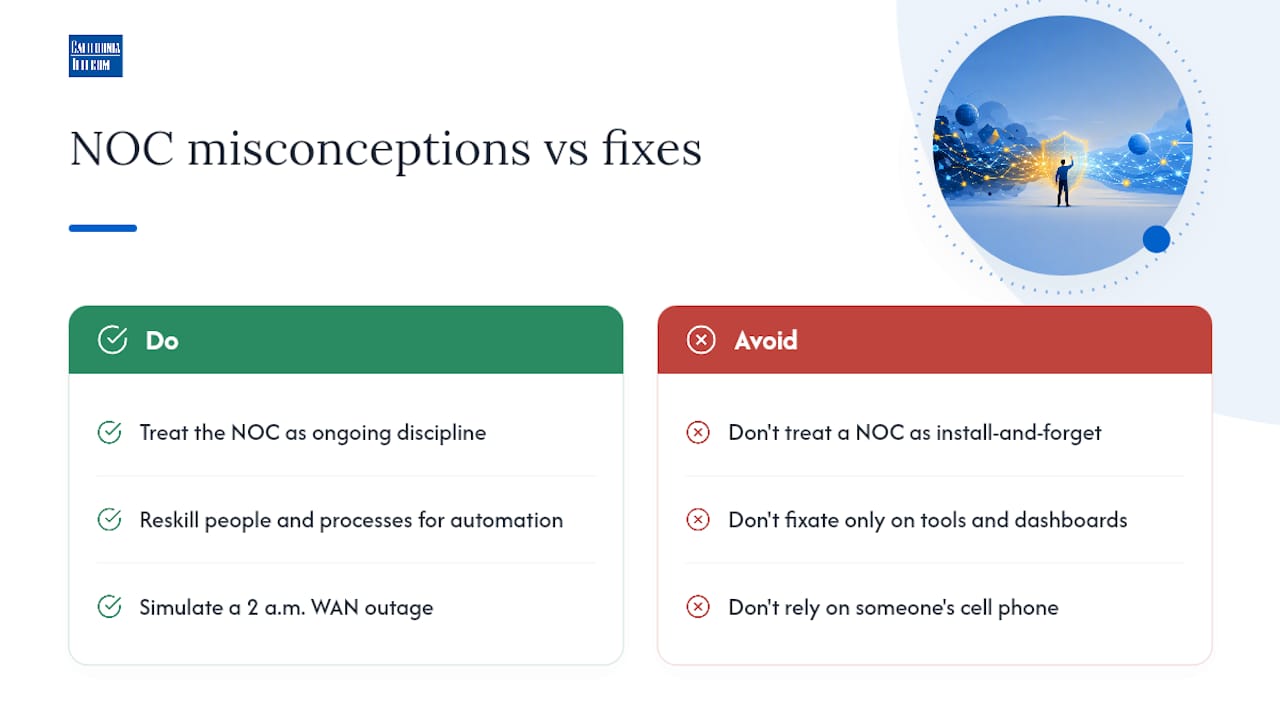
The conventional advice fixates on tools and dashboards, and that's backwards. The RAND research on staffing trade-offs makes this clear: automation only pays off when the people and processes around it are re-skilled to use it, not just bought. A brilliant observability platform staffed by an undertrained overnight shift is worse than a plain dashboard staffed by people who know your network cold.
If you're evaluating whether you need a NOC at all, skip the feature comparison and ask one question first: what happens right now, tonight, if your primary WAN link drops at 2 a.m.? If the honest answer involves someone's personal cell phone and a guess, that's your answer.
— Jim