

How to Evaluate Outsourced Network Engineering Providers## What you need to know before choosing a provider
When you evaluate outsourced network engineering providers, four criteria separate reliable partners from expensive disappointments: SLA specificity, operational simplicity, incident response speed, and the depth of in-house engineering. Get these right and you have a network that runs itself. Miss one and you are chasing tickets across three vendors at 2 AM.
The right managed network provider for a multi-location U.S. business delivers more than uptime. It delivers a single point of accountability: one engineer who knows your sites, one bill, and one number to call when something breaks. That model is what separates a genuine managed service from a glorified help desk.
Pro Tip: Scrutinize SLA language before anything else. A provider who cannot tell you their guaranteed mean-time-to-repair (MTTR) and escalation path within 60 seconds of being asked is not operationally mature enough for a distributed network.
Table of Contents
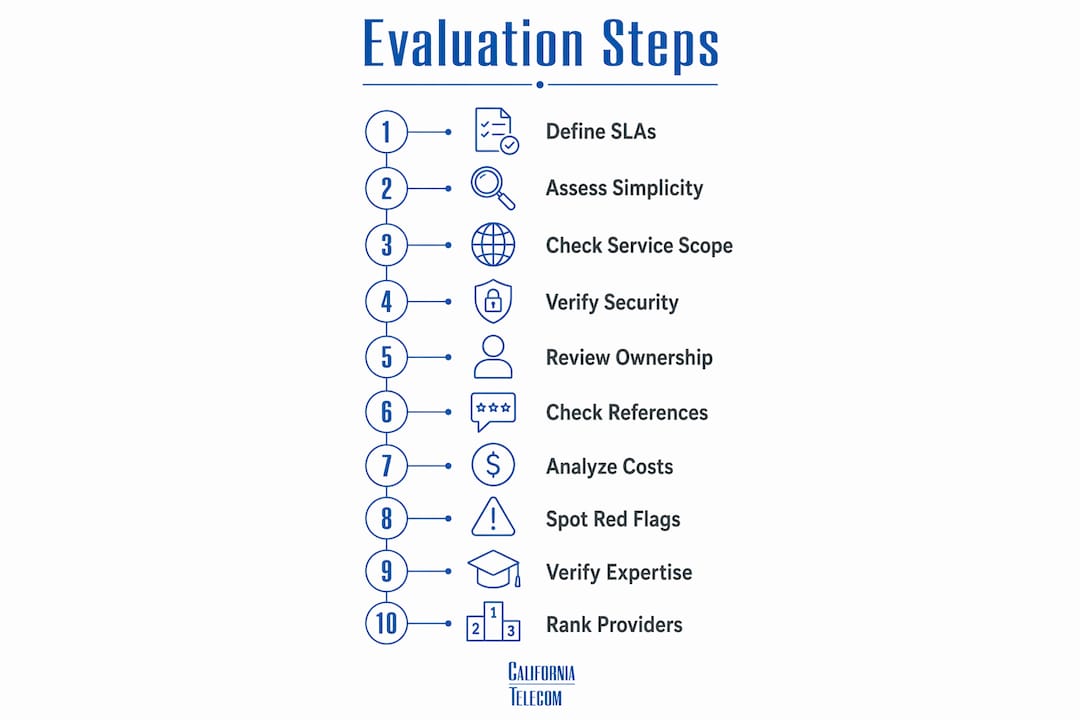
- 1. SLAs: what the numbers actually need to say
- 2. Operational simplicity and vendor consolidation
- 3. Service scope: what managed network services actually cover
- 4. Security posture and compliance certifications
- 5. Engineering ownership per site
- 6. Reputation verification and client references
- 7. Cost structure and hidden fees
- 8. Red flags that signal provider risk
- 9. How to verify provider expertise during engagement
- 10. Risks and benefits of outsourcing network engineering
- 11. A framework for ranking providers objectively
- Key Takeaways
- Californiatelecom covers every location from a single contract
1. SLAs: what the numbers actually need to say
A well-structured SLA stipulates guaranteed uptime percentages alongside acknowledgment, triage, escalation, and resolution timeframes. Look for uptime guarantees that reflect very high availability. For data, high standards are needed; for voice, even stricter availability is typical.
Beyond uptime, the SLA must define MTTR explicitly, not just "best effort." Ask for the contractual resolution window by severity tier. If a provider hedges on that number, the SLA is decorative.
2. Operational simplicity and vendor consolidation
Multi-location businesses consistently prioritize providers that reduce management overhead rather than add to it. Every additional vendor in your stack is another escalation path, another contract renewal, and another point of blame-shifting when something fails.

A single-vendor model with consolidated billing eliminates that friction. You get one relationship to manage, one invoice to reconcile, and one team that owns the outcome across every site.
3. Service scope: what managed network services actually cover
Managed network services span continuous monitoring, incident handling, configuration management, firmware updates, LAN/WAN, cloud connectivity, wireless, disaster recovery, and business continuity. The scope varies significantly between providers, so get a written service catalog before signing anything.
Ask specifically whether the provider handles proactive maintenance or only reactive break-fix. The difference in network stability between those two models is substantial.
4. Security posture and compliance certifications
Security certifications tell you whether a provider has been independently audited or simply claims to be secure. SOC 2 Type II, ISO 27001, and HIPAA compliance are the benchmarks worth requiring for most enterprise environments. A provider without any third-party audit history is a liability for regulated industries.
Verify that security practices extend to your sites, not just the provider's own infrastructure. Ask how they handle firmware patching, access control, and incident disclosure.
5. Engineering ownership per site
There is a meaningful difference between a provider who dispatches whoever is available and one whose engineers design and deploy each site themselves. The latter produces documentation, institutional knowledge, and faster resolution because the engineer already knows the topology.
Customers consistently prefer vendors who assign engineering ownership per location, because that accountability structure directly reduces MTTR when problems surface.
6. Reputation verification and client references
Ask for references from businesses with a similar number of locations and similar industry requirements. A provider who excels at single-site deployments may struggle with 40-location rollouts. Online reviews are a starting point, but a 20-minute call with an actual client reveals far more about escalation behavior and communication quality.
Check whether the provider has documented case studies. Vague testimonials are easy to manufacture; a detailed case study with specific outcomes is harder to fake.
7. Cost structure and hidden fees
Managed network pricing typically follows one of three models: per-device, per-site, or all-inclusive flat rate. Per-device pricing looks attractive at first but scales unpredictably as you add equipment. Per-site pricing is more predictable for multi-location businesses. Flat-rate models offer the cleanest budgeting but require careful scope definition upfront.
Watch for fees that do not appear in the base quote:
- Onboarding and site survey fees billed separately from monthly service
- After-hours support premiums that effectively nullify a 24/7 support claim
- Carrier coordination fees when the provider does not source connectivity directly
- Change management fees for configuration updates that should be routine
- Contract exit penalties that lock you in regardless of performance
Companies using managed network services report more predictable operational expenses compared to in-house models, but only when the contract scope is clearly defined. Ambiguous scope is where hidden costs live.
8. Red flags that signal provider risk
Some warning signs are subtle; others are obvious in the first sales call. Either way, they predict operational problems before you sign.
- Vague SLA language with no defined MTTR or escalation tiers
- Offshore-only NOC with no U.S.-based escalation path for critical incidents
- No dedicated point of contact — you reach a generic queue every time
- Inability to name certifications when asked directly about security compliance
- Reluctance to provide references from multi-location clients
- Pricing that changes significantly between the proposal and the contract
- No documented onboarding process for new sites
A provider who cannot clearly explain their escalation protocols and support coverage hours during the sales process will not improve after you sign.
9. How to verify provider expertise during engagement
Start with a structured questionnaire before the first demo. The questions that reveal the most:
- Which technologies do your engineers hold active certifications in?
- How do you handle firmware and documentation management across sites?
- What is your escalation path from Tier 1 to senior engineering?
- Can you show me a sample SLA with actual MTTR commitments by severity?
- How do you define the boundary between reactive and proactive work in your contracts?
Clear scope definition within the engagement contract, separating reactive from proactive responsibilities, is one of the strongest predictors of long-term provider accountability. If a provider cannot answer that boundary question cleanly, their contract will not protect you.
Pro Tip: Request a sample incident report from a real (anonymized) event. How a provider documents and communicates during an outage tells you more about their operational maturity than any sales deck.
10. Risks and benefits of outsourcing network engineering
The core risk difference between in-house and outsourced network engineering is visibility. Internal failures are often silent until they become critical. Outsourced risks are contractually defined and legally enforceable through SLAs, which means you have recourse when performance falls short.
Key benefits of outsourced network engineering include:
- Access to specialized expertise across multiple technology stacks
- 24/7 monitoring without the cost of staffing a round-the-clock internal team
- Predictable monthly costs versus unpredictable in-house capital expenditure
- Faster scaling when you open new locations
The real downsides are dependency and transition risk. If a provider underperforms and you need to switch, the migration is disruptive. That is exactly why SLA enforcement clauses and exit terms matter as much as the service description itself.
11. A framework for ranking providers objectively
Score each candidate across five weighted criteria. Assign each a score of 1–5, then weight by importance to your business:
| Criterion | Weight | What to measure |
|---|---|---|
| SLA specificity | High | MTTR commitments, uptime tiers, escalation paths |
| Engineering ownership | High | Per-site engineers vs. shared pool |
| Operational simplicity | Medium | Single billing, single contact, vendor count |
| Security compliance | Medium | SOC 2, ISO 27001, HIPAA documentation |
| Cost transparency | Medium | All-in pricing vs. itemized add-ons |
Run every shortlisted provider through this grid before the final decision. The provider who scores highest on SLA specificity and engineering ownership will almost always outperform on reliability over a 12-month period. A small IT team evaluating providers can use this same framework to cut through sales noise and focus on what actually predicts performance.
Key Takeaways
Choosing the right outsourced network engineering provider comes down to SLA specificity, engineering ownership per site, and a single-vendor model that eliminates the operational drag of managing multiple vendors across locations.
| Point | Details |
|---|---|
| SLA specificity matters most | Require defined mean-time-to-repair by severity tier and extremely high uptime guarantees for both data and voice services. |
| Engineering ownership reduces MTTR | Providers who design and deploy each site themselves resolve incidents faster than shared-pool models. |
| Single-vendor model cuts overhead | One bill, one contact, and one accountable team reduces management complexity across locations. |
| Red flags appear early | Vague SLA language, no U.S.-based NOC, and reluctance to share references predict poor performance. |
| Californiatelecom fits this model | Californiatelecom offers in-house engineering per site, a 24/7 U.S.-based NOC, and a single point of contact for multi-location businesses nationwide. |
Californiatelecom covers every location from a single contractMulti-location businesses that have worked through the evaluation framework above often reach the same conclusion: the hardest part is finding a provider who actually owns the engineering, not just the contract. Californiatelecom is built around that exact model. Their engineers design and deploy each site, backed by a 24/7 U.S.-based NOC and strong uptime SLA commitments for data and voice. One provider, one bill, one engineer's number.
For businesses running 5 locations or 50, that structure removes the operational drag that multi-vendor arrangements create. Californiatelecom sources from many carriers, which means you get carrier-agnostic connectivity without managing carrier relationships yourself. Their nationwide managed network services cover the full scope: LAN/WAN, voice, unified communications, and AI solutions, all under a single agreement.
If you want to see how that model applies to your specific locations, request a free consultation and get a scoped proposal from their engineering team.
Recommended
- Picking a Managed Network Services Provider When Your IT Team Is Small | California Telecom
- How to Improve Network Performance with Managed LAN/WAN Solutions | California Telecom
- The Role of a Dedicated Network Engineer in Business | California Telecom
- Professional Services Network Solutions | California Telecom