

The Role of a Dedicated Network Engineer in BusinessA dedicated network engineer is a senior technical professional responsible for designing, implementing, and maintaining enterprise networks across distributed locations. The role of a dedicated network engineer in business goes far beyond keeping the lights on. These engineers own the architecture decisions that determine whether your 50-site or 500-site operation runs at full speed or grinds to a halt. Their expertise spans LAN (local area network), WAN (wide area network), SD-WAN (software-defined WAN), firewall architecture, and zero-trust security frameworks. Businesses that treat this role as a commodity rather than a strategic function pay for it in downtime, security gaps, and runaway infrastructure costs.
What are the primary responsibilities of a dedicated network engineer?
A dedicated network engineer carries a wide set of responsibilities that touch every layer of your network. The core duties fall into five distinct areas.
-
Network design and architecture. The engineer creates standardized site blueprints for multi-location deployments. A repeatable blueprint reduces bespoke problems at each new site and cuts deployment time significantly. Without this standardization, every new office becomes its own firefighting exercise.
-
Technology deployment and management. This includes configuring SD-WAN, VLANs (virtual local area networks), VPNs (virtual private networks), and wireless infrastructure. SD-WAN deployment and firewall architecture are now standard expectations for senior engineers managing multi-site enterprises, alongside Network Access Control and zero-trust implementations.
-
Security management. The engineer defines firewall policies, manages network segmentation, and enforces zero-trust principles. Security is not a separate workstream. It is built into every architecture decision from day one.
-
Proactive monitoring and incident response. The engineer sets up alerting thresholds, owns escalation procedures, and coordinates resolution during outages. Reactive models cost far more in lost productivity than proactive ones.
-
Vendor and ISP coordination. Managing circuit cutovers, resolving ISP disputes, and handling equipment lifecycle decisions require significant time investment that only experienced engineers can handle without creating downstream problems.
A senior engineer in enterprise environments typically brings 5–10 years of experience managing complex architecture across 100 or more sites. That experience level is not arbitrary. It reflects the real complexity of multi-location network management.
Pro Tip: When writing a network engineer job description, require documented experience with multi-site deployments specifically. General networking experience does not translate automatically to distributed enterprise environments.
How does a dedicated network engineer improve business outcomes?
The business case for this role is grounded in measurable operational impact. Here is where the value shows up most clearly.
-
Faster incident resolution. Managed and dedicated engineering models deliver network outage response within 30–60 minutes, compared to 1–4 hour delays in reactive in-house models. For a multi-location retailer or distributor, that difference is the gap between a manageable disruption and a day of lost revenue.
-
Lower operational costs. Managed network services reduce annual spend by 30–50% compared to maintaining a single in-house engineer. That figure accounts for salary, benefits, training, certification renewals, and redundant tooling.
-
Elimination of knowledge silos. A single in-house engineer becomes a single point of failure. Single engineers create knowledge silos that put the entire network at risk when that person leaves or is unavailable. Dedicated teams distribute that knowledge across multiple specialists.
-
Support for digital transformation. SD-WAN migrations, cloud connectivity, and unified communications all require a network foundation that can carry the load. A dedicated engineer designs that foundation before the transformation begins, not after problems surface.
-
Compliance and risk reduction. Proactive architecture decisions reduce your exposure to regulatory violations and security incidents. This is especially relevant for businesses in healthcare, finance, and logistics where network failures carry legal consequences.
The full cost of in-house networking also includes ongoing training and certification renewals that a single engineer cannot sustain alone. That hidden cost is often what tips the calculation toward a dedicated or managed model.
What specialized skills distinguish a senior dedicated network engineer?
Senior engineers bring a skill set that goes well beyond basic configuration work. The gap between a mid-level and senior network engineer is not just years of experience. It is the ability to make architecture decisions that hold up under growth, security pressure, and vendor complexity.
-
Routing protocol expertise. Proficiency in BGP (Border Gateway Protocol) and OSPF (Open Shortest Path First) is non-negotiable for engineers managing multi-site WAN environments. These protocols determine how traffic flows between your locations and the internet.
-
Security architecture. This includes firewall design, NAC (Network Access Control), and zero-trust frameworks. Cloud security best practices now intersect directly with network architecture, making security fluency a core engineering competency rather than a specialty add-on.
-
Automation and infrastructure as code. Senior engineers lead automation initiatives using tools like Terraform and Ansible to reduce manual configuration errors and speed up deployments. This is now a standard expectation, not an advanced differentiator.
-
Business communication. Network engineers now act as translators between business intent and network design. The ability to present a network investment case to a CFO or COO is as important as the technical work itself.
-
Vendor and lifecycle management. Senior engineers manage relationships with ISPs, hardware vendors, and software providers. They track equipment end-of-life dates and plan replacements before failures occur.
Pro Tip: When evaluating candidates for a senior network engineer role, ask them to walk you through a multi-site SD-WAN deployment they led from design to cutover. The specificity of their answer tells you more than any certification list.
What challenges do multi-location businesses face in network management?
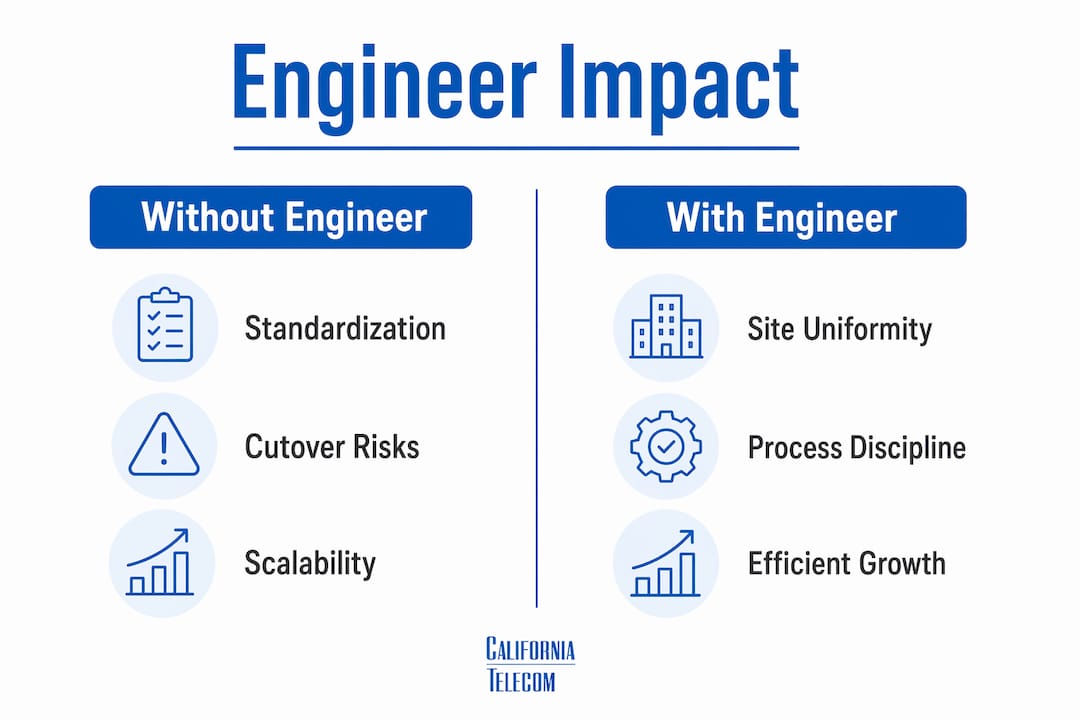
Multi-location businesses face a specific set of network management problems that single-site organizations never encounter. The table below maps the most common challenges to the ways a dedicated engineer addresses each one.

| Challenge | Without a dedicated engineer | With a dedicated engineer |
|---|---|---|
| Site standardization | Each location configured differently, creating support complexity | Repeatable blueprints applied across all sites |
| Incident response | Reactive model with 1–4 hour resolution delays | Proactive monitoring with 30–60 minute response targets |
| Vendor coordination | IT staff chasing multiple ISPs and hardware vendors | Single point of accountability managing all vendor relationships |
| Scaling for growth | New sites built ad hoc, creating technical debt | Architecture designed to absorb new locations cleanly |
| Security consistency | Firewall policies vary by site, creating gaps | Uniform zero-trust and segmentation policies enforced everywhere |
Managing circuit cutovers and multi-site configuration standardization requires a level of process discipline that generalist IT staff cannot maintain alongside their other responsibilities. The engineer's job is to turn one-off problems into solved categories.
Scaling during mergers and acquisitions creates a particularly sharp version of this challenge. Acquiring 20 new locations means absorbing 20 different network configurations, 20 different ISP contracts, and 20 different security postures. A dedicated engineer with a standardization playbook turns that from a multi-year project into a manageable integration.
Proactive monitoring and defined SLAs separate professional network management from the "call when broken" model that most businesses default to when they lack dedicated engineering resources. The difference shows up in uptime numbers and in the confidence of your operations team.
For IT decision-makers evaluating whether to build this capability in-house or through a managed model, the managed network guide for multi-location IT lays out the tradeoffs in practical terms.
Key Takeaways
A dedicated network engineer is the single most important hire for any multi-location business that depends on network uptime, security, and the ability to grow without rebuilding its infrastructure from scratch.
| Point | Details |
|---|---|
| Core responsibilities span five domains | Design, deployment, security, monitoring, and vendor coordination all require dedicated ownership. |
| Experience level matters significantly | Senior engineers with 5–10 years of multi-site experience deliver outcomes that generalists cannot replicate. |
| Downtime costs justify the investment | Dedicated engineering cuts incident response from 1–4 hours to 30–60 minutes, protecting revenue directly. |
| Knowledge silos are a hidden risk | Single in-house engineers create single points of failure; dedicated teams distribute expertise and reduce that risk. |
| Managed models can reduce costs by 30–50% | Combining dedicated engineering with managed services lowers annual network operational spend while expanding coverage. |
What I've learned about getting real value from network engineers
The most common mistake I see IT leaders make is hiring a network engineer and then immediately burying them in helpdesk escalations. You have just hired someone with the skills to redesign your entire WAN architecture, and you are asking them to reset VPN credentials. That is an expensive misalignment.
The engineers who deliver the most business value are the ones given protected time for architecture work. Monitoring, event response, and tier-one escalations belong in a NOC (network operations center) or a managed service layer. Many enterprises lack 24/7 proactive monitoring in-house, and the right answer is not to expect one engineer to cover that gap. It is to pair your internal engineer with a managed NOC so each layer does what it does best.
The second mistake is treating the network engineer as a purely technical role. The best ones I have worked with spend real time with finance, operations, and real estate teams. They know which locations are being considered for expansion before the lease is signed. That advance notice is what allows them to design connectivity into a new site rather than bolt it on after the fact.
Successful network strategies balance internal and managed support, using 24/7 NOC services for event escalation while reserving internal engineers for strategic architecture. That model is not a compromise. It is the most effective use of both resources. If you are evaluating how to structure your network engineering function, the enterprise network design guide is a practical starting point for understanding what that structure should look like.
— Jim
How Californiatelecom supports multi-location network engineering
Californiatelecom delivers managed network services nationwide for multi-location businesses that need dedicated engineering expertise without the overhead of building a full in-house team. Every deployment is designed and installed by Californiatelecom's own engineers, backed by a 24/7 U.S.-based NOC and a 99.99% uptime SLA on data.Californiatelecom sources from 50+ carriers, which means your business gets the right connectivity at each site without you negotiating 20 separate ISP contracts. You work with one provider, one bill, and one engineer's direct number. For multi-location operations managers who need network reliability without the operational drag of managing a distributed infrastructure, Californiatelecom's managed LAN/WAN services are built for exactly that situation. Contact Californiatelecom for a free consultation to see what a purpose-built network architecture looks like for your locations.
FAQ
What does a dedicated network engineer do?
A dedicated network engineer designs, deploys, and maintains enterprise network infrastructure across multiple locations. Their responsibilities include SD-WAN configuration, firewall management, proactive monitoring, and vendor coordination.
How many years of experience does a senior network engineer need?
Senior dedicated network engineers in multi-location enterprises typically require 5–10 years of experience managing complex architecture across 100 or more sites.
How does a network engineer reduce business downtime?
Dedicated engineers implement proactive monitoring and defined escalation procedures that cut incident response times to 30–60 minutes, compared to 1–4 hour delays in reactive in-house models.
What is the difference between in-house and managed network engineering?
In-house models rely on one or two engineers who can become knowledge silos, while managed models provide collective team expertise and 24/7 coverage. Managed network services can reduce annual operational spend by 30–50%.
What skills should I look for when hiring a network engineer?
Look for expertise in BGP, OSPF, SD-WAN, firewall architecture, and zero-trust security, combined with experience in automation tools like Terraform and Ansible, and the ability to communicate network decisions to non-technical business leaders.