

Shrink PCI Scope in 5 Steps: Network Segmentation for IT TeamsYes, segmentation can shrink PCI scope, but only if the systems outside your boundary genuinely cannot reach or influence the cardholder data environment. The PCI SSC's own guidance treats it as a recommended method, not a mandate. Start today by mapping every cardholder data flow and marking which assets sit inside that boundary. That single exercise drives everything else in this guide, including your Requirement 11.4.5 testing plan.
TL;DR:
- Proper segmentation requires effective enforcement and testing, as simply installing firewalls does not automatically exclude systems from scope.
- Cloud and on-premises environments need detailed tagging and thorough validation, especially for ephemeral resources that can quickly change or vanish.
- Mapping data flows and documenting all access points establishes a clear boundary and helps prevent scope creep during audits.
- Penetration testing should actively attempt to pivot from out-of-scope to in-scope networks to verify that segmentation holds under attack conditions.
- Managed segmentation solutions with centralized control and continuous monitoring simplify maintaining PCI compliance across multiple sites.
Table of Contents
- What Counts as CDE, Connected To, and Out of Scope Under PCI Guidance
- Why PCI Network Segmentation Actually Pays Off
- How to Design Segmentation Across On-Prem, Cloud, and Branch Networks
- Building a PCI-Ready Segmentation Rollout Step by Step
- What to Test and What Evidence Auditors Actually Want
- Keeping Segmentation Valid Through Change Control and Re-Validation
- Why Managed Segmentation Often Beats DIY at Multi-Site Scale
- How Californiatelecom Supports PCI Segmentation Projects
- Sources
What Counts as CDE, Connected To, and Out of Scope Under PCI Guidance
The cardholder data environment (CDE) is any system that stores, processes, or transmits cardholder data, plus anything directly connected to it. PCI's scoping model breaks assets into three buckets:
- CDE systems: POS terminals, payment applications, databases holding card numbers.
- Connected-to systems: a directory server that authenticates into a CDE box, a jump host, a monitoring tool with CDE access.
- Out-of-scope systems: assets with no path, direct or indirect, to reach the CDE.
Here's what trips up a lot of teams: installing firewalls between zones doesn't automatically earn out-of-scope status. The PCI SSC is explicit that segmentation has to be enforced correctly and proven through testing, not just deployed. That proof obligation shows up directly in PCI DSS v4.0.1: Requirements 11.4.5 and 11.4.6 govern segmentation validation testing, and 12.5.2 governs how often you confirm your scope is still accurate. Get the categorization wrong and your assessor will pull systems back into scope, sometimes an entire flat network's worth.
Why PCI Network Segmentation Actually Pays Off
Cutting your assessment scope down to the systems that truly touch card data lowers audit cost, shrinks your attack surface, and makes every future PCI cycle faster. The PCI SSC frames a properly segmented environment as one where a compromise on the corporate LAN simply can't reach payment systems. That's the whole point.
Most failures aren't exotic. They're basic hygiene problems that quietly undo the segmentation you thought you had:
- Flat networks where POS and corporate traffic share the same VLAN.
- Stale "any-any" firewall rules nobody remembers approving.
- Shared Active Directory admin accounts bridging in-scope and out-of-scope systems.
- Cloud security group rules pushed live without validation testing.
Modern environments add new wrinkles. Ephemeral cloud workloads spin up and vanish before a quarterly scan even notices them, Zero Trust models shift enforcement to identity rather than network location, and service providers carry their own segmentation validation obligations that your contract needs to spell out.
How to Design Segmentation Across On-Prem, Cloud, and Branch Networks
Effective PCI compliant network design starts with a zone model, not a shopping list of appliances. Draw three zones on paper before you touch a single device: the CDE itself, the connected-to zone that talks to it, and everything else. Every control decision flows from that map.
- Network layer controls. Firewalls, router ACLs, VLAN separation, and dedicated routing paths keep CDE traffic off shared segments. PCI SSC's control examples list these as the baseline, and they still matter even in cloud-heavy shops.
- Host-based controls and microsegmentation. Once traffic is inside a zone, host firewalls and microsegmentation stop east-west movement between servers that share a subnet but shouldn't share trust. A compromised web server on the same VLAN as a payment database is still a breach waiting to happen if nothing stops lateral movement.
- Cloud-native boundaries. VPC or VNet separation, tightly scoped security groups, IAM roles limited to least privilege, and infrastructure-as-code guardrails that block drift all serve the same purpose the firewall does on-prem. The PCI SSC's guidance for modern architectures specifically calls out documenting these dynamic, often short-lived assets so auditors can see why they're out of scope.
- Branch and retail patterns. Dedicated VLANs and separate SSIDs for POS traffic, enforced consistently across every location through SD-WAN or SASE policy, keep a multi-location retail chain from having different interpretations of the same rule set.
Pro Tip: Tag every cloud resource with its scope classification (CDE, connected-to, out-of-scope) at creation time through your IaC templates. Retrofitting tags after the fact is where most cloud scoping arguments with a QSA start.
Host isolation techniques used for regulated devices, like the patterns in medical device network segmentation, translate directly to payment terminals and kiosks that need the same kind of hard boundary.
Building a PCI-Ready Segmentation Rollout Step by Step
Skipping steps here is how teams end up re-doing segmentation work mid-audit. Work through this sequence in order.
- Map data flows and inventory assets. Use discovery tools and manual interviews with application owners to trace every path card data travels, then tag each asset by scope category. Diagrams aren't optional paperwork. They're the artifact your QSA will ask for first.
- Define the boundary and document justification. For every port and protocol crossing from connected-to into the CDE, write down the business reason it exists. If nobody can justify it, close it.
- Implement deny-by-default rules. Default-deny at every zone boundary, and route all administrative access through hardened jump hosts protected by multi-factor authentication. Shared admin paths are the single most common way segmentation quietly fails.
- Roll out in stages. Test new rules in a lab environment or an isolated VLAN before touching production. Apply changes to one site or segment first, monitor for broken traffic, and keep a documented rollback plan ready.
- Document everything. Rule owners, change approval records, and test results all need to sit in one place your assessor can review without a scavenger hunt. Practitioner guides like GRCTrack's segmentation walkthrough consistently flag documentation gaps as the top reason segmentation claims get challenged.
What to Test and What Evidence Auditors Actually Want
Validation isn't a formality. It's the difference between segmentation that holds up and segmentation you merely hope works.
Segmentation penetration testing needs testers positioned inside out-of-scope networks, actively attempting VLAN hopping, tunneling through allowed protocols, and pivoting from a compromised connected-to system toward the CDE. Vulnerability scans launched from out-of-scope segments should never reach CDE addresses at all. If a scan gets a response from a payment server, your boundary has a hole.
Build an evidence pack before your assessor asks for one:
- Current network diagrams matching the live environment, not last year's version.
- The full firewall rule set, archived with owner, business justification, and change history per rule.
- Segmentation penetration test reports showing attempted and failed pivot paths.
- Log extracts and alert samples proving continuous monitoring at the CDE boundary is actually running, not just configured.
Service providers face a tighter clock here: PCI SSC guidance sets their segmentation testing cadence at a minimum of every six months, compared to the annual cycle most merchants follow.
Keeping Segmentation Valid Through Change Control and Re-Validation
Segmentation degrades the moment nobody's watching it. Requirement 12.5.2 requires scope confirmation at least annually and after any significant change, and Requirements 11.4.5/11.4.6 tie that back to actual penetration testing, not a checklist review.
Build change control around every rule modification, not just major projects:
- Impact analysis before any firewall or routing change touching a zone boundary.
- Peer review of the specific rule change, with sign-off logged against a named owner.
- A tested rollback plan for every change, not just the risky-looking ones.
- Periodic discovery scans to catch new assets or shadow IT that quietly bridges zones nobody intended to connect.
Track a handful of operational metrics continuously: total CDE asset count, denied connection attempts at the CDE boundary, and the percentage of firewall rules with a documented owner and justification. A rising denied-attempt count at the boundary is often the earliest sign someone's testing a path that shouldn't exist.
Why Managed Segmentation Often Beats DIY at Multi-Site Scale
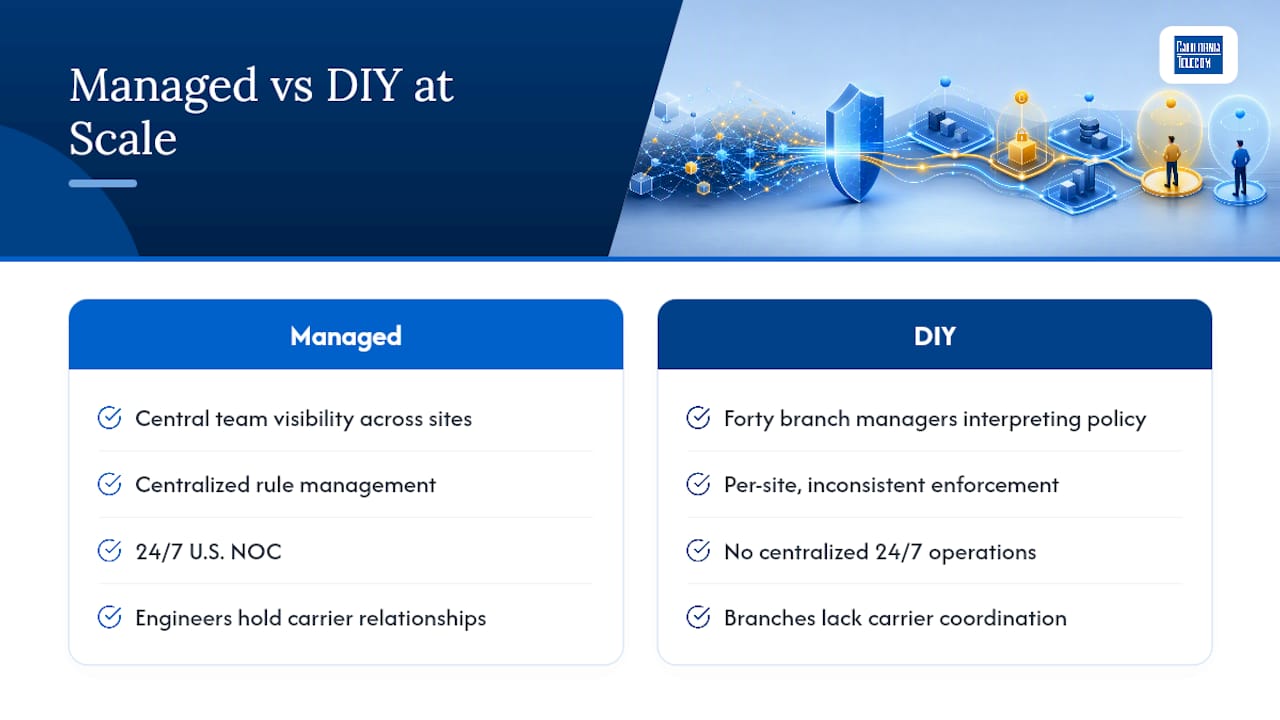
Segmentation theory is straightforward. Enforcing identical zone boundaries across 30 branch locations, each with its own ISP quirks and hardware lifecycle, is where most internal teams lose the thread. Central policy management matters more than any single firewall feature once you're past a handful of sites.
A managed LAN/WAN model with centralized rule management and a 24/7 U.S.-based NOC gives one team visibility into every boundary at once, instead of forty branch managers each interpreting the segmentation policy their own way. When evaluating a managed provider for this work, ask pointed questions: Who designs the actual zone architecture? Do their engineers hold the carrier relationships needed to deploy consistent SD-WAN policy nationwide? What evidence package do they hand you before your assessment, and does it include rule history, not just current-state diagrams?
— Jim
How Californiatelecom Supports PCI Segmentation Projects
Running consistent segmentation across a dozen retail locations or a distributed logistics network is an operations problem as much as a technical one. Californiatelecom is built around solving exactly that gap: one provider, one engineer's number, and a design process where our own engineers configure every site instead of handing you off to a call center.Our managed LAN/WAN service centralizes firewall policy and rule management across every location, backed by a 24/7 U.S.-based NOC and a 99.99% uptime SLA on data services. Add SD-WAN and SASE for consistent branch enforcement, and centralized logging that gives your compliance team a single view into boundary activity instead of forty disconnected firewall consoles. If you're planning a segmentation rollout across multiple sites and want an engineer-led design instead of a self-service dashboard, request a consultation and walk through your current architecture with our team.
Sources
- Guidance for PCI DSS Scoping and Network Segmentation (PCI SSC)
- New Information Supplement: PCI DSS Scoping and Segmentation Guidance for Modern Network Architectures (PCI SSC blog)
- Payment Card Industry Data Security Standard v4.0.1 (PCI SSC)
- Network Segmentation for PCI DSS — Design, Implement, and Validate | GRCTrack