

Network Bandwidth Planning for Multi-Location BusinessesNetwork bandwidth planning for multi-location enterprises is the process of allocating network capacity across distributed sites to maintain reliable connectivity, low latency, and consistent application performance. Without a structured approach, IT teams face a familiar trap: some sites are starved for bandwidth while others run at 30% utilization. The discipline draws on traffic analysis, WAN architecture design, Quality of Service (QoS) policies, and continuous monitoring to keep every branch performing at the level the business demands. Getting it right requires more than a one-time assessment. It requires a repeatable process that adapts as your organization grows.
What data do you need before planning bandwidth across multiple sites?
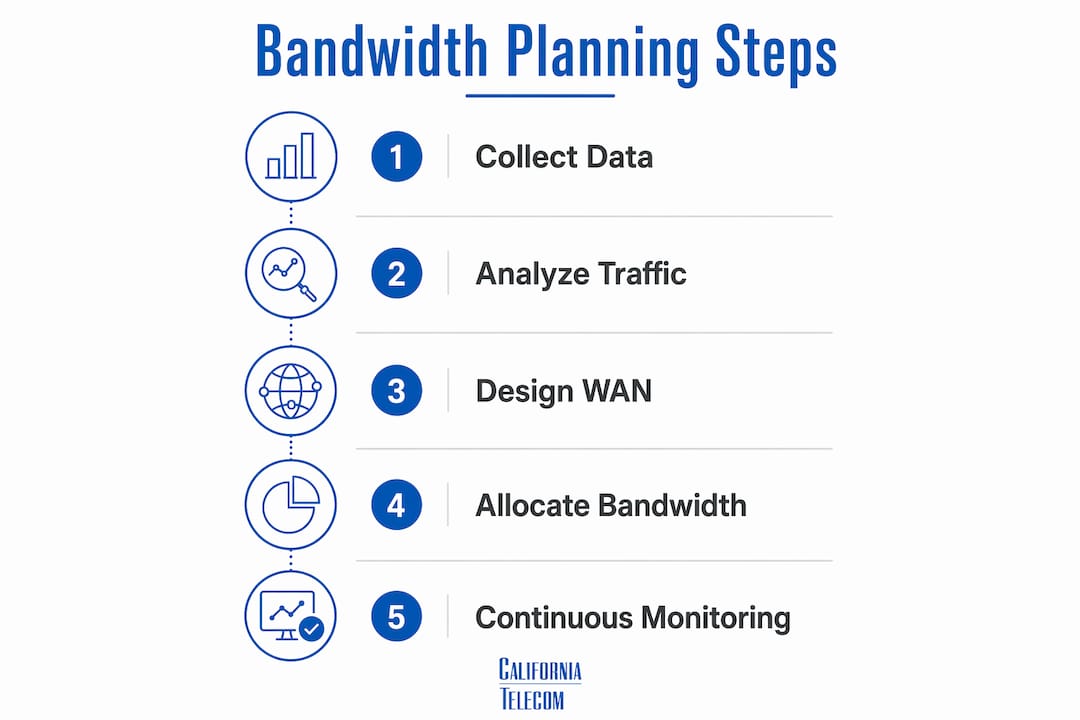
Effective network bandwidth planning multi-location work starts with documentation, not design. You cannot size circuits correctly without knowing who is on the network, what applications they run, and when peak demand hits. Building a scalable multi-site network is a phased lifecycle project spanning assessment, design, procurement, deployment, and testing. Skipping the assessment phase is the single most common reason enterprises end up over-buying at headquarters and under-provisioning at branch offices.
The core data inputs you need before designing anything are:
- User count per site: Include both full-time staff and peak concurrent users such as contractors or shift workers.
- Application inventory: Catalog every application by type, including voice over IP (VoIP), video conferencing, ERP systems, cloud SaaS tools, and file backup jobs.
- Traffic patterns: Identify peak hours, off-peak windows, and any scheduled batch jobs that run during business hours.
- Current circuit utilization: Pull 30 days of utilization data from each site. Look for sustained peaks above 70%, not just averages.
- Cloud dependency: Cloud adoption increases WAN and internet traffic significantly for SaaS applications. Factor in split-tunneling configurations before finalizing any circuit size.
The right monitoring technology makes this data collection continuous rather than a one-time snapshot. NetFlow, a protocol that exports IP traffic data from routers and switches, gives you per-application, per-user visibility without deploying additional probes at every site. Pair NetFlow data with a centralized dashboard and you move from guessing to measuring.
Pro Tip: Integrate your capacity planning process with a real-time visibility platform from day one. Capacity planning built on 30-day-old SNMP averages will always lag behind actual demand.
| Data Input | Why It Matters |
|---|---|
| User count per site | Determines baseline bandwidth floor for each location |
| Application inventory | Identifies latency-sensitive traffic requiring QoS priority |
| Peak utilization data | Reveals true demand, not just average consumption |
| Cloud and SaaS usage | Adds internet circuit load often missed in WAN-only assessments |
| Scheduled batch jobs | Prevents off-peak jobs from saturating links during business hours |
How should you design a WAN architecture that supports bandwidth allocation across sites?
WAN architecture is the foundation that either enables or limits every bandwidth allocation strategy you apply later. The best WAN architecture for most multi-location enterprises today is a hybrid design: MPLS for mission-critical traffic combined with broadband or 5G for SaaS and general internet access, managed by SD-WAN. Each transport type has a distinct role.

MPLS delivers predictable latency and guaranteed bandwidth, making it the right choice for ERP traffic, real-time voice, and any application where packet loss is unacceptable. Its cost per megabit is higher than broadband, so using it for YouTube or software updates wastes money. Broadband internet provides high throughput at low cost and works well for cloud applications, web browsing, and backup traffic. 5G fills the gap at sites where fiber is unavailable or as a failover path when primary circuits go down. A multi-site network rollout also requires careful design choices such as hierarchical IP addressing, network segmentation, and modular hardware to support growth without redesigning the entire network.
SD-WAN sits above these transport layers as a traffic management engine. It reads real-time metrics including latency, packet loss, and jitter, then routes each application's traffic over the best available path. That means a VoIP call stays on MPLS while a file sync moves to broadband automatically, without manual intervention. For distributed enterprises, SD-WAN transforms connectivity by making path selection policy-driven rather than static.
Hardware standardization at the WAN edge is non-negotiable. Standardizing WAN edge hardware before layering SD-WAN on top is the only way to enforce consistent policies across every site. Mixed hardware environments create fragmented management, inconsistent security postures, and gaps in monitoring coverage. Treat the WAN edge as a template: the same device model, the same firmware version, the same base configuration deployed at every location.
Redundancy design follows naturally from the hybrid WAN model. Every site should have at least two independent transport paths from different providers. When one circuit fails, SD-WAN fails over in seconds rather than waiting for a technician to notice an outage. For guidance on scaling WAN infrastructure as you add locations, the architecture decisions made at site one set the pattern for every site that follows.
What bandwidth allocation strategies optimize performance across multiple sites?
Bandwidth allocation is not just about buying enough capacity. It is about making sure the right traffic gets the right share of whatever capacity exists. Application-aware routing with QoS and traffic shaping prevents latency in real-time voice and video traffic even when nominal bandwidth appears sufficient. A link running at 60% average utilization can still drop VoIP calls if a backup job spikes to 80% for 30 seconds without any QoS policy in place.
The core techniques for effective bandwidth allocation across distributed sites include:
- QoS classification: Tag traffic at ingress using DSCP (Differentiated Services Code Point) markings. Voice gets Expedited Forwarding (EF). Video conferencing gets Assured Forwarding (AF41). Best-effort traffic like software updates gets the default queue.
- Traffic shaping and rate limiting: Cap non-critical traffic categories so they cannot consume more than a defined percentage of link capacity. This protects real-time applications during peak hours without requiring additional circuits.
- Application-aware routing: Let SD-WAN route each application class over its optimal path based on live performance metrics, not static routing tables.
- Admission control: Before a new call or video session starts, the network checks whether sufficient bandwidth exists. If not, the session is queued or redirected rather than degrading existing sessions.
Modern bandwidth allocation heuristics outperform legacy round-robin approaches by improving critical traffic success rates dramatically while reducing computation time. That research finding matters in practice because it validates moving away from static quarterly bandwidth reviews toward iterative, policy-driven allocation that adjusts in real time.
Pro Tip: Never rely on a quarterly bandwidth assessment as your primary planning tool. Traffic patterns shift weekly as new SaaS applications get adopted. Build your allocation model to update automatically from live monitoring data.
Prioritization decisions should reflect actual business impact. A retail chain's point-of-sale system deserves higher priority than a warehouse's software update server. A healthcare organization's electronic health record (EHR) application outranks general web browsing. Map your QoS tiers to business criticality, not just technical traffic type.
Multi-location screen networks offer a useful parallel. Bandwidth planning for distributed screen networks follows the same logic: classify content delivery traffic, cap it during peak business hours, and monitor utilization per site. The principle applies equally to any distributed enterprise environment.
How do you monitor bandwidth capacity and adapt planning over time?
Proactive capacity planning requires continuous, real-time monitoring of top talkers, link utilization, and packet loss across all sites from a single dashboard. Reactive troubleshooting, where IT teams respond only after users complain, creates recurring problems that erode trust in the network and the team managing it.
The operational process for continuous bandwidth management follows a clear sequence:
- Establish baselines: Run monitoring for at least 30 days before making any allocation changes. Baselines reveal true peak demand, not just average load.
- Set utilization thresholds: Flag any site where sustained utilization exceeds 70% of circuit capacity for more than 15 minutes during business hours. That threshold signals a capacity review, not an emergency.
- Identify top talkers: Use NetFlow data to find which applications, users, or devices consume disproportionate bandwidth. Address the cause before adding capacity.
- Adjust QoS policies iteratively: Treat QoS as a living configuration. Review and update traffic classifications quarterly or after any major application deployment.
- Trigger capacity upgrades proactively: Order circuit upgrades before utilization hits 85%. Carrier provisioning timelines mean a reactive order often arrives after the problem has already affected users.
| Metric | Threshold for Action |
|---|---|
| Sustained link utilization | Above 70% during business hours |
| Packet loss | Above 0.5% on voice or video circuits |
| Latency (WAN) | Above 150ms round-trip for real-time applications |
| Jitter | Above 30ms on VoIP circuits |
Californiatelecom's network monitoring solutions provide real-time visibility into all of these metrics across every site, feeding data directly into capacity planning decisions rather than sitting in a separate reporting silo.
What are the most common mistakes in multi-location bandwidth planning?
The most expensive mistake in multi-site bandwidth planning is treating it as a one-time project. Networks change constantly as new applications are deployed, headcount shifts, and cloud adoption accelerates. Static plans become wrong within months.
The most common mistakes IT teams make include:
- Under-provisioning branch sites: Headquarters gets fiber while remote offices run on circuits sized for half their current user count. Branch performance suffers, and the problem is often misdiagnosed as an application issue.
- Over-buying at every site: The opposite error. Buying 1 Gbps circuits for a 20-person office because "we might need it someday" wastes budget that could fund better monitoring or redundancy.
- Fragmented WAN edge hardware: Running different router models across sites makes consistent policy enforcement impossible. SD-WAN cannot compensate for hardware inconsistency at the edge.
- Neglecting application prioritization: Deploying SD-WAN without configuring QoS policies delivers broadband aggregation but not traffic management. The real value of SD-WAN is policy enforcement, not just cost reduction.
- Ignoring cloud traffic in circuit sizing: SaaS applications route traffic through internet circuits, not MPLS. Failing to account for Microsoft 365, Salesforce, or Zoom traffic when sizing internet circuits is a planning gap that shows up immediately after deployment.
Managing stakeholder expectations around deployment timelines matters as much as the technical work. A full multi-site rollout covering assessment, design, procurement, and deployment realistically takes several months. Promising faster results creates pressure that leads to shortcuts in the assessment phase, which is exactly where the most critical planning decisions get made.
Key Takeaways
Effective multi-location bandwidth planning requires structured data collection, hybrid WAN architecture, application-aware QoS policies, and continuous monitoring to prevent both under-provisioning and wasted capacity.
| Point | Details |
|---|---|
| Start with documented baselines | Collect 30 days of utilization, application, and user data before designing any circuit or policy. |
| Use hybrid WAN architecture | Combine MPLS for critical traffic with broadband or 5G for general access, managed by SD-WAN. |
| Enforce QoS at every site | Classify and prioritize traffic using DSCP markings so voice and ERP always get bandwidth first. |
| Monitor continuously, not quarterly | Set utilization thresholds and trigger capacity reviews before users experience degradation. |
| Standardize WAN edge hardware | Consistent device models and configurations are the prerequisite for effective SD-WAN policy enforcement. |
Why most bandwidth planning projects fail before they start
After working with distributed enterprise networks across dozens of industries, the pattern is consistent: organizations invest in SD-WAN or upgrade circuits, then wonder why performance problems persist. The answer is almost always the same. They skipped the assessment phase or treated it as a checkbox rather than the foundation of every decision that follows.
The uncomfortable truth about multi-site bandwidth planning is that the technology is rarely the problem. QoS, SD-WAN, and hybrid WAN are well-understood tools. The failure point is process. Teams that run quarterly bandwidth reviews instead of continuous monitoring will always be reacting to problems that real-time data would have predicted weeks earlier. Teams that deploy SD-WAN on top of inconsistent hardware will spend more time troubleshooting policy exceptions than managing the network.
Hardware standardization at the WAN edge is the recommendation I push hardest, because it is the one that gets skipped most often. The argument against it is usually cost or timeline. The argument for it is that every hour spent managing hardware inconsistency is an hour not spent on capacity planning, security, or the next location rollout.
The shift from reactive to proactive bandwidth management is not a technology purchase. It is a commitment to treating monitoring data as the primary input to every planning decision. Organizations that make that shift stop chasing complaints and start preventing them.
— Jim
How Californiatelecom handles bandwidth planning across your locationsCaliforniatelecom designs and deploys hybrid WAN and managed SD-WAN architectures for multi-location businesses nationwide, sourcing circuits from 50+ carriers and managing every site through a single engineering team backed by a 24/7 U.S.-based NOC. Every deployment starts with a full traffic assessment, not a sales proposal. The result is a network sized to actual demand, with QoS policies configured before the first circuit goes live.
For IT managers who want one provider, one bill, and one engineer's number for every location, Californiatelecom's nationwide managed network services cover the full lifecycle from assessment through ongoing capacity management. Schedule a consultation to get a custom bandwidth plan built around your sites, your applications, and your growth timeline.
FAQ
What is network bandwidth planning for multi-location businesses?
Network bandwidth planning for multi-location businesses is the process of assessing traffic demand at each site and allocating circuit capacity, QoS policies, and WAN architecture to deliver reliable application performance across all locations. It is a continuous process, not a one-time project.
How do I calculate bandwidth needs for multiple locations?
Start by documenting the user count, application mix, and peak utilization data at each site, then size circuits so sustained utilization stays below 70% during business hours. Factor in cloud and SaaS traffic on internet circuits separately from MPLS or private WAN capacity.
What is the best WAN architecture for multi-site bandwidth management?
A hybrid WAN combining MPLS for latency-sensitive traffic with broadband or 5G for general internet access, managed by SD-WAN for real-time path selection, is the most effective architecture for most multi-location enterprises today.
How does SD-WAN improve bandwidth allocation across branches?
SD-WAN routes each application's traffic over the best available path based on live metrics including latency, packet loss, and jitter, enforcing QoS policies consistently across every site without manual reconfiguration.
How often should multi-location bandwidth plans be reviewed?
Bandwidth utilization thresholds should be monitored continuously, with formal capacity reviews triggered whenever any site sustains utilization above 70% for more than 15 minutes during business hours. Annual or quarterly reviews alone are not sufficient for networks with active SaaS adoption or growing headcount.