

How Enterprise Voice Systems Work: A 2026 Technical GuideEnterprise voice systems are integrated telephony and communication platforms that manage high-volume business voice interactions across internal networks and external connections to the Public Switched Telephone Network (PSTN). At their core, they combine a Private Branch Exchange (PBX) for internal call control, SIP or PRI trunking for carrier connectivity, Session Border Controllers (SBCs) for security and signaling, and unified communications platforms like Microsoft Teams. These components work together to deliver scalable, redundant, carrier-grade voice across your entire organization.
The key elements you need to understand:
- PBX or cloud PBX (Microsoft Phone System): Routes calls internally, manages extensions, voicemail, and call queues
- SIP trunking: Replaces physical phone lines with software-defined voice channels connecting your PBX to the PSTN
- PRI trunking: The legacy fixed-channel alternative to SIP, still found in older enterprise environments
- Session Border Controllers: Sit at the network edge, normalizing SIP signaling, transcoding codecs, and blocking malicious traffic
- Microsoft Teams with Direct Routing or Operator Connect: Modern PSTN connectivity options for cloud-based enterprise voice
- RTP (Real-time Transport Protocol): Carries the actual audio between endpoints once SIP establishes the session
Understanding how these pieces fit together is what separates a voice system that holds up under load from one that fails when you need it most.
Table of Contents
- How enterprise voice systems work: the core technologies
- What modern enterprise voice solutions actually deliver
- How cloud computing changes enterprise voice architecture
- Advanced architecture: voice AI and reliability engineering
- Californiatelecom handles the complexity so your team doesn't have to
- Key Takeaways
How enterprise voice systems work: the core technologies
The technical foundation of any enterprise voice deployment comes down to two distinct functions: call control and media transport. Getting both right requires understanding each component's role.
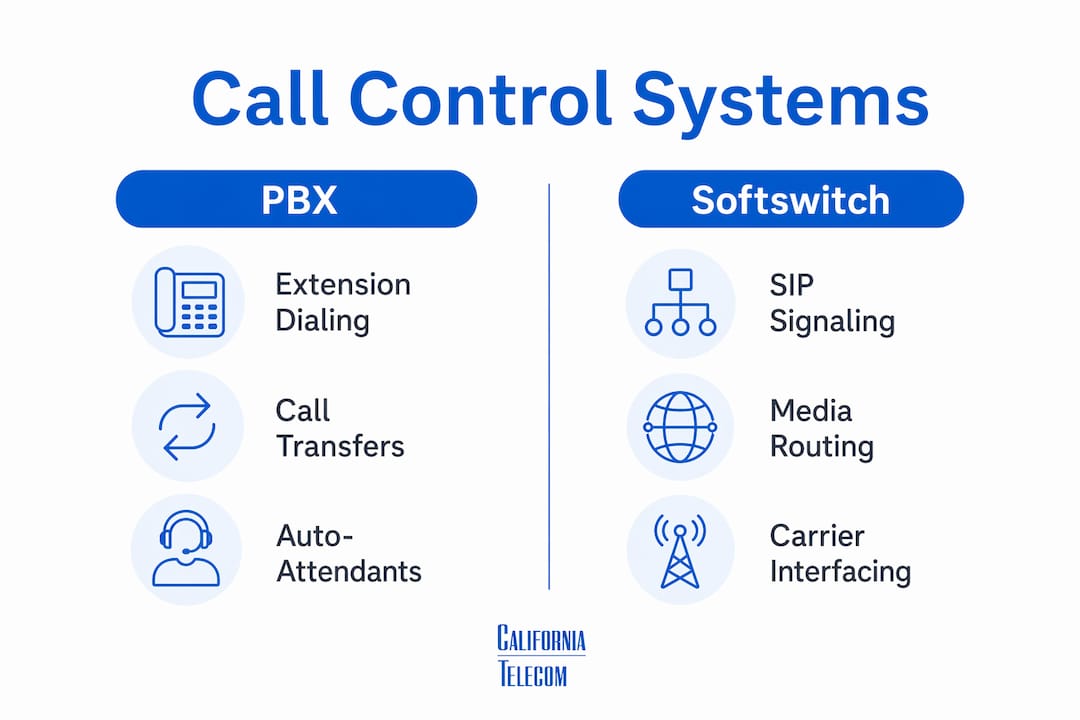
PBX and softswitch: the call control brain
The PBX is the internal routing engine. It handles extension dialing, call transfers, auto-attendants, hunt groups, and voicemail. Traditional hardware PBXs have largely given way to IP-PBXs and cloud-based softswitches, but the function is identical. Microsoft Phone System delivers a complete cloud PBX inside Microsoft 365, handling all internal call routing without requiring on-premises hardware.
The distinction between the PBX as the internal "brain" and SIP trunking as the external "highway" to the PSTN is one that experienced architects treat as foundational. Each requires its own high-availability design. Conflating them leads to under-engineered systems where a carrier outage takes down internal calling, or an internal PBX failure cuts off PSTN access entirely.
Session Border Controllers
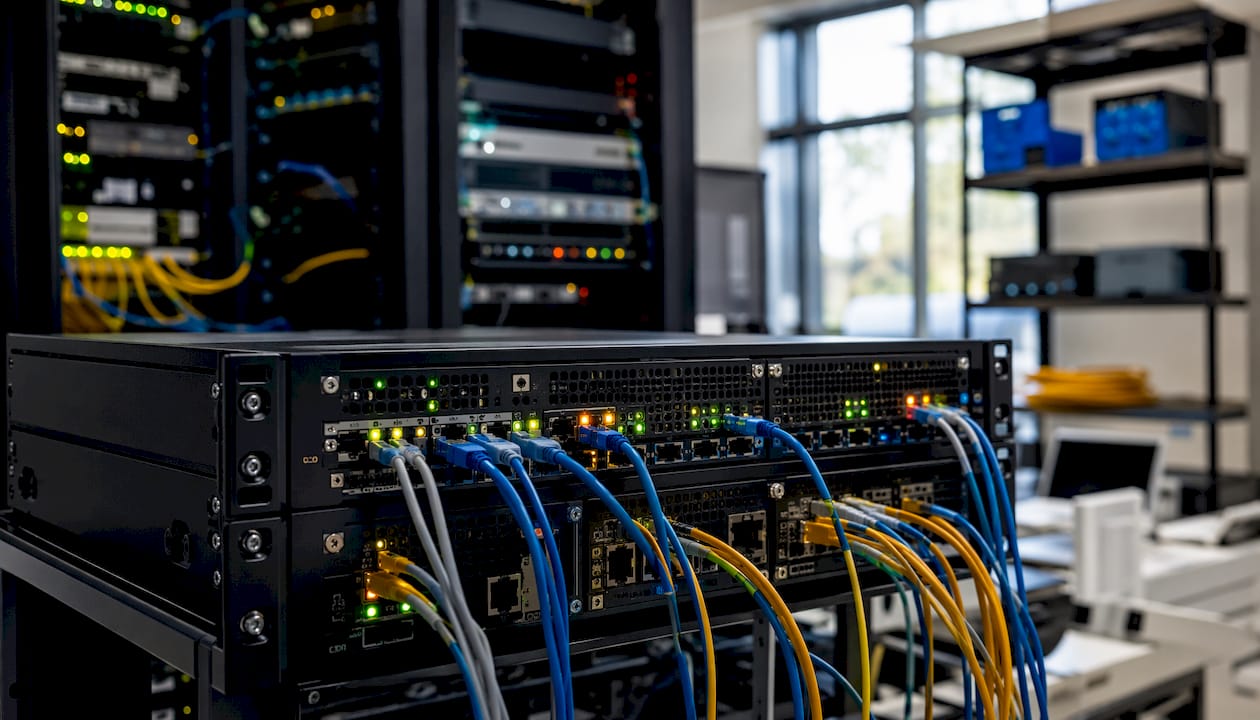
SBCs sit at the boundary between your internal network and the carrier. They normalize SIP signaling differences between vendors, transcode audio codecs when endpoints don't share a common format, and protect against denial-of-service attacks targeting your voice infrastructure. Active-active SBC clustering with shared session state is the standard for enterprise deployments. A single SBC with no failover peer is one of the most common and costly architectural mistakes in enterprise voice.
SIP trunking vs. PRI trunking
| Feature | SIP Trunking | PRI Trunking |
|---|---|---|
| Medium | IP network (software-defined) | Physical T1/E1 circuits |
| Capacity | Elastic, scales on demand | Fixed B-channels per PRI |
| Provisioning | API-driven, minutes | Physical installation, weeks |
| Redundancy | Multi-carrier, geographic POPs | Single physical path |
| Cost model | Pay-per-use or metered | Fixed monthly regardless of usage |
Enterprise SIP trunking replaces fixed physical lines with elastic, software-defined voice channels, enabling capacity scaling and multi-carrier redundancy. Organizations migrating from PRI to SIP typically see immediate reductions in fixed telecom spend, because PRI forced you to size for peak load and pay that ceiling year-round.
Microsoft Teams PSTN connectivity options
| Method | How it works | Best for |
|---|---|---|
| Calling Plans | Microsoft acts as your PSTN carrier | Simpler deployments, no existing carrier |
| Direct Routing | Your own SIP carrier connects via a certified SBC | Enterprises with existing carrier contracts |
| Operator Connect | Carrier manages the SBC; connects directly to Teams | Faster deployment, less infrastructure overhead |
Microsoft Teams Enterprise Voice enables organizations to use Teams as a full phone system, integrating call control, routing, and voicemail through Microsoft Phone System. Direct Routing gives you the most flexibility; Operator Connect trades some of that flexibility for faster deployment and reduced SBC management burden.
Protocols: SIP, RTP, and codecs
SIP (Session Initiation Protocol) handles signaling: setting up, modifying, and tearing down calls. Once a session is established, RTP carries the audio. Codec selection (G.711, G.729, Opus) determines audio quality and bandwidth consumption. QoS configuration at the network layer, including DSCP marking for SIP signaling at CS5 and RTP media at EF, keeps voice packets prioritized over general data traffic. Latency, jitter, and packet loss all degrade call quality and must be actively monitored.
What modern enterprise voice solutions actually deliver
Modern enterprise voice goes well beyond dial tone. The feature set that decision-makers should evaluate covers five areas.
Unified communications integration ties voice to messaging, video, presence, and file sharing inside a single platform. Microsoft Teams is the dominant example in enterprise environments, but the principle applies across any UCaaS deployment. When voice lives inside the same platform as chat and meetings, context travels with the call.
AI voice capabilities are moving from novelty to operational infrastructure. Automated attendants, real-time transcription, call analytics, and AI-driven routing all reduce the manual overhead of managing high call volumes. The VoIP features that matter most in 2026 increasingly involve AI-assisted workflows rather than traditional telephony features alone.
Redundancy and failover separate enterprise-grade systems from everything else. Multi-carrier SIP trunking, redundant voice lines, and geographically distributed points of presence (POPs) ensure that no single failure takes down voice across your organization.
- Quality of Service (QoS): DSCP marking, bandwidth reservation, and jitter buffers maintain call clarity under network load
- Security: TLS for SIP signaling, SRTP for media encryption, and SBC-level access control prevent eavesdropping and toll fraud
- Scalability: Cloud-based SIP trunking absorbs traffic spikes without manual capacity planning or hardware procurement
Pro Tip: Before finalizing any enterprise voice deployment, run a latency and jitter baseline across every WAN link that will carry voice. A link that looks fine for data can produce unacceptable call quality the moment voice traffic competes with bulk transfers.
How cloud computing changes enterprise voice architecture
The shift from on-premises PBX to cloud-hosted voice changes the economics and the architecture simultaneously.
| Deployment model | Infrastructure ownership | Scalability | Typical use case |
|---|---|---|---|
| On-premises PBX | Enterprise-owned hardware | Fixed, manual | Regulated industries, existing investment |
| Cloud UCaaS | Provider-managed | Elastic, automatic | Multi-location, distributed workforce |
| Hybrid | Mixed | Flexible | Transition phase, compliance requirements |
Cloud-based enterprise voice supports elastic SIP scaling, pay-per-use pricing, and API-driven provisioning, reducing fixed costs and improving agility. The operational difference is stark: a retail company running a peak promotion shouldn't need to file capacity-increase tickets with a carrier. The architecture should absorb the spike automatically.
Geographic redundancy is one of the clearest cloud advantages. On-premises systems are vulnerable to site-level failures. Cloud deployments distribute call processing across multiple data centers, so a regional outage doesn't silence your phones. UCaaS solutions built on distributed infrastructure deliver this by default rather than as an add-on.
API-driven carrier integration is the other major shift. Modern SIP trunking exposes REST APIs for provisioning numbers, configuring routes, querying call detail records, and managing E911 records programmatically. Telecom becomes code, which means voice infrastructure can be version-controlled, tested, and deployed through the same pipelines as your other software.
Advanced architecture: voice AI and reliability engineering
The most technically demanding area of enterprise voice in 2026 is real-time voice AI. Getting it right requires understanding both the telephony layer and the AI pipeline.

The voice AI pipeline
A streaming, pipelined architecture running Speech-to-Text (STT), LLM reasoning, and Text-to-Speech (TTS) concurrently is the industry standard for sub-second voice AI responses. Sequential pipelines, where each stage waits for the previous to finish, are too slow for natural conversation. The cascaded approach achieves a best-case time-to-first-audio of 729ms with full function-calling support, compared to roughly 13 seconds for native speech-to-speech models that lack streaming output.
The sentence buffer is the critical orchestration primitive. It accumulates streaming LLM tokens until a sentence boundary is detected, then immediately forwards that sentence to TTS while the LLM continues generating the next one. The result is that audio playback begins before the full response is generated, creating the perception of instant response.
Pro Tip: The "hard part" of a voice AI agent is the LLM's reasoning and function-calling logic, not the voice layer. Prioritize orchestration architecture and concurrency over chasing faster individual models.
Voice AI gateway architecture
A voice AI gateway connects telephony (SIP or WebRTC) with AI services, managing audio capture, transcription, AI processing, and response synthesis within an 800ms latency budget. The gateway is the orchestration middleware that keeps the telephony layer and the AI layer from needing to know about each other's internals.
The orchestration layer manages session state, conversation memory, and real-time provider failover. When an AI provider goes down mid-call, the orchestration layer switches to a backup transparently, without dropping the session. For enterprise deployments integrating AI agents into voice workflows, this failover capability is what separates a production system from a prototype.
SBC redundancy and carrier-grade reliability
| Redundancy layer | Purpose | What to verify |
|---|---|---|
| Internet connectivity | Prevents ISP outage from killing voice | Diverse circuits from independent ISPs |
| Session Border Controllers | Eliminates edge-device single points of failure | Active-active clustering with shared state |
| Carrier interconnect | Protects against upstream carrier outages | Multi-carrier routing |
| Geographic POP distribution | Limits blast radius of regional incidents | At least two geographically distant POPs |
Many enterprises under-architect SBC redundancy, deploying a single SBC and assuming the carrier's uptime SLA covers the gap. It doesn't. The SBC is your edge device; if it fails, calls fail regardless of what the carrier is doing. Active-active clustering with shared state means both SBCs handle live traffic simultaneously, so losing one doesn't interrupt any existing sessions.
Media bypass configurations in hybrid Microsoft deployments route media streams directly between endpoints and PSTN gateways, bypassing the Mediation Server when network conditions allow. This reduces latency and processing load, but requires precise Call Admission Control (CAC) and network routing configuration to work correctly.
Californiatelecom handles the complexity so your team doesn't have to
Running enterprise voice well requires sourcing from multiple carriers, configuring SBCs for active-active redundancy, managing QoS across every WAN link, and keeping the whole stack monitored around the clock. Most IT teams have other priorities.Californiatelecom delivers managed voice and network services nationwide, sourcing from 50+ carriers and deploying each site through its own engineers. The 99.999% uptime SLA on voice is backed by a 24/7 U.S.-based NOC, not a ticket queue. Multi-location businesses get one provider, one bill, and one engineer's direct number instead of chasing three vendors when a site goes down. Whether you need hosted UCaaS, Microsoft Teams calling, or a hybrid architecture that bridges your existing PBX investment with cloud SIP trunking, Californiatelecom designs and manages the full stack. Contact Californiatelecom to get a deployment assessment for your environment.
Key Takeaways
Enterprise voice systems deliver carrier-grade reliability by combining PBX call control, SIP trunking, active-active SBC clustering, and cloud-based redundancy into a single, managed architecture.
| Point | Details |
|---|---|
| SIP replaces PRI | SIP trunking delivers elastic, software-defined channels versus PRI's fixed B-channels per circuit. |
| SBC redundancy is critical | Active-active SBC clustering with shared state prevents edge-device failures from dropping live calls. |
| Voice AI needs streaming architecture | The cascaded STT-LLM-TTS pipeline achieves a best-case 729ms time-to-first-audio with full function calling. |
| Cloud adds geographic redundancy | UCaaS deployments distribute call processing across multiple data centers, eliminating single-site failure risk. |
| Californiatelecom manages the full stack | Californiatelecom sources from 50+ carriers and backs enterprise voice with a 99.999% uptime SLA and 24/7 NOC support. |