

Why Businesses Need Redundant Voice Lines in 2026Losing your phone system for an hour doesn't just frustrate customers. It stops sales calls, freezes support queues, and leaves your team scrambling on personal devices. 48% of companies report operational disruption from technical failures, and 74% of enterprises with multi-site operations plan to adopt consolidated, redundant SIP trunking architectures by 2026. The reason businesses need redundant voice lines comes down to one fact: voice calls cannot be queued and retried the way email can. When a customer calls and nothing picks up, that opportunity is gone.
Redundant voice lines, also called voice failover infrastructure, are communication architectures built with multiple independent paths so that if one connection fails, another takes over automatically, often within seconds. For multi-location businesses, this isn't a luxury configuration. It's the baseline for staying operational when something inevitably breaks.
Key reasons businesses implement voice redundancy:
- Automatic failover keeps calls routing during ISP outages, carrier failures, or hardware faults
- MTTR drops from hours or minutes to seconds or milliseconds with proper redundancy in place
- Multi-site operations gain centralized management without single points of failure
- Regulatory and compliance obligations in healthcare, finance, and legal sectors require continuous voice availability
- Californiatelecom backs managed voice services with a 99.999% uptime SLA across all customer locations
How redundant voice lines actually work
At its core, voice redundancy means your phone system has more than one path to carry calls. When the primary path fails, traffic shifts to the backup automatically, without anyone touching a cable or calling a carrier.
The main architectural components:
- SIP trunking over IP: Instead of physical copper circuits, calls travel over internet-based SIP trunks that can be rerouted dynamically through software
- Multiple internet connections: Dual ISP setups, ideally using different technologies (fiber plus fixed wireless, for example) and different providers, eliminate the single-connection failure point
- Geo-redundant SIP proxies: Providers operate SIP infrastructure across multiple data centers in separate regions; if one goes down, signaling shifts to another automatically
- DNS SRV records: These allow your PBX to discover and connect to backup SIP servers without manual reconfiguration
- SD-WAN: Application-aware routing steers voice traffic to the best-performing link in real time, monitoring jitter and packet loss rather than waiting for a complete outage
The distinction between passive backup and active load balancing matters here. A passive standby setup keeps a secondary connection idle until the primary fails. Active load balancing runs both connections simultaneously, distributing traffic and providing instant continuity when one path degrades. For multi-location VoIP deployments, active load balancing is the stronger architecture because it also improves call quality during normal operations.
Legacy fixed circuits like PRI lines cannot reroute dynamically. When a PRI circuit fails, restoration requires field technicians, hardware replacement, and carrier scheduling. SIP-based redundancy reroutes at the signaling layer in seconds.
What your business actually gains from voice redundancy
The financial case for redundancy is straightforward once you price a real outage. Downtime costs for SMBs often exceed $1,000 per hour, and most businesses experience more than 1.5 hours of ISP-related downtime annually. That math alone justifies the investment for most organizations.
Redundancy reduces MTTR from hours or minutes to seconds or milliseconds, turning potential outages into imperceptible hiccups for voice infrastructure.
Beyond raw uptime, the operational benefits compound across a multi-location footprint:
- Faster recovery: Automatic failover means no one has to diagnose the problem before calls resume. The system detects the failure and reroutes.
- Cost reduction through consolidation: SIP trunking cuts telecom admin time by up to 40% by consolidating billing, contracts, and management into a single platform instead of separate carrier agreements per site.
- SD-WAN cost offsets: Replacing legacy private circuits with SD-WAN-enabled IP routing typically delivers 50–70% cost reductions compared to MPLS, while adding intelligent routing capabilities.
- Customer experience: A caller who hears silence for ten seconds hangs up. Redundancy keeps your support lines and sales queues live during the exact moments when customers need you most.
- Compliance posture: Regulated industries including healthcare and financial services face specific requirements around communication availability. Documented failover architecture supports audit readiness.
For a retail chain running dozens of locations, the inability to share unused voice capacity across sites is its own cost problem. Redundant SIP trunking solves that by pooling channels across the entire network.
Best practices for building a resilient voice architecture in 2026
The shift from legacy fixed circuits to software-defined IP routing is the single most consequential architectural decision for voice resilience. Modern best practices build on that foundation.
What a well-designed redundant voice architecture looks like:
- Multi-carrier strategy: Single carrier dependency means a provider-level failure halts all communications. Distributing SIP trunks across two or more carriers with separate upstream networks eliminates that exposure.
- Geographic diversity: SIP proxies and media servers should span multiple regions. A hurricane or regional fiber cut that takes out one data center shouldn't affect voice traffic routing through another.
- Policy-based routing: Configure specific traffic types, particularly voice, to always prefer the highest-quality path. SD-WAN makes this practical at scale across dozens of sites.
- Automatic health monitoring: Systems should detect failure via SIP OPTIONS checks or latency thresholds, not wait for a complete outage. Failover triggered by degraded quality beats failover triggered by total loss.
- Eliminate SIP ALG: Disabling SIP Application Layer Gateway on routers and firewalls is one of the most commonly overlooked steps. SIP ALG modifies headers and causes registration failures and one-way audio, undermining failover behavior.
Carrier marketing often claims "redundancy" without specifying geographic diversity. True resilience requires distribution across separate regions and independent network paths, not just duplicate equipment in the same facility. When evaluating providers, ask specifically where their SIP proxies are located and which upstream carriers they use.
Californiatelecom sources from 50+ carriers and designs each site through its own engineers, which means the redundancy architecture reflects actual network diversity rather than a single-vendor dependency dressed up as redundancy.
Operational considerations for multi-location businesses
Voice redundancy isn't purely a technical problem. It's a business continuity program that requires governance decisions before any equipment is configured.
The most common failure in voice disaster recovery isn't technical. It's the absence of pre-defined authority: no one knows who can authorize a failover, what the success criteria are, or which voice flows matter most. That ambiguity costs time during the exact moments when speed matters.
Operational decisions to make before an outage occurs:
- Define critical voice flows: Which call paths must survive at all costs? Inbound customer support, emergency lines, and revenue-critical sales queues typically top the list.
- Assign failover authority: Document who can make the call to activate backup routing, and what signals trigger that decision.
- Centralized vs. decentralized architecture: A centralized SIP trunk at headquarters simplifies billing and pooling but creates a single dependency if the HQ connection fails. Decentralized local trunks at each site add resilience but multiply administrative overhead. Most multi-location businesses land on a hybrid.
- Compliance documentation: Regulated industries need records of failover testing, SLA performance, and recovery procedures. Build that documentation into the program from the start.
Californiatelecom's single-provider model addresses the administrative side directly. One bill, one NOC, one engineer's contact. When something fails at 2 AM, you're not triaging which of three vendors owns the problem. That clarity is part of what consolidating telecom vendors actually delivers in practice.
Pro Tip: Build a disaster recovery plan that explicitly names your critical voice flows and assigns failover authority before you need it. A plan that exists only in someone's head fails at the worst possible moment.
Risks and challenges in voice redundancy implementation
Redundancy introduces its own failure modes if implemented carelessly. Understanding the common pitfalls helps you avoid them.
Misconfigured failover detection is the most frequent problem. If your system waits for a complete connection loss before triggering failover, degraded call quality during the transition window will still drop active calls. Configure health checks based on latency and packet loss thresholds, not just binary up/down status.
Asymmetric routing occurs when outbound and inbound traffic take different paths. During a failover event, this can cause one-way audio or registration failures. Test failover behavior in both directions before relying on it.
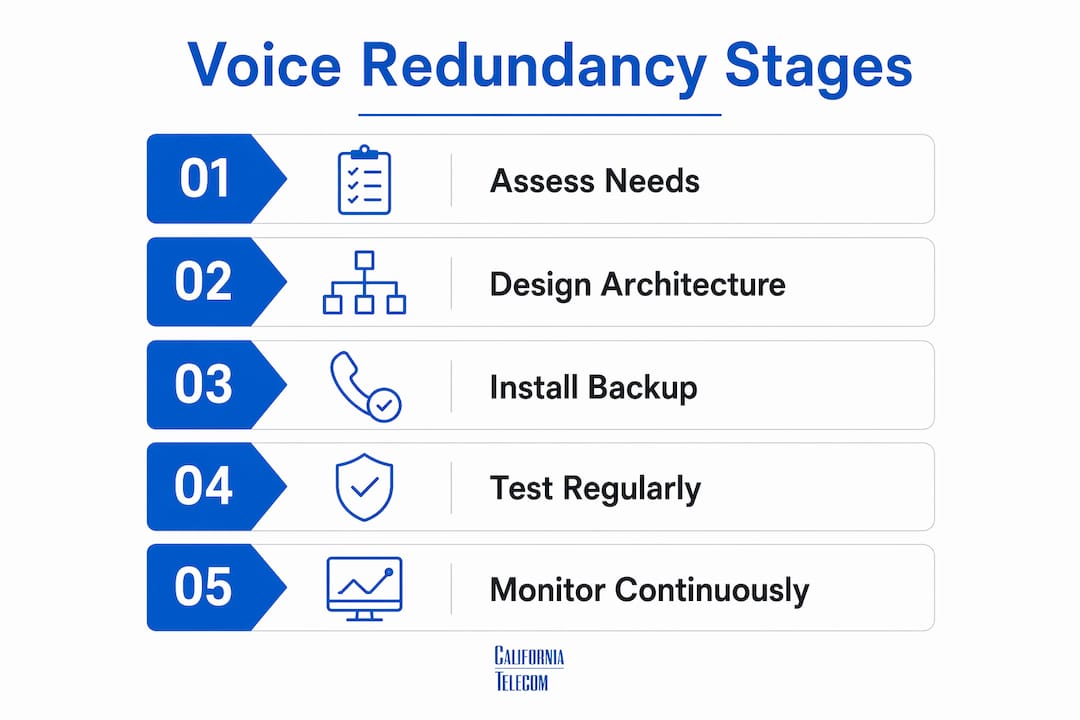
Untested standby paths are a false sense of security. A standby SIP trunk that hasn't been tested in months may have configuration drift, expired credentials, or capacity limits that only surface during an actual outage. Schedule regular failover tests.
Cost creep from over-provisioning is real, particularly for organizations that add redundant circuits at every site without pooling capacity intelligently. SD-WAN with centralized management lets you right-size redundancy per site based on actual criticality rather than applying the same architecture everywhere.
Finally, shared responsibility gaps cause failures that neither the provider nor the customer catches until it's too late. Providers handle infrastructure failover. Customers must define application-level logic, prioritize voice flows, and verify that their PBX and endpoints behave correctly during a switchover. Both sides have to do their part for the system to hold.
Key Takeaways
Redundant voice lines are the difference between a minor inconvenience and a business-impacting outage, and the architecture you build before a failure determines which one you experience.
| Point | Details |
|---|---|
| Outage impact is immediate | 48% of companies report operational disruption from technical failures; voice calls cannot be retried like email. |
| MTTR drops dramatically | Proper redundancy reduces recovery time from hours or minutes to seconds or milliseconds. |
| Admin costs fall with consolidation | Centralized SIP trunking cuts telecom admin time by up to 40% across multi-location operations. |
| Governance is half the solution | Pre-defined failover authority and critical voice flow prioritization prevent chaos during an actual outage. |
| Provider diversity matters | Multi-carrier, geo-redundant architectures eliminate the single-vendor dependency that turns one failure into a full outage. |
The case for treating voice redundancy as a business decision, not an IT project
Most organizations approach voice redundancy as a technical checklist: add a second ISP, configure a backup SIP trunk, call it done. That framing misses the harder part.
The businesses that actually stay operational during a regional outage or carrier failure aren't the ones with the most equipment. They're the ones that decided in advance which calls matter most, who owns the failover decision, and what "recovered" looks like. The technical architecture executes that plan. Without the plan, even well-configured redundancy produces confusion during the moments it's supposed to prevent.
There's also a competitive dimension that gets underplayed. When a regional outage hits, the businesses that stay reachable capture the customers whose usual vendors went dark. That's not a theoretical benefit. It's a direct revenue opportunity that redundancy either positions you to take or forfeits entirely.
Californiatelecom's approach, backed by a 99.999% voice uptime SLA and a 24/7 U.S.-based NOC, is built around this reality. The managed network services model means your redundancy architecture is designed, deployed, and monitored by engineers who own the outcome, not a carrier that hands you a circuit and a support ticket number.
***Multi-location businesses running voice on a single carrier or a single internet connection are one regional event away from a communication blackout. Californiatelecom designs and manages redundant voice infrastructure nationwide, with geo-diverse SIP trunking, automatic failover, and a single point of contact for every site. Get a free consultation and find out what your current architecture is actually exposed to.