

What Is Bandwidth Aggregation? A Guide for IT TeamsBandwidth aggregation is defined as the practice of combining multiple internet connections into a single logical link to increase throughput and build redundancy into your network. The industry standard term for this practice in LAN environments is link aggregation, governed by IEEE 802.3ad, also known as the Link Aggregation Control Protocol (LACP). At the WAN level, the equivalent is WAN bonding. Both approaches solve the same core problem: a single connection has a fixed ceiling, and aggregation raises that ceiling without replacing your infrastructure. Californiatelecom designs and deploys these configurations for multi-location businesses nationwide, backed by a 99.99% uptime SLA on data.
What is bandwidth aggregation and how does it actually work?
Bandwidth aggregation works by treating multiple physical connections as one logical pipe. At the LAN level, LACP bundles Ethernet ports on switches and routers. At the WAN level, WAN bonding splits individual data packets across multiple internet links and reassembles them at a remote endpoint.
That reassembly step is what separates true aggregation from everything else. True WAN bonding requires a secondary endpoint, typically a bonding server or VPN concentrator, to reorder split packets before they reach their destination. A standard edge router cannot do this on its own. Without that endpoint, you have load balancing, not aggregation.
The packet-level process works like this:
- Packet splitting: Outbound data is divided across two or more WAN links simultaneously.
- Parallel transmission: Each link carries a portion of the same data stream at the same time.
- Reassembly: The bonding server at the far end reorders packets into the correct sequence.
- Delivery: The application receives a single, coherent data stream as if one fast connection handled everything.
LACP automatically detects link failure and reassigns traffic to active links without manual intervention. That dynamic failover is a core feature of the protocol, not an add-on.
Pro Tip: Before purchasing any router marketed as supporting "bandwidth aggregation," ask the vendor whether it performs packet-level bonding or session-based load balancing. The answer changes your architecture entirely.
Modern intelligent WAN bonding goes further by dynamically steering traffic based on carrier signal quality, latency, and cost. Flow duplication, flow balancing, and full bandwidth aggregation can run concurrently on the same platform, letting you tune for performance or cost depending on the application.

Bandwidth aggregation vs load balancing: what is the real difference?
Load balancing and bandwidth aggregation are not the same thing. The distinction matters more than most IT teams realize, and confusing the two leads to expensive misconfiguration.
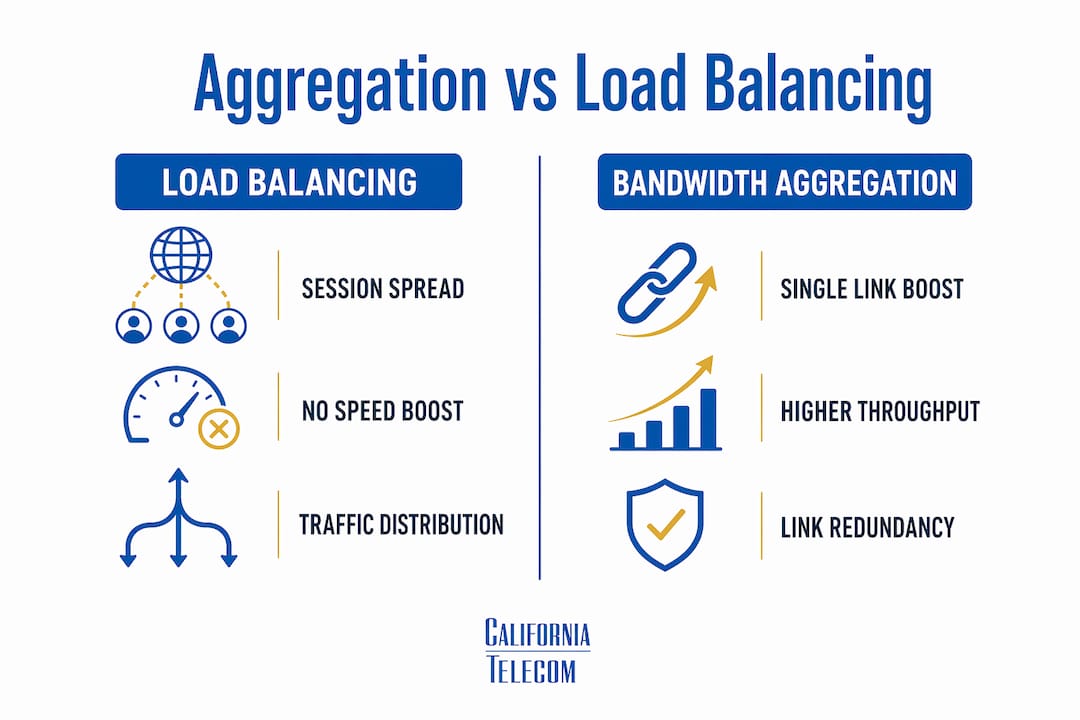
Load balancing distributes separate sessions across multiple links. Each session, whether a video call, a file download, or a VPN tunnel, travels over one link at a time. No single session benefits from the combined capacity of all links. Bandwidth aggregation, by contrast, allows a single session to use combined bandwidth from all links simultaneously.
The practical difference is significant. A business combining two 80Mbps connections via load balancing is still limited to 80Mbps per session. With true WAN bonding, that same business gets close to 160Mbps for a single large file transfer or video stream.
| Feature | Load balancing | True bandwidth aggregation |
|---|---|---|
| Single-session speed boost | No | Yes |
| Requires bonding server | No | Yes |
| Failover capability | Yes | Yes |
| Complexity | Low | Medium to high |
| Best for | General multi-user traffic | Data-intensive single sessions |
Most edge routers marketed as "bandwidth aggregation" devices actually perform Weighted Round Robin session load balancing. That works fine for a busy office where dozens of users run independent sessions. It fails when one application needs more bandwidth than a single link can provide.
Load balancing is the right call when your traffic is naturally distributed across many simultaneous sessions. True aggregation is necessary when individual applications, think large file transfers, live video production, or real-time backups, need to exceed the capacity of your fastest single link.
What are the benefits of bandwidth aggregation for businesses?
The primary benefit of bandwidth aggregation is higher effective throughput without replacing existing circuits. Link aggregation allows networks to scale bandwidth as demand grows by adding links rather than upgrading to a single higher-capacity line. That is a meaningful cost advantage when a dedicated fiber upgrade requires new infrastructure.
The second benefit is redundancy. Aggregating diverse connection types, for example, a fiber line combined with a 4G/5G cellular connection, creates a network that survives the failure of any single link. Pooling diverse connection types significantly increases fault tolerance compared to single-link connectivity, supporting the kind of uptime that business-critical applications demand.
Key business benefits include:
- Increased throughput for data-intensive workloads like video conferencing, cloud backups, and large file transfers.
- Built-in failover that reroutes traffic automatically when one link degrades or fails.
- Cost-efficient scaling by adding a second or third connection rather than replacing all infrastructure.
- Disaster recovery support through multi-path routing that keeps sites online during outages.
- Carrier diversity that protects against provider-level outages, not just hardware failures.
The most underappreciated benefit is uptime. Bandwidth aggregation's most valuable benefit is maintaining near-continuous uptime through multi-path redundancy and failover, not raw speed gains. For a multi-location business, a single downed link at a distribution center or branch office can halt operations. Aggregation with failover eliminates that single point of failure. You can read more about the business case for dedicated fiber redundancy to understand how link diversity compounds these gains.
How to implement bandwidth aggregation: key considerations
Implementation starts with an honest assessment of your hardware. Not every router supports LACP, and not every device that claims to support it does so in active mode. Cross-vendor compatibility and correct configuration are the two most common failure points in link aggregation deployments. Verify that every switch and router in the path supports the protocol before committing to a design.
A practical implementation checklist:
- Audit existing hardware. Confirm LACP support on all switches and routers. Check whether devices support active or passive LACP mode.
- Choose your aggregation layer. Decide whether you need LAN-level link aggregation, WAN bonding, or both.
- Provision a bonding endpoint. For WAN bonding, identify a bonding server or cloud-based reassembly service that sits between your site and the internet.
- Select diverse carriers. Use connections from different providers and different technologies to maximize fault tolerance.
- Configure failover thresholds. Define what constitutes a failed link and how quickly traffic should reroute.
- Test under load. Run throughput and failover tests before going live. Simulate link failure to confirm automatic rerouting works as expected.
- Monitor continuously. Track per-link performance, packet loss, and latency after deployment.
Network bonding adds overhead. Encapsulation and reassembly reduce actual throughput below the theoretical sum of your links. Plan your capacity with that reduction in mind, particularly for latency-sensitive applications like VoIP or real-time video.
Pro Tip: When calculating expected throughput, subtract at least 5–10% from the theoretical combined capacity to account for encapsulation overhead and reassembly latency. Build that buffer into your SLA requirements.
Managing multiple ISPs also adds operational complexity. Each carrier has its own support structure, billing cycle, and escalation path. That overhead is real, and it compounds across multi-location deployments. Working with a managed provider that coordinates across carriers removes that burden from your team. Californiatelecom sources from 50+ carriers and manages the coordination through a single point of contact.
Common bandwidth aggregation solutions and protocols in 2026
The foundation of LAN-level aggregation is IEEE 802.3ad (LACP), the open standard for bundling Ethernet ports into a single logical interface. LACP is vendor-neutral, meaning equipment from different manufacturers can interoperate, provided both sides are configured correctly.
At the WAN level, solutions fall into two broad categories: hardware-based bonding appliances and cloud-based bonding services. Hardware appliances sit on-premises and manage packet splitting locally. Cloud-based services route traffic through a provider's bonding infrastructure, which handles reassembly and traffic management remotely. WAN aggregation managed by protocols like LACP leads to optimized throughput, reduced congestion, and a better experience for end users when configured correctly.
| Solution type | Best use case | Key requirement |
|---|---|---|
| LACP (IEEE 802.3ad) | LAN link bundling | Compatible switches and routers |
| Hardware WAN bonding appliance | On-premises WAN aggregation | Local bonding endpoint |
| Cloud-based WAN bonding | Multi-location or remote sites | Provider-managed bonding server |
| Intelligent WAN bonding | Dynamic traffic management | Real-time carrier quality monitoring |
Proprietary bonding protocols exist and can outperform open standards in specific configurations, but they lock you into a single vendor ecosystem. Cross-vendor deployments are safer with LACP. For enterprises managing network performance across multiple locations, the choice between proprietary and open protocols often comes down to whether the performance gain justifies the vendor dependency. Understanding your types of business internet connections is a prerequisite before selecting any aggregation architecture.
Key Takeaways
Bandwidth aggregation delivers its greatest value not from raw speed gains but from the combination of higher throughput and built-in redundancy that keeps multi-location businesses online when individual links fail.
| Point | Details |
|---|---|
| Aggregation vs load balancing | True aggregation boosts single-session speed; load balancing only distributes separate sessions across links. |
| LACP is the standard | IEEE 802.3ad governs LAN link aggregation and supports automatic failover without manual intervention. |
| WAN bonding needs an endpoint | Packet-level WAN bonding requires a bonding server or cloud service to reassemble split packets. |
| Overhead reduces throughput | Actual throughput is less than the theoretical sum; plan capacity with a 5–10% buffer. |
| Redundancy is the top benefit | Multi-path failover across diverse carriers protects uptime better than any single high-capacity circuit. |
Why most businesses get bandwidth aggregation wrong
The most common mistake I see is IT teams enabling "aggregation" on their edge router and assuming the job is done. It almost never is. What those routers actually do is session load balancing. The single application that needs 200Mbps still hits the wall of one 100Mbps link, and nobody understands why until a painful troubleshooting session reveals the router was never doing true bonding.
The second mistake is treating aggregation as a speed solution rather than a resilience solution. Speed is a side effect. The real reason to aggregate links is to eliminate the single point of failure that takes your business offline when a carrier has an outage. I have seen companies invest heavily in aggregation hardware and then connect both links to the same ISP. That is not redundancy. That is two paths to the same failure point.
My honest advice: verify bonding capability before you buy any hardware, use carriers from different providers and different technologies, and account for overhead in your capacity planning. If managing multiple ISPs across multiple sites sounds like more operational work than your team can absorb, that is a legitimate reason to work with a managed provider. The network redundancy setup decisions you make today determine whether your business stays online during the next carrier outage. Network resilience is also a core component of cloud-based business continuity planning, and the two strategies reinforce each other.
— Jim
How Californiatelecom supports your bandwidth aggregation strategy
Californiatelecom delivers nationwide managed network services designed for multi-location businesses that need reliable, high-performance connectivity without the overhead of managing multiple carriers and vendors.Californiatelecom sources from 50+ carriers, designs each site through its own engineers, and backs every deployment with a 24/7 U.S.-based NOC. Whether your sites need LAN link aggregation, WAN bonding across fiber and cellular, or a fully managed failover architecture, Californiatelecom handles the carrier coordination, configuration, and ongoing monitoring. You get one provider, one bill, and one engineer's number. Explore Californiatelecom's managed LAN/WAN solutions or contact the team for a consultation tailored to your network requirements.
FAQ
What is the bandwidth aggregation definition in simple terms?
Bandwidth aggregation is the process of combining multiple internet connections into one logical link to increase total throughput and add redundancy. The industry standard for LAN environments is IEEE 802.3ad (LACP).
How does bandwidth aggregation differ from load balancing?
Load balancing distributes separate sessions across multiple links, so no single session exceeds one link's capacity. True bandwidth aggregation splits individual packets across links, allowing one session to use the combined speed of all connections.
Is bandwidth aggregation necessary for my business?
Bandwidth aggregation is necessary when individual applications require more throughput than your fastest single link can provide, or when your business cannot tolerate downtime from a single carrier failure. For general multi-user traffic, session load balancing may be sufficient.
What protocols support bandwidth aggregation?
IEEE 802.3ad (LACP) is the primary open standard for LAN link aggregation. WAN bonding relies on proprietary or cloud-based protocols that manage packet splitting and reassembly across multiple internet connections.
Does bandwidth aggregation reduce actual throughput?
Yes. Encapsulation and reassembly overhead mean actual throughput is slightly less than the theoretical sum of all aggregated links. Network architects should plan capacity with a buffer to account for this reduction.
Recommended
- Why Healthcare Needs Dedicated Bandwidth in 2026 | California Telecom
- How to Improve Network Performance with Managed LAN/WAN Solutions | California Telecom
- Why Dedicated Fiber Beats Broadband: Save Your Business from $9,000 Per Minute Downtime | California Telecom
- Picking a Managed Network Services Provider When Your IT Team Is Small | California Telecom