

Why Healthcare Needs Dedicated Bandwidth in 2026Dedicated bandwidth in healthcare is a private, uncontended internet connection that guarantees consistent performance for every critical application on your network, from Epic and Cerner EHR platforms to 4K telehealth video and large DICOM imaging files. Shared broadband cannot make that guarantee. When a hospital's network slows down, clinical workflows stall, documentation gaps open, and patient safety risks follow. Understanding why healthcare needs dedicated bandwidth is the first step toward building a network that supports care delivery instead of obstructing it.
Why healthcare needs dedicated bandwidth: the core case
Dedicated Internet Access (DIA) is the industry term for what most healthcare administrators call "dedicated bandwidth." It means your facility's connection is not shared with other businesses or tenants. DIA provides private bandwidth with SLA-backed uptime of 99.99%, which prevents the performance degradation common in shared networks. That reliability matters because Epic and Cerner, the two dominant EHR platforms in U.S. hospitals, require consistent low-latency connections to function without errors or delays.
The importance of bandwidth in healthcare goes beyond speed. A dropped connection during a telehealth visit does not just frustrate the patient. It can create a documentation gap that becomes a compliance liability. Dropped connections cause documentation gaps and clinical delays that carry legal exposure far exceeding the cost of a better connection. That reframes bandwidth as a risk management tool, not a commodity.
Healthcare organizations also run multiple high-demand applications simultaneously. A single operating room may pull real-time monitoring data, stream surgical video, and sync cloud-based records at the same time. Shared broadband cannot prioritize any of those streams. Dedicated bandwidth, paired with Quality of Service (QoS) policies, can.

What are the bandwidth requirements for different healthcare settings?
Healthcare bandwidth requirements vary dramatically by facility type and clinical function. Bandwidth scales from 4 Mbps for a solo physician practice to 100+ Mbps for mid-size hospitals, with intensive departments like radiology and the ICU demanding 10–40 GbE dedicated connections. The FCC updated its fixed broadband benchmark to 100 Mbps download and 20 Mbps upload in Q1 2026, but that floor is far below what most hospitals actually need. A 10 GbE backbone is the standard for large hospital networks, and 4K telemedicine alone requires at least 25 Mbps symmetrical.

| Healthcare setting | Recommended bandwidth | Primary drivers |
|---|---|---|
| Solo physician practice | 4–10 Mbps | EHR access, scheduling, basic telehealth |
| Multi-provider clinic | 25–50 Mbps | Video visits, cloud EHR, staff devices |
| Mid-size hospital | 100–500 Mbps | Imaging, concurrent telehealth, monitoring |
| Large hospital or health system | 1 Gbps to 10 GbE | DICOM files, AI diagnostics, surgical robotics |
| ICU or OR department | 10–40 GbE dedicated | Real-time monitoring, surgical video, redundancy |
Symmetrical upload capacity is often the overlooked variable. Most consumer and business broadband products are asymmetrical, meaning download speeds far exceed upload speeds. Symmetrical bandwidth and low latency are more critical than peak download speeds for cloud-based EHR updates and real-time sync. When a clinician saves a patient record to a cloud platform, that is an upload event. Slow upload speeds create the same bottleneck as slow download speeds, just in a less visible way.
Large imaging files compound the problem. CT scans, cardiology studies, and MRI datasets are measured in gigabytes. Dedicated internet eliminates imaging bottlenecks by providing predictable throughput for DICOM files, which keeps specialist consultations on schedule and prevents reporting delays.
How does dedicated bandwidth improve security, compliance, and efficiency?
Dedicated bandwidth is a compliance and liability management tool as much as it is a connectivity product. The benefits of dedicated bandwidth in this context fall into three clear categories.
- Network segmentation: Separating guest Wi-Fi from clinical traffic prevents a patient's personal device from competing with an EHR session or a monitoring feed. It also limits the attack surface for ransomware, which has hit U.S. hospital networks repeatedly in recent years.
- Guaranteed uptime: A 99.99% uptime SLA translates to less than 53 minutes of downtime per year. Shared broadband carries no such guarantee. For a hospital running 24/7 operations, that difference is measurable in clinical risk.
- QoS prioritization: QoS-managed 100 Mbps outperforms unmanaged 500 Mbps for clinical priority traffic. Prioritizing EHR, telehealth, and patient monitoring over administrative or guest traffic means the most critical applications always get the bandwidth they need.
Healthcare organizations also face HIPAA requirements that demand documented controls over how patient data moves across networks. A dedicated, segmented connection with a formal SLA creates an auditable record of network performance. That record matters when a compliance review or legal dispute requires evidence of due diligence.
Pro Tip: Work with your network provider to define QoS policies before deployment, not after. Retrofitting traffic prioritization rules onto a live clinical network is disruptive and costly.
Dedicated internet access vs. shared broadband: what is the real difference?
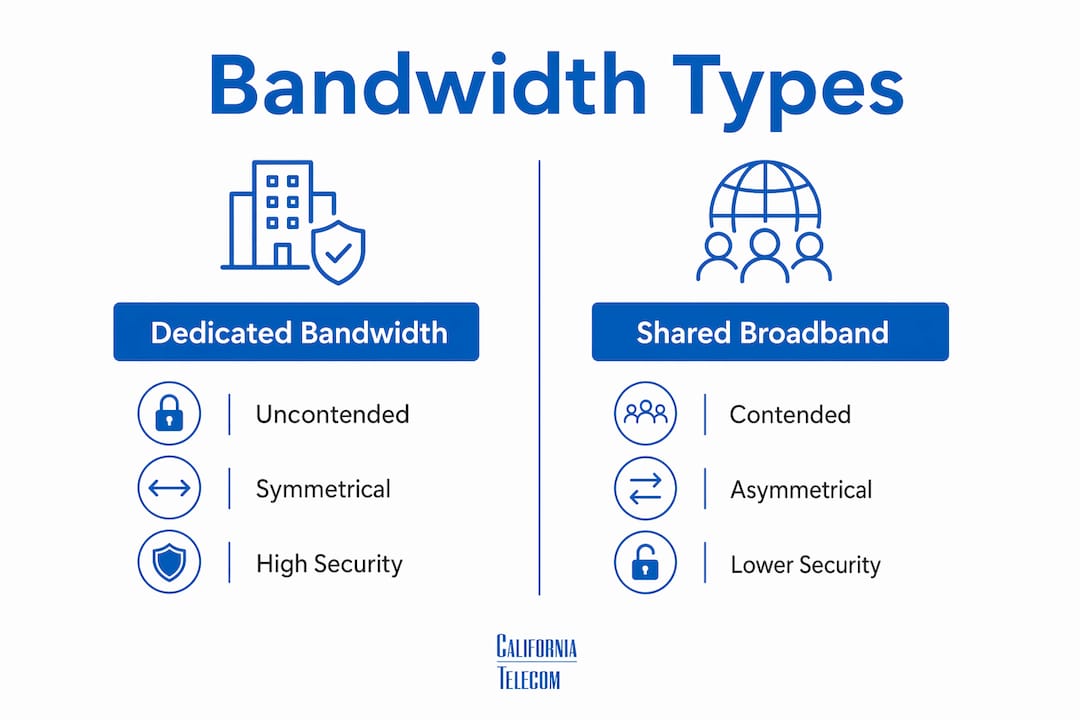
The practical difference between dedicated internet access and shared broadband comes down to one word: contention. Shared broadband means your facility's connection is pooled with other users on the same physical infrastructure. During peak hours, every user on that pool competes for the same capacity.
| Feature | Dedicated Internet Access | Shared broadband |
|---|---|---|
| Bandwidth contention | None. Uncontended private circuit | High. Shared with other users |
| Uptime SLA | 99.99% guaranteed | Best-effort, no SLA |
| Upload/download symmetry | Symmetrical available | Typically asymmetrical |
| QoS support | Full QoS policy control | Limited or none |
| Scalability | Scalable on demand | Capped by shared pool |
| Cost | Higher, predictable | Lower, variable performance |
For telehealth, contention is a direct clinical risk. A shared broadband connection that performs well at 7 a.m. may degrade significantly at 2 p.m. when neighboring businesses are active. A 4K telehealth session requires a stable 25 Mbps symmetrical connection throughout the visit. Shared broadband cannot guarantee that. Dedicated bandwidth is essential for maintaining clinical trust in telemedicine, because dropped or lagging connections erode patient-provider communication in ways that are difficult to recover from.
Fiber infrastructure strengthens the case further. Fiber-based DIA delivers consistent speeds regardless of distance from the provider's central office, which matters for multi-location health systems where some sites may be in suburban or rural areas. The benefits of dedicated fiber include lower latency, higher reliability, and greater capacity headroom compared to cable or DSL alternatives.
What are best practices for planning healthcare network bandwidth?
Effective healthcare IT bandwidth solutions require planning before deployment, not reactive upgrades after problems appear. The following practices reflect what high-performing health networks actually do.
- Overprovision by at least 40%. Experts recommend overprovisioning fiber capacity by 40% and segmenting patient and guest traffic to prevent jitter from affecting diagnostic devices. Retrofitting a hospital network after the fact is expensive and operationally disruptive.
- Treat Wi-Fi as edge distribution only. Wi-Fi is insufficient as a backbone due to interference and congestion risks. Wired fiber should carry all primary clinical traffic. Wi-Fi handles end-user devices at the edge of that infrastructure.
- Schedule bulk transfers off-peak. Large imaging file transfers, software updates, and backup jobs should run outside core clinical hours. This preserves bandwidth for real-time applications during the day without requiring a larger pipe.
- Implement QoS before go-live. Define traffic classes and priority rules during network design. EHR platforms, telehealth video, and patient monitoring should sit in the highest priority class. Administrative traffic and guest internet access belong at the bottom.
- Plan for AI and next-generation applications now. Integration of telemedicine, cloud EHR, and AI diagnostics raises bandwidth demands exponentially. A network sized for today's workload will be undersized within 18–24 months if AI diagnostic tools or surgical robotics are on your roadmap.
Pro Tip: Run a traffic audit before signing any bandwidth contract. Identify your top five bandwidth consumers by application and time of day. That data will determine whether you need a larger pipe, better QoS policies, or both.
Key takeaways
Dedicated bandwidth is the single most important infrastructure decision a healthcare organization makes, because it determines whether every clinical application performs reliably or fails unpredictably.
| Point | Details |
|---|---|
| DIA vs. shared broadband | Dedicated Internet Access provides uncontended bandwidth with a 99.99% uptime SLA that shared broadband cannot match. |
| Bandwidth scales with facility size | Requirements range from 4 Mbps for solo practices to 10 GbE for large hospital departments. |
| Symmetrical upload matters | Cloud EHR sync and real-time monitoring depend on upload speed as much as download speed. |
| QoS outperforms raw speed | A QoS-managed 100 Mbps connection outperforms an unmanaged 500 Mbps pipe for clinical applications. |
| Overprovision and segment | Build 40% headroom into fiber capacity and isolate clinical traffic from guest networks from day one. |
The uncomfortable truth about healthcare network investment
I have worked with enough health system IT teams to recognize a pattern. The conversation about dedicated bandwidth almost always starts after something goes wrong. A telehealth platform freezes during a cardiology consult. An Epic session times out mid-documentation. A radiology report is delayed because a CT file took 20 minutes to transfer instead of two. The network was never the problem anyone wanted to talk about until it became the problem no one could ignore.
The real issue is that bandwidth predictability is invisible when it works. Clinicians do not notice a well-designed network. They notice every failure. That asymmetry creates a budget bias toward reactive fixes rather than proactive design. A hospital that spends $50,000 upgrading its network after a crisis would have spent far less building it right the first time.
The future makes this more urgent, not less. AI-assisted diagnostics, surgical robotics, and ambient clinical documentation tools are moving from pilot programs to standard care delivery. Each of those technologies requires low-latency, high-throughput connectivity that shared broadband simply cannot provide. Healthcare organizations that treat network infrastructure as a capital investment today will not be scrambling to retrofit clinical spaces tomorrow.
The organizations I respect most treat their network the same way they treat their medical equipment: with formal specifications, regular performance reviews, and a clear upgrade path. Connectivity is not a utility. It is a clinical asset.
— Jim
How Californiatelecom supports healthcare network needs
Healthcare organizations running multi-location networks need more than a fast connection. They need a provider that understands clinical environments, manages the infrastructure end to end, and answers the phone when something goes wrong at 2 a.m.Californiatelecom delivers managed network services for healthcare organizations nationwide, sourcing from 50+ carriers to design and deploy the right solution for each site. Every deployment is backed by a 24/7 U.S.-based NOC, a 99.99% uptime SLA on data, and a single engineer contact instead of a vendor queue. For multi-location health systems that need consistent performance across every site, Californiatelecom's nationwide managed network solutions provide the dedicated bandwidth, QoS management, and traffic segmentation that clinical operations require. Contact Californiatelecom for a free consultation.
FAQ
What is dedicated internet access in healthcare?
Dedicated Internet Access (DIA) is a private, uncontended connection that gives a healthcare facility exclusive use of its bandwidth. Unlike shared broadband, DIA includes a formal SLA guaranteeing 99.99% uptime and consistent speeds for critical applications like Epic, Cerner, and telehealth platforms.
How much bandwidth does a hospital need?
Mid-size hospitals typically require 100–500 Mbps, while large health systems need 1 Gbps to 10 GbE depending on their application mix. Intensive departments like the ICU or OR may require 10–40 GbE dedicated connections to support real-time monitoring and surgical video.
Why does upload speed matter for healthcare networks?
Cloud-based EHR platforms and real-time patient monitoring generate constant upload traffic. Symmetrical bandwidth, where upload and download speeds are equal, prevents bottlenecks that asymmetrical broadband products create when clinicians sync records or transmit imaging data to remote specialists.
How does QoS improve healthcare network performance?
Quality of Service (QoS) policies assign priority levels to different types of traffic. A QoS-managed 100 Mbps connection outperforms an unmanaged 500 Mbps pipe for clinical applications because EHR, telehealth, and monitoring traffic always receive bandwidth first, regardless of what else is running on the network.
What is the compliance risk of using shared broadband in healthcare?
Dropped connections on shared broadband create documentation gaps in EHR systems, which can become HIPAA compliance liabilities and medical-legal exposure. Dedicated bandwidth with a formal SLA provides the auditable performance record that compliance reviews and legal proceedings require.