

What Is a Managed SD-WAN Service? 2026 GuideA managed SD-WAN service is a third-party delivered solution where a provider designs, deploys, and operates your software-defined wide area network across every business location. The industry term is "managed SD-WAN," and it sits within the broader category of managed network services that offload WAN complexity from internal IT teams. The managed SD-WAN market is projected to grow at 31.6% annually, driven by IT teams stretched thin across help desk operations and multi-site network upkeep. For multi-location businesses, that growth reflects a real operational problem: managing distributed WAN infrastructure without dedicated expertise creates gaps in performance, security, and visibility.
What is a managed SD-WAN service, and how does it work?
SD-WAN separates the control plane from the data plane. The control plane sets routing policy centrally. The data plane moves traffic across physical circuits, which can include broadband, MPLS, LTE, or 5G links. A managed SD-WAN provider operates both layers on your behalf.
The provider deploys edge devices at each location and connects them to a centralized controller. That controller enforces traffic policies across every site simultaneously. When a circuit degrades, the controller reroutes traffic automatically to a healthier path, often before users notice a problem. This is the core of how SD-WAN transforms connectivity for distributed businesses.

Providers who manage both the SD-WAN overlay and the underlying transport circuits give you a single escalation point. Integrated overlay and underlay management improves accountability and cuts troubleshooting time during outages. Without that integration, you end up coordinating between your SD-WAN vendor and your circuit carriers separately, which slows incident resolution.
A fully managed service also includes 24/7 monitoring, firmware patching, configuration changes, and SLA-backed response times. The table below shows the core components of a managed SD-WAN architecture.
| Component | Function | Who manages it |
|---|---|---|
| Edge devices (CPE) | Connect each site to WAN circuits | Provider |
| SD-WAN controller | Enforces routing and security policies | Provider |
| Transport circuits | Broadband, MPLS, LTE, or 5G links | Provider (integrated) or separate carrier |
| Management console | Centralized visibility and reporting | Provider, with customer read access |
| 24/7 NOC | Proactive monitoring and incident response | Provider |
The key architectural advantage is centralization. Policy changes made at the controller propagate to every site instantly, rather than requiring a technician to touch each location individually.
What are the main benefits of managed SD-WAN for multi-location businesses?
The most direct benefit is operational relief. Outsourcing SD-WAN management removes the burden of ongoing configuration, patching, and 24/7 monitoring from your internal team. That frees your engineers to focus on applications and business projects rather than circuit troubleshooting.
Beyond workload reduction, managed SD-WAN delivers measurable improvements across several dimensions:
- Centralized policy management. A single management console aligns network policies globally, replacing fragmented site-by-site configurations with a unified system.
- Faster site deployment. Zero-touch provisioning reduces new site setup from weeks to minutes. A preconfigured edge device ships to the location, and the controller applies the correct policy automatically when it comes online.
- Predictable costs. Managed SD-WAN runs on a per-site OPEX model backed by SLAs. That replaces unpredictable CAPEX spending on hardware and the hidden labor costs of self-management.
- Improved security posture. Consistent configuration across all locations reduces the risk of misconfigurations that expose the network to threats or compliance failures.
- Dynamic failover. When a primary circuit fails, the controller shifts traffic to a backup path in seconds, maintaining application performance without manual intervention.
- Single-vendor accountability. One provider owns the outcome. You call one number instead of coordinating between a WAN vendor, a circuit carrier, and an internal team.
Pro Tip: Ask prospective providers whether their SLA covers the transport circuits or only the SD-WAN software layer. A software-only SLA leaves you exposed when the physical circuit fails.
The scalability advantage compounds over time. Fast, scalable WAN workflows let businesses add locations without proportional increases in IT headcount or complexity.
Managed SD-WAN vs. self-managed SD-WAN: What should your business choose?
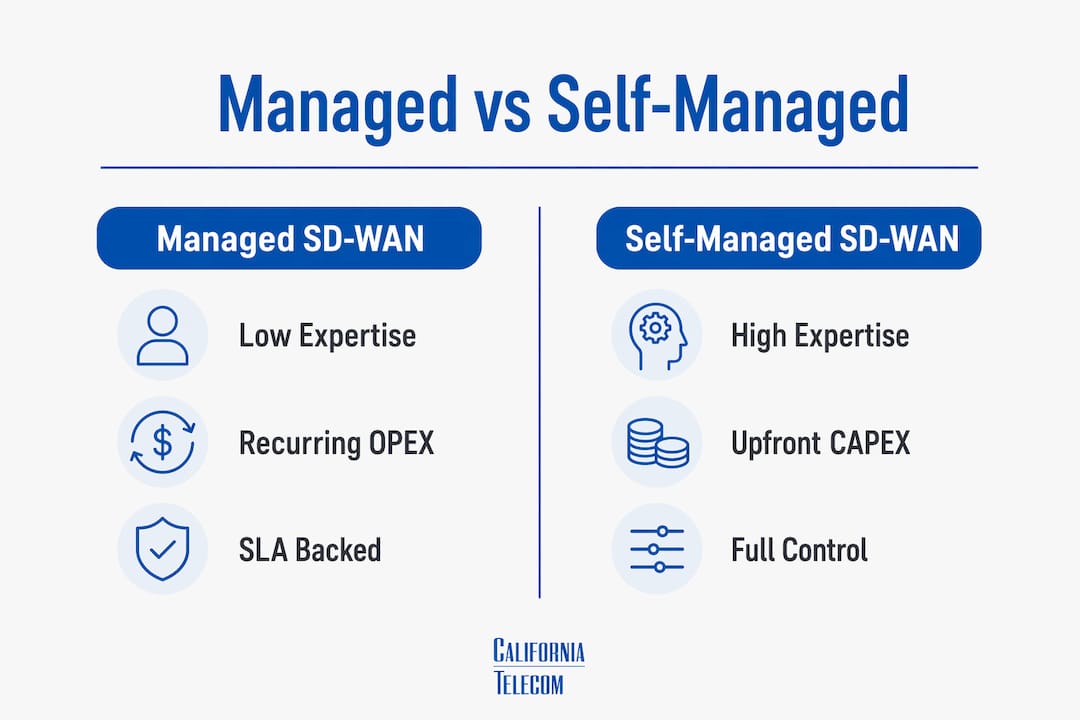
The choice between managed and self-managed SD-WAN comes down to three factors: internal expertise, deployment velocity, and cost structure.
Self-managed SD-WAN gives your team full policy authority. You control every routing rule, security policy, and configuration change without waiting on a provider's change window. That control has real value for organizations with large, experienced network engineering teams and complex, custom routing requirements. The trade-off is significant: self-managed requires upfront CAPEX for hardware and controllers, plus the ongoing operational cost of staffing a team with SD-WAN expertise across every shift.
Managed SD-WAN operates on an OPEX recurring fee per site backed by SLAs, while self-managed requires upfront CAPEX and internal operational expenses. For most multi-location businesses, the OPEX model is easier to budget and scales more predictably as the network grows.
| Evaluation factor | Managed SD-WAN | Self-managed SD-WAN |
|---|---|---|
| Internal expertise required | Low | High |
| Upfront cost | Low (OPEX per site) | High (CAPEX hardware) |
| Policy control | Provider-enforced | Full internal control |
| Deployment speed | Fast (zero-touch) | Depends on internal capacity |
| 24/7 monitoring | Included | Requires dedicated staff |
| Scalability | Provider-managed | Internal team dependent |
Co-managed models exist between these two extremes. In a co-managed arrangement, your team handles some configuration while the provider manages the infrastructure. Co-managed SD-WAN agreements often create friction because businesses underestimate change-request latency. If your application teams push updates faster than the provider's change windows allow, you create a bottleneck that slows the entire business.
Pro Tip: If you choose a co-managed model, document your change request SLA expectations before signing. Misaligned timelines are the most common source of frustration in co-managed deployments.
For businesses scaling network infrastructure to new locations rapidly, fully managed SD-WAN almost always wins on deployment speed and operational simplicity.
Key challenges when deploying a managed SD-WAN service
Managed SD-WAN simplifies operations, but deployment still requires careful planning. The most common failure points are predictable and avoidable.
- Change management misalignment. Internal teams often submit configuration change requests without understanding the provider's SLA windows. Aligning your internal update cycles with provider timelines before go-live prevents operational bottlenecks.
- Fragmented transport relationships. Providers who manage only the SD-WAN software layer leave you coordinating separately with circuit carriers. When an outage occurs, you spend time determining whether the problem is in the overlay or the underlay. Selecting a provider who manages both eliminates this ambiguity.
- Incomplete security policy coverage. SD-WAN introduces direct internet breakout at each site. Security policies must cover every breakout point, not just the data center perimeter. Confirm that your provider's security framework extends to every edge device.
- MPLS cutover planning. Replacing MPLS with SD-WAN requires careful cutover sequencing. Running both networks in parallel during transition reduces downtime risk. Cutting over too quickly without parallel testing is the fastest way to disrupt business operations.
- Visibility gaps. Some providers offer limited customer-facing dashboards. Demand access to real-time performance data for every site. Without visibility, you cannot verify that the provider is meeting SLA commitments.
Operational success depends heavily on coordinated change management between internal teams and the service provider. Treat the provider relationship as a partnership with defined processes, not a hands-off outsourcing arrangement.
How to choose the right managed SD-WAN provider
Provider selection is where most businesses make their most consequential mistake: choosing on price alone without evaluating integration depth.
- Overlay and underlay ownership. Providers that manage both transport circuits and the SD-WAN overlay give you a single escalation point and faster incident resolution. Avoid providers who manage only the software layer.
- SLA specificity. Review SLA terms for uptime guarantees, change window timelines, and incident response times. A 99.99% uptime SLA on data circuits is a meaningful benchmark. Vague SLA language is a warning sign.
- Proactive monitoring. Providers should detect and respond to issues before they affect users. Ask how the NOC identifies problems: reactive ticket-based systems are inferior to continuous circuit-level monitoring.
- Multi-location experience. Providers experienced with distributed businesses understand the operational patterns of retail chains, healthcare networks, and professional services firms. Ask for references from businesses with a similar site count and industry.
- Pricing transparency. Demand itemized pricing per site with no hidden fees for standard changes. Providers who bundle transport, management, and support into a clear per-site fee are easier to budget and hold accountable.
Californiatelecom sources from 50+ carriers, designs and deploys each site through its own engineers, and backs every service with a 24/7 U.S.-based NOC. That integration of transport and management into a single provider model is exactly what the evaluation criteria above describe. For IT leaders also evaluating broader technology integration, the 2026 enterprise AI selection guide covers how AI tools layer onto managed network infrastructure.
Key Takeaways
A managed SD-WAN service delivers the greatest value when the provider controls both the SD-WAN overlay and the underlying transport circuits, giving multi-location businesses a single point of accountability for performance, security, and cost.
| Point | Details |
|---|---|
| Core definition | A managed SD-WAN service outsources WAN design, deployment, and operations to a third-party provider. |
| Integrated management | Choose providers who manage both the SD-WAN overlay and transport circuits to avoid fragmented vendor relationships. |
| Cost model | Managed SD-WAN runs on a predictable OPEX per-site fee, replacing unpredictable CAPEX and hidden staffing costs. |
| Deployment speed | Zero-touch provisioning reduces new site setup from weeks to minutes, enabling rapid expansion. |
| Change management | Align internal change request cycles with provider SLA windows before deployment to prevent operational bottlenecks. |
What I've learned after years of watching SD-WAN deployments succeed and fail
The businesses that get the most out of managed SD-WAN share one trait: they treat the provider as an extension of their IT team, not a black box they hand a check to every month. The ones that struggle almost always made the same mistake. They selected a provider based on the SD-WAN software platform and assumed the transport layer would sort itself out.
It never does. When a circuit goes down at a branch at 2:00 AM, you do not want to be calling three different vendors to determine who owns the problem. The provider who manages both the overlay and the underlay picks up one call and owns the resolution. That single-point accountability is worth more than any feature on a product spec sheet.
The other pattern I see consistently is underinvestment in the cutover plan. Businesses rush the MPLS-to-SD-WAN transition because they want to capture cost savings immediately. Running parallel networks for 30 days costs money. Cutting over too fast and taking down a distribution center or a clinic costs far more. Patience during cutover is not caution. It is operational discipline.
The unified management console is genuinely transformative for multi-site operations. When your team can see every site's performance in one dashboard and push a policy change to 50 locations simultaneously, the operational model of your network changes completely. That shift from site-by-site firefighting to centralized control is the real value of managed SD-WAN, and it compounds every time you add a location.
— Jim
Californiatelecom's approach to managed SD-WAN for multi-location businesses
Multi-location businesses need more than SD-WAN software. They need a provider who owns the entire network stack from circuit to console.Californiatelecom delivers nationwide managed network services with a single contract, one bill, and one engineer's direct number. The team designs and deploys every site using its own engineers, sources circuits from 50+ carriers, and monitors every location through a 24/7 U.S.-based NOC backed by a 99.99% uptime SLA on data. Whether you are consolidating MPLS, deploying new branches, or replacing a patchwork of carrier relationships, Californiatelecom's managed SD-WAN solutions give your IT team the visibility and support to run a distributed network without the operational drag. Contact Californiatelecom for a free consultation to assess your specific network requirements.
FAQ
What is a managed SD-WAN service in simple terms?
A managed SD-WAN service is a networking solution where a third-party provider designs, deploys, and operates your wide area network across all business locations. Your internal team gains network performance and visibility without managing the infrastructure directly.
How does SD-WAN differ from traditional MPLS?
SD-WAN routes traffic intelligently across multiple circuit types including broadband, LTE, and MPLS, while traditional MPLS relies on a single dedicated circuit type. SD-WAN typically delivers lower cost per site and faster failover than MPLS alone.
What does managed SD-WAN cost?
Managed SD-WAN pricing follows a per-site OPEX model, meaning you pay a recurring monthly fee per location rather than large upfront hardware costs. Exact pricing varies by provider, circuit type, and number of sites.
How long does it take to deploy managed SD-WAN at a new site?
Zero-touch provisioning reduces new site deployment from weeks to minutes once the edge device arrives on-site. The provider's controller applies the correct configuration automatically when the device connects.
What should I look for in a managed SD-WAN provider?
Prioritize providers who manage both the SD-WAN overlay and the underlying transport circuits, offer a 24/7 NOC, publish specific SLA terms for uptime and response times, and provide a customer-facing dashboard with real-time site visibility.
Recommended
- What Is SD-WAN and How It Can Transform Your Business Connectivity | California Telecom
- SD-WAN Hospitality Implementation: A 2026 Enterprise Guide | California Telecom
- How SD-WAN transforms connectivity for multi-location businesses | California Telecom
- SD-WAN vs. MPLS: Which Makes Sense for Your Business? | California Telecom