

SD-WAN Hospitality Implementation: A 2026 Enterprise GuideEnterprise SD-WAN is defined as a software-controlled network architecture that routes traffic across multiple connection types based on real-time application policies. For multi-site hospitality businesses, enterprise SD-WAN hospitality implementation solves a problem that traditional WAN never could: managing dozens or hundreds of venues from a single control plane without sacrificing reliability. A hybrid SD-WAN/MPLS design assigns sensitive payment and property management system (PMS) traffic to private MPLS circuits while routing guest Wi-Fi and cloud applications over SD-WAN. This approach cuts WAN infrastructure costs by up to 50% compared to all-MPLS networks while maintaining the uptime that hospitality operations demand.
What does enterprise SD-WAN hospitality implementation require?
Successful SD-WAN deployment starts with a thorough infrastructure audit, not with hardware orders. IT managers at multi-site properties need a clear picture of what they have before they can define what they need.
Assess your current WAN and application landscape
Map every existing circuit at each venue, including MPLS links, broadband connections, and LTE backup paths. Identify which applications are mission-critical: PMS platforms, point-of-sale (POS) systems, payment gateways, and guest Wi-Fi each carry different latency and reliability requirements. Policy-based routing and automated failover can only be configured correctly when you know exactly which traffic needs guaranteed uptime and which can tolerate brief interruptions.
Review your hotel network infrastructure documentation for each site. Properties without current network diagrams should generate them before any SD-WAN vendor conversation begins.
Define performance and security objectives
Set specific targets before deployment, not after. Typical hospitality benchmarks include sub-50ms latency for PMS transactions, zero-downtime failover for payment processing, and guest network isolation from staff and operational traffic. Security objectives should include network segmentation between guest, staff, and back-office zones, plus compliance with PCI DSS for all payment traffic paths.
Hardware and environmental considerations
Standard commercial networking hardware fails in coastal and open-air resort environments. Industrial-grade outdoor equipment rated for salt-air and high humidity is the only reliable choice for beachfront or open-air venues. Silent connectivity failures from corroded components are a known risk at coastal properties, and they are far more expensive to diagnose than the hardware upgrade that prevents them.
Pro Tip: Build a site-by-site hardware specification sheet before procurement. Categorize each venue by environment type: indoor controlled, outdoor covered, and outdoor exposed. This prevents ordering standard-grade equipment for venues that need industrial-grade components.
Key prerequisites checklist before SD-WAN deployment:
- Complete circuit inventory for every venue (MPLS, broadband, LTE)
- Application dependency map covering PMS, POS, payment, and guest Wi-Fi
- Network segmentation requirements documented per site
- Environmental classification for hardware selection
- Installation window coordination with property operations teams
- Onsite contact confirmed at each venue for day-of access
How do you deploy SD-WAN across multiple hospitality venues?
A phased rollout is the only reliable method for multi-site hospitality SD-WAN deployment. Attempting a simultaneous cutover across dozens of properties creates compounding risk with no clean recovery path.
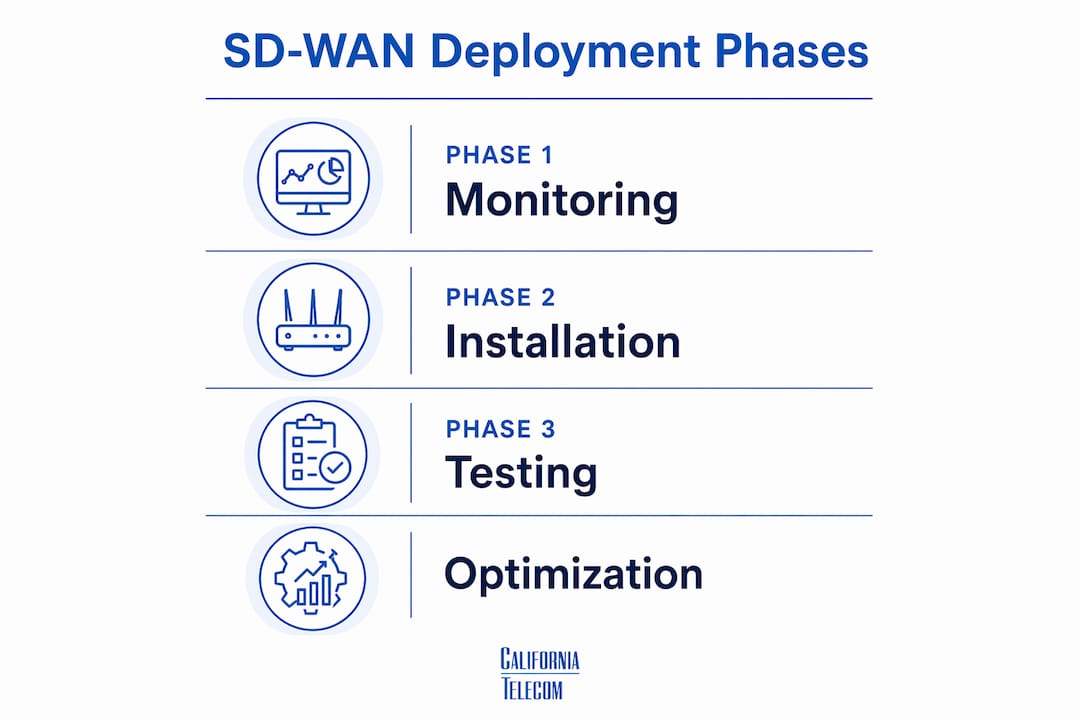
Phase 1: Monitoring and baseline
Deploy passive monitoring agents at each venue before touching any live configuration. Collect two to four weeks of traffic data covering peak check-in periods, weekend occupancy spikes, and any seasonal events. This baseline tells you exactly how much bandwidth each application consumes and where current bottlenecks occur. AI-native management platforms can cut troubleshooting time from days to hours by surfacing these patterns automatically.

Phase 2: Installation and configuration
Schedule all physical installations during early morning windows. Strict 5:00 AM to 9:00 AM installation windows eliminated trading disruption across an 850-venue SD-WAN rollout by completing all work before guest activity began. This approach is non-negotiable for properties with 24-hour front desk operations.
Assign dedicated regional engineers to geographic clusters of venues rather than rotating generalist technicians. Regional specialists develop site-specific knowledge that reduces escalations and shortens each visit. Californiatelecom deploys its own engineers for every site, which eliminates the coordination gap that appears when a managed services provider subcontracts installation to unfamiliar local contractors.
Configure SD-WAN policies in this order:
- Payment and PMS traffic: Assign to MPLS or the highest-reliability circuit with automatic failover to a secondary private link.
- Staff operational traffic: Route over SD-WAN with QoS priority above guest traffic.
- Guest Wi-Fi: Route over broadband or LTE circuits with bandwidth caps per session to prevent single users from degrading shared performance.
- Cloud and loyalty applications: Route dynamically based on real-time path quality scores.
Phase 3: Testing and optimization
Test every failover scenario before declaring a venue live. Physically disconnect the primary circuit and confirm that PMS and payment traffic switches to the backup path within the SLA window. Verify that guest traffic does not bleed into staff VLANs during the failover event. Pueblo Bonito resorts achieved consistent guest connectivity across large resort campuses by pairing AI-native SD-WAN with a zero-trust security model, which enforces segmentation even during network state changes.
Pro Tip: Run a full failover test at each venue during the installation window, not after go-live. Discovering a misconfigured policy at 6:00 AM with an engineer onsite is a five-minute fix. Discovering it at 2:00 PM during peak check-in is a guest-facing incident.
What are the biggest challenges in hospitality SD-WAN deployments?
Multi-site hospitality SD-WAN projects fail more often from operational friction than from technical complexity. Knowing the common failure points lets you build mitigation into the project plan from day one.
The real risk in hospitality SD-WAN is not the technology. It is the assumption that a network project can run on the same timeline as a software rollout. Physical venues have access constraints, environmental variables, and operational schedules that software deployments do not. Build those realities into your project plan before you commit to a go-live date.
Legacy system integration
Many hospitality properties run PMS platforms that were designed for fixed LAN environments. These systems sometimes use broadcast-dependent protocols that behave unpredictably across SD-WAN overlays. Test legacy PMS compatibility in a lab environment before deploying to production venues. If your PMS vendor has an SD-WAN compatibility matrix, request it before procurement.
Security and compliance across segmented networks
Guest network isolation is both a security requirement and a compliance obligation under PCI DSS. Misconfigurations that allow guest traffic to reach payment infrastructure create audit failures and potential breach exposure. Hospitality properties face increased cyber attack risk specifically because of the high volume of transient users connecting to shared infrastructure. Pair SD-WAN segmentation with a zero-trust access policy that authenticates every device before granting network access, regardless of which VLAN it connects to.
Maintaining service quality during cutover
The cutover moment, when you switch a venue from its old WAN to the new SD-WAN overlay, carries the highest risk of guest-facing disruption. Schedule cutovers during the lowest-occupancy window of the week, typically early Tuesday or Wednesday mornings. Confirm that the property's front desk team has a direct phone number for the lead engineer during the cutover window. Integrating physical hotel security systems on a separate, dedicated network segment during cutover prevents security camera or access control outages from compounding the network transition risk.
Environmental equipment failures
Coastal and open-air venues expose networking hardware to conditions that void standard warranties within months. Salt-air corrosion attacks copper contacts and antenna connections silently. The failure appears as intermittent connectivity rather than a clean outage, which makes it difficult to diagnose remotely. Specify industrial-grade, IP-rated enclosures for all outdoor access points and edge devices at any venue within two miles of saltwater.
How do you measure SD-WAN success in hospitality networks?
Post-deployment measurement determines whether your SD-WAN investment is performing as designed or drifting toward the same problems it was meant to solve.
| KPI | Target | Measurement method |
|---|---|---|
| Network uptime | 99.99% per venue | NOC monitoring with per-circuit availability logs |
| Failover speed | Under 50ms for PMS/payment | Automated failover testing, monthly |
| Application response time | Sub-100ms for PMS transactions | Synthetic monitoring from each venue |
| Guest Wi-Fi satisfaction | Tracked via post-stay survey | Correlated with network performance logs |
| Incident resolution time | Under 4 hours for critical issues | Ticket-to-resolution tracking in NOC |
AI-powered analytics platforms shift network management from reactive to proactive. AI-native platforms identify bottlenecks before they affect guests, which is a fundamentally different operational posture than waiting for a front desk complaint to trigger a support ticket. Southern Sun's SD-WAN adoption reduced connectivity issues by up to 90% and cut operational costs by approximately 20%. Those numbers reflect what consistent AI-driven monitoring delivers over time.
Adjust SD-WAN policies seasonally. A beach resort in july operates at different traffic volumes than the same property in january. Centralized dashboards that display real-time bandwidth consumption per venue let network managers push policy updates across all sites simultaneously rather than logging into each venue individually. Californiatelecom's 24/7 U.S.-based NOC provides this visibility continuously, which means your team is not the one watching dashboards at 3:00 AM during a holiday weekend.
Ongoing managed Wi-Fi services extend the value of SD-WAN by keeping the guest-facing layer aligned with the same performance standards applied to the core WAN. A well-configured SD-WAN edge device paired with an under-maintained Wi-Fi layer still produces poor guest experiences.
Why AI-driven SD-WAN changes hospitality operations permanently
The most important shift I have seen in hospitality networking over the past several years is not the technology itself. It is what the technology makes possible for the people running these properties.
Before AI-native SD-WAN, a network issue at a resort property followed a predictable and painful path. A guest complained. The front desk called IT. IT logged a ticket. Someone remoted in, spent an hour diagnosing, and either fixed it or dispatched a technician. The guest had already checked out frustrated. That cycle repeated hundreds of times per year across a large portfolio.
AI-native platforms break that cycle entirely. CIOs at luxury resort groups now describe SD-WAN as an environment that frees staff to focus on service rather than troubleshooting. That is not marketing language. It reflects a real operational shift where the network manages itself and escalates only when human judgment is genuinely required.
The hybrid SD-WAN/MPLS design is the piece that most IT managers undervalue at the start of a project. Keeping payment and PMS traffic on private MPLS circuits while routing everything else over SD-WAN is not a compromise. It is the correct architecture for hospitality. It gives you cost efficiency where you can afford flexibility and guaranteed reliability where you cannot afford risk.
My honest recommendation: do not treat the deployment as a one-time project. The properties that get the most from SD-WAN are the ones that treat it as a managed service with ongoing policy reviews, seasonal adjustments, and continuous monitoring. The technology is only as good as the operational discipline behind it.
— Jim
Californiatelecom's managed SD-WAN for hospitality networks
Multi-site hospitality businesses need a network partner who designs, deploys, and monitors every venue without handing off responsibility to a subcontractor at the critical moment.Californiatelecom delivers nationwide managed network services built specifically for multi-location operations. Every site is designed and deployed by Californiatelecom's own engineers, backed by a 24/7 U.S.-based NOC and a 99.99% uptime SLA on data. You get one provider, one bill, and one engineer's direct number instead of chasing multiple carriers across your portfolio. Californiatelecom sources from 50+ carriers, which means the right circuit for each venue, not the only circuit a single carrier can provide. Contact Californiatelecom to discuss a managed LAN/WAN solution tailored to your property count and traffic requirements.
Key takeaways
Enterprise SD-WAN hospitality implementation succeeds when hybrid network design, phased deployment, and AI-driven monitoring are applied together across every venue from day one.
| Point | Details |
|---|---|
| Hybrid design reduces cost and risk | Assign PMS and payment traffic to MPLS; route guest and cloud traffic over SD-WAN to cut WAN costs by up to 50%. |
| Phased rollout prevents disruption | Deploy monitoring first, install during 5:00 AM to 9:00 AM windows, and test failover before go-live at each venue. |
| Regional engineers accelerate delivery | Dedicated regional specialists reduce escalations and shorten site visits across large multi-property portfolios. |
| AI monitoring shifts posture from reactive to proactive | AI-native platforms identify bottlenecks before guests notice, cutting connectivity issues by up to 90%. |
| Industrial hardware is non-negotiable at coastal venues | Standard equipment fails silently in salt-air environments; specify IP-rated industrial-grade components for every outdoor installation. |
FAQ
What is SD-WAN in the context of hospitality networks?
SD-WAN is a software-defined networking approach that routes traffic across multiple connection types based on application policies rather than fixed circuits. In hospitality, it enables centralized management of guest Wi-Fi, PMS, and payment traffic across dozens or hundreds of venues from a single control plane.
How does a hybrid SD-WAN and MPLS design work for hotels?
A hybrid design assigns latency-sensitive and compliance-critical traffic, such as PMS and payment processing, to private MPLS circuits, while routing guest Wi-Fi and cloud applications over SD-WAN. This approach reduces WAN costs by up to 50% compared to all-MPLS while maintaining the reliability that payment and PMS systems require.
How long does a multi-site SD-WAN deployment take?
Deployment timelines vary by portfolio size, but a phased approach covering monitoring, installation, and optimization typically runs four to twelve weeks for properties in the range of 10 to 50 venues. Larger portfolios of 100 or more sites benefit from regional engineering teams working in parallel to compress the overall timeline.
What are the biggest security risks during SD-WAN cutover?
The primary risk is misconfigured network segmentation that allows guest traffic to reach payment or PMS infrastructure during the transition. Testing every VLAN boundary and failover path before go-live, and scheduling cutovers during low-occupancy windows, eliminates most cutover-related security incidents.
Does SD-WAN work with legacy PMS platforms?
Most modern SD-WAN platforms support legacy PMS systems, but broadcast-dependent protocols used by older PMS software can behave unpredictably across SD-WAN overlays. Request a compatibility matrix from your PMS vendor and test in a lab environment before deploying to production venues.