

Service Managers: Make OLA Timings Fit a 4 hour SLAAn SLA is the promise your organization makes to a customer. An OLA is the internal deal that makes keeping that promise possible. Confuse the two, or forget that the OLA even exists, and you'll hit SLA breaches even when every internal dashboard glows green. The fix is straightforward: define both clearly, then make sure the timings inside your OLAs actually add up to fit inside your SLA targets.
TL;DR:
- OLAs must align with SLA timelines to ensure internal response and resolution times collectively meet customer promises.
- Vendor Underpinning Contracts need to fit within SLA windows, requiring careful cross-checking and renegotiation if mismatched.
- Measuring end-to-end incident resolution time through regular customer journey audits helps identify hidden bottlenecks and watermelon SLAs.
- Regularly reviewing internal OLAs for all supporting teams prevents misaligned targets and unnoticed handoff delays that can cause SLA breaches.
- Outsourcing complex OLA management to providers like California Telecom offers a scalable solution for multi-site, vendor-rich environments without internal staffing burdens.
Table of Contents
- SLA vs OLA: Definitions, Underpinning Contracts, and SLOs
- Why Watermelon SLAs Wreck Customer Trust
- Types of SLA and How to Pick the Right Structure
- Metrics That Make SLAs and OLAs Measurable
- How to Write an OLA That Actually Underpins Your SLA
- Diagnosing SLA Breaches: Root Causes and Fixes
- What Practitioners Get Wrong About OLA Reviews
- When a Managed Provider Solves the OLA Problem for You
- Where to Go Deeper on SLA and OLA Standards
- Sources
- FAQ
SLA vs OLA: Definitions, Underpinning Contracts, and SLOs
A Service Level Agreement (SLA) is the formal, external document between your organization and a customer. It spells out what service you'll deliver, how you'll measure it, and what happens if you miss. A typical SLA clause includes commitments on uptime, response times for critical incidents, and consequences for failing to meet these guarantees. These are legal commitments, often tied to invoicing and contract renewal.
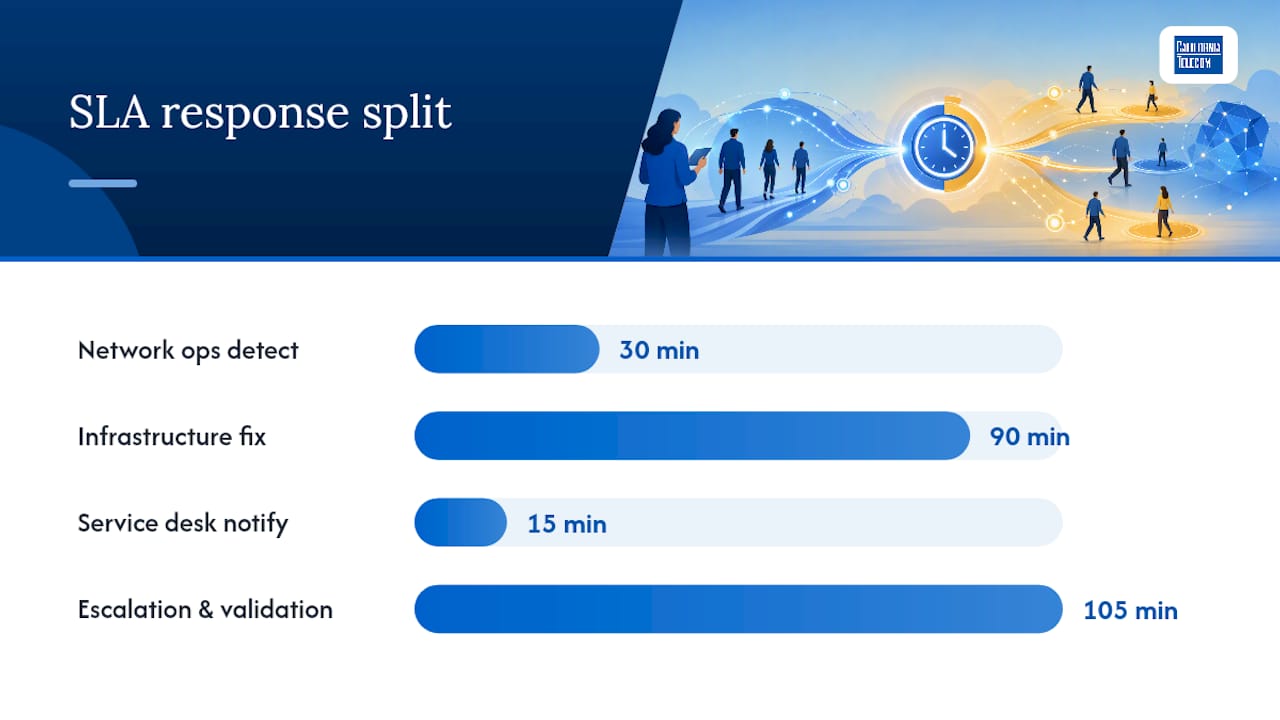
An Operational Level Agreement (OLA) is the internal counterpart. It's an agreement between departments, teams, or systems inside the same organization that support delivery of the SLA. Where an SLA says "4 hour response," the OLA breaks that down: network operations gets 30 minutes to detect and triage, the infrastructure team gets 90 minutes to apply a fix, and the service desk gets 15 minutes to notify the customer once resolved. Under ITIL's service level management practice, the SLA is the external customer commitment, the OLA is internal team coordination, and a third structure, the Underpinning Contract (UC), covers vendor commitments.
A UC is a contract with an external third-party supplier whose delivery timing has to slot into your internal process the same way an OLA does. If your data center provider promises hardware replacement in 6 hours, that number has to fit inside your customer-facing SLA window, not the other way around.
SLOs (Service Level Objectives) are the measurable targets buried inside both SLAs and OLAs, things like error rate, latency, or percentage uptime. IBM describes SLOs and KPIs as the mechanism that turns a vague promise into something you can actually audit.
A quick reference for how the pieces relate:
- SLA — external, customer facing, carries financial or contractual consequences.
- OLA — internal, team facing, defines who does what and by when.
- UC — external, vendor facing, underpins the OLA's internal targets with outside delivery windows.
- SLO — the specific measurable number inside any of the three (99.9% uptime, 15 minute detection, 2 hour vendor swap).
Why Watermelon SLAs Wreck Customer Trust
Internal metrics can look perfect while customers are furious. That gap exists because teams often measure the wrong thing, or measure the right thing without checking whether it adds up across departments.
The classic failure case is the watermelon SLA: green on the outside, red on the inside. Your monitoring dashboard shows every OLA target met, every ticket closed within window, every team hitting its number. Customers are still complaining about slow resolution. The mismatch usually comes from measuring individual team performance in isolation instead of the end-to-end chain a customer actually experiences. Advisera's guidance on SLA, OLA, and UC alignment points to a related and more basic problem: teams that label their own internal agreement an "SLA" instead of an OLA, which muddies accountability and makes it harder to spot where the real bottleneck sits.
OLAs exist precisely to prevent this kind of blame shifting. When the network team, the service desk, and the vendor all know their slice of the timeline and their handoff point, nobody can claim "we hit our number" while the customer waited three extra hours because nobody owned the gap between teams.
This is also where XLA (Experience Level Agreement) enters the conversation. ITIL 4's shift toward business outcomes argues that technical SLA compliance isn't the same as a good customer experience, and mature service organizations track both.
Pro Tip: Run a "customer journey time audit" quarterly: trace one real incident from the moment it was reported to resolution, and compare that actual elapsed time against your published SLA. If OLA metrics say you're compliant but the audit shows otherwise, you've found your watermelon.
Types of SLA and How to Pick the Right Structure
Not every SLA should look the same, and the structure you choose depends on how many customers, services, and internal teams you're coordinating.
- Service-based SLA. One agreement covers a specific service for all customers who use it, such as a shared email platform. It's simple to manage because the terms don't change per customer, but it can't account for customers with different priority levels or negotiated terms.
- Customer-based SLA. One agreement covers everything a specific customer receives across multiple services. This works well for enterprise accounts with bundled contracts, though it takes more work to draft and track since every service inside it may have a different baseline.
- Multi-level SLA. Layered structure, typically corporate level, customer level, and service level, stacked so broad organizational commitments sit above specific customer or service terms. Multi-level SLA structures suit large enterprises running many services across many customer segments, since changes at the corporate level don't require rewriting every individual contract.
If you're a smaller managed service operation with a handful of clients, service-based agreements are usually enough. Once you're juggling dozens of clients each with different service bundles, or running SLAs across multiple business units internally, multi-level becomes worth the added drafting overhead. The type of provider matters too: an internal IT department negotiating with business units has more flexibility to adjust OLA terms mid-cycle than a provider bound by an external, contractually locked SLA.
Metrics That Make SLAs and OLAs Measurable
Numbers are what turn an SLA from a promise into something enforceable. The most common ones show up in nearly every ITSM framework:
- Availability/uptime — the percentage of time a service is operational, commonly 99.9% or 99.99% depending on criticality.
- MTTR (Mean Time to Resolution) — average time from incident report to fix, a core SLA metric customers actually feel.
- MTTA (Mean Time to Acknowledge) — how fast your team responds once an alert fires, usually an internal OLA metric.
- SLO breach rate — percentage of incidents that missed their target window, a KPI used to spot systemic problems before they become chronic.
- First-call resolution rate — relevant for service desk OLAs supporting a customer-facing SLA on ticket handling.
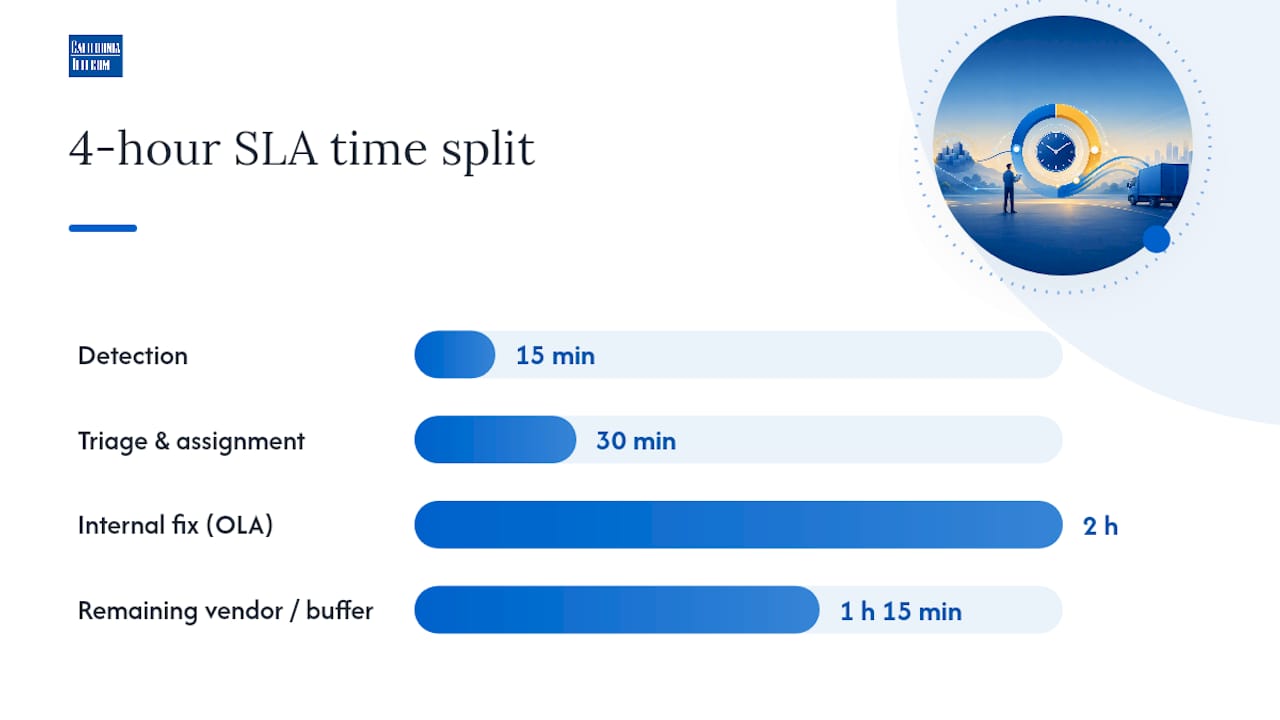
The real work is in the timeline math. Say your SLA promises 4-hour resolution for a critical outage. That 4 hours has to be divided among every team and vendor in the chain: detection (say 15 minutes via automated monitoring), triage and assignment (30 minutes), internal fix work under the OLA (2 hours), and if a vendor's hardware is involved, their UC-guaranteed replacement window has to fit inside whatever time remains, with a buffer left over for the unexpected. If those windows don't sum to less than your SLA target, you've written an OLA that guarantees failure before the first incident even happens.
Statistic Callout: SLOs and KPIs are the measurable backbone of every SLA, according to IBM's breakdown of service level agreements: SLOs set the performance baseline (latency, error rate, uptime), while KPIs are the ongoing monitoring tool used to judge whether that baseline is actually being held.
Dashboards should track these numbers in real time, not just in a monthly report. Alert thresholds set at 80% of your OLA window, not 100%, give teams room to escalate before a breach happens rather than after.
How to Write an OLA That Actually Underpins Your SLA
A good OLA isn't a copy of the SLA with different letterhead. It's a separate document built from the SLA backward.
- Map every SLA commitment to the teams and systems that support it. For each SLA metric (uptime, response time, resolution time), list which internal team, system, or process is responsible for that piece of the chain.
- Set measurable internal targets with named owners. Every OLA line item needs a specific number and a specific accountable role, not a department name. "Network Operations Lead: 15 minute acknowledgment" beats "Network team: fast response."
- Define escalation paths, handoff rules, and reporting cadence. Specify exactly when a ticket moves from tier 1 to tier 2, who gets notified, and how often status updates happen during an active incident.
ServiceNow's community guidance on mapping SLA, OLA, and UC responsibilities recommends testing these mappings against real incident timelines rather than trusting them on paper, since assumptions about handoff speed rarely survive contact with an actual outage.
Before you sign off on any OLA, run through this checklist:
- Does every SLA metric have a matching OLA owner?
- Do the summed internal timings (detection + triage + fix) fit inside the SLA window with a buffer?
- Are vendor UC delivery windows factored into the OLA math, not treated as separate?
- Is there a named escalation contact for every shift, not just business hours?
- Does the OLA get reviewed on the same cadence as the SLA, or does it go stale?
| OLA field | What it should specify |
|---|---|
| Supporting team/system | Which internal group owns this piece of the SLA |
| Measurable target | Specific number (minutes, percentage) tied to that team's task |
| Named owner | Role or individual accountable, not just a department |
| Escalation trigger | The point at which the ticket moves up a tier |
| Reporting cadence | How often status is communicated during an active incident |
Diagnosing SLA Breaches: Root Causes and Fixes
Most SLA breaches trace back to one of three problems: missing OLAs, mismatched UC timings, or metrics that measure the wrong thing.
Missing OLAs happen when a service launches with a customer-facing SLA but nobody wrote the internal agreement to back it up. Teams end up improvising response times under pressure, and improvised timing rarely fits the promised window.
Mismatched UC timings show up when a vendor's contractual delivery window, say 8 hours for hardware replacement, doesn't actually fit inside the 4-hour SLA you promised the customer. That gap sits invisible until an actual outage exposes it.
Wrong metrics happen when OLAs track team-level completion instead of end-to-end elapsed time, which is exactly how watermelon SLAs get created in the first place.
Fixes for each:
- Run a tabletop incident simulation and time every handoff, not just the final resolution.
- Cross-check every vendor UC against the SLA windows it supports, and renegotiate any contract that doesn't fit.
- Rebuild OLA reporting to track cumulative elapsed time across the whole chain, not isolated team metrics.
Pro Tip: Once a quarter, pick your worst recent incident and rebuild its timeline minute by minute against every OLA and UC involved. It will almost always reveal the exact gap a watermelon SLA was hiding.
What Practitioners Get Wrong About OLA Reviews
Most service teams review SLAs constantly and OLAs almost never. That's backward. The SLA is the easy part to audit, it's a static document with a clear pass/fail number. The OLA is where things actually break, because internal teams change staffing, tooling, and priorities far more often than contracts get renegotiated.
Watch the handoff points during any SLA review, not just the totals. A team can hit its individual OLA target every single month while the gap between that team and the next one quietly grows, and nobody notices until a customer escalation forces the audit.
California Telecom's own structure reflects this discipline: a 99.99% uptime SLA on data services backed by a 24/7 U.S. based NOC means the internal monitoring and escalation chain has to be tight enough, every hour of every day, to make that number real rather than aspirational. In a recent multi-site deployment, aligning carrier UC delivery windows with internal NOC response times was the difference between a client's uptime target being a number on paper and a number they could actually count on across every location.
— Jim
When a Managed Provider Solves the OLA Problem for You
Building airtight OLAs across dozens of locations, vendors, and internal teams takes real bandwidth, bandwidth most IT departments don't have to spare. If you're managing multiple sites, juggling several carrier contracts, and still trying to guarantee uptime without a dedicated NOC watching every handoff, the internal coordination problem gets bigger than most teams can staff for.California Telecom exists for exactly that gap. Instead of building OLA infrastructure and negotiating separate UCs with 50+ carriers yourself, you get one provider, one bill, and one engineer's number, backed by a 99.99% uptime SLA on data and 99.999% on voice, with the internal escalation chain and vendor alignment already built into the service. Our engineers design and deploy each site directly, and our 24/7 U.S. based NOC handles the detection, triage, and vendor coordination that would otherwise live inside your own OLA. If you're evaluating whether to build that capability internally or hand it to a partner who already runs it at scale, request a free consultation and we'll walk through what an SLA review looks like for your specific site footprint.
Where to Go Deeper on SLA and OLA Standards
For formal frameworks, start with ITIL's service level management practice and Advisera's ISO 20000 aligned breakdown of SLAs, OLAs, and UCs. Both cover the practitioner terminology and templates referenced throughout this guide.
Sources
- What is an SLA? (IBM explanation of SLOs and KPIs)
- SLA, OLA, UC explanation and real-life mapping (ServiceNow Community)
FAQ
What is an OLA in ITIL?
An OLA in ITIL is the internal agreement between a service provider and its own supporting teams that defines how they'll meet the commitments made in the external SLA. It covers things like internal response times, handoff rules, and named ownership, and it exists specifically to keep customer-facing promises achievable.
What is the difference between an SLA, an OLA, and an underpinning contract?
An SLA is the external agreement with the customer, an OLA is the internal agreement between supporting teams, and a UC is a contract with an outside vendor whose delivery timing has to fit inside the SLA window. ITIL's framework treats all three as connected pieces of the same delivery chain, not separate documents that can be managed in isolation.
What do SLA, OLA, and UC mean in tools like ServiceNow?
In ITSM platforms, SLA tracks the customer-facing timer and breach status, OLA tracks internal task timers tied to specific teams, and UC tracks vendor commitment windows feeding into the same incident record. ServiceNow's community guidance frames this as mapping every timer to a real owner so nothing falls through the gap between systems.
What are the three types of SLAs?
The three primary SLA structures are service-based (one agreement covers a service for all customers), customer-based (one agreement covers all services for one customer), and multi-level (layered corporate, customer, and service tiers). Multi-level structures tend to suit larger organizations managing many services across varied customer segments, while smaller operations usually do fine with a single service-based model.
How much does a managed network SLA cost?
Pricing for managed SD-WAN, dedicated fiber, and related SLA-backed services from California Telecom depends on site count, bandwidth needs, and contract terms, so current pricing is available directly on the Managed SD-WAN page rather than as a flat published rate.