

Single Provider vs Multi-Vendor Networking: What IT Leaders Should ChooseFor most multi-location businesses, a single-provider networking model is the right call. It delivers consistent SLAs across every site, puts one team on the hook for uptime, and eliminates the policy fragmentation that quietly drives up operational costs in multi-vendor environments. Multi-vendor strategies make sense in specific, narrow cases, but they are the exception.
Quick verdict:
- Reliability: Single-provider SLAs cover the whole network; multi-vendor SLAs stop at each vendor's edge.
- Operational complexity: One dashboard, one NOC, one escalation path versus coordinating across multiple vendor consoles and support queues.
- Security consistency: A single policy engine enforces zero-trust and access controls uniformly; multi-vendor stacks create enforcement gaps between platforms.
When multi-vendor is the right call instead: specialized hardware requirements at specific sites (e.g., legacy industrial controllers), regulatory mandates that require a particular certified vendor in a given region, or a planned best-of-breed transition, in which you are migrating off an expiring contract and need temporary overlap.
Table of Contents
- How do single-provider and multi-vendor networking actually compare?
- What are the real operational tradeoffs between these two approaches?
- How should IT leaders decide between these two models?
- What does a realistic multi-site migration timeline look like?
- How does a managed single-provider model solve the problems multi-vendor creates?
- What did a real multi-location consolidation look like?
- Key Takeaways
- What most IT teams get wrong about this decision
- Californiatelecom handles multi-location consolidation from day one
- Useful sources
How do single-provider and multi-vendor networking actually compare?
The table below maps the seven dimensions that matter most to multi-location IT teams.
| Dimension | Single-Provider | Multi-Vendor | Edge Goes To |
|---|---|---|---|
| Reliability / uptime | Unified SLA across all sites | Per-vendor SLAs; gaps at handoff points | Single-provider |
| Operational complexity / skills burden | One console, one team | Multiple dashboards, multiple cert tracks | Single-provider |
| Security policy consistency | One policy engine, uniform enforcement | Policy drift between platforms | Single-provider |
| Cost / TCO | Potential pricing premium; lower OPEX headcount | Negotiation leverage; higher integration costs | Depends on scale |
| Time-to-deploy / migration timeline | Coordinated rollout, one PM | Staggered by vendor; harder to sequence | Single-provider |
| Support model / single point of contact | One ticket, one escalation path | Vendor finger-pointing on cross-platform issues | Single-provider |
| Vendor lock-in vs. supply diversity | Higher lock-in risk; mitigated by multi-carrier sourcing | Supply diversity; higher management overhead | Multi-vendor |
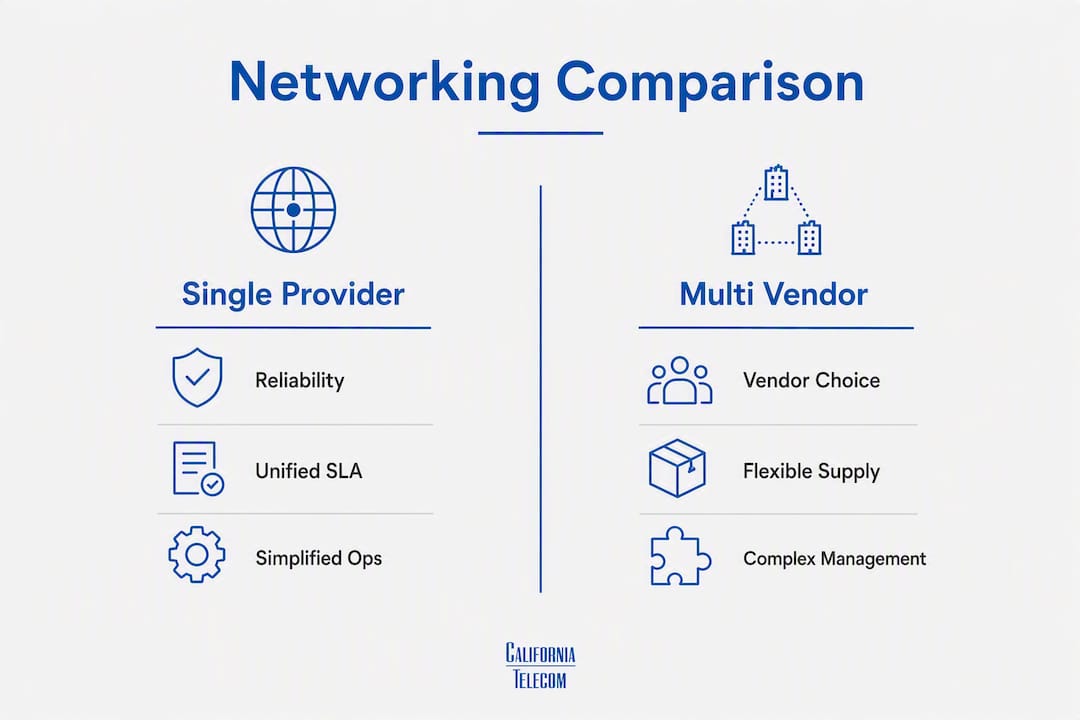
For enterprises running 10 to 200+ locations, single-provider wins on six of seven dimensions. The one exception, supply diversity, is largely neutralized when your single provider sources from multiple carriers rather than owning the underlying infrastructure.
What are the real operational tradeoffs between these two approaches?
Single-provider: what you gain and what you give up
Pros:
- Consistent SLAs enforced across every site from one contract
- Unified security policy engine, which matters especially when rolling out zero-trust or SASE
- Single NOC handling triage, remediation, and post-incident review
- Simplified billing: one invoice instead of a stack of carrier statements
- Centralized firmware and configuration updates pushed simultaneously
Cons:
- Vendor lock-in is real; exiting a multi-site contract mid-term is expensive and slow
- Pricing leverage is lower once you are fully committed
- A single supplier dependency means a provider outage or business disruption affects your whole network
Multi-vendor: what you gain and what you give up
Pros:
- Best-of-breed selection per network layer or site type
- Carrier and technology diversity reduces single-point-of-failure risk
- Competitive pricing through parallel vendor negotiations
Cons:
- Security policy fragmentation across platforms, especially during SASE migrations
- Multiple vendor dashboards and certification tracks create skills gaps that strain lean IT teams
- SLA misalignment: when an outage spans two vendors, neither owns the full resolution
- Higher ticket volume and longer mean time to repair (MTTR) when incidents require cross-vendor coordination
EMA research reported by TechTarget found that 53% of the most successful SD-WAN deployments used a single vendor, compared with just 13% of the least successful ones. That gap is not a coincidence. It reflects what happens operationally when troubleshooting crosses vendor boundaries: ticket handoffs, blame-shifting, and delayed resolution.
Centralized management also reduces the need for frequent on-site visits, which directly lowers OPEX headcount and cuts MTTR. For a 50-location business, that difference in travel and labor costs adds up fast.
How should IT leaders decide between these two models?
The decisive criteria are: number of locations, whether you require centralized security control (zero-trust, SASE), your internal skills depth, and how fast you need to be operational.
Score your situation against these dimensions:
- Reliability priority: If any site going down costs you revenue or compliance standing, single-provider SLAs are non-negotiable.
- Security model: Zero-trust and SASE implementations are significantly harder to enforce consistently across multiple SD-WAN vendors.
- Internal skills: Can your team manage multiple vendor consoles and maintain separate certifications? Most mid-market IT teams cannot without adding headcount.
- Speed of deployment: A coordinated single-provider rollout moves faster than sequencing multiple vendor contracts and project managers.
- Geographic coverage: Does one provider cover all your markets, or do you need regional specialists?
Questions to ask vendors during RFPs:
- What is your SLA for data uptime and voice uptime, and what are the penalty structures?
- Do you operate a 24/7 U.S.-based NOC, and what is the escalation path after hours?
- How many carriers do you source from, and how is failover handled?
- What migration support do you provide for sites still on MPLS contracts?
- What are the exit clauses if we need to terminate a site mid-contract?
Metrics to capture before you decide:
- Current monthly outage minutes per site
- Average time-to-repair across your existing vendors
- Number of vendor dashboards your team actively monitors
- Number of unique carriers across your locations
- Current licensing and support spend per site per month
Pro Tip: Before any vendor conversation, pull 90 days of outage logs and map which incidents required cross-vendor coordination. That number alone often makes the case for consolidation more clearly than any vendor presentation.
What does a realistic multi-site migration timeline look like?
Plan for over a year for a full multi-site network consolidation. That is the industry standard, and it accounts for legacy contract wind-downs, staged hardware deployments, and staff training.
- Months 1–2: Discovery and pilot. Audit all existing carrier contracts, hardware, and SLAs. Select two to three pilot sites. Owner: network engineering and procurement.
- Months 3–5: Pilot deployment and validation. Deploy managed SD-WAN at pilot sites, run parallel with existing connections, and validate SLA performance. Owner: vendor PM and network engineering.
- Months 6–10: Staged regional rollout. Migrate sites in geographic clusters. Integrate with legacy MPLS where contracts have not yet expired. Owner: vendor PM, on-site technicians, security team.
- Months 11–14: Legacy cutover. Decommission legacy carrier connections as contracts expire. Validate unified policy enforcement across all sites. Owner: network engineering and security.
- Months 15–18: Optimization. Tune SD-WAN policies, complete staff training on the unified dashboard, and run post-migration SLA review. Owner: IT operations.
Risk mitigation that actually works:
- Run parallel connections during cutover; do not cut legacy circuits until the new connection has passed a 30-day stability window.
- Stagger SLA thresholds during ramp: hold the vendor to a lower penalty threshold in the first 60 days, then step up to full SLA terms.
- Build knowledge-transfer sessions into the contract, not as an afterthought.
Pro Tip: Negotiate a site-level exit clause into your contract from day one. If a specific location underperforms after the ramp period, you want the right to migrate that site without triggering a full-contract penalty.
How does a managed single-provider model solve the problems multi-vendor creates?
A managed single-provider approach centralizes SLAs, monitoring, and configuration updates under one team, which directly reduces MTTR and prevents the policy drift that accumulates in multi-vendor environments over time.

The operational workflow looks like this: a site goes down, one ticket enters the NOC, the NOC triages using a unified dashboard with visibility across every location, remediates or escalates to the carrier, and closes with a post-incident report. No vendor handoffs. No "that's the other vendor's circuit" delays.
Capabilities that matter in a managed single-provider:
- Multi-carrier sourcing (not just one underlying network) so supply diversity is preserved
- 24/7 U.S.-based NOC with defined escalation paths
- Unified management dashboard with real-time visibility across all sites
- Integrated SD-WAN and SASE policy engine for consistent security enforcement
- Turnkey site deployments including hardware, configuration, and on-site technician coordination
- Wireless backup for automatic failover when primary circuits fail
When evaluating SLAs, the numbers to demand are clear. Californiatelecom, for example, backs its managed network services with a 99.99% uptime SLA on data and 99.999% on voice, with a 24/7 U.S.-based NOC and defined penalty structures. Those are the benchmarks worth holding any managed provider to.
A single-provider model does not mean a single carrier. The best managed providers source from 50+ carriers and aggregate that diversity behind one contract, one dashboard, and one support team. That is how you get supply diversity without the operational overhead of managing it yourself.
For a deeper look at how SD-WAN transforms multi-location connectivity, the technical architecture behind this model is worth reviewing before your RFP.
What did a real multi-location consolidation look like?
A multi-location wholesale distributor consolidated its fragmented carrier environment into a single managed network, and the operational difference was immediate.
Scope and challenges:
- Dozens of locations across multiple states, each with independently sourced internet connections
- Inconsistent SLAs across carriers, with no unified visibility into network health
- IT team spending significant time coordinating between multiple carrier support queues
What was done:
- Phased consolidation under a single managed provider with multi-carrier sourcing
- Unified SD-WAN deployed across all sites with a single NOC handling monitoring and remediation
- Simplified billing consolidated into one monthly invoice
Results:
- Reduced the number of vendor contacts IT managed for network issues
- Improved SLA adherence across all locations under a single contract
- Freed IT staff from carrier coordination to focus on higher-value work
The full case study details the deployment scope and outcomes. The tactical lesson other IT teams can reuse: start the consolidation at your highest-volume, highest-risk sites first. Those sites generate the most support tickets and deliver the clearest before/after comparison for executive reporting.
Key Takeaways
For most multi-location businesses, a managed single-provider networking model outperforms multi-vendor on reliability, security consistency, and operational cost, with a realistic consolidation timeline of 12–18 months.
| Point | Details |
|---|---|
| Single-provider wins on most dimensions | Reliability, security enforcement, MTTR, and support model all favor a single-provider approach for 10–200+ location enterprises. |
| EMA research backs consolidation | 53% of the most successful SD-WAN deployments used one vendor versus 13% of the least successful. |
| Plan for 12–18 months | Multi-site consolidations require phased rollouts to accommodate legacy contracts and staged hardware deployments. |
| Multi-vendor has narrow valid use cases | Specialized hardware, regional regulatory mandates, or temporary best-of-breed transitions justify a multi-vendor approach. |
| Californiatelecom as a benchmark | Californiatelecom's managed model covers multi-carrier sourcing, 24/7 U.S.-based NOC, and 99.99%/99.999% SLAs for data and voice. |
What most IT teams get wrong about this decision
The conventional framing treats single-provider vs multi-vendor networking as a technology debate. It is not. It is an operational capacity question.
Most mid-market IT teams are running lean. Three to eight people managing 20, 50, or 100 locations cannot realistically maintain expertise across multiple vendor platforms, track separate SLA clocks, and coordinate cross-vendor incident resolution at the same time. The multi-vendor model was designed for large enterprise teams with dedicated vendor management staff. Applying it to a lean IT organization does not give you best-of-breed results. It gives you a skills gap and a longer MTTR.
The other trap: assuming vendor lock-in is the biggest risk. It is a real risk, and exit clauses matter. But the operational cost of managing fragmented vendors, measured in staff hours, incident delays, and security policy drift, typically exceeds the cost of a well-negotiated single-provider contract. Negotiate hard on exit terms, demand site-level flexibility, and confirm your provider sources from multiple carriers. Those three moves neutralize most of the lock-in concern without sacrificing the operational benefits of consolidation.
Californiatelecom handles multi-location consolidation from day one
Running 20, 50, or 100 locations on fragmented carrier contracts is expensive in ways that rarely show up on a single line item. Californiatelecom is built specifically for this problem: one managed provider, one bill, one engineer's number, and a 24/7 U.S.-based NOC watching every site.Californiatelecom sources from 50+ carriers, deploys each site through its own engineers, and backs every service with a 99.99% data uptime SLA and 99.999% on voice. The managed LAN/WAN services include SD-WAN, wireless backup, unified communications, and real-time AI-powered monitoring through a single dashboard. No vendor finger-pointing. No parallel support queues.
For multi-location businesses ready to consolidate, the starting point is a site readiness assessment and a pilot at your two or three highest-risk locations. From there, Californiatelecom's team handles phased rollout, legacy contract coordination, and cutover. To see what nationwide coverage looks like for your footprint, visit the nationwide managed network services page or request a free consultation to scope your consolidation.
FAQ
Is single-provider or multi-vendor networking better for multi-location businesses?
For most multi-location businesses, a managed single-provider model outperforms multi-vendor on reliability, security consistency, and operational cost — unified SLAs across every site, one security policy engine, one NOC, and one bill.
What do you give up by choosing a single provider?
Best-of-breed selection per network layer, carrier and technology diversity, and the pricing leverage of parallel vendor negotiations. The trade is real; it just tends to be outweighed by the policy fragmentation and handoff gaps multi-vendor creates.
How long does a multi-site network consolidation take?
Plan for 12–18 months for a full consolidation. That is the industry standard, and it accounts for legacy contract wind-downs, staged hardware deployments, and staff training.
How should IT leaders decide between the two models?
Score four criteria: number of locations, whether you need centralized security control (zero-trust or SASE), your internal skills depth, and how fast you need to be operational. The more locations and the more centralized the security requirement, the stronger the single-provider case.
Useful sources
- EMA / TechTarget: The creeping threat and challenges of multivendor SD-WAN — Primary research on SD-WAN success rates by vendor count; the 53% vs. 13% finding cited in this article.
- CBT Nuggets: The network stack debate — Practical guidance on when mixing vendors is sensible and when single-vendor integration wins.
- Network World: Multiple SD-WAN vendors can complicate move to SASE — Explains the specific management complexity that multi-vendor SD-WAN creates during SASE transitions.
- Network Computing: Networking best-of-breed vs. single vendor — Framework covering eight decision factors including staff capability and lock-in risk.
- Californiatelecom: Multi-Location Wholesale Distributor case study — Real deployment example showing consolidation scope, actions, and outcomes.
- Californiatelecom: SD-WAN for multi-location businesses — Technical and business-level explanation of managed SD-WAN for distributed enterprises.