

Last-Mile Connectivity for Multi-Site Businesses: 2026 GuideLast-mile connectivity is defined as the final physical segment linking a business site to the core telecommunications network, carrying all voice, data, and internet traffic between that location and the wider infrastructure. The industry term for this segment is "local loop," though "last-mile connectivity" has become the standard working phrase among network architects and IT leaders. For multi-site operators, this final link is not a minor detail. It determines whether your branch offices, warehouses, and retail locations perform as a unified network or as a collection of isolated, underperforming sites. Understanding what last-mile connectivity means, and which technologies deliver it, is the first step toward building a network that supports real business outcomes.
What is last-mile connectivity, and which technologies deliver it?
Last-mile connectivity is the strategic foundation for all inter-site communication, enabling centralized resource access, data transmission, and business continuity across distributed locations. Three technologies dominate this space in 2026: fiber, Fixed Wireless Access (FWA), and satellite. Each serves a distinct role depending on site type, geography, and deployment urgency.
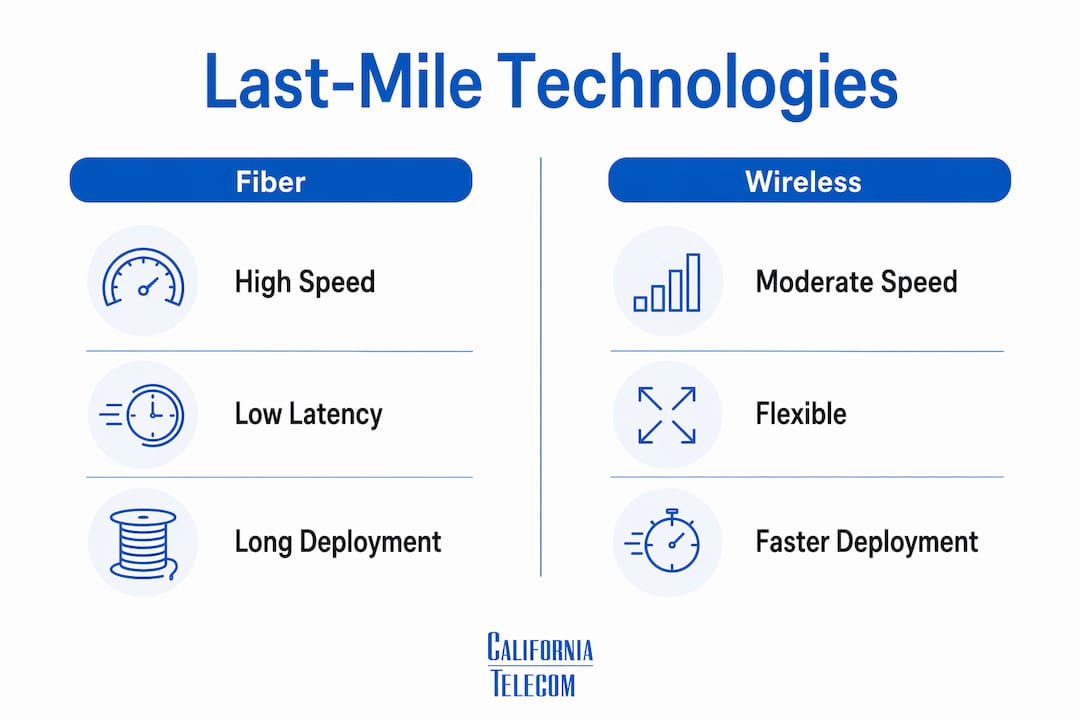
Fiber delivers the highest performance available. Speeds range from 1 Gbps to 10 Gbps or more, with latency as low as 1–5 ms. Fiber suits headquarters, data centers, and high-density office locations where performance is non-negotiable. The trade-off is time. Fiber installations require civil works, trenching, and carrier coordination, pushing deployment timelines to 6–18 months in many markets.

Fixed Wireless Access fills the gap where fiber is too slow or too expensive to deploy. FWA delivers 300 Mbps to 1.4 Gbps at 8–25 ms latency and can be operational within days, not months. Industrial zones, suburban branches, and temporary sites benefit most from this technology. FWA is not a fiber replacement. It is a commercially superior option where fiber rollout is cost prohibitive or the timeline is unacceptable.
Satellite has moved well beyond its backup role. Modern low-earth-orbit satellite services now deliver 50–200 Mbps at 20–50 ms latency with global reach, making them viable as a primary or tertiary layer for remote and mobile sites where fiber and wireless are impractical.
| Technology | Typical Speed | Latency | Deployment Time | Best Use Case |
|---|---|---|---|---|
| Fiber | 1–10 Gbps+ | 1–5 ms | 6–18 months | HQ, data centers, dense offices |
| Fixed Wireless Access | 300 Mbps–1.4 Gbps | 8–25 ms | 3–14 days | Branches, industrial sites, rapid deployments |
| Satellite | 50–200 Mbps | 20–50 ms | Days to weeks | Remote sites, mobile operations, backup paths |
Pro Tip: Never evaluate last-mile technology in isolation. Match the technology to the site profile: fiber for permanence and volume, FWA for speed and flexibility, satellite for reach and redundancy.
How does last-mile connectivity shape multi-site network architecture?
The last-mile technology you choose at each site directly shapes your overall network topology. Multi-site networks use three primary topologies: hub-and-spoke, full mesh, and partial mesh. Each balances redundancy, cost, and management complexity differently.
In a hub-and-spoke design, branch sites connect to a central hub, typically a headquarters or data center. Traffic flows through the hub, which simplifies management but creates a single point of failure. Full mesh connects every site directly to every other site, maximizing resilience but increasing cost and complexity significantly. Partial mesh sits between the two, connecting critical sites directly while routing lower-priority locations through the hub.
The last-mile link at each node determines what topology is even possible. A branch running on satellite with 50 Mbps throughput cannot carry the same mesh traffic load as a fiber-connected site. This is why technology-agnostic planning matters. Tailoring the connection type to each site's role in the topology produces better outcomes than forcing a single technology across all locations.
Security is the other dimension that last-mile choices affect directly. Unmanaged connections, where each site procures its own internet link independently, create what network architects call "network sprawl." Sprawl means inconsistent firewall policies, fragmented visibility, and gaps that attackers exploit. Unified environments with consistent policies across all sites eliminate this risk and give IT teams a single view of network health.
Pro Tip: Map your site roles before selecting topology. A distribution center that processes real-time inventory data needs a different architecture than a satellite office with ten employees on video calls.
What operational factors should business leaders plan for?
Operational planning for last-mile connectivity comes down to four practical considerations: time-to-service, redundancy design, cost versus performance trade-offs, and path diversity.
-
Time-to-service. The gap between fiber and wireless deployment timelines is not a minor inconvenience. Fiber can take 6–18 months to install, while FWA goes live in 3–14 days. For a business opening a new branch or recovering from a site failure, that gap is the difference between operating and waiting. Build FWA or satellite into your site-launch playbook as the day-one connection, with fiber following when the civil works complete.
-
Redundancy design. Single-link sites fail. Every business-critical location needs at least two independent last-mile paths on diverse physical routes. A fiber primary with FWA backup covers most failure scenarios. Adding satellite as a tertiary layer addresses the rare but costly events where both primary and secondary links fail simultaneously.
-
Cost versus performance trade-offs. Fiber carries the highest monthly cost and the longest lead time. FWA costs less and deploys faster but has lower peak throughput. Satellite costs vary widely depending on the service tier. The right answer is not the cheapest option or the fastest option. It is the option that matches the site's traffic profile and criticality to the business.
-
Path diversity. Two links from the same carrier running through the same physical conduit are not redundant. True path diversity means different carriers, different physical routes, and ideally different technology types. A hybrid connectivity stack combining fiber, FWA, and satellite delivers this diversity and adapts to site-specific constraints that no single technology can address alone.
Connecting last-mile planning to broader business growth strategy is not optional for multi-site operators. Network capacity decisions made today constrain or enable the sites you open in the next three years.
How can organizations improve last-mile access and network reliability?
Improving last-mile access is not a one-time project. It is an ongoing architecture discipline. The organizations that get it right follow a consistent set of practices.
-
Blend technologies by site profile. Assign fiber to high-volume, permanent locations. Deploy FWA at branches where speed-to-service matters more than peak throughput. Use satellite as a resilience layer at remote or temporary sites. This approach, described in hybrid connectivity strategies, mitigates risk and adapts to constraints that a single-technology approach cannot handle.
-
Centralize network monitoring. Distributed sites managed through separate portals and separate carrier relationships produce blind spots. A centralized network operations platform gives IT teams real-time visibility across every site, every link, and every performance metric. Problems surface before they become outages.
-
Demand strong SLAs. A 99.99% uptime SLA on data and 99.999% on voice sets a measurable standard. Carriers and managed service providers that cannot commit to these figures in writing are not appropriate partners for business-critical sites.
-
Align upgrades with digital transformation goals. Last-mile upgrades that happen in isolation from application migration, cloud adoption, or AI deployment create mismatches between network capacity and business demand. Treat connectivity as a strategic architecture component, not a commodity purchase, and plan upgrades in parallel with the workloads they will carry.
Pro Tip: When evaluating managed network partners, ask specifically how they handle the time-to-service gap at new sites. A provider with FWA in their toolkit can have a branch connected in days. A provider without it will tell you to wait for fiber.
Integrating new connectivity technologies into an existing multi-site network requires a clear change management process, not just a technical upgrade plan.
Key Takeaways
Last-mile connectivity is the single most consequential infrastructure decision for multi-site businesses, because every application, voice call, and data transfer depends on the quality of that final physical link.
| Point | Details |
|---|---|
| Last-mile defined | The local loop is the final physical segment connecting each business site to the core network. |
| Technology match matters | Fiber suits high-volume permanent sites; FWA suits branches needing fast deployment; satellite covers remote and backup needs. |
| Topology follows technology | The last-mile link at each site determines which network topology is viable and how resilient the overall architecture can be. |
| Redundancy requires diversity | True redundancy means different carriers, different physical routes, and different technology types at each critical site. |
| SLAs set the standard | Demand 99.99% uptime on data and 99.999% on voice from any managed network partner before signing a contract. |
What I've learned from watching businesses get last-mile wrong
The most common mistake I see multi-site operators make is treating last-mile connectivity as a procurement decision rather than an architecture decision. They ask "what is the cheapest fiber option in this market?" instead of "what does this site need to function reliably within our broader network?" Those are fundamentally different questions, and they produce fundamentally different outcomes.
The second mistake is underestimating the time-to-service problem. I have watched businesses plan a branch opening around a fiber installation date, only to push the launch back three months because the carrier missed the civil works window. FWA exists precisely to solve this problem. A branch that goes live on FWA day one and migrates to fiber six months later loses nothing and gains everything in terms of operational continuity.
The third mistake is building redundancy on paper without verifying path diversity in practice. Two fiber links from the same carrier often share the same physical conduit for the last mile into the building. When that conduit is cut, both links fail simultaneously. Real redundancy requires deliberate design, not just a second contract.
The businesses that get last-mile right treat connectivity as a layered architecture problem. They assign technologies to sites based on role, traffic profile, and criticality. They centralize monitoring so problems surface before they become outages. And they work with partners who can execute across fiber, FWA, and satellite without requiring the business to manage three separate vendor relationships. That last point matters more than most decision-makers realize until they have lived through the alternative.
— Jim
How Californiatelecom supports multi-site last-mile connectivity
Multi-site businesses that need reliable, well-designed last-mile connectivity across dozens or hundreds of locations face a coordination problem as much as a technology problem.Californiatelecom solves both. Headquartered in Chino, CA, Californiatelecom sources from 50+ carriers and designs each site through its own engineers, deploying fiber, FWA, and satellite solutions matched to each location's specific needs. Every service is backed by a 24/7 U.S.-based NOC, a 99.99% uptime SLA on data, and 99.999% on voice. Business leaders work with one provider, one bill, and one engineer's contact instead of managing a fragmented carrier stack. Explore nationwide managed network services or request a free consultation to see how a purpose-built multi-site network changes what your business can do.
FAQ
What is last-mile connectivity in simple terms?
Last-mile connectivity is the final physical link between a business location and the broader telecommunications network. It carries all internet, voice, and data traffic in and out of that site.
What are the main last-mile connectivity technologies for businesses?
The three primary technologies are fiber, Fixed Wireless Access, and satellite. Fiber delivers the highest performance; FWA deploys fastest; satellite reaches locations where the other two are unavailable.
How long does last-mile connectivity take to deploy?
Fiber installations typically take 6–18 months due to civil works requirements. Fixed Wireless Access can be operational in 3–14 days, making it the preferred option for rapid site launches.
Why does last-mile connectivity matter for multi-site businesses?
Multi-site connectivity enables resource sharing and application access across all locations as if they share a single local network. Poor last-mile links at any site break that unified experience and create security and performance gaps.
What is a hybrid last-mile connectivity stack?
A hybrid stack combines fiber, FWA, and satellite at a single site or across a portfolio of sites to maximize availability and address multiple failure modes. This layered approach is the standard for business-critical multi-site networks in 2026.