

California CPUC Telecom Regulations Guide for ProvidersCalifornia's Public Utilities Commission sets some of the most detailed telecommunications compliance requirements in the country. Every provider operating in the state, whether a facilities-based carrier, a switchless reseller, a wireless company, or a VoIP service, must navigate a specific set of application processes, service quality standards, consumer protection rules, and ongoing reporting obligations before and after launching service.
Here is what the California CPUC telecom regulations framework requires at a glance:
- Operating authority: Providers must obtain either a Certificate of Public Convenience and Necessity (CPCN) under Public Utilities Code §1001 or register under PU Code §1013 before offering service.
- Consumer protections: General Order 168 mandates a consumer bill of rights covering disclosure, billing practices, slamming prevention, and dispute resolution for all CPUC-regulated carriers.
- Service quality: General Order 133-D establishes minimum standards for installation intervals, trouble reports, out-of-service repairs, and answer times, with automatic fines for chronic failures.
- Outage reporting: All certificated and registered carriers must submit Major Service Interruption (MSI) reports whenever an outage meets FCC Network Outage Reporting System (NORS) thresholds.
- Financial thresholds: Applicants must demonstrate at least $25,000 in liquid assets for non-facilities-based providers or $100,000 for facilities-based carriers.
- Tariff filing: Most telephone corporations must file tariffs annually by February 15 unless they qualify for an exemption.
- Scope: CPUC jurisdiction covers wireline, wireless, and interconnected VoIP providers, treating all as telephone corporations under California law.
How does the California CPUC telecom regulations guide apply to your application?
Getting authorized to operate in California starts with one decision: CPCN or registration. The answer depends on whether you own facilities and whether you are already providing voice service in the state.
1. CPCN application under Public Utilities Code §1001
The CPCN process applies to facilities-based providers and to any applicant already offering voice services in California. The CPUC CPCN application form covers seven core areas: service type, proposed facilities, geographic scope, financial qualifications, managerial and technical expertise, environmental review, and performance bond compliance.
Applicants must specify the service type, choosing among Competitive Local Exchange Service, Interexchange Service, or Fixed Interconnected VoIP, and indicate whether they are facilities-based or switchless resellers. Geographic scope requires attaching maps and lists of ILEC territories where service is planned. Providers seeking to operate in Small Incumbent Local Exchange Carrier territories face additional requirements under Appendix A of Decision 20-08-011.
2. Financial qualification thresholds
Financial requirements differ by provider type. Switchless resellers and non-facilities-based applicants must show a minimum of $25,000 in reasonably liquid assets available for first-year expenses. Facilities-based applicants, both full and limited, must demonstrate $100,000 in liquid assets. Alternatively, an applicant with profitable interstate operations may demonstrate sufficient cash flow in lieu of the liquid asset requirement.

3. Managerial and technical expertise attestation
Every applicant must attest that it has the managerial and technical expertise to operate the type of service indicated. The attestation requires disclosing whether any officer, director, partner, or owner of more than 10% of the company has been investigated by the FCC or any law enforcement or regulatory agency. Any "Not True" response disqualifies the applicant from using the 1013 registration process and requires the full CPCN route. Applicants must also attach resumes and organizational details for all key personnel.
4. Sworn affidavit requirements
The application requires a sworn affidavit declaring that no officer, director, partner, or significant owner has a history of bankruptcy, fraud findings, felony convictions, criminal referrals, or prior telecom license revocations. This affidavit is signed under penalty of perjury under California law. Any exception must be disclosed with full documentation attached as an appendix.
5. Performance bond compliance
Upon approval, all CPCN holders and 1013 registrants must comply with CPUC performance bond requirements as established in Decisions 10-09-017, 11-09-026, 13-05-035, and 24-11-003. The bond requirement protects consumers and the state in the event a provider ceases operations or fails to meet its obligations.
6. 1013 Registration for non-facilities-based providers
Providers that do not own facilities and have not yet begun offering voice services in California may use the 1013 Registration process under PU Code §1013. This path is faster and less document-intensive than a full CPCN application. The critical restriction: if you are already providing voice services in California, you cannot use this form. The 1013 form states this explicitly and directs those applicants to the CPCN process under §1001.
7. Wireless ID and Nomadic registrations
Wireless providers and nomadic VoIP providers have distinct registration categories. Wireless ID registration applies to carriers providing mobile wireless service in California. Nomadic registration covers providers whose customers may use the service from multiple locations, which is common for over-the-top VoIP services. Both categories still require sworn affidavits, financial attestations, and performance bond compliance.
8. Tariff filing or exemption election
The CPCN application form includes a section where applicants elect whether they are eligible for and seek an exemption from tariff filing requirements. Providers that are not exempt must attach a draft initial tariff as Appendix L. This election has long-term compliance implications, since non-exempt carriers must file updated tariffs annually.
What does General Order 168 require from California telecom providers?
General Order 168 is the CPUC's comprehensive consumer protection framework for all Commission-regulated telecommunications utilities. It applies to wireline and wireless carriers alike, and its rules cover the full customer lifecycle from marketing through service termination.
The core obligations under GO 168 include:
- Carrier disclosure (Rule 1): Carriers with annual gross intrastate revenues above the threshold set in PU Code §435(c) must publish and maintain current California tariffs and pending tariff changes on a publicly accessible website, free of charge.
- Marketing practices (Rule 2): All marketing must be accurate and not misleading. Carriers may not make false or deceptive representations about rates, terms, or service quality.
- Service initiation and changes (Rule 3): Providers must clearly disclose all terms before initiating service and must notify customers of any material changes to rates or conditions.
- Billing (Rule 6): Bills must be clear, itemized, and accurate. Charges for non-communications-related products and services require explicit customer authorization before appearing on a telephone bill.
- Slamming prevention: The CPUC handles both interstate and intrastate unauthorized carrier change complaints. Carriers are prohibited from switching a customer's service without verified authorization.
- Billing disputes (Rule 11): Carriers must have a process for investigating and resolving billing disputes promptly. Customers may not have service terminated while a bona fide dispute is pending.
- Service termination (Rule 9): Termination requires advance notice and must follow specific procedural steps. Carriers cannot terminate service for disputed amounts.
- Emergency 911 service (Rule 15): All carriers must maintain access to emergency services and comply with E911 obligations.
- Agent accountability: Acts of an agent on behalf of a carrier are treated as acts of the carrier. A provider cannot escape liability by pointing to a third-party sales representative.
"Each carrier shall observe these rules when dealing with the public, including small businesses. Acts of an agent on behalf of a carrier are considered acts of the carrier for purposes of these rules." — General Order 168, Part 2, Section A
GO 168 also governs billing for non-communications-related charges under Part 4. Any carrier that opens its billing platform to third-party charges must obtain affirmative customer authorization, provide clear disclosure, and give customers a straightforward way to dispute or remove those charges. This provision became effective july 1, 2001, and remains fully in force.
Pro Tip: Review your agent and third-party vendor contracts specifically for GO 168 compliance. If a sales agent slams a customer or places unauthorized charges, the CPUC holds your company responsible, not the agent.
How do GO 133-D service quality standards affect your operations?
General Order 133-D, adopted in Decision 16-08-021 and corrected in Decision 16-10-019, sets the floor for service quality across California's telephone corporations. The CPUC service quality page outlines which carriers must comply and what metrics they must hit.
GO 133-D applies to telephone corporations, including ILECs, CLECs with 5,000 or more customers under the Uniform Regulatory Framework, and rural telephone companies under rate-of-return regulation. Facilities-based interconnected VoIP providers are also subject to the Major Service Interruption reporting requirements under the order.
Minimum service quality metrics
| Metric | Standard |
|---|---|
| Installation interval | Basic telephone service installed within 5 business days |
| Installation commitments | Provider meets scheduled installation commitments (excluding customer-caused delays) |
| Customer trouble reports | — |
| Out-of-service repair | Out-of-service repairs completed within 24 hours |
| Answer time | 80% of calls reach a live agent within 60 seconds |
Carriers collect trouble report and out-of-service data monthly and submit it to the CPUC quarterly using prescribed Excel templates. All reports go to telcoservicequality@cpuc.ca.gov.
Enforcement and the chronic failure mechanism
Carriers that miss any standard for two consecutive months must submit a corrective action plan to the CPUC's Communications Division. Missing a standard for three consecutive months triggers chronic failure status and automatic fines. The fine structure scales with the carrier's size, measured by its share of total access lines in California.
A carrier in chronic failure has one alternative to paying the fine: it may propose to invest twice the fine amount into network improvements designed to cure the deficiency. This investment-in-lieu-of-fine mechanism aligns the penalty with actual service improvement rather than just revenue extraction. A recent CPUC resolution approved a major carrier's plan to invest $71 million in fiber deployment to resolve outstanding GO 133-D violations across multiple years, with $9 million specifically in lieu of fines totaling $2,663,100 for 2024 failures.
"A carrier's failure to meet GO 133-D service quality standards limits customers' ability to call 911 and other emergency services and restricts public safety personnel from communicating with each other during emergencies or disasters." — CPUC Resolution T-17880
Major Service Interruption reporting
All certificated and registered carriers, including wireless registrants and entities subject to PU Code §285, must file MSI reports with the CPUC whenever a communications outage meets FCC NORS reporting thresholds. This obligation does not pause during FCC Disaster Information Reporting System (DIRS) activations. Even when the FCC allows carriers to suspend NORS filing during a DIRS event, the CPUC still requires MSI reports. Copies go to both the Communications Division and the Public Advocates Office.
Which CPUC consumer and broadband programs should providers know about?
The CPUC administers several programs that directly affect how providers operate, what they must offer, and what funding they can access. Providers that ignore these programs often miss both compliance obligations and revenue opportunities.
- California LifeLine: A state-subsidized program providing discounted telephone and broadband service to qualifying low-income households. Carriers authorized to provide LifeLine service become subject to GO 133-D service quality standards. Enrollment and billing rules are separate from standard tariff requirements.
- California Teleconnect Fund (CTF): The CTF program provides discounted telecommunications services to qualifying schools, libraries, hospitals, and community organizations. Participating providers must apply for CTF certification and comply with program-specific billing and reporting rules.
- California Advanced Services Fund (CASF): Funds broadband infrastructure deployment in unserved and underserved areas. Providers can apply for grants and loans to build out networks in eligible areas, with ongoing reporting obligations tied to deployment milestones.
- Broadband mapping participation: The CPUC maintains broadband availability data and participates in state and federal mapping efforts. Providers may be required to submit coverage data and respond to challenges to their reported service areas.
- Public participation in proceedings: The CPUC conducts formal rulemaking proceedings, applications reviews, and rate cases that are open to public comment. Providers can file comments, protests, or responses through the CPUC's online docket system.
- Tariff filing requirements: Most telephone corporations must file tariffs annually by february 15. Carriers seeking exemption must obtain prior approval and maintain records demonstrating eligibility. Non-exempt carriers that miss the filing deadline face compliance exposure.
- Universal service surcharges: Interconnected VoIP providers are required under PU Code §285(c) to collect and remit surcharges on California intrastate revenue to fund public purpose programs including LifeLine and CTF.
Understanding California broadband infrastructure policy is increasingly relevant as the CPUC expands its oversight beyond traditional wireline service to cover broadband and wireless providers.
What financial and operational qualifications does the CPUC require?
The CPUC's qualification standards exist to screen out undercapitalized or operationally unfit applicants before they reach customers. These are not formalities.
Financial thresholds in practice
The $25,000 and $100,000 liquid asset requirements are minimums, not targets. A switchless reseller entering a competitive market with exactly $25,000 in liquid assets will struggle to absorb the operational costs of the first year and may face additional hurdles if required to provide deposits to local or interexchange carriers. Applicants with profitable interstate operations can substitute demonstrated cash flow for the liquid asset requirement, but they must document that cash flow with a financial instrument meeting the specifications in Appendix F of Decision 24-11-003.
Facilities-based applicants face the $100,000 threshold because their first-year costs include infrastructure deployment, interconnection agreements, and environmental compliance. The CPUC's financial and managerial attestation checks require complete disclosures. Any omission or misrepresentation can result in disqualification, not just a request for additional information.
Managerial and technical expertise
The expertise attestation is more than a checkbox. Applicants must attach resumes for all officers, directors, partners, and owners of more than 10% of the company. The CPUC reviews these to confirm that the management team has relevant experience operating a telecommunications business. A team with no prior telecom experience will face scrutiny, and the Commission may request additional documentation or impose conditions on the authorization.
Performance bond obligations
Performance bonds protect customers if a carrier exits the market abruptly. The bond amount and structure follow the decisions cited in the application form. Carriers must maintain the bond throughout their operating authority period and notify the CPUC if the bond lapses or is reduced.
Ongoing compliance recordkeeping
Approved carriers must maintain records sufficient to demonstrate compliance with all applicable CPUC rules, including service quality data, billing records, consumer complaint logs, and financial statements. The CPUC's Consumer Protection and Enforcement Division conducts audits and investigations, and carriers that cannot produce records on request face enforcement exposure.
Pro Tip: Build your compliance recordkeeping system before you launch service, not after your first CPUC audit notice arrives. Retroactively reconstructing service quality data or billing records is far more expensive than maintaining them from day one. Tools like structured data logging and quarterly internal audits against GO 133-D metrics catch problems before the CPUC does.
Providers managing network compliance requirements across multiple California locations should treat the CPUC's financial and operational standards as a baseline, not a ceiling.
How does the CPUC enforce telecom regulations and what are the penalties?
The CPUC's enforcement authority over telecommunications providers is broad and backed by statutory penalty powers under Public Utilities Code §2107. Enforcement actions range from informal compliance letters to formal investigations, fines, and license revocations.
Enforcement pathways
The CPUC's Consumer Protection and Enforcement Division (CPED) handles complaints from consumers and initiates investigations based on complaint patterns, audit findings, or referrals from other divisions. When a carrier receives a complaint, it must respond within the timeframes specified in GO 168. Failure to respond or resolve complaints can escalate to a formal investigation.
For service quality violations, the GO 133-D enforcement mechanism is largely automatic. Carriers that miss standards for two consecutive months receive a corrective action plan requirement. Three consecutive months of failure triggers chronic failure status and fines that scale with the carrier's size. The CPUC does not need to initiate a separate proceeding to impose these fines; they accrue under the terms of the general order itself.
Fine structure under GO 133-D
The daily base fine for failing the out-of-service standard is $25,000, scaled by the carrier's share of total California access lines. Fines for customer trouble report and answer time failures escalate based on consecutive months of non-compliance, starting at zero for the first two months and increasing to $2,000 per day at 12 or more consecutive months of failure. These fines are also scaled by access line share.
Carriers have the option to propose investing twice the fine amount into network improvements rather than paying the penalty. This investment-in-lieu-of-fine path requires submitting a detailed proposal and obtaining CPUC approval. The Commission has found in some cases that the investment-in-lieu mechanism has not been effective in remedying persistent service quality problems, which is part of why the CPUC opened Rulemaking 22-03-016 to consider strengthening the enforcement framework.
License revocation and operating authority suspension
The CPUC can suspend or revoke a carrier's CPCN or registration for serious violations, including fraud, repeated consumer protection violations, or failure to maintain required financial qualifications. A carrier whose operating authority is revoked cannot use the 1013 registration process for any future application and must go through the full CPCN process under §1001.
Referrals and coordination
The CPUC coordinates with the FCC on enforcement matters involving federal rules, including NORS reporting failures and slamming complaints. The Commission also works with the California Attorney General's office on consumer fraud cases. Carriers that violate both state and federal rules can face parallel enforcement actions from both agencies.
What is the typical timeline for CPUC application review and approval?
The CPUC does not publish a single fixed processing time for all telecom applications, but the procedural steps follow a predictable sequence that providers can use to plan their market entry timeline.
1013 Registration timeline
The 1013 registration process is the faster path. Once a complete application is filed, the CPUC Communications Division reviews it for completeness and compliance. If the application is complete and the sworn affidavit and financial attestation are unqualified, registration can be granted without a formal hearing. Providers should expect a review period of several weeks to a few months, depending on application volume and any deficiencies that require supplemental filings.
CPCN application timeline
The CPCN process is longer and more procedurally complex. After filing, the application is noticed in the CPUC's Daily Calendar, which opens a public comment period. Protests or interventions from other parties, including incumbent carriers or consumer advocates, can extend the timeline significantly. Applications that raise no contested issues and qualify for the 21-day expedited CEQA review process move faster than those requiring a full environmental assessment.
Facilities-based applicants proposing new construction must complete the CEQA review before the CPCN can be granted. The expedited 21-day process applies only to projects that qualify for a categorical exemption. Applicants that cannot demonstrate a categorical exemption face a longer environmental review timeline.
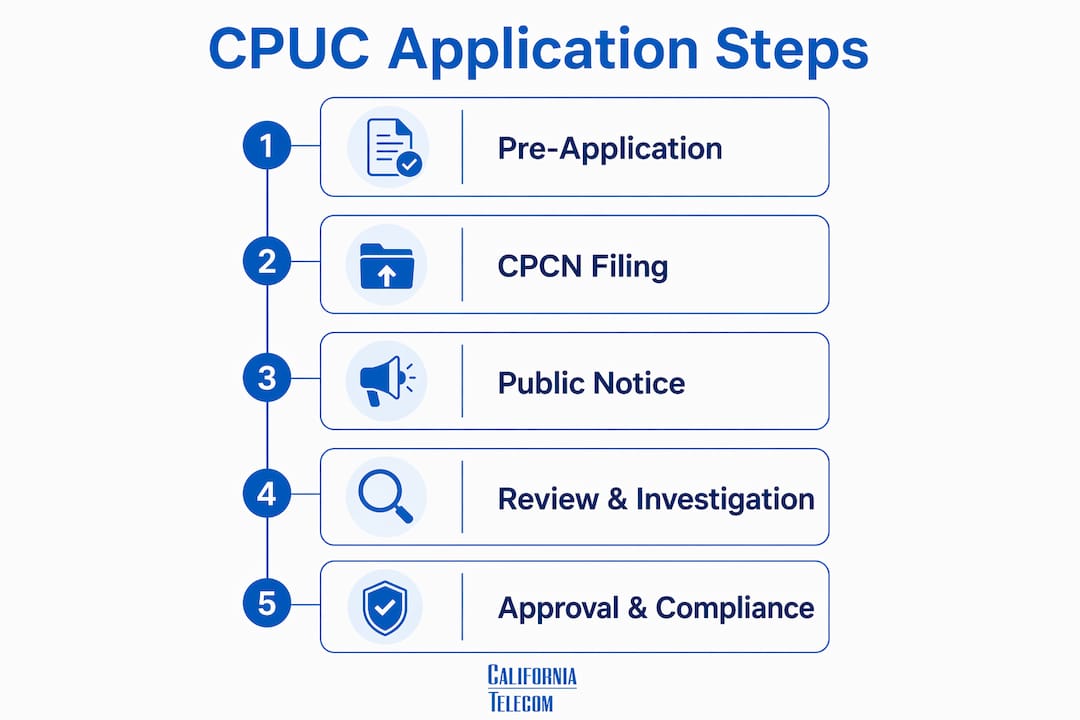
Key procedural steps
- Pre-filing preparation: Gather financial instruments, resumes, maps, and draft tariffs (if required). Confirm that no officer or owner has a disqualifying history.
- Application filing: Submit the completed form with all required appendices to the CPUC Communications Division.
- Completeness review: The Division reviews the filing and may issue a deficiency letter requesting additional information. Responding promptly to deficiency letters is the single biggest factor in controlling your timeline.
- Public notice: The application is published in the CPUC's Daily Calendar. A 20-day protest period follows for CPCN applications.
- CEQA review: Facilities-based applicants undergo environmental review. Expedited 21-day review is available for qualifying projects.
- Commission action: For uncontested applications, the assigned Commissioner or the full Commission issues a decision granting or denying the application.
- Post-approval compliance: Upon approval, the carrier must comply with performance bond requirements and begin meeting all applicable service quality, consumer protection, and reporting obligations.
Pro Tip: File a complete application the first time. Deficiency letters reset your clock and can add months to your timeline. Have legal counsel review the sworn affidavit section carefully before filing, since any "Not True" response on a 1013 form disqualifies you from that process entirely.
What compliance obligations apply specifically to VoIP and broadband providers?
The CPUC's jurisdiction over VoIP and wireless providers as telephone corporations means these technologies are not exempt from California's telecom compliance framework. The Commission confirmed this jurisdiction in its emergency disaster relief rulemaking (R.18-03-011) and has consistently applied consumer protection and network reliability mandates to interconnected VoIP and wireless carriers.
VoIP-specific requirements
Interconnected VoIP providers must register with the CPUC before offering service in California. Fixed interconnected VoIP service is explicitly listed as a service type on both the CPCN application form and the 1013 registration form. VoIP providers that own or control facilities used to provide service, including the line to the end user's location, are treated as facilities-based carriers and must meet the $100,000 liquid asset threshold.
VoIP providers subject to PU Code §285 must submit MSI reports to the CPUC whenever an outage meets FCC NORS thresholds. The administrative burden is minimal because it requires only sending copies of reports already prepared for the FCC's NORS system. The CPUC adopted this requirement specifically because public safety requires monitoring VoIP service reliability, and the incremental effort for carriers is trivial.
VoIP providers must also collect and remit California public purpose program surcharges on intrastate revenue under PU Code §285(c). This includes contributions to LifeLine and CTF. The surcharge obligation applies regardless of whether the VoIP provider has a physical presence in California.
Broadband provider obligations
Broadband-only providers occupy a different regulatory space. The CPUC does not currently regulate broadband internet access service as a telephone corporation service, but broadband providers that also offer voice services are subject to CPUC jurisdiction for those voice components. The CPUC's Rulemaking 22-03-016 is actively considering whether to extend GO 133-D service quality standards to wireless and broadband services, which could significantly expand compliance obligations for providers in those categories.
Broadband providers participating in CASF or other state funding programs take on additional reporting and buildout obligations tied to their grant or loan agreements. These are contractual obligations layered on top of any regulatory requirements.
Wireless carrier obligations
Wireless carriers are telephone corporations under California law and are subject to GO 168 consumer protections, MSI reporting requirements, and E911 obligations. The CPUC confirmed jurisdiction over wireless providers in its emergency disaster relief rulemaking and has applied minimum service and coverage standards for public health and safety purposes. Wireless carriers that receive federal high-cost support or provide LifeLine service are also subject to GO 133-D service quality standards.
Providers managing ISP contracts that include VoIP or wireless components should verify that each service element meets the applicable CPUC registration and compliance requirements.
What reporting and recordkeeping obligations go beyond service quality?
GO 133-D service quality reporting is the most visible compliance obligation, but California telecom providers face a broader set of reporting and recordkeeping requirements that span financial, operational, and consumer protection domains.
Financial reporting
Carriers must maintain financial records demonstrating ongoing compliance with the liquid asset requirements applicable to their authorization type. While the CPUC does not require annual financial statements from all carriers, it can request financial records during an audit or investigation. Carriers that fall below the required financial thresholds after authorization must notify the CPUC and may face conditions or restrictions on their operating authority.
Tariff filing and maintenance
Non-exempt telephone corporations must file tariffs annually by february 15. Tariffs must reflect current rates, terms, and conditions. Any material change to rates or service terms requires a tariff amendment filed in advance of the change, with customer notice as required by GO 168 Rule 8. Carriers that receive a tariff exemption must still maintain records demonstrating their continued eligibility for that exemption.
Outage reporting
MSI reports must be filed with both the CPUC Communications Division and the Public Advocates Office whenever an outage meets FCC NORS thresholds. The CPUC does not accept the FCC's DIRS activation as a reason to skip MSI filing. Carriers must use the prescribed MSI report format and submit notification, initial, final, and withdrawn reports as applicable.
Consumer complaint records
GO 168 requires carriers to maintain records of consumer complaints and their resolution. The CPUC's Consumer Affairs Branch can request complaint data at any time under Rule 13. Carriers must respond to Consumer Affairs Branch requests within the specified timeframes, and failure to respond is itself a violation.
Annual ETC outage reports
Carriers designated as Eligible Telecommunications Carriers must submit annual ETC outage reports in addition to NORS reports. These reports document outage events over the prior year and are part of the carrier's ongoing ETC certification obligations.
Corrective action plan documentation
Carriers that enter corrective action plan status under GO 133-D must maintain detailed records of the actions taken to cure service quality deficiencies. These records support the quarterly progress reports required by the CPUC and are essential if the carrier later seeks to exit chronic failure status. Avoiding common telecom compliance mistakes in recordkeeping is one of the most practical ways to reduce enforcement risk.
How can you participate in CPUC regulatory proceedings?
The CPUC conducts its regulatory work through formal proceedings that are open to participation by carriers, consumer advocates, and the public. Understanding how these proceedings work gives providers both a compliance advantage and an opportunity to shape the rules they will live under.
Types of proceedings
The CPUC uses several proceeding types relevant to telecom providers:
- Rulemakings (R.): Used to adopt or amend general orders and rules. Rulemaking 22-03-016, for example, is currently examining whether to extend GO 133-D standards to wireless and broadband services. Providers with a stake in the outcome should file comments.
- Applications (A.): Individual carrier applications for CPCNs, rate changes, or other authorizations. Other parties can protest or support these applications.
- Investigations (I.): Initiated by the CPUC to examine potential violations or policy issues. Carriers under investigation have the right to respond and present evidence.
- Advice Letters (AL): Used for routine filings like tariff changes, corrective action plans, and investment-in-lieu-of-fine proposals. Advice letters are noticed publicly and subject to protest.
How to participate
The CPUC's online docket management system (eDockets) is the primary platform for filing comments, protests, and responses. Parties must register with the CPUC to file documents electronically. The Commission's Rules of Practice and Procedure govern filing deadlines, service requirements, and the format of submitted documents.
For rulemakings, the assigned Commissioner issues a scoping memo that defines the issues to be addressed and the procedural schedule. Parties can file opening comments, reply comments, and participate in workshops or hearings. The CPUC also holds public participation hearings for proceedings with significant consumer impact, where members of the public can testify without formal party status.
Why participation matters for providers
Carriers that do not participate in rulemakings affecting their service category risk having rules adopted without their input. The CPUC's current rulemaking on GO 133-D amendments, for instance, could extend service quality standards and enforcement mechanisms to wireless and VoIP providers in ways that significantly affect compliance costs. Providers that engage early, file substantive comments, and propose workable alternatives have historically influenced the final shape of CPUC rules.
Filing a protest against a competitor's CPCN application is also a legitimate use of the proceeding process, provided the protest raises genuine regulatory concerns rather than purely competitive objections.
How Californiatelecom supports your compliance and connectivity needs
Navigating CPUC compliance while building and operating a network across multiple California locations is a real operational challenge. Californiatelecom works with multi-location businesses to design, deploy, and manage networks that meet California's regulatory requirements without the overhead of managing multiple carriers and vendors.Californiatelecom sources from 50+ carriers, handles site design and deployment through its own engineers, and backs every service with a 24/7 U.S.-based NOC, a 99.99% uptime SLA on data, and 99.999% on voice. For businesses that need to meet CPUC service quality expectations without building an internal compliance team, that single-provider model removes a significant operational burden. Explore Californiatelecom's managed network services to see how a single provider can handle the complexity of California's telecom environment across every location you operate.
Key Takeaways
California telecom providers must satisfy CPUC application, service quality, consumer protection, and reporting requirements before and after launching service, with financial thresholds, sworn affidavits, and ongoing compliance obligations that vary by provider type.
| Point | Details |
|---|---|
| CPCN vs. 1013 registration | Providers already offering voice service in California must use the CPCN process; the 1013 path is only for those not yet operating. |
| Financial thresholds | Non-facilities-based providers need $25,000 in liquid assets; facilities-based carriers need $100,000. |
| GO 133-D chronic failure | Missing any service quality standard for three consecutive months triggers chronic failure status and automatic fines. |
| Investment-in-lieu option | Carriers in chronic failure can propose investing twice the fine amount into network improvements instead of paying the penalty. |
| VoIP and wireless scope | Interconnected VoIP and wireless providers are telephone corporations under California law and subject to GO 168, MSI reporting, and E911 obligations. |