

SBC Network Explained: What Engineers Need to KnowA Session Border Controller (SBC) is a network element that terminates and re-originates real-time IP sessions at a network boundary, acting as a Back-to-Back User Agent (B2BUA) for SIP traffic. Every SIP INVITE that crosses the border passes through the SBC twice: once inbound, once outbound. That architecture is what gives operators control over security, interoperability, and policy enforcement on voice and video sessions.
Three reasons operators deploy SBCs at network borders:
- Security perimeter: The SBC hides internal topology, enforces access control lists, and absorbs DoS/DDoS floods before they reach the core.
- Interoperability: It normalizes SIP headers, bridges RTP/SRTP, and resolves codec mismatches between incompatible endpoints or vendor stacks.
- Policy and compliance: It enforces call admission control, generates CDRs, and serves as the enforcement point for STIR/SHAKEN caller ID attestation and CALEA lawful intercept hooks.
Standards bodies have shaped SBC behavior from the start. RFC 5853 catalogs the functions operators require from SBCs and flags where those functions conflict with SIP's end-to-end design principles. The IETF draft on SBC functions documents operator motivations and derived requirements for future standardization. 3GPP maps SBC roles to IMS elements like the P-CSCF in LTE and 5G access networks.
Table of Contents
- What does an SBC actually do on the signaling and media planes?
- How SBC deployment models differ: appliance, virtual, cloud, and decomposed
- Which protocols and interoperability problems do SBCs resolve?
- Where does an SBC sit in your network architecture?
- Common SBC use cases across enterprise and carrier networks
- How to evaluate and specify an SBC: a practical checklist
- Key Takeaways
- The part of SBC deployment most teams underestimate
- Californiatelecom's managed voice services include SBC capabilities
- Useful sources and further reading
What does an SBC actually do on the signaling and media planes?
The Wikipedia overview of session border controllers describes SBCs as devices that protect SIP-based VoIP networks by terminating and re-originating sessions to enforce policy and hide topology. That description is accurate but incomplete. The real picture splits across two planes.
Signaling plane functions include perimeter defense, protocol normalization, and traffic management. On the perimeter, the SBC enforces ACLs, rate-limits SIP messages, dynamically blacklists sources showing attack patterns, and hides the internal IP addresses and topology of the network behind it. Protocol normalization means rewriting SIP headers, fixing malformed Contact and Record-Route fields, and resolving incompatibilities between vendor SIP stacks. Traffic management covers call admission control (CAC), per-trunk or per-tenant routing policies, codec enforcement, and CDR generation for billing and forensics.
Media plane functions are where the SBC earns its keep in complex deployments. The SBC anchors RTP and SRTP streams, bridges between encrypted and unencrypted media legs, performs transcoding when endpoints negotiate incompatible codecs, and exposes media forking hooks for lawful intercept and call recording. QoS tagging (DSCP marking) happens here too, so voice packets receive priority treatment across the IP network.
RFC 5853 note: The IETF's catalog of SBC functions explicitly states that many SBC practices conflict with SIP's end-to-end principles, particularly header modification and topology hiding. Operators accept that tradeoff because the operational benefits outweigh the architectural purity argument in most production networks.
The IETF draft on SBC functions goes further, enumerating operator requirements and noting that the label "SBC" covers a wide range of implementations. Two products both called SBCs may share only a subset of functions. That matters when you are writing an RFP.
How SBC deployment models differ: appliance, virtual, cloud, and decomposed
The form factor of an SBC shapes its operational model as much as its feature set does. Four models are in production use today.
- SBCaaS (managed hosted SBC): A carrier or managed provider runs the SBC on your behalf. Verizon's SBCaaS service guide documents this model as a cloud/hosted SBC running on virtual machines. You trade direct hardware control for OPEX pricing, vendor-managed certificate lifecycle, and SLA-backed availability.
Decomposed architectures separate the signaling controller from the media processing function. The signaling plane scales independently from the media plane, which helps carriers handle burst call volumes without over-provisioning transcoding capacity. The tradeoff is added latency when signaling and media functions communicate across a network segment.
Ribbon Communications' glossary notes that virtualized and cloud-native SBC deployments are now common for carrier and UCaaS operators because they enable elastic scale, though they increase the need for orchestration and careful latency planning.
Pro Tip: Match the deployment model to the use case. Enterprise edge SBCs (eSBCs) typically run as appliances or VMs at the customer premises for predictable latency. Service provider access SBCs handle subscriber traffic and benefit from VM-based scale. Peering SBCs at carrier interconnects often run as high-availability appliance pairs or clustered VMs where throughput and redundancy matter more than elasticity.
Which protocols and interoperability problems do SBCs resolve?
SIP is the dominant signaling protocol, but "SIP" in production covers a wide range of dialects. A Cisco Unified Communications Manager, a Avaya PBX, and a cloud UCaaS platform may all speak SIP and still fail to interoperate without an SBC in the path.
The core protocol work an SBC performs:
SIP and SDP normalization. The SBC rewrites Contact headers, fixes broken Record-Route entries, strips or adds headers that downstream systems require, and resolves SDP offer/answer mismatches. SIP identity headers (PAI, P-Asserted-Identity) require careful handling because stripping them breaks STIR/SHAKEN verification downstream.
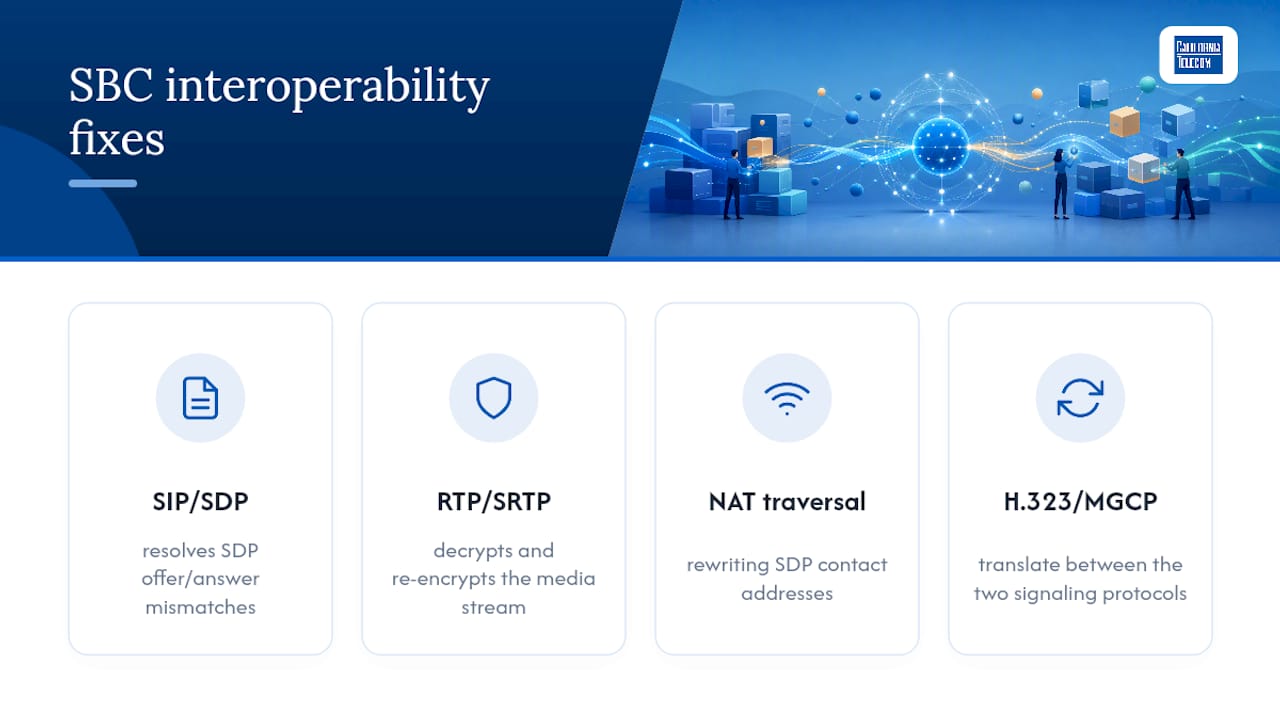
RTP/SRTP bridging. When one leg is encrypted (SRTP) and the other is not (RTP), the SBC decrypts, processes, and re-encrypts the media stream. This is one of the most common interoperability requirements at the enterprise-to-carrier boundary.
NAT traversal. Most enterprise SIP endpoints sit behind NAT. The SBC handles NAT traversal by rewriting SDP contact addresses and acting as a media relay, effectively replacing the ICE/TURN/STUN negotiation that endpoints would otherwise need to perform themselves. In environments where endpoints do support ICE, the SBC can interwork between ICE-capable and non-ICE endpoints.
"The SBC acts as a normalization layer between incompatible SIP implementations, absorbing the differences so that neither endpoint needs to know what the other is running." This is the practical reason SBCs persist in networks that theoretically should not need them.
Legacy H.323 and MGCP endpoints still appear in enterprise networks, particularly in older contact centers and campus PBX environments. SBCs with H.323/SIP interworking translate between the two signaling protocols, letting legacy hardware coexist with modern SIP trunks. For VoIP deployments at ISPs and tech companies, this interworking capability is often what makes a migration feasible without a full rip-and-replace.
Where does an SBC sit in your network architecture?
Placement determines what traffic the SBC sees and what policies it can enforce. Three canonical positions exist.
- Enterprise eSBC: Deployed at the enterprise edge, typically between the internal UC platform (Cisco, Microsoft Teams, Avaya) and the SIP trunk provider. Handles NAT traversal, per-tenant routing, and encryption bridging. For multi-site enterprise deployments, a central eSBC or per-site eSBCs enforce consistent policy across locations.
A simplified SIP INVITE flow through a B2BUA SBC looks like this: the originating endpoint sends INVITE to the SBC's inbound interface. The SBC terminates that dialog, applies policy (CAC check, header normalization, STIR/SHAKEN verification), then re-originates a new INVITE toward the destination on its outbound interface. The two SIP dialogs are independent. RTP is anchored at the SBC unless media release is triggered after call establishment.
Redundancy and scale options include active/standby pairs (failover in seconds), active/active clustering with shared state (sub-second failover), and load balancers distributing SIP traffic across an SBC cluster. Carrier-grade deployments use geographic redundancy across data centers, with DNS-based or anycast routing directing traffic to the nearest healthy SBC node.
Common SBC use cases across enterprise and carrier networks
SBCs appear in more scenarios than most engineers expect when they first encounter the technology.
- SIP trunking: The most common enterprise use case. The eSBC sits between the PBX or UCaaS platform and the SIP trunk provider, handling NAT traversal, authentication, codec negotiation, and per-trunk CAC. For large business VoIP deployments, the eSBC is often the only element that makes a SIP trunk from one provider work with a PBX from another vendor.
- UCaaS peering: Cloud UC platforms (Microsoft Teams Direct Routing, for example) require a certified SBC to connect enterprise SIP trunks to the cloud platform. The SBC handles encryption bridging, per-tenant session isolation, and routing between the PSTN trunk and the cloud platform's SIP interface.
- VoLTE/IMS interconnect: Ericsson documents SBCs as carrier-class, virtualized products securing control and media traffic for LTE/5G IMS environments. In LTE call flows, the access SBC (A-SBC) handles subscriber registration and media security at the IMS access edge, interworking between the UE and the P-CSCF.
- Contact center integration: SBCs provide media forking for call recording, QoS guarantees for agent voice quality, and scaling controls that prevent a traffic spike from overwhelming the contact center platform. Per-agent or per-queue CAC policies are enforced at the SBC.
- Cloud conferencing: SBCs bridge between enterprise SIP infrastructure and cloud conferencing platforms, handling codec normalization (G.711 to Opus is common), SRTP bridging, and per-session bandwidth controls.
For carrier voice services and partner ecosystems, SBCs at the peering layer enforce inter-carrier SLA commitments and provide the CDR data needed for settlement.
How to evaluate and specify an SBC: a practical checklist
Procurement decisions for SBCs fail most often because buyers specify a product name rather than a function list. The IETF's own guidance is to specify features, not rely on the "SBC" label.
Capacity and performance decision table
| Dimension | Enterprise eSBC | Service Provider Access SBC | Peering SBC |
|---|---|---|---|
| Concurrent sessions | Hundreds to low thousands | Tens of thousands | Tens of thousands |
| Transcoding requirement | Often required (codec mismatch) | Selective (subscriber mix) | Rarely required |
| Latency tolerance | — | <10 ms | <5 ms |
| Deployment model | Appliance or VM | VM cluster or cloud-native | Appliance pair or VM cluster |
| HA requirement | Active/standby | Active/active cluster | Active/active, geo-redundant |
Mandatory feature checklist
- B2BUA with full SIP header engine (rewrite, add, strip per policy)
- STIR/SHAKEN signing and verification with automated certificate renewal
- DoS/DDoS mitigation: rate limiting, dynamic blacklisting, challenge-response
- SRTP/TLS support on all interfaces
- Topology hiding and ACL enforcement
- CDR generation with exportable records (RADIUS, syslog, or REST API)
- Media anchoring with configurable media release policies
- Transcoding support (G.711, G.729, Opus at minimum) with capacity licensing
- Lawful intercept (CALEA-compliant media forking)
- Management API (REST or NETCONF) for automated provisioning
Pro Tip: For interoperability testing, use SIPp or Spirent Avalanche to generate realistic SIP/SDP traffic against the SBC before production cutover. Most major SBC vendors maintain interoperability labs; request test results for the specific PBX or UCaaS platform you are connecting. Pay particular attention to SDP offer/answer edge cases and DTMF handling (RFC 2833 vs. SIP INFO) — these are the most common failure points in real deployments.
Operational requirements to verify: call success rate monitoring (target >99.5% for enterprise), MOS scoring or R-factor reporting, jitter and packet loss thresholds per call leg, and logging retention for forensic analysis. High-availability design should be validated with a failover test under load, not just a standby switchover in a lab.
Key Takeaways
An SBC is a B2BUA that terminates and re-originates every SIP session at a network border, giving operators control over security, interoperability, and policy enforcement for all real-time IP traffic.
| Point | Details |
|---|---|
| B2BUA architecture is fundamental | Every SIP dialog terminates at the SBC; two independent legs give operators full control over headers and media. |
| Specify functions, not the label | "SBC" covers dozens of features; RFC 5853 recommends requiring a specific function list in any procurement. |
| Media anchoring vs. latency | Anchoring enables policy and intercept but extends the media path; enable media release where transcoding and intercept are not required. |
| STIR/SHAKEN is an SBC responsibility | SBCs sign outbound and verify inbound SIP INVITE identity headers; certificate expiration is the most common compliance failure. |
| Californiatelecom manages SBC functions end-to-end | Californiatelecom integrates SBC capabilities into managed voice and multi-carrier network services, handling STIR/SHAKEN certificates, 24/7 NOC monitoring, and per-site policy for multi-location businesses. |
The part of SBC deployment most teams underestimate
The technical architecture of an SBC is well-documented. What is less discussed is the operational weight that comes with running one in production.
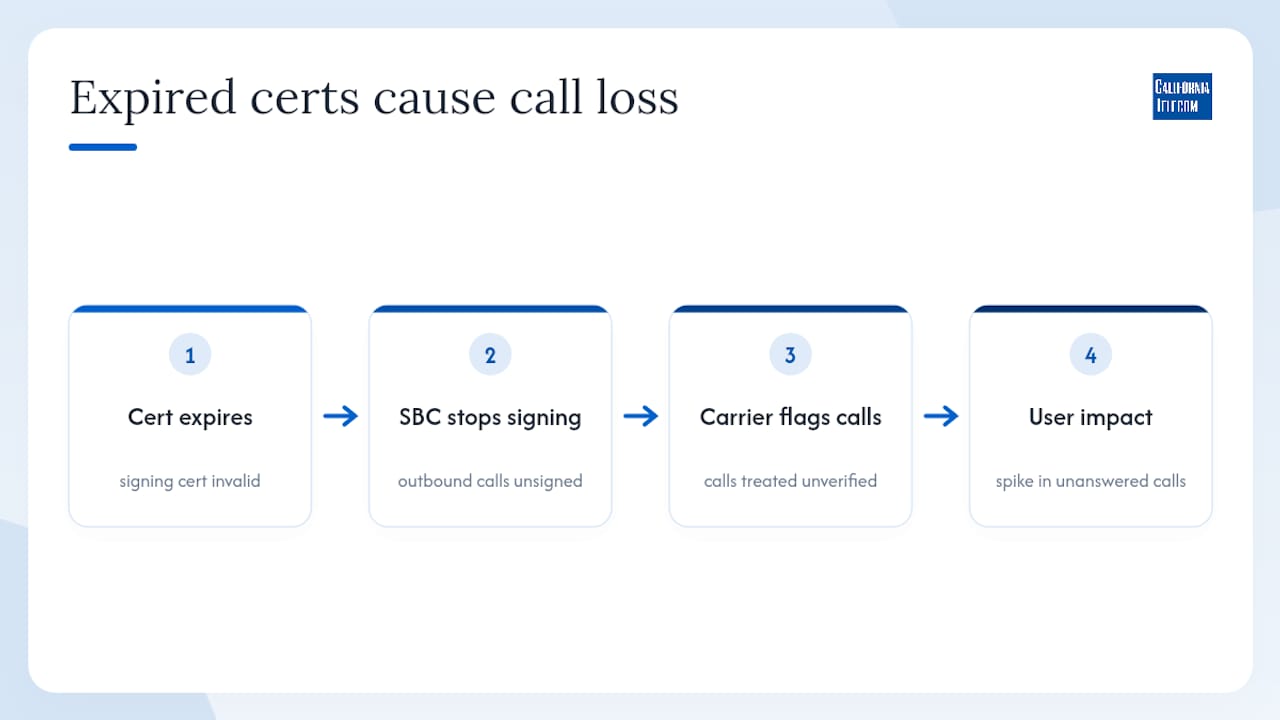
Certificate management for STIR/SHAKEN is a good example. The signing certificate must come from a SHAKEN-authorized CA and has a finite validity period. If it expires, outbound calls either fail verification or go unsigned. Many teams discover this only after a certificate expires unexpectedly. The SBC itself does not care; it just stops signing. The carrier on the other end starts flagging your calls as unverified, and the first symptom is a spike in unanswered calls, not an alarm in the monitoring dashboard.
The same pattern applies to codec licensing, transcoding capacity, and HA failover testing. These are not configuration tasks you do once at deployment. They are ongoing operational disciplines. An SBC that was correctly sized for 500 concurrent sessions two years ago may be running at 90% capacity today because the business added locations or migrated to a new UCaaS platform.
The vendors who sell SBCs are good at documenting features. They are less good at telling you what the operational burden looks like at year two or year three. A managed provider that has run SBCs across dozens of customer environments has seen those failure modes and built processes around them. That institutional knowledge is harder to buy than the hardware.
Californiatelecom's managed voice services include SBC capabilities
Multi-location businesses that need SBC-grade security and interoperability without building an internal SBC operations team have a direct path: Californiatelecom integrates SBC functions into its managed UCaaS and voice services, covering design, deployment, STIR/SHAKEN certificate management, and 24/7 NOC monitoring from a single U.S.-based team.The practical difference from self-managing an SBC: Californiatelecom sources from 50+ carriers, so per-site SIP trunk policy and CAC rules are configured and monitored centrally rather than site by site. The 99.999% voice SLA is backed by active/active redundancy and real-time alerting, not a manual failover checklist. Certificate renewals, codec policy updates, and security patches happen as part of the managed service, not as reactive tickets after something breaks.
For businesses with distributed locations, nationwide managed network services from Californiatelecom mean one provider, one bill, and one engineer's number for the entire voice and data stack. To discuss SBC requirements for your network, contact Californiatelecom for a consultation.
FAQ
What is an SBC and what does it do?
A session border controller is a back-to-back user agent (B2BUA) that terminates and re-originates every SIP session at a network border. That position gives operators control over security, interoperability, and policy enforcement for real-time voice and video traffic, while hiding internal network topology.
What interoperability problems does an SBC solve?
Production “SIP” covers a wide range of dialects. A Cisco Unified Communications Manager, an Avaya PBX, and a cloud UCaaS platform may all speak SIP and still fail to interoperate without an SBC normalizing signaling between them.
What are the SBC deployment models?
Four are in production use: hardware appliance, virtual machine, cloud-hosted, and decomposed (signaling and media split across elements). The form factor shapes the operational model as much as the feature set does.
How should you evaluate an SBC before buying?
Specify functions, not product names — that is the IETF's own guidance. Procurement fails most often when buyers shortlist by the “SBC” label instead of a concrete feature list: session capacity, transcoding needs, SIP header manipulation, and high-availability design.
Useful sources and further reading
The references below are the primary sources for the technical claims in this article. Each one serves a different purpose depending on what you need next.
- RFC 5853 - Requirements from Session Initiation Protocol (SIP) Session Border Control (SBC) Deployments
- draft-ietf-sipping-sbc-funcs
- Session border controller
- What is a Session Border Controller (SBC)? | Ribbon Communications
- Session Border Controllers: A Complete Guide - TelcoBridges
- Session Border Controller - Ericsson
- SESSION BORDER CONTROLLER AS A SERVICE + - Verizon
- 3GPP