

Managed IT's Role in California Business Growth in 2026Managed IT services have become the operational backbone for California small and medium businesses that need predictable costs, continuous security, and compliance coverage they cannot build in-house. Rather than waiting for systems to fail, a managed service provider (MSP) monitors your infrastructure around the clock, patches vulnerabilities before they become incidents, and handles everything from help desk tickets to CCPA audit documentation. The shift from reactive break-fix support to proactive management is the defining difference, and for California SMBs navigating one of the country's most demanding regulatory environments, that shift is no longer optional.
The core functions a managed IT engagement typically covers:
- 24/7 monitoring and alerting across servers, endpoints, and cloud platforms
- Patch management and software updates on a defined schedule, not when someone remembers
- Cybersecurity stack management including endpoint detection, firewalls, and multi-factor authentication
- Help desk support with defined response SLAs so employees stay productive
- Compliance documentation for CCPA, CPRA, and HIPAA, including continuous risk assessments
- Data backup and disaster recovery with tested restore procedures
- Cloud administration for platforms like Microsoft 365 and AWS
- Strategic IT planning through a virtual CIO (vCIO) function aligned to business goals
Businesses that make this shift report 65% less unplanned downtime compared to those still running reactive break-fix support. That figure alone reframes managed IT from a cost line to a productivity investment.
What are the real advantages of managed IT for California SMBs?
The financial case is clearer than most business owners expect. A single fully loaded in-house IT administrator costs a substantial amount annually once you add benefits, tools, training, and the coverage gaps that person leaves on nights and weekends. A managed IT provider covering the same 25-person company typically runs considerably less per year, and you get a team of specialists instead of one generalist. Salary comparisons that ignore benefits, training, and turnover risk consistently understate the true cost of in-house IT.

Cybersecurity depth is where the gap widens most. MSPs integrate recognized frameworks like NIST and CIS Controls into daily operations, creating the layered defense that cyber insurance carriers now require as a condition of coverage. One internal generalist cannot simultaneously be a firewall engineer, a compliance analyst, and a backup specialist. MSPs staff those roles separately, which means your security posture reflects actual expertise rather than whoever had time last Tuesday.
Compliance is the other pressure point specific to California. The CCPA and its expansion under CPRA impose ongoing obligations including data mapping, consumer request management, access logging, and breach notification procedures. HIPAA adds administrative, technical, and physical safeguards for any business touching protected health information. MSPs operationalize these requirements into continuous monitoring and audit-ready documentation, so compliance becomes a system rather than a last-minute scramble before an audit.
Key advantages at a glance:
- Predictable monthly costs replace variable emergency repair bills
- 24/7 coverage without staffing a round-the-clock internal team
- Compliance assurance for CCPA, CPRA, and HIPAA through continuous monitoring
- Cybersecurity frameworks (NIST, CIS Controls) embedded in daily operations
- Scalability by adjusting the service agreement rather than hiring
- Access to specialists across networking, security, cloud, and compliance
Stat to know: SMBs using managed IT report 45% fewer security incidents compared to businesses relying on reactive break-fix support, according to CompTIA's IT Industry Outlook.
Scalability deserves its own mention. Adding a location, onboarding 20 new employees, or migrating to a new cloud platform requires adjusting a service agreement, not posting a job listing. For California businesses growing through acquisition or expansion, that flexibility has real dollar value.
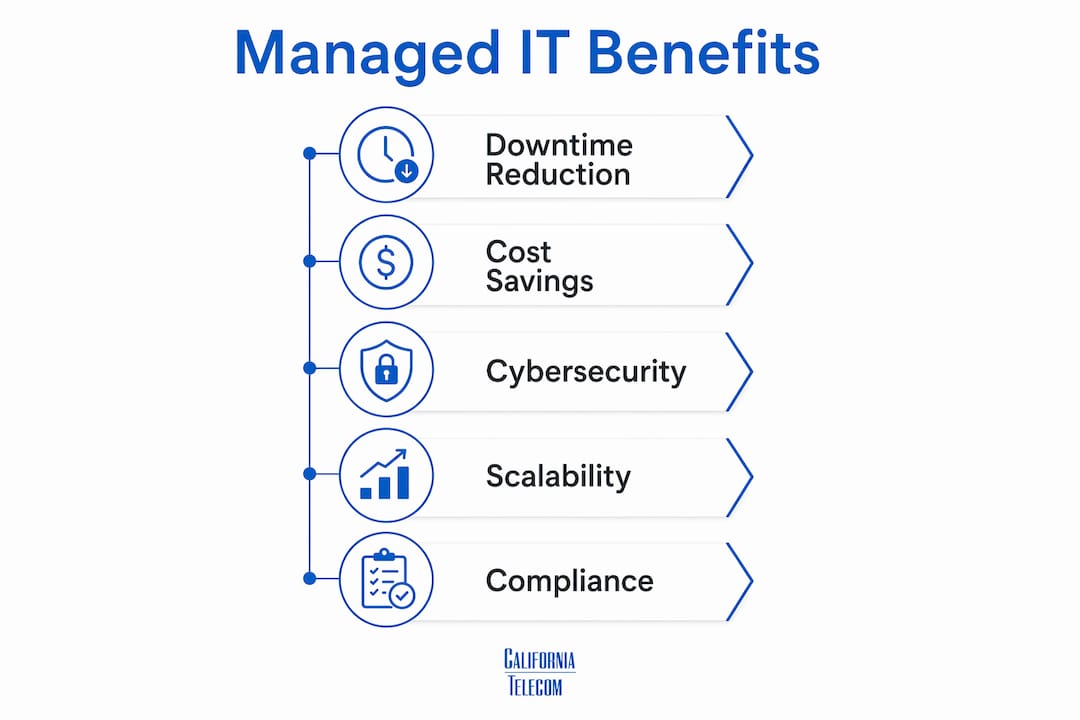
How managed IT improves day-to-day operations for California businesses
Uptime is the most immediate operational benefit. When your MSP monitors systems continuously and resolves warning signs before they cascade into failures, your team works without interruption. The break-fix alternative means your phone call is the alert, which guarantees the problem has already cost you productivity before anyone starts fixing it.

The less obvious benefit is what your internal team stops doing. When IT issues land on the desk of your most tech-savvy employee or, worse, on yours, those hours come directly out of your core business. Outsourcing IT management to specialists frees leadership and staff to focus on customers, revenue, and growth. That reallocation of attention is harder to quantify than downtime reduction, but most business owners feel it within the first quarter of a managed IT engagement.
Technology adoption accelerates, too. Cloud migration, secure remote work infrastructure, and unified communications platforms all require planning, configuration, and ongoing management that most SMBs cannot execute cleanly on their own. An MSP brings the project management and technical depth to run those transitions without disrupting operations.
Operational improvements managed IT delivers:
- Reduced unplanned outages through proactive monitoring and maintenance
- Faster issue resolution because the provider already knows your environment
- Secure remote work configurations for distributed or hybrid teams
- Cloud platform management for Microsoft 365, AWS, and similar services
- Employee productivity protected by fast help desk response times
- Technology roadmap planning aligned to business objectives
A California professional services firm with 60 employees, for example, might spend months struggling with inconsistent VPN performance and a patchwork of security tools no one fully manages. After moving to a managed IT model, the firm gets a unified security stack, a monitored network, and a help desk that resolves tickets in under two hours. The IT lead, previously buried in password resets, shifts to managing vendor relationships and planning the firm's next office expansion. That is the operational shift managed IT actually produces.
What IT challenges are unique to California small and medium businesses?
California's regulatory environment is genuinely more demanding than most states. The CCPA, expanded by CPRA, applies to a broad range of businesses, not just large tech companies, and violations carry financial penalties plus reputational damage that small businesses cannot absorb easily. HIPAA adds another compliance layer for healthcare-adjacent firms, covering everything from dental practices to health tech startups. Maintaining continuous audit readiness through documented risk assessments and evidence tracking is an ongoing operational requirement, not a one-time project.
The cybersecurity threat environment compounds the compliance burden. Security incidents tied to skills shortages affected 88% of organizations in a recent study, a figure that reflects exactly the position most California SMBs find themselves in. One internal generalist cannot cover the full scope of modern IT security, and burning that person out trying is how businesses end up with deferred patches, missed alerts, and a breach that costs far more than a managed IT contract ever would.
Building in-house IT depth is expensive and slow. Recruiting, onboarding, and retaining IT specialists in California's labor market is a real cost and a real risk. When that person leaves, the institutional knowledge walks out with them. Coverage gaps during vacations, illness, and turnover are not edge cases; they are predictable events that most SMBs handle badly.
Specific challenges California SMBs face:
- CCPA and CPRA compliance requiring ongoing data mapping, access controls, and breach response procedures
- HIPAA obligations for healthcare and health-adjacent businesses covering technical and administrative safeguards
- Cybersecurity threat exposure that outpaces what a single generalist can address
- Audit documentation gaps when compliance evidence is not continuously maintained
- Coverage gaps from key-person dependency in small internal IT teams
- Cost and complexity of recruiting and retaining specialized IT talent in California
The co-managed IT model addresses a specific version of this challenge. For businesses with moderate-sized IT teams, co-managed IT keeps internal institutional knowledge while adding 24/7 monitoring, security operations, and after-hours coverage the internal team cannot provide alone. Nobody gets replaced; the internal team gets the backup it actually needs.
Pro Tip: If your IT lead is constantly underwater with help desk tickets and security tasks keep getting deferred, that is a capacity problem, not a competence problem. Co-managed IT solves it without a second full-time hire.
How Californiatelecom's managed network services support California businesses
Californiatelecom operates from Chino, CA, and delivers managed network services to multi-location businesses across California and nationwide. The model is built around a single point of accountability: one provider, one bill, and one engineer's direct number, rather than the vendor-juggling that typically consumes IT and operations staff at growing companies.
The technical foundation is built on sourcing from 50+ carriers, which means Californiatelecom designs each site's connectivity around the best available options rather than pushing a single carrier's product. Every deployment goes through Californiatelecom's own engineers, not a third-party subcontractor, and the network is backed by a 24/7 U.S.-based Network Operations Center (NOC).
| Service element | Californiatelecom specification |
|---|---|
| Data uptime SLA | 99.99% |
| Voice uptime SLA | 99.999% |
| Monitoring | 24/7 U.S.-based NOC |
| Carrier sourcing | 50+ carriers |
| Deployment model | In-house engineers |
| Billing | Single provider, single invoice |
For California businesses with compliance obligations, the single-provider model has a specific advantage: documentation and accountability are consolidated. When a CCPA or HIPAA audit requires evidence of network controls, access logging, or incident response procedures, there is one place to go rather than assembling records from three different vendors. Californiatelecom's managed services also support unified communications through UCaaS and hosted PBX solutions, giving businesses voice reliability at 99.999% uptime alongside their data infrastructure.
The operational drag of managing a distributed network is one of the most underappreciated costs in multi-location businesses. Each site that runs on a different carrier, with different support contacts and different billing cycles, multiplies the administrative burden on internal staff. Californiatelecom's approach collapses that complexity into a single managed relationship, which frees internal teams to focus on business operations rather than network troubleshooting.
For California businesses expanding to multiple locations, Californiatelecom's nationwide managed network coverage means the same engineering standards and SLA commitments follow each new site, rather than requiring a new vendor search every time the business grows.
Should you choose managed IT or build an in-house IT team?
The honest answer depends on headcount, compliance load, and how much of IT you actually want to own. For most California businesses under 100 employees, managed IT delivers more capability per dollar than an equivalent in-house investment, because the comparison is between one generalist and a team of specialists, not between two equivalent options.
In-house IT has real advantages: deeper organizational context, dedicated focus, and stronger cultural integration. A long-tenured internal IT person knows your systems, your quirks, and your staff in ways a new MSP relationship takes time to replicate. That institutional knowledge has genuine value, which is exactly why the co-managed model often outperforms both extremes for mid-sized businesses.
The risk argument for in-house IT is frequently overstated. Well-structured managed IT contracts include SLAs, escalation paths, and accountability mechanisms that provide meaningful control over service delivery. Internal IT staff also vary in accountability and performance. Control is a function of contract structure and management, not just employment status.
Where the math clearly favors managed IT:
- Under 50 users: One in-house hire cannot match a full team's coverage or specialization, and two hires cost more than most managed contracts
- 50–200 users with existing IT staff: Co-managed IT keeps institutional knowledge and adds the coverage and specialization the internal team lacks
- Compliance-heavy environments: MSPs with CCPA, CPRA, and HIPAA expertise reduce audit risk that generalist staff cannot address alone
- Growing businesses: Adding users or locations adjusts a service agreement rather than triggering a hiring cycle
The full cost of in-house IT for a 20–50 user organization runs $210,000–$245,000 annually for two fully loaded employees, against $60,000–$120,000 for a comparable managed IT engagement. At that comparison, the financial case for managed IT at the SMB scale is straightforward.
What should you look for when choosing a managed IT provider in California?
The wrong MSP creates as many problems as it solves. A provider that lacks California-specific compliance expertise will leave gaps in your CCPA and HIPAA posture that you will not discover until an audit or a breach. The selection criteria that actually matter:
Compliance experience in California. Ask specifically about CCPA, CPRA, and HIPAA implementations. Request examples of how they maintain audit-ready documentation for clients. A provider that cannot answer those questions in detail is not the right partner for a California business.
Documented SLA performance. Ask for SLA adherence reports, not verbal commitments. A 99.99% uptime SLA means nothing if the provider cannot show historical performance against it.
Security framework alignment. Confirm the provider integrates NIST or CIS Controls into their standard service, not as an add-on. Cyber insurance carriers increasingly require evidence of framework alignment, and your MSP should be able to provide it.
24/7 coverage with a U.S.-based team. After-hours incidents do not wait for business hours. A provider with a U.S.-based NOC and defined escalation procedures for nights and weekends is a materially different offering from one that relies on a ticketing system and a callback.
Co-managed flexibility. If you have existing IT staff, confirm the provider can work alongside them rather than requiring a full replacement. The best MSPs treat co-managed arrangements as a standard offering, not an exception.
Single-provider accountability. Providers that consolidate network, security, voice, and cloud management under one agreement reduce the coordination overhead that fragments accountability across multiple vendors.
For multi-location California businesses, Californiatelecom's professional services network solutions offer a concrete example of what single-provider accountability looks like in practice: one engineering team, one NOC, and one contract covering connectivity and voice across every site.
What trends are shaping managed IT adoption in California in 2026?
Co-managed IT is the fastest-growing arrangement in 2026, driven by the specific pain of internal IT teams that are capable but stretched too thin to cover security operations, compliance documentation, and after-hours monitoring simultaneously. The model has moved from niche to mainstream because it solves a real problem without requiring businesses to replace people they value.
AI integration is entering managed IT service delivery in ways that are practical rather than theoretical. Tools that flag anomalous network behavior, automate patch prioritization, and generate compliance evidence are now part of standard MSP tooling. For California businesses evaluating how AI fits into their operations, platforms like ControlRoom AI illustrate how AI-driven project management can complement the operational efficiency that managed IT delivers at the infrastructure level.
Cyber insurance requirements are tightening, and MSPs are increasingly positioned as the mechanism through which SMBs meet those requirements. Carriers now ask for evidence of 24/7 monitoring, endpoint detection and response tools, multi-factor authentication, and documented incident response plans. Businesses without a managed IT partner often cannot produce that evidence, which affects both their insurability and their premiums.
California's regulatory environment continues to evolve. CPRA enforcement has added teeth to CCPA obligations, and sector-specific requirements in healthcare, finance, and legal services are not getting simpler. The businesses that treat compliance as a continuous operational system rather than an annual checkbox are the ones that avoid penalties and maintain customer trust.
Is managed IT worth it for your California business?
Managed IT services are worth it for any California business where technology downtime, a security incident, or a compliance failure would materially hurt operations or revenue. That covers most SMBs operating in the state today.
The calculation is not complicated. Compare the fully loaded cost of the IT coverage you actually need against what a managed IT engagement costs for your user count. Factor in the compliance risk you carry without continuous monitoring and documentation. Add the productivity cost of downtime and the reputational cost of a breach. At that honest comparison, managed IT typically wins for businesses under 150 users, and the co-managed model extends that advantage further up the size range.
The businesses that get the most from managed IT are the ones that treat their MSP as a technology partner rather than a vendor. That means sharing business goals, involving the provider in planning decisions, and using the vCIO function to align IT spending with growth objectives. The managed IT relationship that produces the best outcomes is the one where the provider understands where the business is going, not just what the network looks like today.
Key Takeaways
Managed IT services give California SMBs the compliance coverage, security depth, and operational reliability that in-house teams at this scale cannot match alone.
| Point | Details |
|---|---|
| Downtime reduction | Businesses using managed IT report 65% less unplanned downtime versus reactive break-fix support. |
| Cost advantage | — |
| Compliance coverage | MSPs operationalize CCPA, CPRA, and HIPAA into continuous monitoring and audit-ready documentation. |
| Security framework | MSPs embed NIST and CIS Controls into daily operations, meeting cyber insurance requirements. |
| Californiatelecom SLA | Californiatelecom backs data services with a 99.99% uptime SLA and voice with 99.999%, supported by a 24/7 U.S.-based NOC. |
Ready to see what managed IT looks like for your California business?
Californiatelecom designs and deploys managed network services for California businesses that need reliable connectivity, compliance-ready infrastructure, and a single point of accountability across every location. With 50+ carrier relationships, in-house engineers, and a 24/7 U.S.-based NOC, the team builds networks that perform at the SLA level your business actually requires.Whether you are running a single office in Los Angeles or managing multiple sites across the state, Californiatelecom's managed network services give you the coverage, documentation, and uptime guarantees that California's regulatory environment demands. Talk to an engineer about your current setup and where the gaps are.
Recommended
- California Telecom | Internet, Voice & Managed Services
- Managed network guide for California multi-location IT | California Telecom
- California Business Internet Provider Options in 2026 | California Telecom
- Why California broadband infrastructure matters for multi-location enterprises | California Telecom