

How Outsourced Network Services Cut Your IT BudgetOutsourcing network services will reduce and stabilize your IT budget in most cases, with industry sources reporting typical operating-cost reductions reported in the low double digits for organizations moving from in-house networking to managed models. Payback windows often land within about a year once you factor in downtime avoidance and staffing changes. That said, three conditions determine whether you land at the high or low end of that range:
- Scale: Multi-site organizations with five or more locations see the strongest savings because provider economies of scale outpace what any single IT team can negotiate with carriers.
- Service scope: Bundling connectivity, monitoring, and voice under one contract unlocks the biggest labor and vendor-management savings. Narrow out-tasking (just circuit management, for example) produces narrower results.
- SLA targets: High-availability requirements (99.99% uptime and above) carry premium pricing. Validate whether your business actually needs five-nines voice before paying for it.
The fastest way to validate savings for your environment is a two-to-three-site pilot with a defined baseline. Run it for 60–90 days, measure MTTR, ticket volume, and cost variance against your current spend, and you will have a defensible ROI case for the CFO before committing to a full rollout.
Key Takeaways
| Point | Details |
|---|---|
| Run a spend audit first | Capture circuits, labor, hardware CapEx, licenses, and downtime cost before comparing any vendor proposal. |
| Require SOC 2 Type II and ISO 27001 | Security certifications are the primary stakeholder barrier to managed network adoption — require documented evidence, not attestation. |
| Specify SLA metrics in the contract | Require 99.99% uptime on data, 99.999% on voice, MTTR under four hours, and automatic service credits for misses. |
| Pilot two to three sites for 60–90 days | A structured pilot with a rollback plan validates savings and SLA delivery before full commitment. |
| Californiatelecom | Delivers single-bill managed network services with multi-carrier sourcing, 24/7 U.S.-based NOC, and contract-level SLAs for multi-location businesses. |
Table of Contents
- How does outsourcing network services actually cut IT costs?
- What should you audit before comparing vendor proposals?
- Which pricing model gives you the most budget predictability?
- What security and compliance evidence should you require from a provider?
- What SLA metrics and contract clauses actually protect your budget?
- How do you choose the right managed network partner?
- What savings and ROI benchmarks should you present to the CFO?
- How do you run a pilot with minimal disruption?
- How does Californiatelecom approach budget-focused managed network services?
- What risk management strategies protect you if outsourcing goes wrong?
- How do you align your internal team during the transition?
- How do you avoid vendor lock-in when negotiating a managed network contract?
- How do you monitor vendor performance after the contract is signed?
- The case for outsourcing is strong, but only if you govern it
- Californiatelecom can run your pilot and manage the transition
- Primary sources and further reading
- Sources
How does outsourcing network services actually cut IT costs?
The savings are not magic. They come from specific levers, and knowing which ones apply to your environment tells you how much to expect.
Labor and staffing is the biggest lever for most organizations. A managed provider spreads NOC engineers across dozens of clients, so you are effectively buying a fraction of a senior network engineer's time at a fraction of the fully loaded cost. Cisco's managed-services guidance documents reduced maintenance and operations costs as a primary benefit of out-tasking, with some contexts showing notable reductions from this lever alone.
AIOps automation amplifies the labor savings further. When AI-driven management handles routine monitoring, anomaly detection, and ticket triage, NOC headcount requirements drop sharply. ACG Research's modeled business case for Juniper Mist AI-driven wired and wireless access found a modeled OpEx reduction substantially greater than typical labor savings and meaningful TCO savings over five years, with labor automation as the primary driver. That is a modeled scenario, not a guarantee, but it illustrates the ceiling when AIOps is fully deployed. For a practical look at how cloud-native ML deployment drives operational savings, the underlying cost mechanics are similar.
The remaining levers are real but smaller:
- Predictable subscription pricing converts unpredictable CapEx refreshes and emergency repair bills into a fixed monthly line item, which finance teams value even when the absolute dollar amount is similar.
- Reduced truck rolls from cloud-managed SD-WAN and centralized configuration cut per-site field-ops costs that rarely show up in anyone's budget line until they are audited.
- Volume discounts on hardware and licenses that a provider negotiates across its entire customer base are rarely available to a mid-market IT buyer purchasing for 20 or 30 sites.
Where outsourcing can increase costs: vendor margins on hardware, premium pricing for high-availability SLAs, and change-order fees for anything outside the base scope. Go in with eyes open on those.
Pro Tip: License consolidation is the most overlooked savings candidate. Before you issue an RFP, pull every network-related software license your team pays for (monitoring tools, SD-WAN controllers, security dashboards) and ask each vendor whether those are included in their managed fee. Duplicate licenses are common and easy to eliminate.
What should you audit before comparing vendor proposals?
An apples-to-apples comparison with a managed provider requires a complete baseline of your current spend.
Build your baseline across these categories:
- Connectivity circuits: Monthly recurring charges for each WAN link, including backup circuits and any burstable bandwidth fees.
- Carrier fees: Per-site access fees, early termination penalties on existing contracts, and any usage-based overages.
- Hardware CapEx: Annualized cost of routers, switches, firewalls, and access points, including refresh cycles. A five-year refresh cycle on a $50,000 hardware stack is $10,000 per year in your baseline.
- Software licenses: Network monitoring platforms (SolarWinds, PRTG, Auvik), SD-WAN controllers, firewall management consoles, and any per-device licensing.
- NOC and help-desk labor: Fully loaded cost (salary, benefits, overhead) of every engineer whose time is meaningfully allocated to network operations. Include on-call premiums.
- Field maintenance and truck rolls: Average cost per dispatch multiplied by annual frequency. For a 20-site organization running two dispatches per site per year at $400 each, that is $16,000 annually, often buried in a general IT services line.
- Security stack: Firewall licensing, intrusion detection subscriptions, SIEM feeds, and any third-party security monitoring.
- Downtime cost: Estimate conservatively. If a single site outage costs $5,000 per hour in lost productivity and transactions, and you average two outages per year at two hours each, that is $20,000 in downtime cost that a managed provider's SLA credits and faster MTTR can offset.
Cisco's guidance on managed network services specifically recommends quantifying availability and downtime risk as part of the SLA evaluation, which means your downtime cost estimate belongs in the baseline, not just the risk register.
Hidden costs to annualize: emergency circuit repairs, premium routing charges during outages, and on-site hardware refreshes that happen irregularly. Pull three years of invoices, not one, to catch them.
Which pricing model gives you the most budget predictability?
Managed network vendors use four primary pricing shapes, and the right one depends on your CFO's preference for CapEx versus OpEx and how stable your site count is.
Fixed monthly subscription (Network-as-a-Service / NaaS) is the cleanest model for budget predictability. You pay a flat monthly fee per site or per service bundle, hardware is typically included or leased, and there are no surprise refresh bills. Managed Internet Provider models consolidate multiple carrier invoices into one predictable monthly bill, which reduces administrative overhead on top of the direct cost savings. CFOs generally prefer this model because it converts network infrastructure from a lumpy CapEx line into a predictable OpEx line.
Per-site or per-device pricing scales linearly with your footprint. It is transparent and easy to model, but watch for minimum-commit clauses that lock you into paying for sites you close.
Consumption-based pricing ties your bill to actual bandwidth usage or device counts. It suits organizations with highly variable traffic but creates forecasting risk in high-growth periods.
Hybrid (CapEx plus managed fee) means you own the hardware and pay a recurring management fee. This can lower the monthly fee, but it reintroduces refresh risk and complicates exit planning.
Ask every vendor these questions before signing:
- What triggers a change order, and what is the standard change-order rate?
- Are truck rolls included in the base fee or billed separately?
- What happens to pricing if we add or remove sites mid-contract?
- Are hardware refresh costs included, and what is the refresh cycle?
- What support tier is included, and what does a higher tier cost?
- Are there bandwidth overage charges, and at what threshold do they kick in?
What security and compliance evidence should you require from a provider?
MarketsandMarkets identifies privacy and security concerns as the primary barrier to managed network adoption, even when cost savings are clear. That means your security checklist is not just a technical requirement — it is the internal stakeholder argument you need to win.
Require documented evidence of:
- SOC 2 Type II audit report (not just attestation). Type II covers a period of time, not a point-in-time snapshot, and is the minimum credible standard for a provider handling your network traffic.
- ISO 27001 certification from an accredited body. MarketsandMarkets specifically recommends this as a trust signal for managed network adoption.
- HIPAA readiness documentation if you operate in healthcare. Ask for a signed Business Associate Agreement and evidence of HIPAA-aligned network segmentation.
- PCI DSS scope documentation if any sites process card payments. Understand exactly which network segments fall in-scope and how the provider handles cardholder data environment isolation.
- CIS Controls mapping to verify the provider's baseline security posture against a recognized framework.
Beyond certifications, require these architectural controls:
- Encryption in transit (minimum TLS 1.2, preferably 1.3) and at rest for any stored configuration or log data.
- Network segmentation documentation showing how your traffic is isolated from other tenants in a multi-tenant environment.
- A written breach response playbook with defined notification timelines (ideally 24–72 hours, not just "promptly").
- Data ownership clauses in the contract stating that your configuration data, logs, and traffic metadata belong to you and are returned or destroyed on contract termination.
Pro Tip: Include audit rights and periodic third-party penetration testing requirements in your RFP. A provider that resists either is telling you something important about their security posture.
What SLA metrics and contract clauses actually protect your budget?
SLA metrics are not just uptime theater. Each one maps to a real financial exposure, and the contract clauses around them determine whether you collect when the provider misses.
Key metrics to specify:
Contract clauses that directly affect budget risk:
- Service credits: Require automatic credits (not manual claims) when uptime targets are missed. Specify the credit percentage per hour of excess downtime.
- Termination for convenience: You need the right to exit without cause on 30–90 days' notice, with no penalty beyond the notice period. Providers that resist this clause are pricing in lock-in.
- Exit assistance: Require the provider to cooperate with a successor vendor for a defined transition period (typically 60–90 days) at no additional charge.
- Data and asset return: All configuration files, IP address assignments, and network documentation must be returned in a usable format within 30 days of termination.
- Change-order pricing transparency: Require a published rate card for out-of-scope work so you are not negotiating emergency pricing during an incident.
For a detailed look at evaluating SLA requirements and uptime guarantees before you sign, the criteria above translate directly into RFP language.
How do you choose the right managed network partner?
Evaluate providers on five weighted dimensions. The weights below are a starting point; adjust them based on your organization's risk profile.
| Evaluation Dimension | Weight | What to Measure |
|---|---|---|
| Technical fit and scope | low double digits | Covers all required services (WAN, LAN, voice, security, monitoring) |
| SLA and service credits | low double digits | Uptime targets, MTTR commitments, automatic credit mechanism |
| 3-year TCO | 20% | All-in cost including change orders, truck rolls, and hardware |
| Security and compliance posture | 20% | SOC 2 Type II, ISO 27001, relevant vertical certifications |
| Support coverage and NOC | 10% | 24/7 U.S.-based NOC, escalation path, named engineer contact |
RFP questions that reveal true capability:
- How many certified network engineers staff your NOC, and where are they located?
- What is your escalation path from Tier 1 to a senior engineer, and what is the target time for each step?
- Provide three references from multi-site deployments in our industry, with contact information.
- Show us a sample invoice from a customer with a similar site count and scope.
- Walk us through your last major outage: what happened, how long did resolution take, and what changed afterward?
- How do you handle a site that has a legacy PBX or on-premises security appliance that cannot be replaced immediately?
Red flags to watch for:
- SLAs expressed as "best effort" or with no defined credit mechanism.
- Hardware and licensing costs listed as "pass-through" with no cap or rate card.
- No reference customers in your industry or of your size.
- NOC described as "follow-the-sun" with no U.S.-based coverage during off-hours.
- Vague answers about data ownership and exit assistance.
For multi-site provider selection criteria specific to distributed networks, the evaluation framework above applies directly.
What savings and ROI benchmarks should you present to the CFO?
The honest benchmark range is 20–50% reduction in network operating costs, per industry guidance on managed network transformations, with payback typically in 6–12 months when downtime avoidance and staffing changes are included. AIOps-driven scenarios can push OpEx reductions higher, as the ACG Research model demonstrates, but those figures assume full automation deployment and should be stress-tested before you put them in a board presentation.
A simplified three-year TCO comparison for a 20-site organization:
Assumptions: two senior network engineers at $140,000 fully loaded each; hardware refresh at $400,000 over five years; two outages per year at $20,000 each in-house versus 0.4 outages at $20,000 under managed SLA. Adjust these inputs for your actual labor market and downtime exposure.
The assumptions that most affect ROI: labor cost (the biggest variable), downtime frequency and cost per hour, and whether hardware is included in the managed fee or billed separately. If the ROI still holds, you have a defensible case.
How do you run a pilot with minimal disruption?
A well-scoped pilot answers three questions before you commit: Can the provider hit the SLA targets? Does the cost model match the proposal? And can your team govern the relationship without losing visibility?
Follow these steps:
- Define pilot scope. Select two to three sites that represent your typical footprint, not your easiest ones. Include one site with a legacy system (older PBX, on-premises firewall) to surface integration issues early.
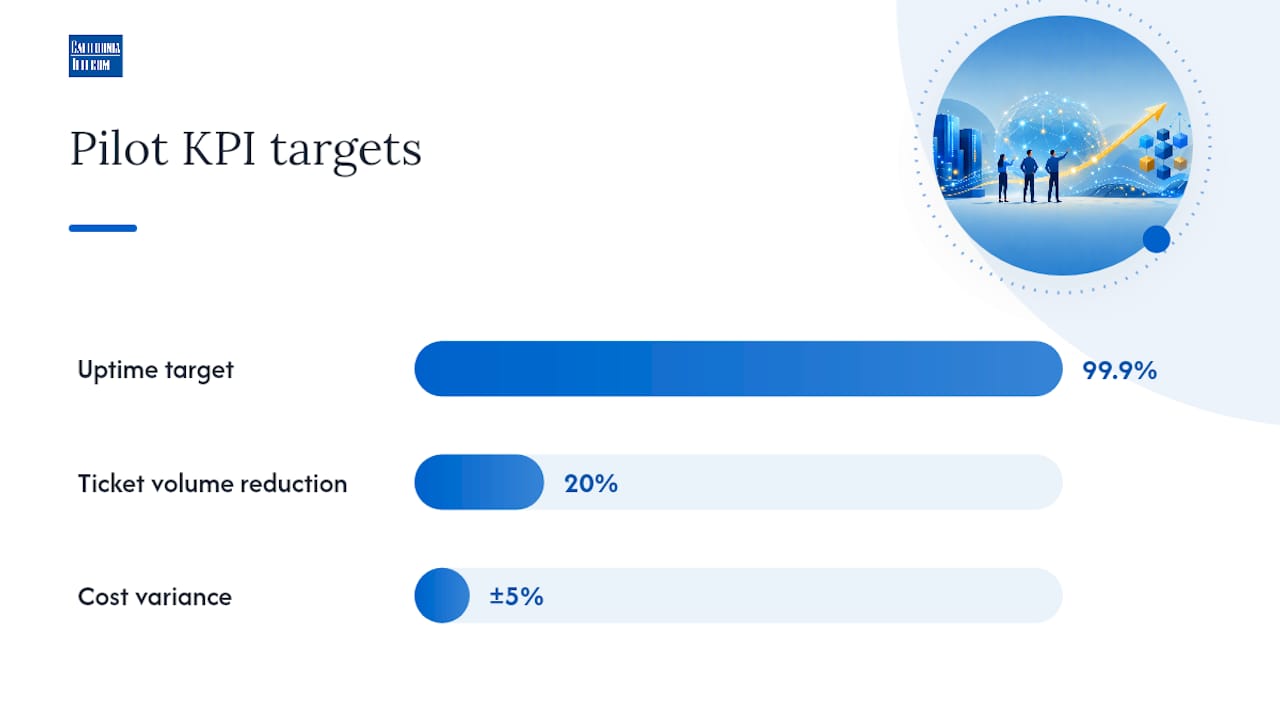
- Set proof-of-value objectives. Write down the specific outcomes that would constitute success: uptime above 99.9%, MTTR under four hours, ticket volume down 20% from baseline, cost within 5% of proposal.
- Establish a baseline. Pull 90 days of current performance data (uptime logs, ticket counts, circuit invoices) before cutover so you have a clean comparison.
- Define a rollback plan. Document the steps to revert each pilot site to in-house management within 48 hours. This is not pessimism; it is the governance discipline that makes the pilot credible to your board.
- Run the pilot for 60–90 days. Shorter pilots miss seasonal variation and provider learning curves. Longer ones delay the decision unnecessarily.
- Review KPIs at 30, 60, and 90 days. Do not wait for the end. Early variance signals whether the provider is on track or needs a course correction.
- Conduct a cutover/rollback checkpoint at day 45. If two or more KPIs are off-track, escalate formally before the pilot window closes.
Pilot KPIs to track: uptime per site, MTTR per incident, ticket volume versus baseline, end-user experience scores (a simple weekly survey works), and cost variance against the proposal.
Common integration pitfalls: legacy PBX systems that require analog tie lines the provider's SD-WAN platform does not support natively; on-premises security appliances with custom routing policies that conflict with the provider's standard architecture; and custom BGP configurations at data center interconnects. Surface all of these in the scoping call before the pilot starts, not during it.
For guidance on improving network performance with managed LAN/WAN solutions during a pilot, the KPI framework above maps directly to the deployment playbook.
How does Californiatelecom approach budget-focused managed network services?
Californiatelecom's model is built around the specific friction points that drive IT budget waste at multi-location organizations: too many carriers, too many bills, and too many vendor relationships to manage.
The core value proposition:
- Multi-carrier sourcing from 50+ carriers means Californiatelecom selects the best-fit circuit for each site rather than forcing every location onto a single carrier's footprint. That translates to better pricing and built-in redundancy.
- Single bill, single engineer contact eliminates the administrative overhead of managing 10 or 20 separate carrier relationships. For a 20-site organization, that overhead is real and measurable.
- 24/7 U.S.-based NOC with defined escalation paths, not an offshore call center that routes tickets to a queue.
- 99.99% uptime SLA on data and 99.999% on voice, backed by contract-level credits, not just marketing language.
In a typical pilot engagement, Californiatelecom scopes two to five sites, establishes a performance baseline, and delivers against defined KPIs: uptime, MTTR, and cost variance against the proposal. The single-bill model means the cost comparison is straightforward, and the carrier redundancy architecture reduces the probability of the outage scenarios that inflate downtime cost in the baseline.
For multi-location buyers evaluating nationwide managed network services, the procurement model is one contract, one provider, and one point of accountability, which reduces negotiation friction and simplifies vendor governance significantly.
What risk management strategies protect you if outsourcing goes wrong?
Outsourcing network operations transfers execution risk to a provider but does not eliminate it. The organizations that get hurt are the ones that outsource and then stop governing.
Contingency planning starts with defining your maximum tolerable downtime per site and per application. Map that to the provider's MTTR commitment. If the gap between tolerable downtime and MTTR is less than two hours, you need a secondary circuit or a wireless backup in the contract scope, not just a credit clause.

Exit strategies require more planning than most buyers invest. Before you sign, document: which IP addresses you own versus the provider's, where your DNS records live, what hardware is yours versus leased, and how long the provider's transition assistance period lasts. A provider that owns your IP block and your hardware has significant leverage at renewal. Negotiate IP portability and hardware buyout options at contract inception, not at termination.
Dual-provider architecture is worth considering for critical sites. Running a primary managed provider alongside a secondary circuit from a different carrier adds cost but eliminates single-vendor dependency for your highest-risk locations.
Contractual risk controls to include: force majeure definitions that are narrow enough to hold the provider accountable for foreseeable failures, liability caps that are proportionate to your annual contract value (not capped at one month's fee), and indemnification clauses that cover data breach costs attributable to the provider's network.
Governance cadence matters as much as contract language. Monthly performance reviews, quarterly business reviews with senior provider contacts, and annual contract audits keep the relationship accountable without requiring you to rebuild an internal NOC.
How do you align your internal team during the transition?
The technical cutover is usually the easy part. The organizational transition is where pilots stall and rollouts get delayed.
Your internal network engineers will reasonably ask what their role is after outsourcing. The honest answer is that it shifts from hands-on configuration to governance and oversight: reviewing provider dashboards, approving change requests, escalating when SLAs are missed, and managing the vendor relationship. That governance shift requires shared dashboards, formal change control, and defined decision rights to keep the provider aligned with your risk appetite. Engineers who understand that framing tend to engage productively. Engineers who feel sidelined tend to undermine the transition.
Practical alignment steps:
- Involve your senior network engineer in provider selection and pilot design. Their technical credibility with the provider is an asset, and their buy-in reduces transition friction.
- Define a RACI matrix before cutover: who approves change requests, who escalates outages, who owns the monthly performance review.
- Communicate the transition timeline to business stakeholders (store managers, branch leaders, operations teams) at least two weeks before cutover, with a single point of contact for questions.
- Run a tabletop exercise simulating a major outage under the new model before go-live. It surfaces gaps in the escalation path and builds team confidence.
Change management is not a soft skill here. It is a budget risk. A transition that stalls because internal teams are not aligned costs real money in delayed savings and extended parallel-run periods.
How do you avoid vendor lock-in when negotiating a managed network contract?
Lock-in in managed network contracts is structural, not accidental. Providers build it in through IP address ownership, proprietary hardware, and long initial terms. Knowing where it lives lets you negotiate it out.
IP address portability is the highest-stakes item. If the provider assigns IP addresses from their own block, you cannot take those addresses with you when you leave. Require that your organization either owns its IP block or that the contract includes a 90-day transition period during which the provider continues to route your traffic while you migrate. ARIN-registered IP blocks you own directly are the cleanest solution.
Hardware ownership matters at contract end. Proprietary CPE (customer premises equipment) that only works on the provider's platform is a switching cost. Negotiate a hardware buyout option at fair market value, or require that the provider use vendor-neutral hardware (standard Cisco, Juniper, or similar) that can be managed by a successor provider.
Contract term and renewal mechanics: Initial terms of three years are standard; five years is aggressive. Push for annual renewal options after the initial term, or at minimum a 12-month notice period before auto-renewal locks you in for another multi-year cycle.
Multi-vendor architecture at the circuit level reduces lock-in even when you have a single managed provider. If the provider sources circuits from multiple carriers (as Californiatelecom does from 50+ carriers), you retain more flexibility than if the provider is also the sole carrier.
Negotiation tactics that work: request a published rate card for all out-of-scope services before signing; require a transition assistance clause with a defined scope and no additional fee; and ask for a most-favored-nation pricing clause if you expect to add sites over the contract term.
How do you monitor vendor performance after the contract is signed?
Post-implementation governance is where the budget savings either materialize or quietly erode. Providers that are not actively monitored tend to deprioritize accounts that do not push back.
Build a three-layer monitoring approach:
Real-time visibility: Require access to the provider's monitoring dashboard or a shared observability platform. You should be able to see uptime, latency, and packet loss per site without filing a ticket. Californiatelecom's Vergepoint hardware provides single-dashboard observability across all managed sites, which is the right model. If a provider cannot give you real-time visibility into your own network, that is a red flag.
Monthly performance reporting: Require a formal monthly report that includes uptime per site, MTTR per incident, ticket volume by category, and any SLA credits owed. Review it against the contract targets, not just the provider's narrative.
Quarterly business reviews: Bring a senior provider contact into a structured review that covers performance trends, upcoming changes, and any contract concerns. This is where you surface pattern problems (recurring latency on a specific circuit, slow escalation on after-hours tickets) before they become SLA disputes.
Metrics to track continuously: uptime per site, MTTR per incident, ticket-to-resolution ratio, end-user experience scores, and cost variance against the proposal.
The governance model shifts your internal team from doers to overseers, but oversight requires data. Insist on it contractually before you sign.
The case for outsourcing is strong, but only if you govern it
Most IT leaders I talk to approach managed network services as a cost-cutting exercise and then underinvest in the governance that makes the savings stick. But the organizations that capture those savings consistently are the ones that treat the provider relationship as an active management responsibility, not a set-it-and-forget-it contract.
If you have a specialized compliance environment (healthcare, financial services) or a highly customized network architecture, start with a hybrid approach: out-task monitoring and NOC coverage while keeping architecture decisions in-house. Out-tasking a single function is a legitimate first step, not a compromise. The pilot model described above is the right entry point for either path.
Californiatelecom can run your pilot and manage the transitionFor multi-location IT leaders who need a clean, budget-predictable managed network without rebuilding their vendor stack, Californiatelecom delivers one bill, one engineer's number, and carrier redundancy sourced from 50+ providers. A pilot engagement starts with two to five sites, a defined baseline, and proof-of-value KPIs so you have a defensible ROI case before you commit to a full rollout. Schedule a free consultation to scope your pilot and get a managed network services proposal built around your site count, compliance requirements, and budget targets.
FAQ
How much can outsourcing network services actually save?
The honest benchmark range is a 20–50% reduction in network operating costs, with payback typically in 6–12 months once downtime avoidance and staffing changes are included. Treat vendor claims outside that range with skepticism.
What should you audit before comparing vendor proposals?
Build a complete baseline of current spend first: monthly recurring charges for every WAN circuit including backups, network labor, hardware CapEx, software licenses, and the cost of downtime. Without that baseline, no proposal comparison is apples-to-apples.
Which pricing model gives the most budget predictability?
A fixed monthly subscription (Network-as-a-Service) is the cleanest model for budget predictability. The right choice among the four common pricing shapes depends on your CFO's preference for CapEx versus OpEx and how stable your site count is.
What security evidence should you require from a provider?
SOC 2 Type II and ISO 27001 certifications are the primary stakeholder proof points — security and privacy concerns are the main barrier to managed network adoption, so make the evidence a gating requirement rather than a nice-to-have.
How do you avoid vendor lock-in in a managed network contract?
Lock-in is structural, not accidental: providers build it in through IP address ownership, proprietary hardware, and long initial terms. Negotiate each of those explicitly before signing rather than discovering them at renewal.
Primary sources and further reading
- Cisco guide to buying managed network services — SLA benchmarks, out-tasking cost reduction examples, and QoS guidance from Cisco's managed-services practice.
- ACG Research: Financial Benefits of Juniper Mist AI-Driven Access — Modeled OpEx and TCO savings from AIOps-driven managed Wi-Fi and wired LAN; useful for building a labor-reduction business case.
- MarketsandMarkets: Managed Network Services Market — Market sizing, adoption drivers, and the security/privacy barriers that procurement must address.
- Webperts: Best Managed Network Solutions for IT Outsourcing — Practical cost benchmarks by organization size and scope, including pricing ranges and savings estimates.
- Californiatelecom: Managed Network Services and Connectivity — Provider-side SLA commitments, multi-carrier sourcing model, and NOC coverage details for multi-location buyers.
- Californiatelecom: Managed LAN/WAN Solutions — Technical scope and deployment details for managed LAN/WAN engagements, useful for IT evaluators reviewing service scope.
- FranklinFitch: In-House vs. Outsourcing Networking Solutions — Governance and oversight requirements when transitioning from in-house to managed network operations.
Sources
- Cisco guide to buying managed network services
- Financial Benefits of Juniper Wired and Wireless Access Driven by Mist (ACG Research)
- Best Managed Network Solutions for IT | Webperts
- Managed Network Services Market (MarketsandMarkets)
Recommended
- Picking a Managed Network Services Provider When Your IT Team Is Small | California Telecom
- How to Evaluate Outsourced Network Engineering Providers | California Telecom
- How to Improve Network Performance with Managed LAN/WAN Solutions | California Telecom
- edge.prnewswire.com Alternatives for IT Directors: 2026 | California Telecom