

Keep Clinicians Working With 4 Phase Healthcare Network SegmentationNetwork segmentation limits lateral movement and shields medical devices and PHI from a single compromised endpoint. A good baseline is a risk-based zone architecture that groups assets by clinical function and risk, enforces boundaries with firewalls or ACLs, documents allowed traffic, and validates rule enforcement. Skip any of those four pieces and the segmentation exists on a diagram, not on the wire.
TL;DR:
- Segmentation must include documentation of allowed traffic, and enforcement with firewalls or ACLs, to truly isolate clinical and PHI zones from an attacker's reach.
- Using VLANs, VRFs, or microsegmentation depends on infrastructure complexity and the need for fine-grained control, with microsegmentation enabling per-device policies vital for IoMT.
- An inventory of assets, dependencies, and owner details is critical to creating effective zones such as PHI, clinical applications, medical devices, and visitor networks.
- Enforcing boundaries requires firewalls, ACLs, and NAC solutions at every zone interface, with management access protected by dedicated VLANs or VRFs and strict vendor controls.
- A phased migration approach with validation tests, clinical involvement, and documented allow-lists reduces operational risk and ensures ongoing compliance during network segmentation.
Table of Contents
- What Healthcare Network Segmentation Actually Protects
- Choosing an Architecture: VLANs, VRFs, or Microsegmentation
- Mapping Zones: Grouping Devices by Risk, Not Just Location
- Enforcing the Boundaries: Firewalls, ACLs, NAC, and Management Plane Controls
- How to Segment Healthcare Networks in Phases
- Keeping Clinical Workflows Running During the Project
- Proving It Works: Validation, Testing, and Compliance Evidence
- Where Managed Network Services Fit Into a Segmentation Project
- Balancing Security, Uptime, and Overhead: An Editorial Take
- Sources
- FAQ
What Healthcare Network Segmentation Actually Protects
Ransomware doesn't need to touch every device to shut down a hospital. It needs one flat network and a few hours. Segmentation exists to deny it that runway.
When a workstation in radiology gets compromised, the question that matters is what it can reach next. On a flat network, the answer is everything: infusion pumps, PACS servers, the domain controller, the guest WiFi gateway. On a segmented network, that workstation sits in a clinical VLAN with a firewall between it and the device zone, and the attacker hits a wall instead of a hallway. That containment is the entire point, and it's why HICP practice 5.1 treats isolation of clinical systems and PHI repositories as a baseline expectation, not an advanced control.
Segmentation also solves a problem healthcare can't patch its way out of: legacy IoMT. A ventilator running an unsupported operating system can't get a security update, but it can sit behind a firewall that blocks everything except the specific ports its monitoring system needs. That's often the only realistic protection available for a device with a ten-year service life and a manufacturer that stopped issuing patches years ago.
The benefits compound from there:
- Smaller audit scope. Segmented PHI zones shrink the number of systems in scope for HIPAA risk assessments and reduce what auditors need to review.
- Cleaner incident response. Responders can isolate a zone instead of guessing which of thousands of flat-network devices touched the breach.
- Easier maintenance windows. Patching and vendor access can be scheduled zone by zone instead of network-wide.
- Regulatory alignment. TechTarget reports that proposed 2025 HIPAA Security Rule updates signaled increased regulatory attention on segmentation specifically, not just general access controls.
Pro Tip: Run the "one compromised laptop" test on your own network. Ask what an attacker on a random clinical workstation could reach in five hops. If the answer includes your EHR database or biomedical device VLAN, you have a segmentation gap, not a patching gap.
Choosing an Architecture: VLANs, VRFs, or Microsegmentation
Most healthcare networks need a mix, not a single technology. The architecture decision comes down to how much re-engineering you can tolerate and how granular the control needs to be.
VLANs and subnets with Layer 3 inspection form the baseline for most facilities. Devices get grouped by function, a router or firewall inspects traffic crossing subnet boundaries, and policy gets enforced at that Layer 3 boundary. This is the fastest architecture to deploy on existing switching hardware and works well for separating broad categories like guest WiFi, administrative workstations, and clinical systems.
VRFs and cloud VPC or VNET separation matter more once systems span data centers or cloud environments. A hospital running a hybrid EHR deployment, with parts hosted on-premises and parts in a cloud tenant, needs routing-level separation that a VLAN alone can't provide. VRFs let you maintain logically separate routing tables on shared physical infrastructure, which is useful for multi-tenant environments like shared imaging centers or affiliated practice networks.
Microsegmentation solves the problem VLANs can't: east-west traffic between devices inside the same broad zone. Two infusion pumps sitting in the same clinical VLAN can still infect each other under coarse segmentation. Microsegmentation applies identity-aware or workload-aware policy down to the individual device or application, which research on biomedical device security points to as increasingly necessary because traditional VLANs can't grant per-device control at that resolution.
The trade-offs are real:
- VLANs are cheap and familiar to most network teams but coarse grained.
- VRFs add routing complexity and usually require more experienced staff to manage correctly.
- Microsegmentation delivers the finest control but demands dedicated tooling, device profiling, and ongoing policy maintenance that smaller IT teams often can't staff alone.
Physical separation, running a dedicated cable plant for the most sensitive device classes, still shows up in high-risk environments like operating suites, but it's expensive and inflexible compared to logical segmentation done well.
Mapping Zones: Grouping Devices by Risk, Not Just Location
You cannot segment what you haven't inventoried. Every serious project starts with a device and asset map, not a firewall rule set. NHS Digital's segmentation guidance frames this correctly: segments should be grouped by defined criteria, with access limited to only the traffic each group actually needs, not by whatever happens to already share a switch.
Good inventory work tags each asset with four things: owner (clinical engineering, IT, a third-party vendor), IP range and VLAN assignment, ports and protocols in active use, and dependencies (what it talks to, and what talks to it). Skipping the dependency mapping is the single most common cause of segmentation projects breaking clinical workflows, because nobody realized the infusion pump's drug library sync depended on reaching a server three zones away.
A workable zone model for most hospital networks looks like this:
- PHI zone: EHR databases, billing systems, and anything storing patient records directly.
- Clinical applications zone: PACS, lab information systems, pharmacy systems, tools clinicians interact with daily.
- Medical device zone: infusion pumps, imaging equipment, monitors, and other IoMT, often subdivided further by device criticality.
- Management zone: switches, firewalls, network monitoring platforms, anything used to administer the network itself.
- Guest and general zone: patient and visitor WiFi, staff personal devices, anything with no legitimate reason to reach clinical systems.
- Third-party and vendor zone: remote access for device manufacturers, billing contractors, and other external parties.
Each zone exists because it represents a distinct blast radius. Mixing device management traffic with guest WiFi, for instance, means a compromised guest laptop is one hop from your network switches.
Once zones are defined, build an allow-list register: a documented record of every flow permitted to cross a zone boundary, including source, destination, port, protocol, and business justification. This register becomes both your firewall rule source of truth and your audit evidence. Every entry needs a named owner and a review date, because undocumented "temporary" rules are how flat networks happen one exception at a time.

Pro Tip: Export your firewall rule base and your allow-list register side by side once a quarter. Any rule that isn't in the register is either undocumented risk or a rule you forgot to remove. Both are findings an auditor will catch before you do.
For auditability, keep four artifacts current: network diagrams showing zone boundaries, exported ACL and firewall configurations, the allow-list register itself, and a change approval trail showing who signed off on each new flow.
Enforcing the Boundaries: Firewalls, ACLs, NAC, and Management Plane Controls
A zone diagram means nothing without enforcement at the boundary. The choke point is where policy either holds or doesn't.
Internal segmentation firewalls belong at every boundary between zones of meaningfully different risk, particularly between the general network and the PHI or device zones. Layer 3 ACLs on routers and switches can handle simpler boundaries where a full firewall is overkill, such as separating administrative VLANs from each other within the same trust level. Network Access Control (NAC) appliances add a layer ACLs can't: they verify device identity and posture before granting network access at all, which matters when a rogue laptop tries to plug into a clinical wall jack.
The management plane deserves its own protection, and it's the piece most segmentation projects underinvest in. Switches, firewalls, and monitoring platforms should sit in a dedicated management VLAN or VRF, reachable only through a jump host rather than direct access from general IT workstations. If an attacker compromises a help desk laptop, that laptop should have no direct path to your firewall's administrative interface.
Identity-aware microsegmentation and device admission techniques extend this further by tying policy to what a device is, not just what subnet it happens to sit on. A device profiling system that recognizes "this is an infusion pump" can apply device-specific policy automatically, which scales better than manually maintained IP-based rules as your IoMT inventory grows into the thousands.
Vendor and manufacturer access needs particularly tight controls:
- Terminate all third-party VPN connections into a dedicated vendor zone, never directly into the device or clinical VLAN.
- Require time-bound access requests rather than standing VPN credentials for device manufacturers.
- Log and review every vendor remote session, since this is a common path attackers exploit through compromised supplier credentials.
- Apply the same jump host pattern used for internal admins to any vendor requiring device-level access.
Pro Tip: Ask every device vendor for their required ports and protocols in writing before you build the firewall rule. Vendors often ask for far broader access than their device actually needs, and a documented requirement protects you when you later tighten the rule and clinical engineering asks why.
Government hardening guidance from CISA reinforces the same pattern: identify critical assets, isolate them behind enforced boundaries, and restrict administrative access paths as a baseline control, not an advanced one.
How to Segment Healthcare Networks in Phases
Segmentation projects fail when teams try to rebuild the whole network in one migration window. A phased approach protects clinical continuity while still making measurable progress.
Governance comes first, benefiting from a healthcare website build, AHPRA-compliant approach that supports cross-functional implementation and stakeholder communications. Form a steering group with IT security, network engineering, clinical engineering, and a compliance representative, because decisions about clinical device rules need clinical sign off, not just a security team's approval.
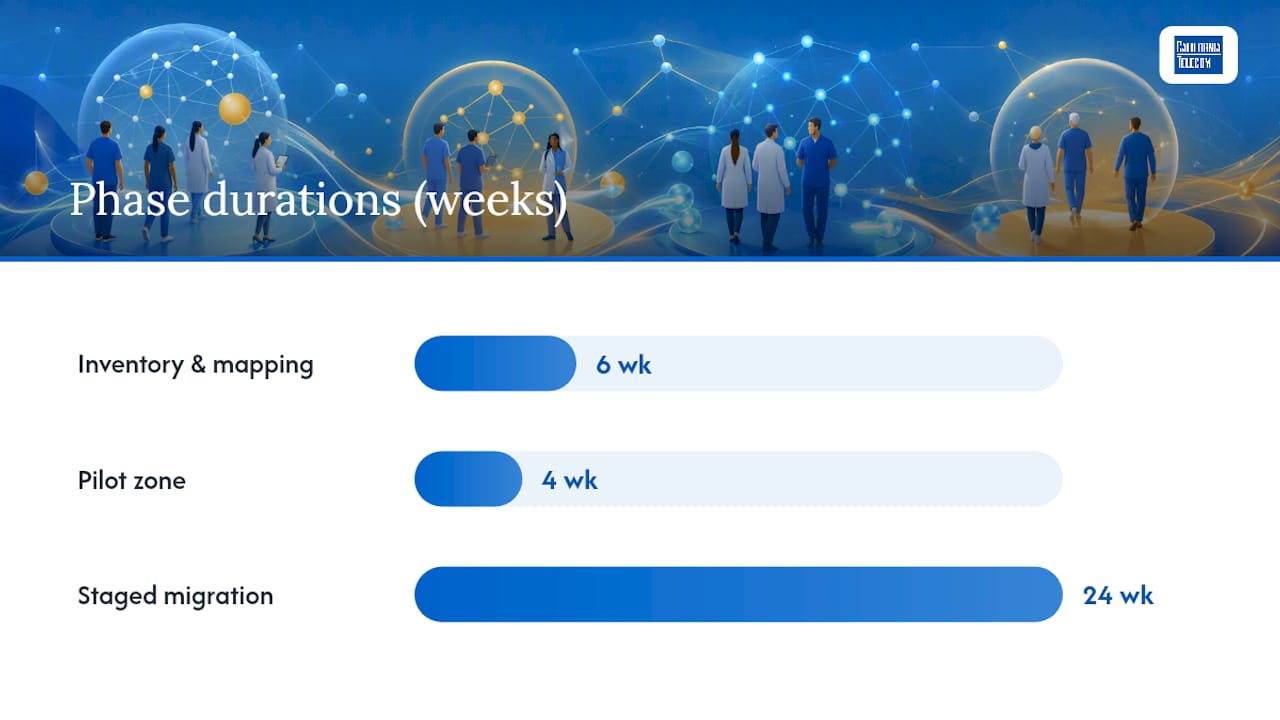
- Inventory and mapping (weeks 1 to 6): Complete the asset inventory and dependency map described earlier. Nothing else proceeds until this is reasonably accurate.
- Pilot zone (weeks 6 to 10): Pick a low-risk, well-understood segment, guest WiFi or a single administrative VLAN, and enforce full segmentation there first. Validate the process before touching anything clinical.
- Staged migration (months 3 to 8, department by department): Move clinical and device zones in waves, starting with departments that have simpler device inventories, saving the highest-complexity areas like the OR and ICU for last once the process is proven.
- Full validation (ongoing from month 6): Run deny tests and allow-list verification across every completed zone, not just the newest one, to catch drift.
Testing before each migration wave should include verifying that every flow in the allow-list register actually works in a staging environment, then confirming that everything not on the list is actually blocked. Rollback plans need a defined trigger, such as any clinical alarm or connectivity failure reported within the first 24 hours of a cutover, and a fast path back to the prior configuration.
Change control tightens as the project matures: early exceptions get granted liberally to avoid outages, but every exception needs a sunset date and a named owner responsible for either closing it or converting it into a permanent, documented allow-list entry. Staffing realistically needs a dedicated network engineer and a clinical engineering liaison for the duration of active migration phases, not just a project manager checking in weekly.
Pro Tip: Schedule your riskiest migration waves for the lowest-census period your facility sees annually, not just the lowest-traffic hour of the day. A rule that breaks a rarely used but critical device, like a backup ventilator interface, may not surface for weeks.
Keeping Clinical Workflows Running During the Project
The fastest way to derail a segmentation project is breaking a workflow a clinician depends on every shift. The fix isn't more caution from IT alone. It's structured collaboration with the people who actually use the equipment.
Clinical engineering and vendor subject matter experts need a seat at the table from the inventory phase onward, not just a courtesy notification before cutover. Peer-reviewed research on segmentation perceptions found that IT and medical technology staff both see segmentation as improving device security, but the same study flagged increased administrative burden and the need for close IT-clinical coordination to avoid disrupting care. That collaboration is not optional overhead. It's the mechanism that prevents outages.
Before writing a single firewall rule for a device zone, map its nonstandard protocols and port requirements directly with the vendor or clinical engineering team managing it. Many medical devices use proprietary protocols on nonstandard ports that a generic firewall rule template will miss entirely, and guessing wrong means a device drops offline mid-shift.
- Test every proposed rule change in a controlled environment or maintenance window before applying it to production clinical VLANs.
- Document test results, including what was tested, what passed, and what failed, as part of the change record.
- Route exception requests through a formal approval process that includes a sunset date, so temporary workarounds don't quietly become permanent security gaps.
- Keep a rollback procedure on hand for every clinical workflow change, tested in advance rather than improvised during an incident.
Proving It Works: Validation, Testing, and Compliance Evidence
A segmentation project isn't done when the firewall rules deploy. It's done when you can prove, with evidence, that the rules do what they claim.
Three tests belong in every validation cycle: deny tests confirming that traffic from the general network cannot reach PHI or device zones, allow-list verification confirming every permitted flow actually matches a documented business need, and simulated lateral movement tests confirming that a compromised host in one zone genuinely cannot pivot into another. Skipping the third test is common and dangerous, because a network can pass basic deny tests while still having an overlooked path an attacker would find in minutes.
Auditors and regulators expect specific artifacts, not verbal assurance:
- Firewall and ACL configuration exports showing the rules as actually deployed, not as originally designed.
- The allow-list register itself, with owners and justifications intact.
- Test logs from each validation cycle, including deny test results and any failures found.
- Change tickets tying every rule modification back to an approval.
This evidence maps directly to what regulators expect. NIST SP 800-66 Revision 2 details the technical safeguards and risk analysis documentation the HIPAA Security Rule requires, and HICP practice 5.1 specifically calls for documented allow-lists and enforcement points around clinical systems and device networks. The FDA's device cybersecurity guidance adds the device-lifecycle angle auditors increasingly ask about: how segmentation compensates for medical devices that can't be patched directly.
Ongoing monitoring closes the loop. Set alerting on anomalous east-west traffic between zones, since that's the signature of lateral movement in progress, and schedule re-validation testing at fixed intervals rather than only after an incident forces the question.
Where Managed Network Services Fit Into a Segmentation Project
Running a multi-site segmentation project with an internal team stretched across a dozen other priorities is where most timelines slip. A managed approach handles the parts that don't scale well with a lean staff.
Californiatelecom designs and deploys managed SD-WAN and managed LAN/WAN architectures that carry segmented overlay networks across every facility a health system operates, with its own engineers handling deployment at each site rather than coordinating multiple regional vendors.
- A single-provider design and deployment model reduces the coordination overhead of running segmentation across sites with different local carriers and equipment.
- Managed firewall services maintain zone enforcement and vulnerability assessment on an ongoing basis, rather than as a one-time project deliverable.
- A 24/7 network operations center provides continuous monitoring for the anomalous east-west traffic that signals lateral movement, with high uptime guarantees on data connectivity.
- Sourcing from multiple carriers means connectivity decisions can vary by facility, avoiding single-vendor bottlenecks during phased migrations.
The California Telecom healthcare network overview and a documented network upgrade case study both show what this looks like applied to a real multi-location deployment.
Balancing Security, Uptime, and Overhead: An Editorial Take
Segmentation adds real administrative weight. Every new zone is another set of rules someone has to maintain, review, and defend during an audit. The healthcare organizations that get this right don't try to segment everything at once. They rank devices by risk, protect the legacy IoMT that can't defend itself first, and build a governance board that includes clinical engineering before the first firewall rule ships. Start with one high-risk zone, measure whether care delivery noticed, then expand. Trying to do it all in a single sweeping project is how good security intentions turn into a 2 a.m. call about a ventilator that lost its network connection.
— Jim
Sources
- NIST SP 800-66 Revision 2: Implementing the HIPAA Security Rule
- Health Industry Cybersecurity Practices (HICP) — 405(d)
- Information Technology and Medical Technology Personnel’s Perception Regarding Segmentation of Medical Devices
FAQ
What Are the Types of Network Segmentation?
The main types are VLAN or subnet segmentation with Layer 3 inspection, VRF-based segmentation for routing separation across data centers or cloud environments, and microsegmentation for granular, identity-aware control between individual devices. Most healthcare networks combine all three depending on the risk level of each zone.
What Is the Network Model of Care in Healthcare?
In a network segmentation context, the model of care refers to grouping IT infrastructure around how clinical services actually function, separating PHI systems, clinical applications, medical devices, and administrative traffic into distinct zones. This mirrors how NHS Digital's guidance frames segmentation: grouping by defined criteria tied to function and risk, not physical location alone.
What Are the NIST Guidelines for Network Segmentation?
NIST does not publish a single standalone segmentation standard, but NIST SP 800-66 Revision 2 details the technical safeguards and risk analysis documentation required to implement the HIPAA Security Rule, which segmentation projects use as their compliance foundation. It emphasizes documented risk analysis, access controls, and audit trails rather than a specific network architecture.
What Are the Main Segments of the Healthcare Industry Network?
The core network zones used in most healthcare segmentation models are PHI systems, clinical applications, medical devices (IoMT), network management, guest and general access, and third-party vendor access. Each zone represents a distinct risk profile and gets its own enforced boundary and documented allow-list.
How Do You Start a Healthcare Network Segmentation Project?
Start with a complete asset inventory that maps device owners, IP ranges, ports, and dependencies before writing any firewall rules. From there, pilot segmentation on a low-risk zone like guest WiFi, validate the process, then migrate clinical and device zones in stages with clinical engineering involved at every step.