

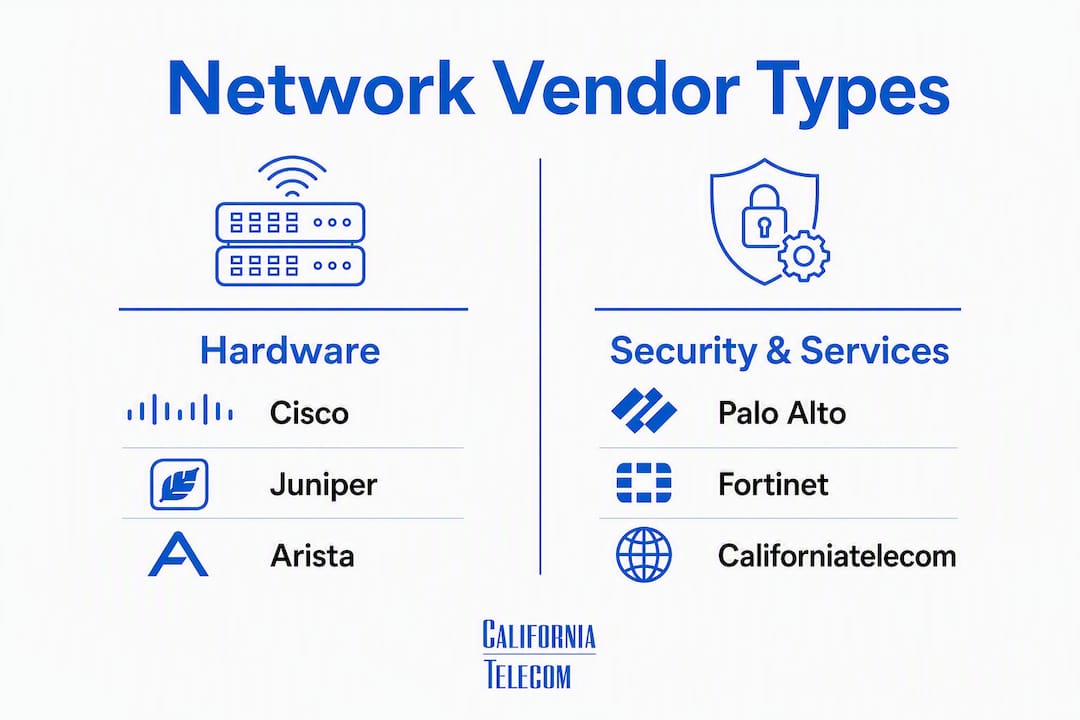
Top Computer Network Companies for IT Leaders in 2026The leading U.S. computer network companies fall into five categories you should evaluate before any RFP: networking hardware and switching (Cisco Systems, Arista Networks, Juniper Networks, Hewlett Packard Enterprise/Aruba, Broadcom), network security (Palo Alto Networks, Fortinet), wireless and edge (Ubiquiti, HPE/Aruba), prosumer and SMB (NETGEAR, Ubiquiti), and managed network services and systems integrators (Californiatelecom, Accenture, NTT DATA, HCLTech, Hughes Network Systems). If you need a single managed provider for multi-location U.S. deployments, skip to the selection criteria section below.
Quick-reference roster by role:
- Data-center switching and campus networking: Cisco Systems, Arista Networks, Juniper Networks
- Network security and SASE: Palo Alto Networks, Fortinet
- Wireless, edge, and cloud-managed Wi-Fi: Hewlett Packard Enterprise (Aruba), Ubiquiti
- Prosumer and SMB networking hardware: NETGEAR, Ubiquiti
- Managed network services and systems integrators: Californiatelecom, Accenture, NTT DATA, HCLTech, Hughes Network Systems, Broadcom (infrastructure)
For guidance on narrowing this list to a shortlist of two or three vendors, go directly to the selection criteria section.
Table of Contents
- Which computer network companies should you actually evaluate?
- How do you choose the right network company for your organization?
- What market trends are reshaping how you pick a network vendor?
- At a glance: which vendor category fits your use case?
- Key Takeaways
- What successful network provider selections actually look like
- Californiatelecom: managed network services built for multi-location businesses
- Sources and further reading
Which computer network companies should you actually evaluate?
The profiles below are grouped by category. Use them to decide which vendor type belongs on your shortlist before you start vendor calls.

Networking hardware and switching
Cisco Systems remains the largest networking equipment company by market capitalization, reported at $251.62 billion as of May 2025. Its portfolio spans campus switching, data-center fabric, SD-WAN (Catalyst/Meraki), and security. Best fit for enterprises that want a single vendor across routing, switching, and wireless, and that have the internal staff to manage Cisco's licensing complexity.

Arista Networks built its reputation on ultra-low-latency data-center switching and a single-binary EOS operating system that simplifies lifecycle management. Verified Market Research highlights Arista's data-center strength specifically. Cloud providers and financial-services firms with latency-sensitive workloads are its natural buyers.
Juniper Networks carries a market cap of $12.04 billion and is known for its AI-driven Mist platform for wireless and wired assurance, plus its MX-series routers for service-provider and large-enterprise WAN. Strong choice when AI-driven telemetry and campus assurance are priorities.
Hewlett Packard Enterprise (Aruba) covers campus Wi-Fi, wired access, and SD-WAN under the Aruba Central cloud management platform. HPE/Aruba appears consistently in analyst comparisons of top enterprise networking vendors and is a natural fit for distributed campuses and healthcare environments that need unified wired and wireless policy.
Broadcom entered enterprise networking through its acquisition of Brocade and VMware, giving it a footprint in data-center switching ASICs and software-defined infrastructure. Most relevant to large enterprises already running VMware-based virtualization who want tighter network-compute integration.
Network security
Palo Alto Networks is the dominant U.S. network security vendor, known for its next-generation firewall platform and its Prisma SASE suite. It targets enterprises that want a single security vendor across on-prem, cloud, and remote-access use cases.
Fortinet competes on price-performance with its FortiGate firewall line and a tightly integrated security fabric. Its FortiSASE product addresses distributed enterprises and branch offices. Fortinet tends to win in mid-market and distributed-retail environments where cost per site matters.
Wireless and edge
Ubiquiti offers cloud-managed Wi-Fi and switching under its UniFi line at a price point well below enterprise vendors. It is widely deployed in hospitality, small campuses, and prosumer environments. The trade-off is limited enterprise-grade support and no 24/7 NOC.
NETGEAR serves the SMB and prosumer segment with wired switches, Wi-Fi routers, and the Orbi mesh line. It is not an enterprise play, but it is a practical choice for small offices and home-office deployments within a larger managed environment.
Managed network services and systems integrators
This is where the decision gets more consequential for multi-location businesses. According to Gartner, managed network services (MNS) are recurring-service models where a third party operates, monitors, secures, and maintains network infrastructure under SLAs. Critically, hardware assets and capital obligations typically remain on the customer's books in an MNSP model, which differs from NaaS arrangements where the provider owns the infrastructure.
The 2026 ISG Provider Lens for U.S. Enterprise Managed Network Services names Accenture, HCLTech, Hughes Network Systems, and NTT DATA among top-tier providers across managed-network models.
- Accenture brings global systems-integration depth and is best suited to large enterprises running complex multi-cloud transformations where network is one workstream among many.
- NTT DATA offers carrier-grade global WAN and managed SD-WAN, with particular strength in multinational enterprises that need consistent SLAs across regions.
- HCLTech provides multi-vendor managed network operations with centralized visibility across physical, virtual, and cloud networks. Its software-driven approach suits enterprises managing heterogeneous infrastructure.
- Hughes Network Systems specializes in satellite and hybrid WAN connectivity, making it the go-to for locations where terrestrial fiber is unavailable or unreliable.
- Californiatelecom is a U.S.-based managed network services provider headquartered in Chino, CA, built specifically for multi-location mid-market and enterprise businesses. It sources from 50+ carriers, deploys each site through its own engineers, and backs every service with a 24/7 U.S.-based NOC, a 99.99% uptime SLA on data, and 99.999% on voice. Customers get one provider, one bill, and a single engineer's contact rather than managing a stack of carrier relationships.
| Vendor | Primary Segment | Notable Strength |
|---|---|---|
| Cisco Systems | Enterprise switching/routing | Broadest portfolio; $251.62B market cap |
| Arista Networks | Data-center switching | Single-binary EOS; low-latency fabric |
| Juniper Networks | WAN / AI-driven campus | Mist AI telemetry; $12.04B market cap |
| Palo Alto Networks | Network security / SASE | Prisma SASE; dominant U.S. security vendor |
| Fortinet | Security / distributed branch | FortiGate price-performance; FortiSASE |
| HPE (Aruba) | Campus Wi-Fi / SD-WAN | Aruba Central cloud management |
| Accenture | Systems integration / MNS | Global multi-cloud transformation depth |
| NTT DATA | Carrier-grade managed WAN | Multinational SLA consistency |
| HCLTech | Multi-vendor managed ops | Centralized cross-domain visibility |
| Hughes Network Systems | Satellite / hybrid WAN | Remote and underserved-site coverage |
| Californiatelecom | U.S. managed network services | Multi-carrier sourcing; 24/7 U.S. NOC |
How do you choose the right network company for your organization?
The answer depends on one question you should answer before any vendor call: are you buying hardware and managing it yourself, outsourcing operations to a managed provider, or moving to a NaaS model where the provider owns the infrastructure? That single decision narrows the field by half.
Prioritized evaluation checklist:
- Define your service model. Hardware-only, managed services, or NaaS each carry different CapEx/OpEx profiles. Gartner's MNSP definition is the clearest reference: MNSPs operate your network but you retain hardware ownership; NaaS providers own the infrastructure.
- Validate SLA metrics beyond uptime. Availability-only SLAs can mask performance degradation that cripples voice and video. Demand granular metrics — latency, jitter, and packet loss — not just a "99.9% uptime" headline.
- Verify multi-carrier and redundancy options. A provider locked to a single carrier creates a single point of failure. Ask how many carriers they aggregate and what the automatic failover process looks like.
- Ask about observability and AI-assisted operations. Require vendors to demonstrate automated alerting, real-time dashboards, and documented mean-time-to-detect figures in a short proof-of-concept window.
- Confirm regional coverage and on-site support. A NOC in another country is not the same as a U.S.-based team that can dispatch an engineer to your site. Confirm staffing geography explicitly.
- Check compliance certifications. Healthcare deployments need HIPAA-aligned controls; financial services need SOC 2 and PCI DSS. Ask for documentation, not just claims.
Sample RFP questions worth asking:
- What are your SLA metrics for latency, jitter, and packet loss — and what are the remedies if you miss them?
- Is your NOC staffed 24/7 in the U.S., or do you use offshore tiers for overnight coverage?
- How do you handle firmware lifecycle management and change windows across multi-location deployments?
- Can you integrate with our existing hardware vendors, or does your managed service require proprietary equipment?
- Provide three reference deployments in our vertical with contact names.
Common red flags:
- SLAs that only define availability, with no performance metrics
- Opaque licensing structures or bundled subscription credits that obscure true cost
- No documented escalation path beyond a generic help desk
- Inability to provide references in your industry or deployment scale
Pro Tip: Ask the vendor to show you the actual SLA language in the contract, not the marketing summary. Providers that own their NOC and publish granular performance metrics in the contract — not just in a sales deck — are the ones who will actually be accountable when something breaks.
For a practical checklist tailored to lean IT teams, Californiatelecom's guide on picking a managed network services provider walks through the same criteria in a format you can hand to procurement.
What market trends are reshaping how you pick a network vendor?
The dominant shift is away from connectivity management as a commodity and toward what ISG describes as "network-led transformation" — where unified observability, AI automation, and SASE become decisive selection factors rather than nice-to-haves. This changes what belongs in your RFP.
ISG's 2026 analysis and BusinessWire reporting confirm that U.S. enterprises are accelerating adoption of managed services and software-defined approaches to centralize visibility across hybrid cloud, remote work, and distributed applications. The driver is predictability: AI-assisted operations reduce mean time to detect and repair on complex distributed networks in ways that manual NOC processes cannot match at scale.
SASE (Secure Access Service Edge) merges wide-area networking and network security into a single cloud-delivered service. For distributed enterprises, it eliminates the need to backhaul branch traffic to a central data center for inspection. Vendors like Palo Alto Networks (Prisma) and Fortinet (FortiSASE) lead here, and Californiatelecom offers managed FortiSASE as part of its managed network stack.
SD-WAN and SD-networking are displacing traditional MPLS architectures. The 2026 ISG report on software-defined approaches highlights SD-networking growth as critical for cloud connectivity, enterprise 5G, and edge integration. The practical implication: any managed provider you evaluate should be able to demonstrate centralized policy management across on-prem, cloud, and edge from a single pane of glass.
Buyer fatigue with complex licensing is also reshaping procurement. IT leaders are increasingly favoring transparent managed providers that can integrate best-of-breed hardware rather than being locked into a single vendor's ecosystem. If your RFP does not explicitly ask about licensing transparency and hardware agnosticism, you may inherit the problem you were trying to solve.
At a glance: which vendor category fits your use case?
Match your primary use case to the right provider type before you build a shortlist.
- Ultra-low-latency data-center switching: Look for single-binary OS, deep telemetry support, and published latency benchmarks. Arista Networks is the reference point here.
- Campus and branch Wi-Fi at scale: Cloud-managed platforms with AI-driven assurance reduce troubleshooting time. HPE/Aruba Central is the enterprise standard; Ubiquiti works for cost-sensitive smaller campuses.
- Network security and SASE for distributed workforces: Prioritize vendors with a unified policy engine across firewall, ZTNA, and SWG. Palo Alto Networks and Fortinet are the two dominant U.S. choices.
- Prosumer and SMB hardware: NETGEAR and Ubiquiti serve this segment well for branch offices and home-office endpoints within a larger managed environment.
- Carrier-grade managed WAN for multinationals: NTT DATA and Accenture have the global footprint and SLA consistency for cross-border deployments.
- Satellite and hybrid WAN for remote sites: Hughes Network Systems is the specialist when terrestrial fiber is not an option.
- U.S.-based managed network services for multi-location mid-market and enterprise: Californiatelecom's multi-carrier model, engineer-led deployments, and 24/7 U.S. NOC make it the practical choice when you want one provider, one bill, and accountable SLAs across all your locations. See managed LAN/WAN solutions for specifics.
- Large-scale systems integration with network as one workstream: Accenture and HCLTech are the right category when network transformation is embedded in a broader digital-transformation program.
Key Takeaways
The most effective approach to selecting among U.S. computer network companies is to define your service model first, then validate SLA granularity, multi-carrier redundancy, and observability capabilities before shortlisting vendors.
| Point | Details |
|---|---|
| Define service model first | Decide between hardware-only, managed services, or NaaS before evaluating any vendor. |
| Demand granular SLAs | Require latency, jitter, and packet loss metrics in the contract, not just uptime percentages. |
| Verify multi-carrier redundancy | Single-carrier providers create single points of failure; confirm automatic failover processes. |
| Match vendor category to use case | Data-center, campus Wi-Fi, security, and managed services require different specialist vendors. |
| Californiatelecom for managed services | Californiatelecom provides multi-carrier managed network services with a 24/7 U.S. NOC and stated SLAs for multi-location businesses nationwide. |
What successful network provider selections actually look like
The pattern that shows up in successful managed-network engagements is straightforward: the providers that win long-term are the ones that behave like an extension of the internal IT team, not a vendor you call when something breaks.
What that means in practice is structured change coordination, documented firmware lifecycle management, and transparent incident governance. The organizations that struggle most are those that evaluated vendors on headline features — "AI-powered," "cloud-native," "SASE-ready" — and skipped the operational questions. They discover six months in that their provider's NOC is offshore, escalation takes hours, and firmware updates happen on the vendor's schedule, not theirs.
The inverse is also true. When a managed provider owns its NOC, publishes granular SLAs, and assigns a named engineer to your account, the relationship changes. Problems get caught before they become outages. Change windows get coordinated instead of sprung. That operational discipline is what Californiatelecom's model is built around: AI-powered network monitoring with real-time alerting, 50+ carrier relationships for redundancy, and engineer-led deployments from day one.
The other recurring mistake is over-weighting brand recognition. Cisco and Palo Alto Networks are excellent hardware and security vendors. But if you are a 30-location retail chain or a regional healthcare group, you do not need a global systems integrator. You need a provider with U.S.-based support, the ability to source the right carrier for each site, and the operational maturity to manage your network as if it were their own.
Californiatelecom: managed network services built for multi-location businesses
Running a distributed network across dozens of locations means managing carrier relationships, hardware lifecycles, SLA disputes, and monitoring gaps simultaneously. Most IT teams did not sign up for that operational load.Californiatelecom handles all of it under one contract. As a nationwide managed network services provider, Californiatelecom sources from 50+ carriers to match the right connectivity to each site, deploys through its own engineers, and monitors everything through its 24/7 U.S.-based NOC. The SLAs are explicit: 99.99% uptime on data, 99.999% on voice, with performance metrics that go beyond availability. The service stack covers multi-carrier SD-WAN, dedicated fiber, wireless backup, unified communications, firewalls, and AI-powered monitoring through the Netverge platform. One provider, one bill, one engineer's number.
For contract and SLA specifics, Californiatelecom's team can walk you through typical deployment timelines and service terms on a free consultation call. Request a consultation to discuss your locations and get a scoped proposal.
FAQ
Which computer network companies should IT leaders evaluate?
Shortlist by category before naming vendors: networking hardware and switching (Cisco remains the largest by market capitalization), network security (Palo Alto Networks), wireless and edge (Ubiquiti's cloud-managed UniFi line), and managed network service providers for multi-location operations.
How do you choose the right network company?
Answer one question before any vendor call: are you buying hardware and managing it yourself, outsourcing operations to a managed provider, or moving to a NaaS model where the provider owns the infrastructure? That single decision determines which vendor category belongs on your shortlist.
What are managed network services?
Per Gartner's definition, managed network services are recurring-service models where a third party operates, monitors, secures, and maintains network infrastructure under SLAs — as opposed to one-time integration or hardware resale.
What market trends are reshaping network vendor selection?
The dominant shift is away from connectivity as a commodity toward network-led transformation, where unified observability, AI automation, and SASE become decisive selection factors rather than nice-to-haves.
Sources and further reading
Research and analyst sources used in this article:
- BusinessWire — U.S. enterprises modernize networks through managed services (ISG summary)
- Verified Market Research — Leading enterprise networking companies
- Statista — Top telecoms equipment companies by market cap, May 2025
- ISG — Network-led transformation insight
- NetFusion Designs — Benefits of working with a managed services provider
Californiatelecom resources for deeper evaluation:
- Managed Network Services overview
- Netverge AI monitoring and observability platform
- Managed LAN/WAN solutions and SLAs
- How to improve network performance with managed LAN/WAN